Can a 90% Parent Buy Out a Turkish Minority Shareholder? TCC Article 208 Conditions and Price
A minority squeeze-out in Turkey under Article 208 of the Turkish Commercial Code is not an automatic consequence of holding 90% of a company. The controlling company must hold at least 90% of both the shares and voting rights, directly or indirectly, and the minority’s conduct must fall within the statutory grounds. Article 208 also regulates the purchase value. A parent cannot replace those requirements with a general commercial preference for owning the subsidiary outright.
Have a general question about this article? Ask anonymously
This guide addresses foreign parent companies considering a buyout and minority investors facing a demand to sell their Turkish participation. It concerns the particular purchase right in Article 208 of Law No. 6102. A negotiated share sale, a minority-led dissolution claim, expulsion from a limited company and a capital-markets squeeze-out are separate legal routes. The correct route must be identified before a notice, valuation instruction or court petition is prepared.
Short and clear answer
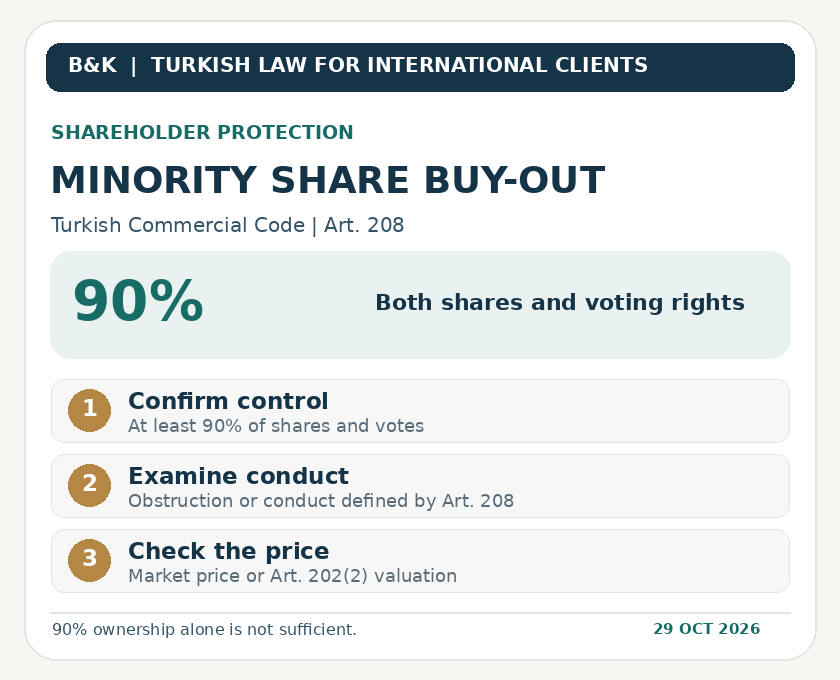
Article 208 requires a controlling company with at least 90% of the shares and voting rights of a capital company and minority conduct falling within the provision. The listed conduct concerns obstructing the company’s work, acting contrary to good faith, causing noticeable difficulty or acting recklessly. Those statutory grounds cannot be replaced with the bare fact that the minority refuses the parent’s preferred sale price.
The provision permits purchase at the stock-exchange value where one exists, otherwise at a value determined in the manner described in Article 202(2). The entitlement to purchase and the proper value are separate questions. Establishing a percentage does not establish misconduct, and alleging misconduct does not permit the parent to select an arbitrary nominal price. The complete corporate, factual and valuation position must be reviewed.
| Issue | Article 208 starting point |
|---|---|
| Person entitled to invoke the provision | The controlling company. |
| Ownership threshold | At least 90% of both shares and voting rights, directly or indirectly. |
| Additional condition | Minority conduct within the listed statutory grounds. |
| Purchase value | Stock-exchange value if present; otherwise the referenced Article 202(2) valuation method. |
| What is insufficient by itself? | A wish for 100% ownership or a disagreement over a voluntary sale. |
Ninety percent of shares and ninety percent of voting rights
The text uses shares and voting rights together. A capital percentage cannot simply be substituted for the voting-rights calculation. Different share classes, voting arrangements and restrictions on exercisable rights can make the two positions different. The review should identify the nominal participation, the voting structure and the legal basis for the rights attributed to the parent. A rounded ownership percentage in a presentation is not adequate proof of both statutory requirements.
The provision expressly permits direct or indirect ownership. That does not mean every company bearing the group’s name can combine unrelated holdings without analysis. Establish the ownership chain and the relevant attributed holdings under the group-company framework. Preserve the calculations and the documents supporting them at the relevant stage of the proposed purchase. Later changes in capital or voting arrangements should not be silently read back into an earlier demand.
The purchase right belongs to the controlling company
Article 208 identifies the controlling company as the holder of the purchase right. The proposed purchaser therefore matters. A group brand, individual executive or separate acquisition vehicle is not automatically interchangeable with that company. Article 195 provides the control framework, including direct and indirect relationships and the relevant cross-border connection. The legal identity of the entity invoking Article 208 should be stated consistently in the notice, valuation instructions and any proceedings.
For an overseas parent, obtain its current corporate identity and authority records alongside the Turkish company’s documents. Distinguish the parent that controls the subsidiary from a treasury company that supplies financing or a sister company that negotiates commercially. A person can communicate on another entity’s behalf without becoming the statutory rights holder. Authority to send a demand and entitlement to invoke the purchase right are separate elements of the file.
The conduct grounds must be established, not merely asserted
Article 208 refers to the minority obstructing the company’s work, acting contrary to good faith, creating noticeable difficulty or acting recklessly. The provision lists alternative descriptions of qualifying conduct; it does not say that the numerical threshold alone is enough. A demand should identify the particular acts relied upon, the relevant dates and the effect on the company. General descriptions such as difficult partner or uncooperative investor do not explain the statutory basis.
The inquiry concerns the company’s functioning and the conduct actually alleged. Identify the decision or operation said to have been obstructed and the legal significance of the minority’s act. Where the allegation concerns a vote, examine the applicable quorum, any class rights and what occurred at the meeting. Where it concerns other conduct, identify the underlying obligation or right. The assessment should not treat commercial friction as self-proving evidence of a statutory ground.
Exercising a minority right is not automatically misconduct
A shareholder can disagree with management, request information and seek judicial protection under the provisions applicable to its position. The parent’s dissatisfaction with those steps does not itself establish the Article 208 grounds. The exercise of rights and an alleged abuse of them must be distinguished. A review should identify the purpose, manner and effect of the conduct rather than treating the existence of objections or litigation as a conclusive answer.
This distinction protects the accuracy of both sides’ arguments. The parent should explain why the particular conduct crosses the statutory boundary, while the minority should preserve the documents showing the legitimate basis of its requests or objections. The firm’s minority shareholder rights guide addresses separate information and meeting mechanisms. Their existence neither guarantees immunity for abusive conduct nor proves abuse merely because they are used.
Build a chronology of events rather than a collection of accusations
The factual file should connect the alleged conduct with actual company operations. Keep meeting notices, agendas, attendance lists, minutes, correspondence, relevant contracts and records of the decision or operation said to have been affected. Identify which minority shareholder acted and in what capacity. A statement made as a director, employee or contracting party should not be confused with exercise of a shareholder right without examining the relevant facts.
Separate established facts from inferences. A postponed transaction, an unanswered request and a disputed valuation are different events and may have different explanations. The chronology should record those explanations and the documents supporting them. Do not create retrospective minutes or omit communications that explain the minority’s position. An evidence-based file permits a legal assessment of the statutory ground; a one-sided label does not replace that assessment.
Article 208 does not authorise purchase at nominal value
The provision states a purchase-value rule: stock-exchange value where available, otherwise a value determined in the manner specified in Article 202(2). Nominal capital, the minority’s historic subscription payment and the parent’s internal accounting carrying value are not interchangeable with that statutory standard. A demand that simply offers the nominal value of the shares should therefore identify the legal and valuation basis on which it claims to satisfy Article 208.
Article 202(2), to which the provision refers for valuation, addresses real value or a value determined by a generally accepted method in the circumstances it describes. It also directs attention to data closest to the court decision. The referenced valuation framework should be applied to the actual company and shares. The parent cannot establish the correct price merely by pointing to the percentage of ownership or to an unaccepted offer made in earlier commercial negotiations.
The valuation instruction must identify the company being valued
Provide the valuer with the current capital structure, share rights, financial statements and records relevant to the company’s assets, liabilities and operations. Identify related-party balances, contingent exposures and material transactions that affect the figures used. The valuer should know the legal valuation question and the date assumptions, not merely be asked to produce the lowest price at which the parent would prefer to acquire the stake.
Keep the calculation transparent enough to examine the method, inputs and adjustments. Distinguish the operating company’s value from the value of a larger international group or an unrelated brand. Preserve the financial information used in earlier negotiations, but do not assume that an old figure remains the statutory value at the relevant assessment date. A disagreement over method should be expressed through the data and legal standard rather than through unsupported assertions that any minority stake deserves an automatic discount.
The reference to Article 202(2) is a valuation reference
Article 208 refers to the manner in which value is determined under Article 202(2). Article 202(2) itself concerns different transactions implemented through control and a shareholder’s compensation or purchase request in the circumstances it sets out. Do not copy every condition of that separate cause of action into an Article 208 demand simply because the valuation provisions are connected. The direction of the purchase request and the statutory grounds are different.
In particular, the opposing-vote or written-objection requirements and the two-year limitation wording in Article 202(2) belong to the claim described there. A legal assessment of Article 208 must identify its own applicable procedural and time questions rather than assume that a reference to valuation imports all of those rules unchanged. Equally, Article 208’s silence on a particular filing period is not a statement that every related claim can be left indefinitely.
A disputed purchase is not an automatic registry deletion
Article 208 establishes a substantive purchase right subject to its conditions. It should not be presented as permission to erase a minority shareholder from corporate records merely by sending a unilateral letter asserting 90% ownership. The entitlement, purchase value and lawful mechanism for completing the transfer must be addressed. Where those matters are disputed, the proposed relief and the appropriate judicial procedure require a properly framed legal analysis.
Identify whether the parties are negotiating a voluntary transfer, contesting the statutory entitlement, disputing the price or challenging a separate corporate act. Those questions can require different documents and procedural steps. The company’s legal form also matters to transfer formalities and registry treatment. A general statement that every buyout needs exactly the same form, or that no legal process is needed once the percentage is reached, would omit the issues the transaction actually presents.
Do not merge Article 208 with other exit remedies
Article 531 concerns a minority application for dissolution of a joint-stock company for just cause, with judicial alternatives to dissolution. Article 640 concerns expulsion from a limited company under its own framework. A negotiated sale is based on agreement. Article 208 is the controlling company’s specific purchase right on the stated threshold and conduct grounds. The fact that each route can result in a shareholder leaving does not make their conditions identical.
The joint-stock dissolution guide and limited-company expulsion guide explain those separate mechanisms. Public-company and capital-markets rules must also be checked where applicable. Article 208’s reference to stock-exchange value should not be used to bypass a special regime governing a particular issuer or transaction.
How a minority shareholder should organise its response
Read the demand in separate parts: the identity of the proposed purchaser, its claimed shares and voting rights, the conduct allegations, the price and the proposed transfer steps. Ask for the records supporting each disputed point. Preserve the shareholder’s own communications, meeting objections, requests for information and evidence explaining the conduct relied upon. A response that addresses only the price leaves the asserted statutory entitlement unexplored.
Check any deadline stated in the demand against its actual legal source. A deadline selected by the parent for negotiations is not automatically a statutory forfeiture period. At the same time, identify any separate meeting resolution, court document or formal notice carrying its own time consequences. The response should not ignore those dates merely because the Article 208 entitlement is disputed. The correct chronology protects the distinction between negotiation and a procedural step requiring action.
Nationwide review for foreign parents and minority investors
For a Turkish legal review, prepare the ownership chain, share and voting calculations, company articles, the buyout demand, the conduct chronology and the available valuation material. Bakırcı & Keskin Hukuk Bürosu assists clients abroad with Turkish corporate matters and nationwide file coordination. The contact page provides current office and appointment arrangements. Initial communication should identify the company and any pending meeting, court or response date.
Frequently asked questions
Is 90% ownership enough on its own?
No. Article 208 requires the stated shares-and-votes threshold and minority conduct falling within its listed grounds. A wish for complete ownership is not a substitute.
Must the parent also hold 90% of voting rights?
Yes. The text refers to both shares and voting rights. The two positions should be calculated and documented separately where the rights structure requires it.
Can indirect ownership qualify?
Article 208 expressly includes direct or indirect ownership. The control chain and the holdings attributed to the invoking company must still be established.
Does refusing a voluntary sale automatically establish obstruction?
No. The particular conduct must be assessed under the statutory grounds. Disagreement over the parent’s preferred transaction or price is not self-proving misconduct.
Can the parent simply pay nominal value?
Article 208 specifies stock-exchange value where present and otherwise the referenced Article 202(2) valuation method. Nominal value is not the stated universal price rule.
Does an information request prove bad faith?
Not automatically. Lawful exercise of shareholder rights must be distinguished from conduct that satisfies the statutory grounds, using the actual purpose, manner and effects.
Is Article 208 the same as limited-company expulsion?
No. Article 640 has its own limited-company framework. The parties, grounds and procedure should not be combined merely because both routes can end a participation.
Does the Article 202 reference import every rule of that claim?
Article 208 refers to the manner of determining value. The different substantive and procedural requirements of the Article 202(2) claim must be analysed separately.
Can the parent delete the minority from the register after a demand?
A demand asserting Article 208 is not itself a substitute for establishing entitlement, value and the lawful steps completing a transfer, especially where those matters are disputed.
What records are most important at the outset?
The ownership and voting records, articles, demand letter, alleged-conduct chronology, meeting documents and valuation evidence should be reviewed together.
Professional information
Av. Halil Bakırcı · Mersin Bar Association registration 3472 · Bakırcı & Keskin Hukuk Bürosu. This article explains the statutory purchase framework without predicting the outcome of an unreviewed shareholder dispute.
Istanbul Office – Polaris Plaza, Maslak / Sarıyer
Bakırcı & Keskin Hukuk Bürosu
Maslak Ahi Evran Caddesi, Polaris Plaza No:21, Kat:9, 34475 Sarıyer/İstanbul
Our physical offices in Istanbul and Mersin coordinate matters throughout Turkey, subject to jurisdiction and the local steps required for each case. Please specify your preferred office when arranging an in-person appointment.
Open the Istanbul office on Google Maps · Contact and appointments
Contact regarding a legal matter
In your first message, you may briefly state the subject, your country or city, and any relevant notification or recent procedural date. Please do not send identity numbers, medical data, or personal documents. Messaging alone does not constitute legal advice or create a lawyer–client relationship.
Discover more from Bakırcı & Keskin Hukuk Bürosu
Subscribe to get the latest posts sent to your email.