Your Turkish Insurer Has Paid: Who Can Sue the Responsible Party Under TCC Article 1472?
Short answer
Under Turkish Commercial Code Article 1472(1), after the insurer pays insurance indemnity, it is legally subrogated to the insured’s claim against the responsible third party only up to the amount paid. It may continue an existing action or enforcement proceeding by proving its payment without the court’s or opponent’s consent. Article 1472(2) protects the insured’s remaining claim after partial payment and makes the insured liable for conduct prejudicing rights passed to the insurer.
Have a general question about this article? Ask anonymously
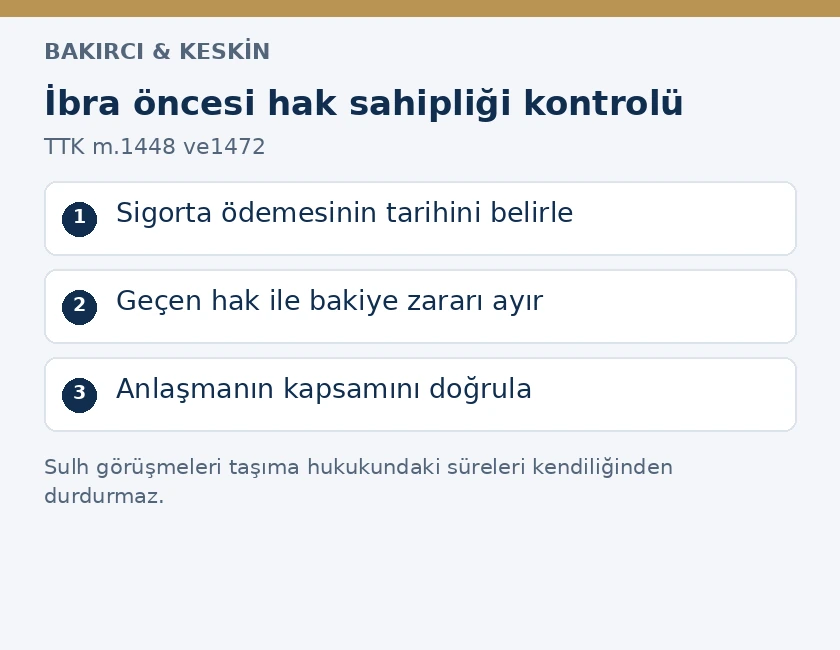
Quick summary
| Statute | Turkish Commercial Code No. 6102 Article 1472 |
|---|---|
| Trigger | Payment of insurance compensation |
| Transfer | Insured’s third-party claim, up to the paid amount |
| Existing action | Insurer can continue after proving payment, without consent |
| Partial payment | Insured retains recovery rights for unpaid loss |
| Release | Insured must not prejudice rights passed to insurer |
Article 1472 requires an indemnity payment before subrogation
Article 1472(1) of Turkish Commercial Code No. 6102 places the insurer in the insured’s legal position when the insurer pays insurance compensation. The rule is expressly tied to payment. An insurer’s acknowledgment of coverage, offer to settle, opening of a claim file or appointment of an assessor is not equivalent to proof that indemnity was actually paid. A foreign policyholder should identify the transfer, amount, date and legal basis before treating the insurer as having acquired the third-party claim.
Subrogation is not an independent new cause of action allowing recovery of everything the insurer chooses to pay. The article transfers the insured’s existing claim against persons responsible for the actual loss, to the extent indemnified. The starting questions are whether the insured had a claim against the particular person, whether a valid payment under the relevant insurance arrangement was made, and what part of the loss that payment covers.
Collect the policy, loss investigation, payment decision, bank evidence and allocation schedule. Where a corporate group, broker or claims administrator made the transfer, determine whether the payment legally belongs to the insurer’s indemnity obligation. A deposit into an intermediary’s account or a general reserve recorded internally should not be described as payment to the insured until the actual transaction is established.
Identify the insured claimant, not simply the person who paid premiums
The person entitled to claim the underlying damage may differ from the person who arranged or funded the policy. A foreign holding company might purchase cover for assets owned by its Turkish subsidiary; a freight forwarder might organise cover for cargo owned by a consignee. The policyholder, insured interest, loss bearer and third-party creditor require separate identification.
Article 1472 speaks of the insurer standing in the place of the insured for the corresponding damages claim. If the insured did not have the relevant claim against the alleged wrongdoer, the insurer cannot create it merely by describing a transfer as statutory subrogation. The legal relationship may depend on ownership, custody, a transport contract or applicable tort rules.
Document the company registration, contractual parties, title to goods, invoices, delivery records and relevant authority. Where an insurer contacts a foreign parent company, verify whether the legal loss was the parent’s or a separate subsidiary’s. Confusing group companies can affect standing, evidence and the correct person to provide a release.
The exact amount of the insurer’s transferred right
Article 1472(1) limits subrogation to the amount actually compensated. It prevents the same insured loss from producing duplicate payment to the insured and insurer. The amount must be linked to the same event and substantive damages claim. This is a quantified succession, not a transfer of every possible separate claim the insured may have against the third party.
For illustration only, suppose the legally recoverable damage is TRY 1,000,000 and the insurer has paid TRY 650,000 under the relevant policy. The insurer’s transferred right can extend up to the TRY 650,000 amount paid, subject to the insured’s underlying enforceable rights and any applicable defences. The insured retains the ability to pursue the uncompensated TRY 350,000 under Article 1472(2). The numbers are illustrative; actual calculation must use proven loss and payment.
An insurer cannot rely on Article 1472 to demand repayment of its entire administrative operating cost or every reimbursement made under a separate head without examining the statutory and contractual nature of the payment. Likewise, the insured should not surrender the remaining part of the claim in a settlement intended to address only the insurer’s portion. An itemised reconciliation is essential.
Article 1472(2) preserves the unpaid part of the insured’s claim
Article 1472(2) expressly states that where the insurer only partially indemnifies the loss, the insured retains its claim against responsible persons for the remaining portion. A foreign owner therefore should not assume that receiving any insurance payment means every right against the negligent contractor, carrier, tenant or other responsible party automatically disappears.
Identify what was and was not compensated. A deductible, uninsured component, policy limit, consequential expense or disputed repair cost can be legally distinct. The fact that a policy does not cover an item does not alone prove that the third party owes that item; the underlying substantive liability law still controls. A clean claim ledger separates insurer-paid items, outstanding insured damage, contested items and unrelated expenses.
The insurer and insured may both need to coordinate claims against the same alleged wrongdoer. If the facts overlap, they should agree on an evidence-preservation and communication plan, but that practical coordination does not cancel the insured’s statutory right to the unpaid component. A recovery ledger must show which claimant received which third-party payment to avoid duplicate collection.
An existing Turkish lawsuit can continue after insurer payment
Article 1472(1) expressly addresses a claim already being litigated or enforced against the responsible party. After proving payment to the insured, the insurer may continue the existing lawsuit or enforcement proceedings from their current stage under statutory subrogation, without needing the court’s or opposing party’s approval. This is a specific procedural effect of the substantive payment-based transfer.
The insurer should supply evidence showing the policy and insured identity, payment document and the connection between that payment and the claim in the pending file. The case file number, court or enforcement office, earlier parties, procedural stage and scope of the amount paid should be recorded. It is not enough to file a generic notice saying that an insurance company has become involved.
Where only part of the damage was paid, the insured may retain a parallel financial interest in the same underlying dispute. Counsel should review the existing claim, any amendments, final orders and remaining portion before requesting procedural continuation. Do not assume that a party substitution regarding the paid portion resolves a separate uninsured loss or a claim asserted by a different legal entity.
Releasing the wrongdoer after the insurer pays may violate Article 1472(2)
Article 1472(2) provides that an insured who acts in a manner infringing rights transferred to the insurer becomes responsible to the insurer. This is particularly important when the insured negotiates directly with the third party after receiving an insurance payment. A broadly worded discharge or settlement may prejudice the insurer’s subrogated right even if the insured intended only to resolve its uninsured loss.
Before signing a release, determine whether the insurer has paid, the paid amount, the claims and parties covered by the settlement, and the specific rights the insurer now holds. A release saying ‘all claims arising from the incident are fully settled’ is not necessarily confined to the insured’s uncompensated portion. An overseas owner should send the proposed settlement and payment ledger for legal review before execution.
Where no indemnity payment has yet occurred, the insurer’s Article 1472 right has not yet passed by the payment trigger. Even then, contractual cooperation duties and other provisions may affect how a settlement should be handled. The correct approach is not to presume every pre-payment release is unrestricted; it is to identify the applicable obligations and timing.
The responsible third party may still raise available substantive defences
Subrogation transfers the insured’s rights, not a stronger claim that defeats every defence available under the underlying liability regime. If the third party was not liable for the event, if the loss amount is unproved or if the claim is legally time-barred, an insurer’s payment does not ordinarily erase those questions. The factual and legal basis of the original claim must be examined.
For property damage the cause may be a contract, negligence, defective work or a specific statutory responsibility. For cargo, the CMR Convention may govern international road carriage and impose its own rules on carrier liability, notices, compensation limits, and limitation periods. A Turkish Commercial Code Article 1472 subrogation claim does not displace applicable CMR defences or create a new transport liability regime.
Examine the original contract, correspondence, delivery record, signed inspection notes and any technical report before declaring the proposed defendant responsible. The insurer’s loss assessor usually determines matters relevant to insurance coverage, whereas the third-party liability dispute may require separate proof of negligence, breach or the treaty conditions.
Payment does not automatically restart the original limitation period
Article 1472 is a rule of legal succession after insurance payment. It should not be treated as creating a fresh general limitation period against the wrongdoer measured from the insurer’s transfer date. The relevant original third-party claim can be governed by Turkish obligations law, transport law, a treaty or another specific statute, each with its own rules and start points.
Keep the date of the loss, the discovery of relevant facts where applicable, contractual delivery dates, written claim notices, court filings, acknowledgments and insurer payment date in separate columns. If the underlying claim is approaching a time limit, an insurer should not wait to reconstruct the legal basis only after an internal settlement is complete. Counsel must verify what interruption or suspension measures are legally available in the actual matter.
A foreign claimant should be cautious of informal assumptions that negotiations always preserve a claim. A message from a claims handler promising to reconsider is not itself a valid procedural step in every jurisdiction. Any action designed to preserve a time limit requires a verified statutory basis and record.
A cargo example: insurer payment and a subsequent claim against a carrier
Consider an illustrative international road shipment delivered damaged. The cargo owner has a policy covering the insured goods and receives a payment for part of the loss. The carrier’s potential responsibility must first be examined under the applicable carriage contract and, when its conditions apply, CMR Articles 17–29 and related provisions. The insurance payment is relevant to who may claim, but it does not answer whether the carrier breached its legal duties.
The claimant should collect the consignment note, delivery reservations, photos of condition, survey, temperature or handling logs, invoices, packing records, claim correspondence and insurance transfer evidence. Record whether the insurer’s payment covered physical damage, freight, salvage or other categories. If the insurer paid only part, Article 1472(2) protects the cargo owner’s remaining third-party recourse right, subject to the carrier’s underlying liability.
A cargo settlement should distinguish the insurer’s subrogated portion and the owner’s uninsured loss. The CMR Article 1 scope guide addresses when the convention applies; CMR jurisdiction involves a distinct treaty analysis. These guides do not replace the individual shipment evidence.
Prepare a payment and loss ledger acceptable to a court
Start with a line-by-line schedule of the insured loss, loss valuation, amount formally accepted by the insurer, date and proof of actual payment, amount the insured still claims, and any recovery already obtained from the wrongdoer. The schedule should identify relevant currencies and any agreed conversion methodology. Never record an internal insurance reserve as money received by the policyholder.
Add the relevant policy endorsement, insured identity, transfer receipt, bank confirmation, formal discharge and insurer correspondence. If the insurer paid a repairer directly, determine what legally and factually was discharged and provide proof. If another group company funded a payment, verify whether it acted for the insurer under the relevant insurance contract rather than assume a subrogation automatically arose.
Keep the original documentary evidence for the third-party claim separately. A building damage report, delivery record or contract identifies underlying liability; a transfer receipt identifies indemnification and the statutory point of succession. The two sets of evidence are necessary for different elements of the Article 1472 analysis.
Foreign policyholders, Turkish property and remote representation
Overseas insured persons may receive the insurer’s payment while a lawsuit in Türkiye is already pending. Identify whether that litigation is brought by the insured personally, a Turkish company or another person holding the underlying claim. The insurer may need to demonstrate its statutory succession to a defined portion, while the insured preserves the remainder. Instructions should not be based on who happened to sign a property-management mandate.
A legal representative can organise the payment file, claim chronology and procedural documents from abroad. The formal powers required for legal proceedings, release, receipt of funds or litigation decisions must be checked for the particular act. A power of attorney granting one task does not necessarily authorise every proposed settlement or surrender of the insured’s separate remaining claim.
Where the responsible party is foreign or the underlying event crossed borders, courts and applicable law require a separate analysis. Turkish private international law, special jurisdiction rules and transport conventions may affect the forum. Neither the insurer’s subrogation nor the owner’s overseas address independently determines jurisdiction.
How to frame a demand after the insurer and owner disagree
A disagreement may concern whether the insurer paid, the quantum transferred, ownership of the underlying claim, the effect of an existing settlement or the amount still owing to the insured. Each should be identified explicitly. A general letter saying the insurance company ‘owns the case’ is an insufficient substitute for Article 1472’s payment and scope requirements.
If an insurer alleges prejudice under Article 1472(2), request identification of the conduct, right infringed and asserted resulting loss. Review the wording of any release, communication with the third party and which rights were transferred at the time. An insured who protected an undisputed uninsured claim should not be accused of destroying all transferred rights without examining what actually occurred.
The written response should separate the legal effect of indemnity payment from the facts of the underlying third-party claim. If proceedings are contemplated, verify the correct parties, jurisdiction and limitation. An initial claim to the insurer, later subrogation recovery and a separate dispute over uninsured loss are not necessarily the same cause of action or forum.
Final Article 1472 checklist for a Turkish insurance file
Identify the insurer, insured and legally responsible third party. Confirm that insurance compensation was paid under an operative indemnity arrangement and retain objective proof. Establish the insured’s own underlying claim and the precise amount which payment transferred by law. Do not assume that a broker payment, promise or interim claim estimate is automatically the statutory event.
Reconcile any partial insurance payment against the full recoverable loss, any policy deductible and past recovery. Under Article 1472(2), record the balance which the insured may still pursue. Before signing a settlement, identify whether its terms impair the insurer’s transferred rights. If litigation has already begun, provide the insurer’s payment proof and examine procedural continuation.
Finally, verify underlying limitations and the applicable liability law. Assemble a consistent file with claim notice, damage evidence, payment ledger, communications and proposed relief. The rule gives precise substantive and procedural consequences, but it does not guarantee that the responsible third party will ultimately be found liable or that every claimed item will be recoverable.
Frequently asked questions
When does the insurer become subrogated under Article 1472?
When it pays indemnity under the relevant insurance, and only to the extent of the payment and underlying insured right.
Does an insurer’s promise to pay cause subrogation?
A mere promise is not the statutory payment event. The file needs proof of the actual insurance indemnity payment.
Can the insurer take over a pending court case?
Article 1472(1) allows continuation of a pending action or enforcement case without court or opponent approval after proving payment.
What happens when only part of the loss was insured?
Article 1472(2) preserves the insured’s own claim against responsible parties for the uncompensated portion.
Can the insured settle directly with the person responsible?
A settlement must not prejudice rights that passed to the insurer; Article 1472(2) can impose responsibility for infringing those rights.
Can insurer and insured both recover the same loss twice?
No. The paid and unpaid portions must be reconciled to prevent duplicate indemnification of the same damage.
Does Article 1472 eliminate a carrier’s CMR defences?
No. The underlying transport liability and its specific defences remain relevant.
Does the insurer have to prove the original wrongdoer’s fault or liability?
The insurer must establish the underlying damages right within the applicable liability regime; insurance payment alone does not establish third-party responsibility.
Does the payment date always start a new limitation period?
No. The inherited claim’s applicable limitation rules must be examined; Article 1472 is not a blanket limitation reset.
Who should keep the original cargo survey and delivery documents?
Both the insured and the insurer need an accessible, reliable record of the underlying loss and payment without altering originals.
What if a foreign parent paid for a subsidiary’s policy?
Identify the actual insured interest and underlying claimant; group ownership alone does not determine who held the third-party damages claim.
Which official statute contains these rules?
Turkish Commercial Code No. 6102, Article 1472(1)–(2), read with applicable indemnity and substantive liability provisions.
Primary sources and related reading
Turkish Commercial Code No. 6102, Articles 1472, 1448, 1454; Ministry of Justice insurance-law mediation reference. Related English guides: assessment expenses, insured beneficiaries and foreign parent companies, CMR scope, and legal instructions from abroad.
Legal assistance and office
Mersin office directions · +90 552 224 43 66 · English-language enquiry. An initial enquiry does not establish legal representation or suspend deadlines.
Istanbul Office – Polaris Plaza, Maslak / Sarıyer
Bakırcı & Keskin Hukuk Bürosu
Maslak Ahi Evran Caddesi, Polaris Plaza No:21, Kat:9, 34475 Sarıyer/İstanbul
Our physical offices in Istanbul and Mersin coordinate matters throughout Turkey, subject to jurisdiction and the local steps required for each case. Please specify your preferred office when arranging an in-person appointment.
Open the Istanbul office on Google Maps · Contact and appointments
Contact regarding a legal matter
In your first message, you may briefly state the subject, your country or city, and any relevant notification or recent procedural date. Please do not send identity numbers, medical data, or personal documents. Messaging alone does not constitute legal advice or create a lawyer–client relationship.
Discover more from Bakırcı & Keskin Hukuk Bürosu
Subscribe to get the latest posts sent to your email.