Creditor Refuses Payment in Turkey: Consignation Under TCO Articles 106–111
A creditor’s refusal to accept payment does not authorise a debtor to keep the money indefinitely and declare the debt finished. Turkish Code of Obligations Article 106 defines creditor default by reference to a proper offer of performance and an unjustified refusal to accept it or provide the necessary cooperation. Article 107 permits release through legally compliant consignation of what must be delivered. Articles 108–111 regulate sale of unsuitable goods, withdrawal of a deposit, other forms of performance and uncertainty concerning the creditor. The route depends on the obligation and the actual obstacle, not merely on an unanswered message.
Have a general question about this article? Ask anonymously
What creditor default means under Article 106
A contract can require the creditor to cooperate before the debtor can perform. Article 106 addresses both refusal to receive properly offered performance and refusal, without justified reason, to carry out preparatory acts that the creditor must undertake. It concerns obligations to do something as well as obligations to deliver something. The first task is therefore to identify the performance owed and the cooperation genuinely needed from the creditor.
A debtor should establish what was offered, when, where and on what terms. An offer of a different item, an incomplete amount or performance at an unauthorised place does not establish proper tender simply because the debtor was willing to do something. Likewise, an offer conditional on the creditor surrendering unrelated rights must be distinguished from an offer of the agreed performance.
The refusal must lack a justified reason. A dispute about defective goods, missing contractual documents or the amount due must be analysed before describing the creditor as being in default. Article 106 is not a way to decide every underlying dispute in the debtor’s favour. It identifies a legal response to obstruction of proper performance.
Check the amount, maturity and agreed place of performance
Article 84 permits a creditor to refuse partial performance when the whole debt is certain and due. That matters where a debtor offers only the undisputed principal while the agreement also calls for another due component. Establish the actual obligation rather than assuming that any offered transfer puts the creditor in default. A part-payment proposal and a full compliant tender serve different purposes.
Article 89 gives priority to the parties’ express or implied agreement about the place of performance. In the absence of a contrary agreement, it distinguishes money debts, obligations concerning a specific item and other obligations. Money debts are performed at the creditor’s residence at the time of payment; a specific item is delivered where it was located when the contract was made; the remaining category is performed at the debtor’s residence when the obligation arose.
The same article addresses a later change of the creditor’s residence that substantially makes performance more difficult. In that situation, performance can take place at the creditor’s previous residence. This is a defined rule, not a licence to choose any convenient payment location. Retain the agreement and relevant addresses because Article 107 also connects judicial designation of the deposit place to the place of performance.
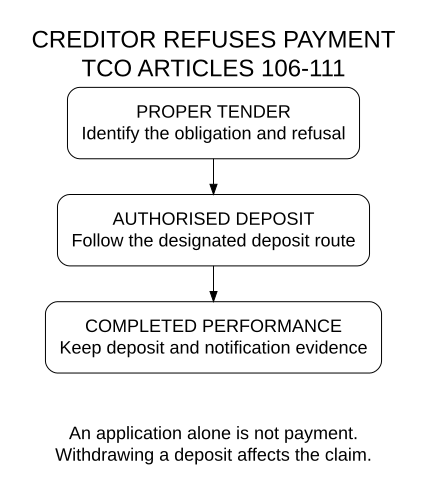
Consignation under Article 107 is a method of performance, not private safekeeping
When the creditor is in default, Article 107 allows the debtor to obtain release by depositing the thing to be delivered, with the risk and expenses borne by the creditor. The judge at the place of performance determines the deposit location. The provision also allows commercial goods to be deposited in a warehouse without a judicial decision. The statutory warehouse exception concerns commercial goods; it is not a general permission to pay a money debt into any account chosen by the debtor.
For a payment obligation, keeping funds in the debtor’s own savings account is not the same as making the legally required deposit. Nor is a transfer to a solicitor’s or another person’s account automatically a statutory consignation. Identify the authorised destination and the conditions for payment into it. Follow the decision and retain the deposit receipt, reference and record of what obligation the payment concerns.
An application asking a court to designate a place is distinct from actually depositing the required performance. The papers should distinguish the application date, decision date and completed deposit date. A debtor should not describe an unfinished application as a completed discharge. The sufficiency and timeliness of the performance remain essential to the substantive result.
The court application and the debt dispute are different questions
Civil Procedure Code No. 6100, Article 382 lists determination of a deposit place, sale of things unsuitable for deposit and deposit of a debt whose creditor is disputed among non-contentious matters. Article 383 makes the civil peace court the default competent court for non-contentious proceedings unless another rule provides otherwise. These provisions must be read with the nature of the underlying transaction.
Commercial matters require particular care because Turkish Commercial Code Article 5 assigns commercial non-contentious matters to commercial courts unless otherwise provided. The parties’ labels or a foreign address do not by themselves resolve that classification. Identify the substantive relationship and any special jurisdiction rule before filing; do not treat every deposit application as belonging to the same court in every context.
Article 388 of the Civil Procedure Code states that non-contentious decisions do not constitute substantive res judicata unless the law provides otherwise. A deposit-place decision should consequently not be advertised as a final judgment deciding every dispute over the amount, validity or performance of the debt. Its procedural function and the effect of the completed deposit must be distinguished.
What the application should establish
The application needs a coherent account of the obligation, its due date, the performance offered and the creditor’s refusal or missing cooperation. Attach the contract, relevant account statement or delivery specification, the communication offering performance and the response. Where no response was received, preserve the delivery evidence and the chronology rather than asserting an undocumented refusal.
Identify the requested deposit by amount and currency for a money obligation, or by a precise description for goods. Explain why the proposed performance corresponds to the agreement. Include the facts establishing the place of performance and the reason the court has been asked to intervene. A vague request to deposit something later is not a substitute for specifying what is owed.
The case file should also make clear whether the dispute concerns creditor default under Article 106 or another obstacle under Article 111. Those legal routes have different starting facts. Supporting both alternatives requires explaining each factual basis, not simply placing every possible article number at the top of the application.
Article 108: perishable or unsuitable goods need a controlled sale procedure
Deposit is not always practical for the thing that must be delivered. Article 108 addresses goods whose nature or the circumstances make deposit unsuitable, goods liable to deteriorate, and goods whose care, preservation or storage requires substantial expense. In those cases, the debtor can, after prior notice to the creditor and with judicial permission, arrange sale by public auction and deposit the proceeds.
The article contains a defined exception where the goods are exchange-listed, have a market price or have a low value relative to the required expense. In those circumstances, public auction is not mandatory and the judge can permit sale without requiring prior notice. The exception does not eliminate the need to address the statutory conditions or obtain the relevant judicial permission.
Preserve the specification, photographs where lawfully obtained, storage records and evidence of deterioration or expense. The requested sale method should be justified against the goods’ characteristics. Disposing of the goods privately and later explaining that storage was inconvenient does not establish that Article 108’s procedure was followed.
Article 109: taking back the deposit has legal consequences
Article 109 permits the debtor to withdraw the deposited thing unless the creditor has declared acceptance or the deposit has resulted in the extinction of a pledge. Those statutory limits should be checked before requesting release of deposited property. A deposit is not merely an account from which the debtor remains free to move funds without affecting the legal position.
When the deposited thing is withdrawn, Article 109 states that the claim continues to exist together with its accessory rights. A debtor cannot rely on the original deposit as having permanently eliminated the obligation while also taking back the performance under this rule. Record the withdrawal and reassess the remaining claim and related rights.
A later settlement should therefore address what happens to the deposited money or goods. Identify whether the creditor is receiving the deposit, whether a different payment is replacing it and whether the relevant security has been released. Avoid signing a receipt that obscures which performance actually satisfied the debt.
Article 110 deals with obligations that are not delivery obligations
Where the obligation does not require delivery of a thing, Article 110 permits withdrawal from the contract in the event of creditor default according to the rules governing debtor default. This cross-reference matters: it is not a universal right to terminate immediately after the creditor misses one telephone call. The appropriate default and withdrawal requirements must be applied to the actual contractual relationship.
Identify the performance that was prevented, the cooperation owed by the creditor and the notices already exchanged. A contractor’s inability to obtain agreed access and a debtor’s wish to pay an invoice are different performance situations. The legal route should match the obligation; attempting to solve a service-cooperation problem by depositing an unrelated sum does not follow automatically from Article 107.
Article 111: uncertainty about who is entitled to receive performance
Article 111 applies where, without the debtor’s fault, uncertainty about ownership of the claim, uncertainty about the creditor’s identity or another personal circumstance arising from the creditor prevents performance to the creditor or its representative. It allows use of consignation or withdrawal rights as in creditor default. The absence of debtor fault and the actual prevention of performance are express parts of the rule.
Competing demands should be supported by the actual documents received. Preserve notices of assignment, authority documents, succession records or other material establishing why the recipient is uncertain. The provision does not authorise a debtor to manufacture doubt merely to delay payment. Nor does making a deposit determine, by itself, which competing claimant ultimately owns the receivable.
A failed international transfer also needs its own explanation. A wrong account number, bank processing problem and genuine uncertainty about the creditor are not identical facts. Obtain the rejection information and verify the recipient through an established channel. Our wrong-IBAN recovery guide addresses the different situation where money has already reached an unintended recipient.
Maintain the payment record and protect separate response deadlines
Keep a single chronology showing the due date, offer, refusal, application, decision, deposit, creditor notification and any subsequent withdrawal. Preserve the exact bank reference or delivery record. For a continuing obligation, identify the periods covered; a deposit for one instalment should not be presented as proof that later instalments were also paid.
Article 103 gives a paying debtor rights concerning a receipt and, when the entire debt is paid, return or cancellation of the relevant debt instrument, subject to the provision’s terms. These records help distinguish an actual discharge from an unresolved administrative entry. A deposit receipt and an acknowledgment of complete settlement are not necessarily equivalent documents.
A creditor-default argument does not by itself suspend a court or enforcement deadline. Review any payment order or summons separately and retain its service record. For cross-border files, our guide to documents received abroad and international contract-dispute guide explain the initial file-identification work.
Frequently asked questions
Does refusal of payment mean I no longer owe the debt?
No. Article 106 defines creditor default; Article 107 provides a route to release through qualifying consignation. Keeping the money yourself or merely filing an application is not the same as completing the required performance.
Can I deposit the money in any bank account?
Article 107 provides for the judge at the place of performance to determine the deposit location. An account selected privately by the debtor is not automatically the statutory destination. Follow the applicable decision and preserve payment evidence.
Can a creditor refuse an incomplete payment?
Article 84 permits refusal of partial performance where the whole debt is certain and due. Establish the full obligation and whether the tender complies before relying on creditor default. Special rules for particular obligations require separate review.
Does every consignation request go to a civil peace court?
Article 383 of the Civil Procedure Code provides that default rule for non-contentious matters unless otherwise regulated. Article 5 of the Commercial Code separately covers commercial non-contentious proceedings. The transaction’s legal classification and special rules must be checked.
Does designation of a deposit place finally decide the amount owed?
Not automatically. Article 388 provides that non-contentious decisions do not constitute substantive res judicata unless the law states otherwise. The deposit decision and a dispute over the underlying debt have different functions.
Can perishable goods be sold instead of stored?
Article 108 permits a judicially authorised sale and deposit of proceeds where its conditions are met. It regulates prior notice and public auction and defines exceptions. A debtor should not substitute an unauthorised private sale.
Can I take back what I deposited?
Article 109 permits withdrawal unless the creditor declared acceptance or the deposit extinguished a pledge. Withdrawal causes the claim to continue with its accessory rights. It is not consistent with treating the same deposit as an irrevocable discharge.
What happens when two people claim the same payment?
Article 111 provides a route where uncertainty about entitlement or identity prevents performance without fault by the debtor. Preserve the competing claims and seek the appropriate deposit procedure rather than choosing a recipient on unsupported assurances.
Does a rejected foreign transfer prove creditor default?
No. Identify why the transfer failed and whether proper performance was offered. A technical bank rejection, an incorrect account and unjustified refusal by the creditor require different analyses.
What should be sent for an English-language review?
Start with the contract type, amount or goods involved, due date and description of the refusal. Keep the contract, notices and bank or delivery evidence ready for an agreed confidential channel. Include any separate court response deadline.
Official sources
Turkish Code of Obligations No. 6098, Articles 84, 89, 103 and 106–111; official Ministry statutory text; Civil Procedure Code No. 6100, Articles 382, 383 and 388; and Turkish Commercial Code No. 6102, Article 5. English descriptions are explanatory; the Turkish statutory text governs.
Istanbul and Mersin offices
For a payment-refusal or deposit review, identify the due date, the performance offered and the creditor’s response in your first enquiry. Use the English contact section to arrange a confidential document channel. Our Mersin-based practice coordinates matters throughout Türkiye through its Mersin and Istanbul offices.
Istanbul — Polaris Plaza
Maslak Ahi Evran Caddesi, Polaris Plaza No:21, Floor 9, 34475 Sarıyer/İstanbul. Istanbul office information.
Mersin — Profit İş Merkezi
İhsaniye Mahallesi, 4903. Sokak, Profit İş Merkezi No:23, Floor 3, Office 14, 33070 Akdeniz/Mersin.
Call +90 552 224 43 66. General legal information; an enquiry does not establish representation or suspend a deadline.
Contact regarding a legal matter
In your first message, you may briefly state the subject, your country or city, and any relevant notification or recent procedural date. Please do not send identity numbers, medical data, or personal documents. Messaging alone does not constitute legal advice or create a lawyer–client relationship.
Discover more from Bakırcı & Keskin Hukuk Bürosu
Subscribe to get the latest posts sent to your email.