Provisional Compensation in Turkey: Payment Before the Final Judgment Under TCO 76
A damages claimant in Turkey can request a provisional payment before the final compensation decision, but financial difficulty alone is not enough. Article 76 of the Turkish Code of Obligations requires convincing evidence supporting the claim and an economic situation that justifies payment. The judge acts on a request and may order the defendant to pay the injured person. Payments are credited against compensation eventually awarded. If compensation is not awarded, the judge orders repayment with legal interest. The application must therefore explain both why the defendant is plausibly responsible and why money is needed before the case is finally resolved.
Have a general question about this article? Ask anonymously
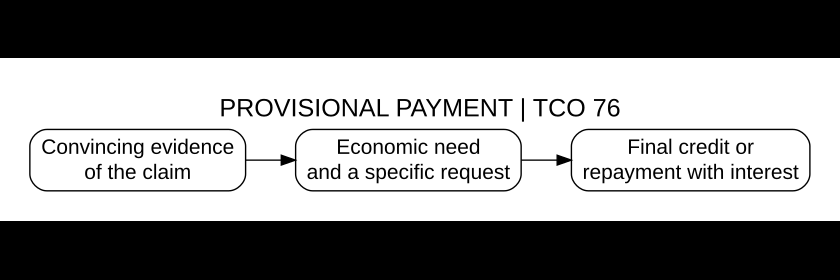
The statute provides an interim payment, not a guaranteed early victory
Article 76 of Law No. 6098 gives the judge power to order a defendant to make a provisional payment to the injured person when the stated conditions are established. It does not promise payment in every compensation action or make the amount in the initial demand immediately collectible simply because a lawsuit was filed.
The language of the provision requires a request. The claimant should identify the relief sought instead of assuming that a reference to hardship somewhere in the narrative will automatically produce a payment order. The request and the evidence supporting it belong in the procedural record of the relevant claim.
A provisional order is also distinct from the final determination of responsibility and the total compensation. The second paragraph expressly anticipates the possibility that compensation will not ultimately be awarded. A claimant must understand that repayment consequence before treating a provisional sum as money that can never be reclaimed.
Identify the defendant’s legal responsibility before presenting the financial need
A serious injury or large expense does not by itself identify who must compensate it. Establish the event, alleged responsible person and legal basis of responsibility. The appropriate rule can depend on the relationship, the conduct and any special liability regime. Article 76 does not replace that substantive inquiry.
For example, the site’s building-owner liability guide addresses a particular statutory basis, while the employee-caused third-party harm guide concerns another. The required factual connection differs, even if both claims include financial loss and a request for provisional payment.
The file should not name every person associated with an incident as automatically liable for the requested advance. Identify the obligation or responsibility attributed to each defendant and the evidence supporting that position. A well-documented economic need cannot cure an unexplained claim against the wrong legal entity.
Convincing evidence is the first express condition
Article 76 calls for convincing evidence showing the justification of the claim. The application should therefore connect documents and observations with the elements of the asserted responsibility. A collection of bills establishes expenditure but does not necessarily establish how the defendant caused it or why that defendant bears the relevant legal responsibility.
Preserve contemporaneous incident records, photographs, relevant correspondence, inspection findings and technical or medical documents appropriate to the claim. Explain what each record proves. The label expert report is not a substitute for reading its assumptions, subject matter and connection with the actual event.
Keep disputed facts visible. A report can support the occurrence of an incident without deciding the allocation of responsibility. A defendant’s message can acknowledge a conversation without admitting the full claim. The application should distinguish those propositions rather than overstate the evidence to make the request appear certain.
The request does not eliminate the ordinary proof of damages
Article 50 addresses proof of loss and fault and permits the judge to assess the amount equitably where exact proof is not possible, taking account of the ordinary course of events and the injured person’s precautions. The rules governing the applicable substantive liability remain relevant. A provisional-payment request should not be presented as a substitute for assembling that damages record.
Where the loss concerns bodily injury, Article 54 identifies treatment expenditure, lost earnings, reduced or lost working capacity and impairment of economic prospects. These are different categories. An amount sought for present expenditure should not silently include an unsupported final calculation of every future loss.
The application should explain which present need is supported by which claimed loss. This does not require pretending that every long-term consequence is already known. It requires an honest separation of established facts, documented current needs and matters that still require examination before the final compensation decision.
The claimant’s economic position is the second express condition
The statute also requires the injured person’s economic situation to justify provisional payment. A strong claim on responsibility does not automatically establish this separate condition. The record should explain the claimant’s present financial position and the need for payment while the case is pending.
Relevant material can include current income, interruption of earnings, necessary expenditure, available resources and payments already received. The point is to present a coherent account, not merely a statement that litigation is slow. Documents should relate to the claimant and the period for which relief is requested.
Foreign nationality or residence abroad does not by itself prove either wealth or financial need. Preserve the original currency figures and explain any conversion used in the application. An overseas bank balance and a Turkish expense schedule must be read together rather than compared through an unexplained exchange-rate assumption.
Document current needs without disclosing unrelated private information
A focused needs schedule identifies the expenditure, amount, date, payee and supporting record. Distinguish amounts already paid from amounts invoiced but still outstanding and from estimates. This allows the court and other party to understand why the requested money is connected with an actual present need.
For an interrupted income stream, identify the source and period of income and the evidence of interruption. An employment contract, an earlier payslip and a current inability to earn answer different questions. A self-employed claimant should likewise distinguish business revenue from the person’s own available income and relevant loss.
Use a confidential document channel for identity, financial and health records. Only material relevant to the application should be collected and transmitted through lawful means. This article concerns the legal evidence for a payment request; it does not assess medical treatment or recommend delaying care while a legal file is prepared.
A specific amount needs a traceable explanation
Article 76 does not prescribe a universal percentage of the claimed compensation or a standard payment for every injury. The requested amount should be supported by the evidence and the claimant’s economic position. A round figure selected without an account is not made persuasive merely by describing it as an advance.
Show the relationship between the immediate need, any existing resources or payments and the sum sought. Identify the period the request is intended to cover. The legal assessment should distinguish a request for a defined payment from an assumption that an identical sum will automatically be paid every month.
The amount sought provisionally should also be distinguished from the final relief pleaded. An interim financial schedule and a complete damages calculation serve different purposes. Keep both updated and explain revisions rather than silently replacing earlier figures or adding the same expenditure twice.
Keep payment protection separate from asset preservation
An order requiring payment to the claimant is not the same act as preserving property or recording evidence. A measure intended to stop disposal of an asset does not, by itself, transfer that asset’s value to the claimant. Conversely, Article 76’s payment framework should not be used as a general explanation of every protective measure available during litigation.
The requested relief must match the problem. A present financial need, a risk that evidence will disappear and a concern about later collection are different issues. Their respective legal conditions and procedures should be identified rather than combined into one request described only as urgent relief.
The evidence-preservation guide addresses the separate task of recording facts before alteration or loss. A completed inspection can support the merits evidence, but it is not itself an Article 76 payment order or a final compensation judgment.
The defendant’s response should address both statutory conditions
A defendant disputing provisional payment should distinguish the merits objection from the economic-needs objection. Evidence that challenges causation answers a different question from evidence showing that a particular expense has already been paid. A clear response identifies which condition or part of the requested amount is disputed.
Provide the complete relevant records rather than selected quotations. A payment already made should identify its purpose and recipient. An alleged inconsistency in the claimant’s financial material should be explained factually, without treating the claimant’s nationality or occupation as proof of a financial position.
The applicable procedural rules and the actual court direction govern how the response is presented. Article 76 itself does not supply one universal response or appeal period for every possible order. Preserve the complete decision and service record and obtain the relevant procedural assessment rather than relying on a generic date stated in correspondence.
Provisional payments are credited against awarded compensation
The second paragraph of Article 76 requires the defendant’s provisional payments to be set off against compensation awarded. The claimant does not receive the final award in full on top of the same provisional amounts without crediting them. Maintain a payment ledger showing dates, amounts, currency and the order or purpose under which each payment was made.
Do not mix a court-ordered provisional payment with an unrelated payment under another obligation. The account should identify which loss or claim each sum concerns. Where several defendants or insurers have made payments, preserve the legal basis and recipient of each rather than treating all receipts as identical.
The final decision and its calculation must address the relevant credits. A settlement reached before judgment should likewise state how provisional payments are treated. A vague reference to the balance can leave uncertainty about whether the earlier payment was included, credited or separately disputed.
No compensation award means repayment with legal interest
If compensation is not awarded, Article 76 directs the judge to order the claimant to return the provisional payments with legal interest. This is an express statutory risk, not a discretionary courtesy to the defendant. It should be explained when the request is prepared, not only after an adverse final result.
The article does not state one numerical interest rate for all times and all calculations. The applicable legal-interest framework and the relevant dates must be identified. This guide therefore does not promise an interest-free advance or supply an unsupported fixed percentage.
Keep proof of receipt and any subsequent repayment. If the parties settle, the settlement should state the agreed treatment of the provisional sum and related interest. A proposed release should be read with the actual payments, not treated as performed before the agreed transfer occurs.
Not every benefit is deducted under the same rule
Article 55 contains particular rules for bodily injury and loss-of-support compensation, including treatment of non-recourse social-security payments and payments not intended as performance. Those rules should not be replaced with a broad statement that every benefit received from any source automatically reduces the defendant’s liability.
Article 76, by contrast, expressly addresses the defendant’s provisional payments and their credit against the award. Classify each receipt by its source and legal purpose before applying a deduction. A social benefit, insurance payment, gift from a relative and court-ordered advance can require different treatment.
The needs assessment and the final damages account are also not necessarily the same calculation. A resource can be relevant to the claimant’s current economic circumstances without its classification for the final award being resolved by that fact alone. Keep the evidence and legal reason for each treatment explicit.
Article 75 concerns later adjustment, not the same payment mechanism
Where the extent of bodily injury cannot be fully determined when deciding the case, Article 75 permits the judge to reserve power to change the compensation decision within two years from its finality. This is distinct from an Article 76 payment while the claim remains under assessment.
The reservation must not be assumed in every bodily-injury judgment. Obtain the actual operative decision and check whether the relevant power was reserved. The two-year reference is also not an automatic extension of every limitation or procedural period connected with the incident.
Where expert evidence remains incomplete, identify what is known and what cannot yet be determined. The court-expert report guide addresses the separate procedure for a reasoned response to an expert opinion. An expert dispute and an interim-payment request should each state their own object and supporting evidence.
A practical application file for a claimant living abroad
| Part of the file | What it should establish |
|---|---|
| The underlying claim | The event, correct defendant and legal basis of responsibility |
| Convincing merits evidence | The connection between records and the claim asserted |
| Economic-needs statement | Current income, necessary expenditure and relevant resources |
| Requested amount | A reproducible calculation linked to the stated need |
| Existing payments | The source, purpose and treatment of amounts already received |
| Procedural record | The application, court directions, decisions and service dates |
Retain originals beside translations. A translated summary should not omit the currency, period, reservation or legal entity appearing in the source document. The file should permit the court to understand both the claim and the economic condition without relying on unsupported assurances.
The practical conclusion is not that every claimant should request an arbitrary advance. It is that Article 76 offers a defined route when convincing evidence and economic need support it, with a final-account and repayment consequence that must be understood from the outset.
Frequently asked questions
Can money be ordered before the final compensation judgment?
Article 76 permits a provisional payment on request where convincing evidence supports the claim and the claimant’s economic situation requires it. The decision is not automatic.
Is financial hardship alone sufficient?
No. The statute also requires convincing evidence showing the justification of the claim. The merits and economic condition must both be addressed.
Must the claimant actually request provisional payment?
Yes. Article 76 provides for a decision on request. Identify the relief, amount and supporting material through the applicable procedure.
Does the statute set a standard percentage of the claim?
No universal percentage appears in Article 76. The amount sought needs an explanation linked to the evidence and economic need.
Is the provisional payment added to the full final award?
It is credited against the compensation awarded under Article 76. Maintain a ledger so the same amount is not recovered twice.
What happens if no compensation is awarded?
The judge orders return of the provisional payments with legal interest. The claimant must understand that statutory repayment risk before relying on the advance.
Does a provisional order finally establish liability?
No. The statute’s credit and repayment provisions distinguish the provisional payment from the final compensation result.
Is provisional payment the same as preserving evidence or assets?
No. Payment, evidence preservation and protection against asset disposal have different purposes and legal requirements. Identify the actual relief needed.
Does residence abroad prove that the claimant has sufficient money?
Not by itself. The actual economic position and relevant records must be examined; nationality or residence is not a substitute for that evidence.
Is Article 75’s two-year reservation the same remedy?
No. Article 75 concerns a reserved power to alter a bodily-injury compensation decision where the extent could not be fully determined. Article 76 concerns provisional payments.
Official legal sources
Turkish Code of Obligations No. 6098, Articles 50–55 and 75–76; official Ministry text, page 15, containing the provisional-payment and adjustment provisions. The English explanation is not an official translation, medical assessment or guarantee of an award.
Ask about a provisional compensation request
Identify the claim, whether proceedings have begun and the immediate financial issue. Do not send medical, identity or private financial records through the initial enquiry.
Istanbul and Mersin offices
Bakırcı & Keskin Law Office is Mersin-based and works throughout Türkiye with an Istanbul and Mersin focus. Arrange a confidential channel for the claim and financial evidence.
Istanbul — Polaris Plaza
Maslak Ahi Evran Caddesi, Polaris Plaza No:21, Floor 9, 34475 Sarıyer/İstanbul. Istanbul office directions.
Mersin — Profit İş Merkezi
İhsaniye Mahallesi, 4903. Sokak, Profit İş Merkezi No:23, Floor 3, Office 14, 33070 Akdeniz/Mersin. Mersin office directions.
Call +90 552 224 43 66. An enquiry does not establish representation or suspend a legal deadline.
Contact regarding a legal matter
In your first message, you may briefly state the subject, your country or city, and any relevant notification or recent procedural date. Please do not send identity numbers, medical data, or personal documents. Messaging alone does not constitute legal advice or create a lawyer–client relationship.
Discover more from Bakırcı & Keskin Hukuk Bürosu
Subscribe to get the latest posts sent to your email.