Dog Bites and Other Animal Damage in Turkey: Keeper Liability Under TCO 67
Turkish civil liability for an animal’s damage is not determined solely by the name recorded as its owner. Article 67 of the Turkish Code of Obligations addresses the person who undertakes the animal’s care and management, permanently or temporarily. That person is responsible for the damage unless the necessary care to prevent it is proved. The article also preserves recourse where another person or another person’s animal frightened the animal. A dog-bite or other animal-damage claim therefore needs evidence of the actual care arrangement, the incident, the loss and the statutory defence—not merely an assertion that somebody owns a pet.
Have a general question about this article? Ask anonymously
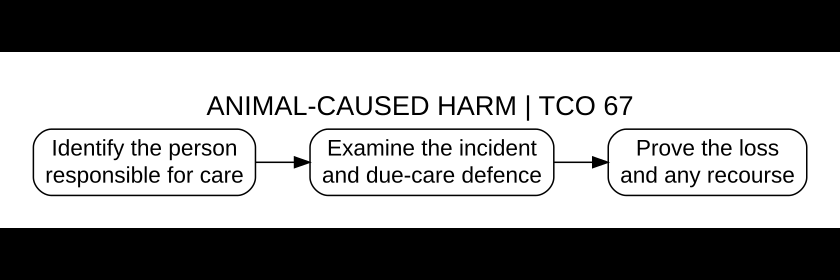
Article 67 identifies care and management, including temporary arrangements
The statutory rule in Law No. 6098, Article 67 expressly covers permanent or temporary care and management. A person reviewing the claim must therefore investigate who had undertaken that role at the relevant time. Ownership records are relevant, but they do not replace the factual and legal assessment of the arrangement.
Obtain any boarding, custody, training or care agreement and the communications surrounding handover. Identify who controlled the animal’s living arrangements and management and in what capacity. A person briefly present beside an animal, a business providing care and an employee following instructions can occupy different positions.
The word temporary should not be used to declare every person who touched a lead automatically responsible under Article 67. The inquiry concerns the actual undertaking of care and management. Keep the facts supporting the proposed keeper’s role visible rather than substituting a photograph, job title or informal description for the whole relationship.
The rule covers more than a bite
Article 67 refers to damage caused by the animal. It is not limited in its wording to a dog bite or to bodily injury. The claim must identify how the animal’s behaviour caused the asserted harm, whether the dispute concerns personal injury, damage to property or another legally supported loss.
Describe the event precisely. Distinguish what was observed from what is inferred after the incident. An animal being found near damaged property is not itself proof of every step in causation. Likewise, a photograph of a wound does not identify the animal, keeper or circumstances without further evidence.
The chronology should record the place, time, persons present and immediate aftermath. The relevant condition of the property or person before the event can also matter. Preserve source material before later repairs, treatment records or descriptions obscure which loss is connected with this particular incident.
The keeper has a statutory defence based on necessary care
Article 67 releases the keeper from responsibility if the keeper proves the necessary care to prevent the damage. The defence is therefore not satisfied merely by saying that the animal is normally friendly or that the keeper did not intend the harm. The evidence must address the care required in the actual circumstances.
Identify the measures actually in place and how they relate to the incident. The management arrangement, supervision, containment and relevant instructions can be important factual matters. Do not replace their examination with an assumption that one document or one precaution automatically answers every possible risk.
Records created after the event should be distinguished from evidence of the earlier position. A later improvement can show remedial action; it does not prove that the earlier arrangement was the same. The legal response should explain the defence from the contemporaneous facts, not reconstruct a system that was never implemented.
A previous bite is not an express prerequisite in Article 67
The provision does not require proof that the animal had injured somebody before. A claimant should not be told that a first incident is automatically exempt merely because a previous complaint cannot be found. The statutory questions remain care and management, damage, causation and the necessary-care defence.
Past behaviour can nevertheless be relevant to what was known and how the animal was managed. Preserve actual earlier warnings or records where they exist, but do not invent a history or repeat unverified online allegations as established fact. Their relevance must be connected with the care issue.
The same caution applies to registration or classification. A record can help identify an animal and its owner, but Article 67 is not reduced to a single box on a registration form. Any separate regulatory duty must be identified under its own legal source rather than assumed from the civil-liability article.
Bodily injury requires a supported damages account
Article 54 identifies treatment expenditure, lost earnings, reduced or lost working capacity and impairment of economic prospects as bodily-injury losses. A demand should distinguish those categories and provide the relevant records. The amount of every future consequence cannot be established merely by adding the first treatment invoice to an arbitrary multiplier.
Keep medical records for the relevant incident, expenditure evidence and the documents needed to assess any earnings loss. This article concerns the legal evidence for compensation, not medical diagnosis. A person needing treatment should obtain appropriate professional care rather than delay it to complete a litigation file.
Article 56 separately permits non-pecuniary compensation in the stated bodily-injury circumstances and addresses relatives in cases of serious bodily harm or death. It does not provide one fixed award for every bite, nationality or holiday disruption. The legal basis and the circumstances of the individual claim must be established.
Property damage and veterinary expenditure need their own proof
A property-loss schedule should identify the damaged item, the claimant’s interest in it, its previous condition and the damage caused by the event. A repair quotation, a paid invoice and a replacement purchase are different records. Explain the purpose and relevance of each rather than treating all three as automatically cumulative losses.
Where another animal was injured, preserve the veterinary records and expenditure connected with that event. Do not assume that every later veterinary cost arose from the same incident. The evidence should distinguish the injury attributed to the event from an unrelated condition or expense.
The existence of property damage does not itself settle every additional emotional-distress claim. A separate legal basis must be identified for the particular remedy asserted. The account should remain tied to the supported claim instead of promising a universal compensation package simply because the injured animal was a valued companion.
Frightening the animal can create a separate recourse issue
Article 67 expressly preserves the keeper’s recourse where another person, or an animal belonging to another person, frightened the animal. The statute therefore recognises a distinction between the injured person’s claim and the keeper’s possible recovery from someone else involved in causing the event.
Establish what occurred and who was responsible for the alleged frightening conduct or animal. A statement that the animal was startled is not a complete account of who should reimburse the keeper. Preserve witness accounts and other lawful evidence connecting the third person’s involvement with the damage.
The recourse reservation should not be presented as automatically defeating the injured person’s claim. The external responsibility, the necessary-care defence and internal recourse are different issues. Where several people are alleged to answer for the same loss, the relevant legal basis for each must be stated rather than assuming equal shares or unlimited liability by association.
The injured person’s conduct must be assessed without assumptions
Article 52 permits reduction or removal of compensation in its stated circumstances, including where the injured person contributed to the occurrence or increase of the damage. The actual conduct and causal effect must be established. Presence near an animal does not automatically mean the injured person accepted every risk or caused the loss.
A warning sign or instruction can be relevant evidence, but its wording, placement and connection with the event matter. Keep the full context. A generic notice should not be treated as conclusive proof that all responsibility shifted to the visitor, and an actual relevant warning should not be omitted from the claimant’s account.
The review should distinguish the original incident from later conduct said to increase the loss. The claimed additional consequence needs a factual connection with that later conduct. This prevents a dispute about mitigation from becoming an unsupported assertion that the victim caused the entire event.
Business premises and employees can raise additional legal grounds
An animal kept at a business can involve questions about the enterprise, the actual keeper and a worker’s assigned duties. Those roles should be identified separately. The fact that the event occurred on commercial premises does not establish that every employee and the property owner are liable on exactly the same ground.
The employer-liability guide addresses Article 66, which has its own assigned-work and care framework. A claim involving an employee’s conduct should explain that conduct rather than assume that Article 67 alone resolves the employment relationship.
A service contract can also contain relevant duties. Obtain the actual agreement and any complaint about its performance. Contractual responsibility and animal-keeper responsibility need to be coordinated without treating the contract as a universal release from statutory liability or a guarantee that every amount demanded is recoverable.
Article 68 concerns a specific property-occupier protection
Article 68 addresses an animal belonging to one person causing damage on another person’s immovable property. It gives the possessor a defined right to capture and retain the animal until the damage is compensated and requires immediate notification to the owner, or steps to find the owner where unknown.
This provision must not be read as a general licence for retaliation or unsafe handling. Its statutory setting, the actual danger and other applicable animal-protection and public-safety rules require consideration. Avoid putting people or animals at further risk in an attempt to create evidence or force payment.
Preserve the property damage, the circumstances and the notice to the owner through lawful means. The right described in Article 68 does not itself determine a disputed compensation amount or eliminate the need to use the appropriate legal process where the parties disagree.
An unidentified or unowned animal requires a different defendant analysis
The absence of an identified owner should not be filled with an unsupported allegation that the nearest resident or business was the keeper. Article 67 requires examination of the care-and-management role. A reliable identification process matters both for the claimant and for a person wrongly associated with an animal.
Claims concerning public authorities and animals without an identified private keeper can involve a different legal regime, responsible authority and procedure. This article does not declare a municipality automatically liable or apply a private-keeper rule as a substitute for that separate assessment.
Retain the official incident records and the evidence about the animal’s location and management. Distinguish a request for authorities to address an immediate safety issue from a claim for civil or administrative compensation. Reporting an event is not itself a judgment awarding payment.
Preserve evidence lawfully and identify what each record proves
| Issue | Useful record |
|---|---|
| Animal identification | Lawfully obtained identification, photographs and official records |
| Care and management | Handover, boarding or care documents and relevant communications |
| The event | Contemporaneous reports, witnesses and properly obtained recordings |
| Necessary care | The actual management and preventive arrangements |
| Injury or property loss | Relevant professional records, condition evidence and expenditure |
| Payments and recourse | Settlement, insurance and reimbursement records |
The electronic-evidence guide explains why complete communications and original files matter. Do not access another person’s accounts or obtain unrelated private records unlawfully. A claim is strengthened by traceable evidence, not by fabricated timestamps or selective screenshots.
Criminal reporting, insurance and a civil claim are separate processes
An incident can require an official report or a criminal-law assessment, but that does not automatically pay the victim’s civil losses. The criminal-complaint guide for foreign clients addresses that distinct procedure. State facts observed and distinguish them from suspicion.
An insurance policy likewise needs review of its actual coverage and notice requirements. The fact that someone has a household or business policy is not proof that this incident is covered. Record insurer and keeper payments and their stated purpose before calculating any remaining claim.
Where an injured claimant has an immediate economic need, the provisional-compensation guide explains Article 76’s separate conditions. Neither the occurrence of a bite nor the filing of a complaint makes an advance payment automatic.
Limitation and proceedings must be checked from the actual chronology
Article 72 supplies the general tort limitation framework, including the knowledge-based two-year period, the ten-year period from the act and the stated longer criminal-law exception. The claim’s legal classification and actual dates must be established. This article does not promise that every incident has the same deadline regardless of circumstances.
The limitation-interruption guide explains why informal demands and negotiations should not be assumed to preserve the claim. Keep any acknowledgment, payment or formal filing that is said to affect time, with its supporting record.
For a person living abroad, retain the original records with translations and identify the proper defendant and procedural route. Include every served claim or decision with its service date. An ongoing discussion with the keeper or insurer does not itself replace a required court response.
Frequently asked questions
Is the registered owner always the only person relevant to liability?
Article 67 focuses on the person undertaking care and management, permanently or temporarily. Ownership records are relevant, but the actual arrangement must be assessed.
Can temporary care fall within Article 67?
Yes. Temporary care and management are expressly included. That does not make every person briefly near the animal automatically its legal keeper.
Does the rule cover only dog bites?
No. Article 67 concerns damage caused by an animal. The claimant must establish the relevant behaviour, causal connection and loss.
Can the keeper avoid liability by proving necessary care?
Yes. Article 67 contains that defence. Evidence must address the care needed to prevent the actual damage, not merely the animal’s usual temperament.
Must a previous bite be proved?
Article 67 does not state a prior-incident prerequisite. Earlier behaviour can be relevant evidence, but a first incident is not automatically exempt on that basis.
What if another person frightened the animal?
Article 67 preserves the keeper’s recourse against the relevant person in its stated circumstances. That internal issue must be distinguished from the injured person’s claim.
Does a warning sign automatically remove all responsibility?
No automatic conclusion follows. The warning, actual care, victim’s conduct and causal facts must be assessed under the relevant provisions.
Does a police report itself award compensation?
No. Official reporting, criminal assessment and the civil damages claim have different functions. Preserve the report as part of the evidence.
Is a municipality automatically the defendant for an unknown animal?
This private-keeper provision does not establish that result. Public-authority responsibility and its procedure require a separate legal assessment.
Which documents should an overseas claimant preserve?
Keep animal and keeper identification, the care arrangement, incident evidence, relevant injury or property records, payments and any formal proceedings.
Official legal sources
Turkish Code of Obligations No. 6098, Articles 52, 54, 56, 67–68 and 72; official Ministry text, page 13, containing the animal-keeper provisions. The English explanation is not an official translation or medical advice.
Ask about animal-caused harm
State the incident date, the type of loss and who was responsible for the animal’s care. Do not send private medical or identity records through the initial enquiry.
Istanbul and Mersin offices
Bakırcı & Keskin Law Office is Mersin-based and works throughout Türkiye with an Istanbul and Mersin focus. Arrange a confidential channel for the incident and compensation records.
Istanbul — Polaris Plaza
Maslak Ahi Evran Caddesi, Polaris Plaza No:21, Floor 9, 34475 Sarıyer/İstanbul. Istanbul office directions.
Mersin — Profit İş Merkezi
İhsaniye Mahallesi, 4903. Sokak, Profit İş Merkezi No:23, Floor 3, Office 14, 33070 Akdeniz/Mersin. Mersin office directions.
Call +90 552 224 43 66. An enquiry does not establish representation or suspend a legal deadline.
Contact regarding a legal matter
In your first message, you may briefly state the subject, your country or city, and any relevant notification or recent procedural date. Please do not send identity numbers, medical data, or personal documents. Messaging alone does not constitute legal advice or create a lawyer–client relationship.
Discover more from Bakırcı & Keskin Hukuk Bürosu
Subscribe to get the latest posts sent to your email.