A Turkish Company Was Deleted from the Register While Litigation Continues: Supplementary Liquidation
Short answer
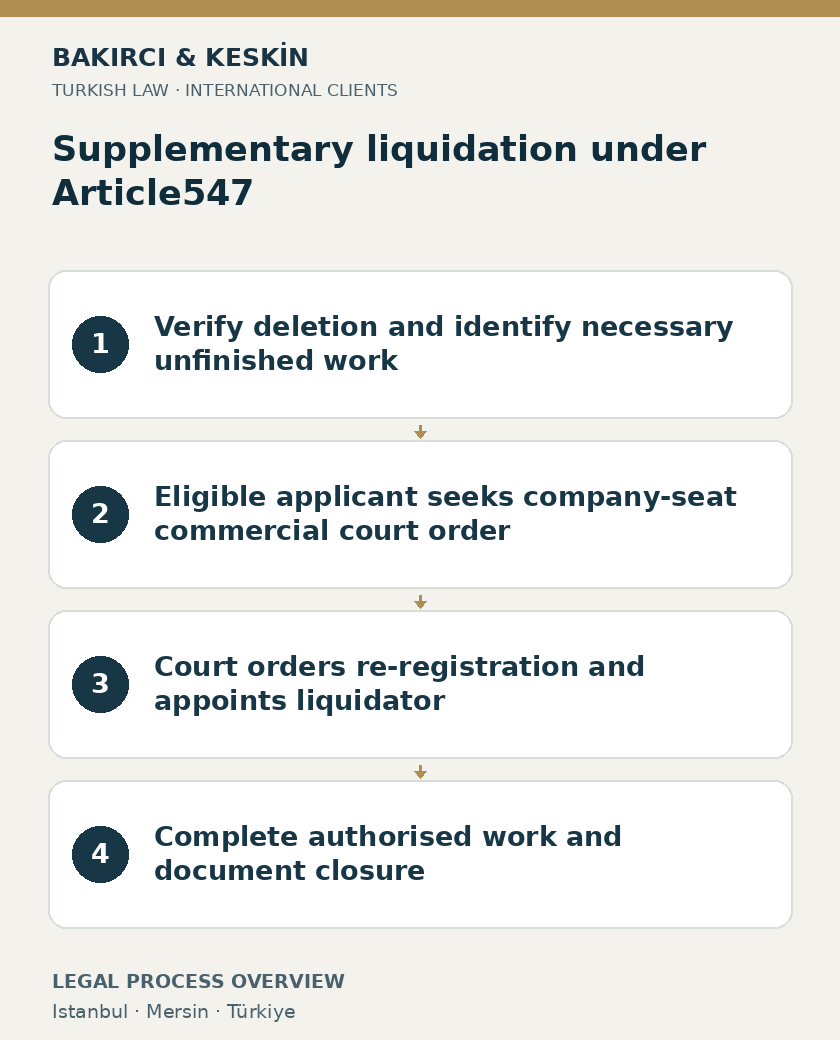
Article 547 of the Turkish Commercial Code allows a company to be registered again where necessary liquidation work remains after liquidation has closed. The last liquidators, board members, shareholders or creditors can apply to the commercial court at the company’s registered seat. The court assesses the need, orders re-registration for supplementary liquidation and appoints the former liquidators or new liquidators. For a foreign claimant with pending litigation, this addresses the company’s corporate and representation position; it does not itself decide the underlying claim or guarantee payment.
Have a general question about this article? Ask anonymously
Quick summary
| Legal issue | A Turkish Company Was Deleted from the Register While Litigation Continues: Supplementary Liquidation |
|---|---|
| Short answer | Article 547 of the Turkish Commercial Code allows a company to be registered again where necessary liquidation work remains after liquidation has closed. The last liquidators, board members, shareholders or creditors can apply to the commercial court at the company's registered seat. The court assesses the need, orders re-registration for supplementary liquidation and appoints the former liquidators or new liquidators. For a foreign claimant with pending litigation, this addresses the company's corporate and representation position; it does not itself decide the underlying claim or guarantee payment. |
| Key legislation | Law No. Commercial Code No. 6102; Law No. Civil Procedure Code No. 6100; Law No. Private International and Procedural Law No. 5718 |
Distinguish dissolution, liquidation and deletion from the register
A company described as closed is not necessarily in the same legal position as a company deleted from the trade register. Article 533 of the Turkish Commercial Code No. 6102 provides that a dissolved company enters liquidation, subject to statutory exceptions. During liquidation it retains legal personality until liquidation ends and uses its name with an indication that it is in liquidation. Its organs’ powers are limited by the liquidation purpose.
Article 545 addresses deletion after liquidation has ended: the liquidators request deletion of the trade name, which is registered and announced. Obtain the actual registry record and announcement. A tax closure, inactive website, empty office or bank account restriction is not a substitute for that corporate record. The relevant dates and the legal basis of deletion determine the next procedural step.
Identify the correct company through its registered name and registration details. A similar trading name, successor business or former shareholder is not automatically the same legal person. The file should show when liquidation began, who represented the company, when liquidation closed and whether deletion occurred before or during the dispute.
The legal basis stated in the deletion record also matters. Article 547 expressly concerns necessary additional work after liquidation has closed. A deletion carried out under a different statutory removal procedure must be examined under that procedure as well. An application should not import a deadline or condition from a different revival regime solely because both processes are described informally as company restoration. Preserve the decision, statutory reference and publication supporting the actual removal.
Article 547 provides a route for necessary supplementary liquidation
Article 547 applies where, after liquidation has closed, it becomes apparent that additional liquidation acts are necessary. The court can order re-registration until those additional acts are completed. The provision therefore has a defined function: enabling unfinished liquidation work to be carried out through a properly represented company.
The article is located in the joint-stock company liquidation framework. Article 643 applies the joint-stock company rules concerning liquidation procedure and the powers of company organs in liquidation to limited companies. The company’s legal form must still be established, but a limited-company file should not be rejected solely because Article 547 appears in the joint-stock company part of the Code.
This remedy differs from starting a dissolution case against an operating company. The guide to just-cause dissolution of a limited company addresses that earlier question. Supplementary liquidation concerns a company whose liquidation has already closed and a concrete remaining task. The application should explain that task directly rather than repeat a dispute about whether the business should originally have been dissolved.
Identify the applicant’s statutory capacity
Article 547(1) identifies the persons entitled to request re-registration: the last liquidators, members of the board, shareholders and creditors. The applicant should state the relevant capacity and provide supporting records. An overseas address does not change the need to establish that the applicant falls within a listed category.
A creditor’s file should connect the asserted debt to the deleted company. Include the relevant contract, invoice, judgment, enforcement documents or pending case materials, according to the actual claim. The application should explain why resolution or performance of that matter requires further liquidation work. Merely describing the company as a former business partner does not establish creditor status or the necessity required by Article 547.
A shareholder should establish the shareholding relevant to the company and liquidation records. A former officer or liquidator should provide appointment and registry documents. These identity and capacity questions should be resolved before filing so that the court can assess the substantive need without uncertainty about who is requesting the order and on what statutory basis.
Show precisely which liquidation work remains
The application must identify an additional act that is necessary after closure. For pending litigation, provide the court, case number, parties, subject matter and current procedural stage. Explain what remains to be decided or implemented and why the deleted company’s legal participation is required. The fact that a dispute exists is relevant, but the petition should connect it to the requested supplementary liquidation.
The same evidentiary discipline applies to an unresolved asset or obligation. Identify the asset, right or debt from the available records and explain the act that cannot be completed under the company’s deleted status. A request for unrestricted revival without an identified task does not express the limited statutory purpose. The court needs a workable description of the additional proceedings, collection, payment or registration work sought.
Use a chronology linking the underlying matter to the liquidation dates. Documents showing the liquidators’ knowledge, the state of pending proceedings and the contents of the closing file can clarify why the matter remained unresolved. The purpose is to establish necessity, not to assume that every omission automatically proves wrongdoing by a former manager.
Apply to the commercial court at the company’s seat
Article 547 expressly identifies the commercial court of first instance at the company’s registered seat. The former office where negotiations took place and the foreign creditor’s preferred location do not replace that statutory connection. Obtain the registry material establishing the relevant seat and verify the competent court before presenting the request.
The requested relief should identify re-registration for the specified supplementary liquidation work and appointment of the necessary liquidator or liquidators. Article 547(2) gives the court the task of assessing whether the request is justified. The petition should support both the need for restoration and the practical representation arrangement needed to carry out the work.
The registry and liquidation record also determine the appropriate parties and service arrangements. Article 547 should not be reduced to a universal form naming the same respondents regardless of how deletion occurred. Check the legal basis of deletion, the last liquidators and relevant procedural requirements. The court filing should include the records needed to resolve those questions rather than rely on a screenshot of an inactive company listing.
Deal with the capacity issue in the existing lawsuit
Article 50 of the Code of Civil Procedure No. 6100 connects capacity to be a party with the ability to enjoy civil rights. Article 114 lists party capacity, litigation capacity and proper legal representation among the procedural conditions. A deleted company in a pending case therefore requires attention to a procedural issue distinct from whether the claimant’s debt or damages allegation is correct.
Article 115 requires the court to examine procedural conditions and, where a deficiency can be remedied, to give a definite period for completion. The actual order in the pending case must be read and complied with. A supplementary liquidation application should be coordinated with that case, with evidence of filing and later orders submitted through the appropriate procedure.
Do not assume that filing for re-registration automatically suspends every deadline in the underlying dispute. Record any period the court has fixed, the act required and the proof of completion. Once re-registration and the liquidator’s appointment are established, the litigation file should contain the documents showing who now represents the company for the authorised work.
Re-registration requires an effective representation arrangement
Under Article 547(2), the court appoints the last liquidators or one or more new persons as liquidators for the additional work and causes registration and announcement. Re-registration of the company and appointment of its representative are linked elements of the remedy. A creditor should obtain the operative order and the resulting registry evidence, not stop at a statement that restoration was granted.
Article 539 provides that liquidators represent the company in court and externally on liquidation matters. It also addresses joint signature where there is more than one liquidator and the applicable arrangements do not provide otherwise. The appointment, signing authority and scope of the task should be checked before instructions, notices or settlement documents are addressed to the company.
The Code permits appointment of new liquidators rather than requiring the same individual in every case. The proposed arrangement should be capable of carrying out the identified work. Availability, authority and any concrete conflict relevant to representation should be placed before the court with evidence. The applicant does not acquire the liquidator’s powers merely by obtaining the re-registration order.
Supplementary liquidation has a limited purpose
Article 547 links the renewed registration to completion of the additional acts. It should not be treated as an unrestricted relaunch of ordinary business. Article 542(1)(b) prohibits liquidators from undertaking new transactions that liquidation does not require. The restored company’s activities must be organised around the court’s order and the statutory liquidation purpose.
Article 548 regulates a different subject, return from liquidation, under its own conditions. That procedure should not be merged with Article 547 merely because both can involve a company continuing in some form. The objective here is completion of unfinished liquidation work after closure. A business owner wishing to resume commercial operations needs an assessment of the different legal route and conditions.
The requested scope should be broad enough to complete the identified matter and precise enough to explain its necessity. A litigation file may require more than obtaining a judgment: the remaining work must be considered through the resulting legal and financial implementation. The order’s wording should be reviewed before assuming authority for additional acts outside the matter placed before the court.
Assess the company’s debts and assets separately from registration
Restoring the corporate vehicle does not establish that sufficient assets exist to pay every claim. Article 542 identifies liquidators’ duties to complete ongoing transactions, collect relevant amounts, realise assets and deal with company debts within the statutory framework. It also addresses the obligation to inform the court where debts exceed assets. The asset position remains a separate part of the recovery assessment.
Article 541 protects creditors during liquidation through notice and provision for known, unmatured or disputed debts. The original liquidation documents should be reviewed for the notices, deposits, security and arrangements relevant to the claimant. Their legal significance depends on the particular debt and the statutory conditions. The absence of immediate payment should not be treated as proof that the claim was extinguished by a register entry.
Prepare an updated claim statement showing principal, payments received, the legal basis of any interest and the current procedural status. A supplementary liquidator needs a reliable account of the remaining obligation. Registration evidence, entitlement to judgment and actual collection are separate items, each requiring its own supporting documents.
A restoration order does not itself impose personal liability
Article 546(2) applies Article 553 to liquidators’ liability. Article 553 addresses loss caused by culpable breach of duties arising from law or the articles of association. A personal liability claim therefore requires its own legal elements and evidence. The fact that supplementary liquidation became necessary should not be presented as an automatic judgment against every former liquidator, director or shareholder.
Separate the relief sought against the company from any allegation concerning an individual’s conduct. Identify the duty, breach, fault, loss and connection relied upon where a liability claim is contemplated. Different parties, evidence and limitation questions can arise. The re-registration file can provide relevant records, but it does not replace the analysis needed for a separate damages claim.
Timing should likewise be assessed claim by claim. Article 547’s two paragraphs do not state a general limitation period for every underlying debt or all forms of corporate revival. The deletion regime, pending court orders and the substantive claim’s limitation rules must be checked. A creditor should not assume that seeking restoration restarts a debt’s limitation period.
Coordinate foreign judgments and overseas authority documents
A foreign judgment against the company creates an additional procedural layer. The foreign judgment enforcement guide explains recognition and enforcement under Law No. 5718. Re-registration under Article 547 does not itself give a foreign judgment Turkish enforcement effect. The company’s capacity and the judgment’s enforceability must each be addressed through the applicable procedure.
Foreign applicants also need clear identity and representation documents. Article 48 of Law No. 5718 addresses security from foreign litigants and enforcement applicants, including the reciprocity exemption. The foreign claimant security guide explains that separate issue. Authentication, translations and authority should be prepared consistently with the person actually applying.
Document completion of the authorised liquidation work
The supplementary liquidation file should retain the restoration order, registration and announcement, liquidator appointment, underlying case documents and evidence of the acts completed. Any payment, transfer or final disposal should be traceable to the relevant authority and records. This establishes what the re-registration achieved.
At the end, the liquidator must address the company’s remaining statutory liquidation and closure steps. The applicant should obtain the records relevant to the resolved claim and verify the position of any outstanding matter. A file is complete when the necessary work and its legal consequences have been documented, rather than merely when a company name reappears in the register.
Frequently asked questions
Does a dissolved Turkish company immediately lose legal personality?
Article 533 provides that a company in liquidation retains legal personality until liquidation ends, subject to the statutory framework. Dissolution, liquidation and deletion are different stages. Obtain the current trade registry record before deciding that supplementary liquidation is required.
What does Article 547 allow?
Where necessary liquidation work remains after liquidation closes, Article 547 allows re-registration until that additional work is completed. The court assesses the need and appoints liquidators. The remedy is directed to the identified supplementary liquidation purpose.
Can a foreign creditor request re-registration?
Creditors are expressly among the applicants listed in Article 547. A foreign creditor must establish creditor capacity, the company’s identity and the necessary additional work. Foreign authority documents and applicable procedural security requirements must also be addressed.
Does the rule also apply to a Turkish limited company?
Article 643 applies the joint-stock company rules concerning liquidation procedure and the powers of organs in liquidation to limited companies. The company’s form and deletion history still require verification, but Article 547 is relevant through that statutory connection.
Which court handles the Article 547 request?
The provision identifies the commercial court of first instance at the company’s registered seat. The registry evidence should establish that seat. The applicant’s residence or the place where an old contract was negotiated does not replace the statutory venue.
Does a pending lawsuit automatically restore the company?
No. The pending matter can support the need for additional liquidation work, but the Article 547 request must be assessed by the court. Any capacity-related order and deadline in the existing case must also be followed and documented.
Must the former liquidator be appointed again?
Article 547(2) allows appointment of the last liquidators or one or more new persons. The court determines the arrangement for the additional work. The resulting appointment, authority and registry entry should be checked before dealing with the company.
Does restoration let the company resume unrestricted business?
The registration under Article 547 is for supplementary liquidation until the additional acts are completed. Article 542 restricts new transactions not required by liquidation. Return from liquidation under Article 548 is a separate procedure with its own conditions.
Does the order make former shareholders or liquidators pay the debt?
No automatic personal payment obligation follows from re-registration. A liquidator liability claim requires the elements of Article 553, applied through Article 546. Claims against shareholders or other persons likewise need a separate legal basis and evidence.
Will supplementary liquidation guarantee recovery of my claim?
It addresses the corporate framework needed for the remaining work. The merits of the debt, enforceability of any judgment, assets, competing rights and liquidation rules remain separate issues. Re-registration itself is not proof that funds are available for payment.
Official legal sources
- Commercial Code No. 6102 — Articles 533, 539, 541, 542, 545, 546(2), 547(1)-(2), 548, 553, 643
- Civil Procedure Code No. 6100 — Articles 50, 114, 115
- Private International and Procedural Law No. 5718 — Articles 48, 50-59
Recorded primary-source check dates: 26 October 2026. The official Turkish legislation controls. A new publication-date check is still required.
Contact information
Do not include confidential documents or identity numbers in an initial message. An enquiry does not establish representation or suspend any legal deadline.
Mersin physical office and Istanbul appointment information
Bakırcı & Keskin Law Office is Mersin-based. Its physical office is in Mersin; Istanbul contact details are for appointment coordination and do not identify a separately staffed physical office. Turkish matters are handled under the applicable jurisdiction and agreed mandate. The competent court and the scope of representation are assessed for each matter.
Istanbul — Polaris Plaza (appointment coordination only)
Maslak Ahi Evran Caddesi, Polaris Plaza No:21, Floor 9, 34475 Sarıyer/İstanbul, Türkiye.Istanbul location directions (confirm appointment availability before travelling)
Mersin — Profit İş Merkezi
İhsaniye Mahallesi, 4903. Sokak, Profit İş Merkezi No:23, Floor 3, Office 14, 33070 Akdeniz/Mersin, Türkiye.+90 552 224 43 66 · Contact details in English. An enquiry does not establish representation or suspend a legal deadline.
Istanbul Office – Polaris Plaza, Maslak / Sarıyer
Bakırcı & Keskin Hukuk Bürosu
Maslak Ahi Evran Caddesi, Polaris Plaza No:21, Kat:9, 34475 Sarıyer/İstanbul
Our physical offices in Istanbul and Mersin coordinate matters throughout Turkey, subject to jurisdiction and the local steps required for each case. Please specify your preferred office when arranging an in-person appointment.
Open the Istanbul office on Google Maps · Contact and appointments
Contact regarding a legal matter
In your first message, you may briefly state the subject, your country or city, and any relevant notification or recent procedural date. Please do not send identity numbers, medical data, or personal documents. Messaging alone does not constitute legal advice or create a lawyer–client relationship.
Discover more from Bakırcı & Keskin Hukuk Bürosu
Subscribe to get the latest posts sent to your email.