Turkish Divorce Papers Sent to an Old Overseas Address: Service and Response
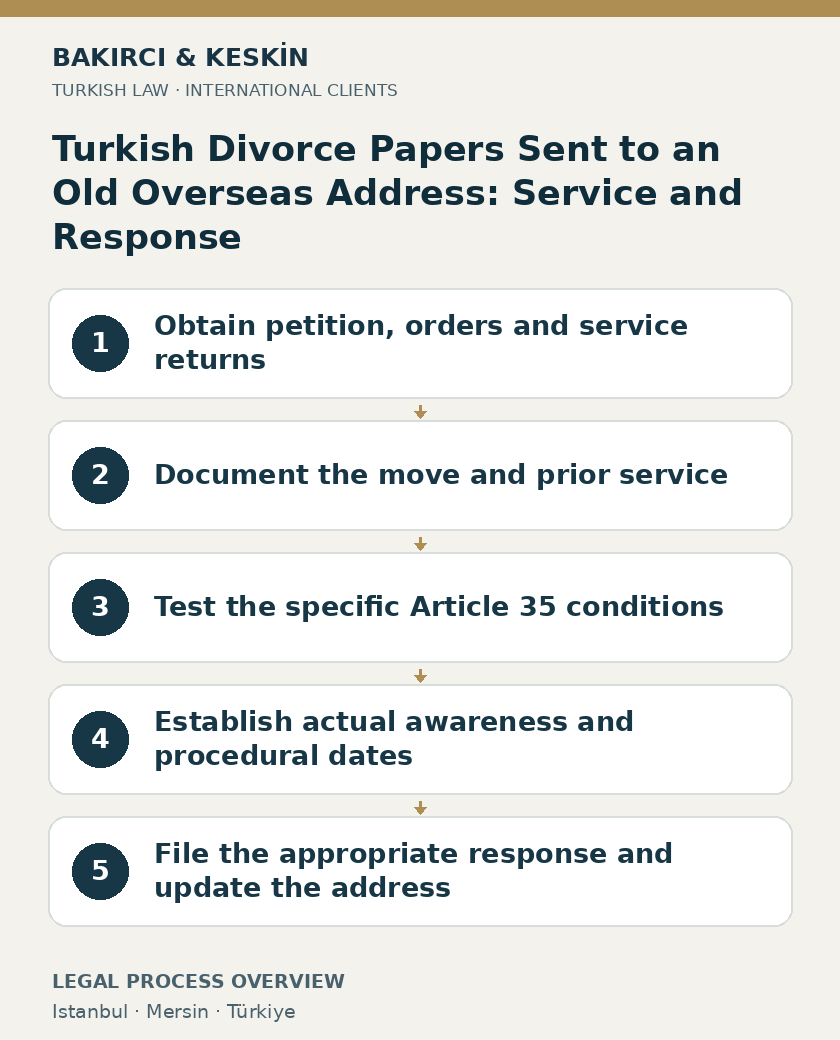
Short answer: A Turkish divorce petition sent to an old overseas address requires examination of the actual service record and the applicable statutory route. An outdated address does not automatically establish invalid service: Notification Law Article 35 contains a specific rule for Turkish citizens who previously received service abroad and failed to notify a change of address, subject to its conditions. If service was irregular but the recipient became aware of it, Article 32 addresses its effect and date. The immediate task is to obtain the court file, document the address history and actual awareness, and take the appropriate procedural step before further deadlines expire.
Have a general question about this article? Ask anonymously
Quick summary
| Legal issue | Turkish Divorce Papers Sent to an Old Overseas Address: Service and Response |
|---|---|
| Short answer | A Turkish divorce petition sent to an old overseas address requires examination of the actual service record and the applicable statutory route. An outdated address does not automatically establish invalid service: Notification Law Article 35 contains a specific rule for Turkish citizens who previously received service abroad and failed to notify a change of address, subject to its conditions. If service was irregular but the recipient became aware of it, Article 32 addresses its effect and date. The immediate task is to obtain the court file, document the address history and actual awareness, and take the appropriate procedural step before further deadlines expire. |
| Key legislation | Law No. 7201 — Articles 25, 25/A, 32, 35; Law No. 6100 — Articles 27, 95, 96, 97, 98, 127, 345; Law No. 5718 — Articles 40, 41 |
Identify which document was sent and how far the divorce case has progressed
Service of the initial divorce petition, a hearing notice, an interim order and the reasoned judgment can have different consequences. Begin with the issuing court, case number, document description and alleged service date. A message from the other spouse saying that the divorce is complete is not a substitute for the court’s records. Obtain the petition, procedural orders, service returns and any judgment before deciding what has been missed.
The court file should show both the documents dispatched and the records returned after attempted service. The envelope alone may establish an address or a postal event without revealing the statutory basis on which the court treated service as complete. Ask for the relevant service instruction, foreign or consular return, delivery record and docket entries. A challenge should identify the contested act and date precisely rather than alleging that the entire case was conducted improperly.
Civil Procedure Code Article 27 protects the right to be informed about proceedings, to make explanations and offer proof, and to have those submissions evaluated through reasoned decisions. That right gives the service issue practical significance. It does not eliminate the need to use the correct procedural remedy. The filing must connect the particular defect to the opportunity to respond that was affected in the actual case.
Reconstruct the address history with dates and documents
Prepare a chronology of the old address, the move, the new address, any official registration update and any notification sent to the Turkish court. Supporting material can include residence-registration records, tenancy documents, utility records and correspondence acknowledging the new address. Distinguish a postal forwarding arrangement from a formal change recorded with a public authority. They establish different facts and do not necessarily satisfy the same statutory obligation.
Identify previous service in the same proceedings. Article 35 addresses consequences following service and a subsequent address change, so an allegation that the papers went to an old address cannot be assessed without the earlier file history. The date of the first valid service, the address used and the capacity of the recipient matter. Preserve the earlier service return even if the present dispute concerns a later document.
Record what the other spouse and the court actually knew, supported by documents. A message giving a new address can be relevant evidence, but sending it to the other spouse and notifying the judicial authority are different events. Avoid merging them into a general assertion that everyone knew. The chronology should identify who received each communication, when it was received and whether it contained the complete address needed for service.
Identify the statutory route used for the overseas recipient
Notification Law Article 25 provides the general framework for service in a foreign country through the competent foreign authority and the specified diplomatic channels. Relevant international instruments and the destination’s permitted procedures also require examination. A Turkish court case does not itself authorise any chosen overseas delivery method. The actual request and return should show which route was used and whether its requirements were met.
Article 25/A creates an additional route for a person abroad who is a Turkish citizen, using the Turkish embassy or consulate. Nationality must therefore be established at the relevant stage. A foreign spouse does not fall within this route merely because the marriage or divorce concerns Turkey. A person with both Turkish and another nationality requires examination of their continuing Turkish nationality rather than an assumption based only on the passport used overseas.
The distinction affects the documents counsel must review. A consular notice under Article 25/A and a foreign authority’s service certificate under another route are different records. The detailed consular mechanism is explained in our Article 25/A service guide. For an old-address dispute, the additional question is whether the address-change provisions apply and whether the record proves their specific conditions.
Examine the specific old-address rule before alleging invalidity
Article 35 first requires a person who has received service, personally or at their address in accordance with the law, to notify the serving judicial authority immediately of a changed address. Later service is then made to the notified address. The existence of this obligation means that a move abroad or within a foreign country should be documented in the court file. Updating unrelated commercial accounts does not establish that the court received that notification.
The final paragraph contains a particular rule for a Turkish citizen previously served at an overseas address. It applies where that person changes the overseas address without notifying the issuing authority and a residential address cannot be determined from the address-registration system. In that situation, it addresses a notification sent under Article 25/A by the embassy or consulate to the overseas address where service previously occurred.
Under that paragraph, service is deemed completed thirty days after the date on which arrival of the notification at that address is documented. Each element therefore needs checking: Turkish citizenship, previous overseas service, a subsequent change, failure to notify the authority, the address-registration position and documented arrival. The rule should neither be ignored nor used as a blanket justification for every document posted to an obsolete foreign address.
The document evidencing arrival is particularly important. A dispatch date, a returned envelope and a delivery record describe different events. Ask which event the court used and which statutory paragraph it applied. Where a required condition is disputed, supply the relevant evidence directly, such as the earlier address notification or official registration record, rather than relying only on a general statement that the recipient no longer lived there.
Check the ordinary Article 25/A notice and calculate its sequence correctly
For the ordinary Article 25/A process, the mission’s notice identifies the subject and issuing authority and warns that failure to apply within thirty days will result in deemed service. It must be sent using a method allowed by the foreign country’s law. The statutory sequence depends on documented delivery of that notice to the addressee under the foreign rules, followed by failure to attend within the specified period.
The thirty-day period does not generally begin with the date on which the Turkish court prepared the petition or sent papers to the consulate. Under the ordinary rule, failure to apply results in service at the end of the thirtieth day following the documented notice delivery. If the person attends but refuses the documents, Article 25/A instead uses the date of the record of refusal. The actual route and event must be identified before calculating any subsequent court deadline.
Keep the consular letter, postal tracking, delivery acknowledgment and any appointment or attendance record together. Where Article 35’s special old-address paragraph is invoked, distinguish its documented-arrival requirement from the ordinary Article 25/A sequence. Treating both as an unexplained thirty days after posting conceals the issue that the court must decide. Accurate dates also allow counsel to explain why the contested service date affects the opportunity to defend.
Apply Article 32 to actual awareness without inventing a new date
Article 32 provides that service made contrary to the prescribed procedure is nevertheless valid if the addressee became aware of it, and treats the date declared by the addressee as the service date. This provision is central when the recipient learns of the papers through forwarding, a later court-file inspection or another documented route. The declaration must identify the actual awareness date honestly and precisely.
Record how the relevant document became known and preserve the material supporting that chronology. Learning that a marital dispute exists is not necessarily the same factual event as obtaining a particular petition or judgment. Explain the distinction with the communications and records available. The court must evaluate the procedural issue within the case; the recipient should not privately assume that choosing a later date automatically binds every authority or restarts every period.
Awareness also changes the practical urgency. Waiting for another postal attempt after obtaining the papers can undermine timely action. Submit the appropriate service objection and necessary procedural response through the competent court, addressing the relationship between them. A complaint to a postal operator or consulate may help obtain evidence, but it does not itself replace a filing required in the divorce case.
Protect the defence to the petition while addressing service
For the ordinary written civil procedure, Civil Procedure Code Article 127 sets a two-week period from service of the statement of claim for the defence. It also permits a single additional period, not exceeding one month, where preparation within the ordinary period is very difficult or impossible and the defendant applies within that period. The additional period begins after the ordinary response period ends; it requires a court decision.
An overseas address dispute does not itself amount to an extension application or a completed defence. Counsel should identify the alleged statutory service date, the date asserted under Article 32 where applicable and the response needed to protect the case. Pleadings can address the procedural objection and the substantive position in the appropriate form. The precise steps depend on the file; there is no safe general rule that the defendant can wait until the service dispute is resolved.
The defence should deal with the actual requests in the petition, including any child-related or financial applications, and identify available evidence. Explain what documents remain abroad and what translation or official retrieval is required. Our guide to Turkish divorce while living abroad covers the wider representation process. Resolving service addresses one procedural problem within that litigation; it does not determine the merits of the divorce.
Distinguish service of a judgment from a request to restore a missed period
If a judgment has already been issued, obtain its complete text, service records and information about any appeal or finality entry. Article 345 generally sets a two-week period for a regional appeal from proper service of the judgment on the relevant party, subject to special statutory rules. Whether that period began, whether service was irregular and what relief is available must be assessed from the judgment’s own procedural history.
Restoration of a missed period is a separate mechanism. Under Articles 95–98, a person prevented by circumstances beyond their control from acting within a statutory or peremptory judicial period can seek restoration subject to the Code’s conditions. Article 95 also excludes that route where the same result can be achieved by another legal route. A service-date objection should therefore not automatically be relabelled as a restoration request.
Article 96 generally requires restoration to be requested within two weeks after the obstacle disappears and contains additional rules tied to the stage and absence at judgment. Article 97 requires the grounds and evidence or indications to be given in a petition and the omitted act to be performed within the restoration-request period. These requirements make prompt procedural classification essential. The competent court also depends on the missed act under Article 98.
A finality notation should be examined against the underlying service and procedural records rather than treated as conclusive proof that no remedy exists. Equally, discovering an address error does not automatically annul the judgment. The requested correction or remedy must fit the actual procedural position, and any ongoing enforcement or registry consequence requires separate attention through the legally available procedure.
Keep objections to jurisdiction separate from defects in service
Proper service does not itself establish that the Turkish court has international or territorial jurisdiction. Conversely, a court that has jurisdiction must still comply with the service rules. Law No. 5718 Article 40 generally determines Turkish courts’ international jurisdiction by domestic territorial rules. Civil Code Article 168 identifies the divorce or separation venues by a spouse’s domicile or the place where the spouses last lived together for at least six months before the action.
For Turkish citizens’ personal-status cases, Article 41 of Law No. 5718 provides a further sequence where the case has not been or cannot be brought before a foreign court. It refers first to the territorially competent Turkish court, then the specified residence or last-domicile connections and ultimately Ankara, Istanbul or Izmir. It should not be presented as an unrestricted choice of any Turkish court whenever both spouses live abroad.
Give counsel information about existing foreign divorce proceedings, domicile, nationality and the spouses’ last shared residence. These facts serve the jurisdiction analysis, while postal records serve the notification analysis. Keeping the questions separate helps the pleading identify the relevant legal basis and applicable objection stage. Winning an argument about an old address does not, by itself, resolve jurisdiction or dispose of the underlying matrimonial claim.
Correct the file for future service and preserve a usable record
Notify the competent authority of the current address in the proper form and retain proof that the notification reached the file. Where a lawyer is appointed, provide a valid power of attorney and clarify the applicable service arrangements. A representative’s involvement should be reflected in the official record. An informal email exchange with a lawyer before appointment does not establish that court documents must already be served on that person.
Maintain one chronology showing the move, previous service, address notifications, disputed delivery, actual awareness, filings and court decisions on the issue. Attach legible copies and preserve originals. Foreign-language records should be prepared for use under the applicable translation and authentication rules rather than relying on an informal summary. This makes the address issue reviewable if the court’s decision later becomes relevant on appeal.
The immediate objective is a properly informed response in a procedurally accurate file. Once the service question is determined, revise the deadline calendar to reflect the court’s ruling and continue the substantive defence. Address disputes are most effectively handled through exact records and timely applications, with separate attention to the petition, judgment and any other document whose service carries its own legal consequence.
Frequently asked questions
1. Is service at an old overseas address always invalid?
No. Article 35 contains a specific rule for Turkish citizens previously served abroad, subject to conditions concerning the address change, notification, registration records and documented arrival.
2. Does changing my bank address notify the Turkish court?
It does not establish that the judicial authority was notified. Preserve evidence of the address notification actually made to the competent authority.
3. Does Article 25/A apply to a foreign spouse overseas?
It is specifically directed to Turkish citizens abroad. A person without Turkish nationality requires examination of the applicable general and international service routes.
4. When does the ordinary consular thirty-day period start?
Article 25/A ties it to documented delivery of the mission’s notice under the permitted foreign method. The court’s dispatch date alone is not that event.
5. What if I learned of the petition despite irregular service?
Article 32 addresses irregular service followed by actual awareness and the declared awareness date. Present the truthful chronology and take the necessary procedural action promptly.
6. Should I wait for the consulate to investigate before responding?
A request for consular or postal information does not itself replace the necessary court filing. Assess and protect the relevant response period while obtaining the records.
7. Is an extension of the defence period automatic because I live abroad?
No. Article 127 requires an application within the ordinary period and the statutory difficulty or impossibility condition; the court decides the additional period.
8. Is restoration of time the same as correcting a service date?
No. Articles 95–98 regulate restoration separately and include conditions, time limits and a requirement to perform the omitted act.
9. Does an address error automatically cancel a divorce judgment?
No. The remedy depends on the service record and procedural stage. Obtain the judgment and complete file before selecting the appropriate application or appeal.
10. Does proper service prove that the Turkish court has jurisdiction?
No. Jurisdiction and service are distinct questions. Relevant jurisdiction provisions include Law No. 5718 Articles 40–41 and Civil Code Article 168.
Official legal sources
- Law No. 7201 — Articles 25, 25/A, 32, 35
- Law No. 6100 — Articles 27, 95, 96, 97, 98, 127, 345
- Law No. 5718 — Articles 40, 41
- Law No. 4721 — Articles 168
Recorded primary-source check dates: 26 October 2026. The official Turkish legislation controls. A new publication-date check is still required.
Contact information
Do not include confidential documents or identity numbers in an initial message. An enquiry does not establish representation or suspend any legal deadline.
Mersin physical office and Istanbul appointment information
Bakırcı & Keskin Law Office is Mersin-based. Its physical office is in Mersin; Istanbul contact details are for appointment coordination and do not identify a separately staffed physical office. Turkish matters are handled under the applicable jurisdiction and agreed mandate. The competent court and the scope of representation are assessed for each matter.
Istanbul — Polaris Plaza (appointment coordination only)
Maslak Ahi Evran Caddesi, Polaris Plaza No:21, Floor 9, 34475 Sarıyer/İstanbul, Türkiye.Istanbul location directions (confirm appointment availability before travelling)
Mersin — Profit İş Merkezi
İhsaniye Mahallesi, 4903. Sokak, Profit İş Merkezi No:23, Floor 3, Office 14, 33070 Akdeniz/Mersin, Türkiye.+90 552 224 43 66 · Contact details in English. An enquiry does not establish representation or suspend a legal deadline.
Istanbul Office – Polaris Plaza, Maslak / Sarıyer
Bakırcı & Keskin Hukuk Bürosu
Maslak Ahi Evran Caddesi, Polaris Plaza No:21, Kat:9, 34475 Sarıyer/İstanbul
Our physical offices in Istanbul and Mersin coordinate matters throughout Turkey, subject to jurisdiction and the local steps required for each case. Please specify your preferred office when arranging an in-person appointment.
Open the Istanbul office on Google Maps · Contact and appointments
Contact regarding a legal matter
In your first message, you may briefly state the subject, your country or city, and any relevant notification or recent procedural date. Please do not send identity numbers, medical data, or personal documents. Messaging alone does not constitute legal advice or create a lawyer–client relationship.
Discover more from Bakırcı & Keskin Hukuk Bürosu
Subscribe to get the latest posts sent to your email.