A Turkish Lawyer’s Power of Attorney Lacks Settlement Authority: Correcting the File
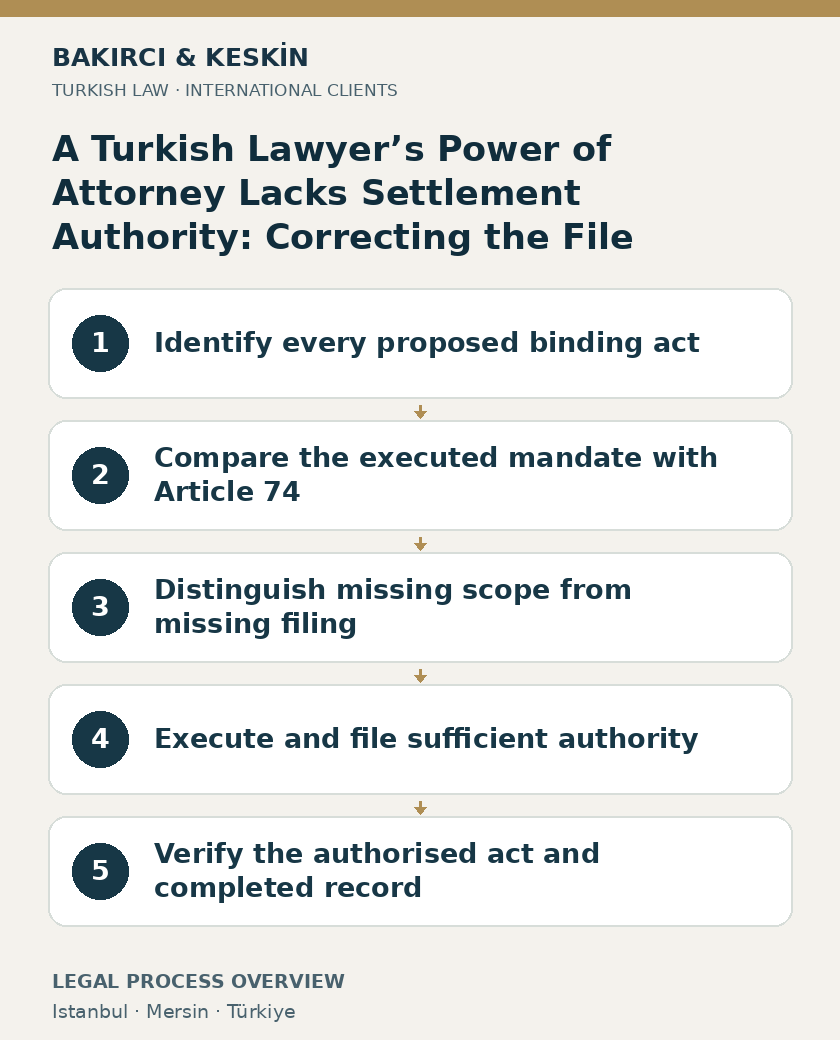
Short answer: A lawyer conducting a Turkish case needs express authority to settle it under Civil Procedure Code Article 74. A general power to litigate does not, by itself, supply every specially required authority. First identify the exact proposed act, compare it with the complete power of attorney and distinguish a missing authority clause from failure to file an otherwise sufficient document. A properly executed replacement or supplementary mandate can address future authority, but the effect of a settlement already purportedly made requires separate examination. Client instructions, formal representative authority and the procedural document ending the case should all express the same intended result.
Have a general question about this article? Ask anonymously
Quick summary
| Legal issue | A Turkish Lawyer’s Power of Attorney Lacks Settlement Authority: Correcting the File |
|---|---|
| Short answer | A lawyer conducting a Turkish case needs express authority to settle it under Civil Procedure Code Article 74. A general power to litigate does not, by itself, supply every specially required authority. First identify the exact proposed act, compare it with the complete power of attorney and distinguish a missing authority clause from failure to file an otherwise sufficient document. A properly executed replacement or supplementary mandate can address future authority, but the effect of a settlement already purportedly made requires separate examination. Client instructions, formal representative authority and the procedural document ending the case should all express the same intended result. |
| Key legislation | Law No. 6100 — Articles 73, 74, 76, 77, 307, 308, 309, 313, 315; Law No. 6098 — Articles 46, 504 |
Identify the exact act before asking for a broader power of attorney
A negotiation can end in a court settlement, a private release, waiver of the claim, acceptance of the opposing claim or withdrawal of an appeal. Those acts are legally different. Start with the proposed document and the intended procedural consequence. An instruction to close the case does not tell the lawyer whether the client intends to surrender the underlying right, resolve it by agreement or take another procedural step.
List each act the lawyer is expected to perform. A settlement may require signing a compromise, releasing the opponent, withdrawing a particular application and making an additional statement in court. Authority for one part should not simply be assumed to cover every other part. Article 74 expressly identifies several acts separately, including settlement, release of the opponent, acceptance of the opponent’s claim and waiver of the claim or legal remedies.
The scope should also identify the proceedings and parties affected. A principal claim, counterclaim and separate enforcement file are distinct items in the legal record. A parent company, subsidiary and director are distinct persons. Before correcting a mandate, determine which client is giving which authority over which dispute. This reduces the risk that a formally broad document is later relied on for a different claim the client never intended to settle.
Read Articles 73 and 74 together, with the mandate rules
Civil Procedure Code Article 73 gives litigation representation a broad ordinary scope, including necessary conduct of the case through finality and specified enforcement and cost-related acts, while preserving matters requiring special authority. Article 74 then lists acts that a representative cannot perform without express authority. The breadth of ordinary case management therefore does not remove the need to check a settlement clause specifically.
Code of Obligations Article 504 separately addresses the scope of the mandate and expressly requires special authority for settlement and other listed acts. The private-law mandate and the court’s procedural representation requirements should be considered together. Describing a document as a general power of attorney does not answer whether its wording contains the authority required for the particular transaction or court statement.
Special authority is also distinct from a lawyer’s professional ability to negotiate or advise. Counsel can analyse an offer and obtain instructions without treating that work as proof of authority to conclude the final transaction. The important point is the act that binds the client or changes the procedural position. Match the proposed operative wording to the statutory category before the final document is signed or submitted.
Audit the complete document, including its translation and attachments
Obtain the entire executed power of attorney, not a photograph of its first page or a summary of the powers. Check the principal’s identity, the named representative, the execution details, every authority clause and any restrictions or expiry language. An omitted page can contain the relevant power or a limitation. The version deposited in the court file should be compared with the original or duly certified version being reviewed.
For a foreign-language mandate, compare the original operative wording with the Turkish translation. A translator should accurately convey an authority already granted; translation does not create an authority absent from the source document. Broad English verbs can obscure distinctions between settlement, waiver, release and acceptance. Record any mismatch and correct the relevant document through a lawful process rather than relying on an advantageous but inaccurate translation.
Build a short authority schedule linking each proposed act to the clause relied on. Mark whether the authority is present, missing, ambiguous or dependent on another instrument. This schedule is a working tool rather than a substitute for legal interpretation. It gives the client and lawyer a precise reason for obtaining a supplementary mandate and avoids asking for an unnecessarily unrestricted document when a defined authority will address the actual defect.
Distinguish missing evidence of authority from a missing grant of authority
Article 76 requires the lawyer to submit the notarised original power of attorney or a lawyer-certified true copy for the litigation or enforcement file, subject to the provision’s separate public-body representation rule. A complete document can therefore exist outside the file while the court lacks the required evidence of it. That filing defect is different from a document that has been filed but never granted express settlement authority.
Article 77 addresses a lawyer who has not produced the original or certified copy. In circumstances where delay could cause harm, the court may permit proceedings or procedural acts subject to a peremptory period for production. If neither the document is supplied nor the principal notifies the court by petition of acceptance within that period, the action is treated as not brought or the procedural acts as not performed. Permission, the specified period and timely compliance must be established from the actual court record.
This mechanism should not be described as a universal cure for every act performed without the special authority required by Article 74. Identify whether the problem is non-production, insufficient scope, the principal’s capacity or another defect. The applicable remedy and consequences depend on that classification. If a court has set a peremptory period, record its terms and service immediately; obtaining a new appointment abroad does not automatically extend it.
A pending authority issue also does not suspend all other obligations in the case. Article 77 expressly addresses several circumstances that do not, by themselves, justify postponement, including a party’s wish to instruct counsel. Protect the relevant filing and hearing position through the available procedure while correcting the document. The court should receive an accurate account of what is missing and what application is being made.
Record the commercial instructions separately from the formal power
A mandate containing settlement authority does not reveal the amount or conditions the client currently wishes to accept. Obtain clear instructions on the sum, currency, payment dates, security, costs, releases and treatment of pending proceedings. Record whether the proposal resolves all claims or only identified components. This makes the lawyer’s practical mandate intelligible even when the formal power of attorney uses broader statutory language.
Likewise, an email agreeing with a proposed amount should not automatically be treated as proof that the court file contains the formal representative authority required by Articles 74 and 76. The communication may evidence the client’s instructions, but the representation documents still require examination. Keep both in the file and resolve any inconsistency before submitting an operative settlement or waiver to the court.
Payment instructions deserve separate precision. Identify the account entitled to receive funds, how cleared receipt will be confirmed and when any release becomes effective. Authority to negotiate, authority to settle and the arrangements for receiving and accounting for money should be examined according to the actual documents and applicable rules. A phrase in a settlement stating that the debt has already been paid must correspond to the facts.
Prepare a properly executed supplementary or replacement mandate from abroad
The additional document should expressly address the acts needed for the intended transaction and identify the principal and representative correctly. Decide whether a supplementary authority can be read with the existing mandate or whether a replacement will provide a clearer record. State the relevant case or dispute where appropriate and consider the effect on existing representatives. A new document should not leave contradictory versions circulating without an explanation of their relationship.
Execution abroad requires examination of the available route and the requirements for Turkish use. Our guide to appointing a Turkish lawyer from abroad addresses the broader process. For the present defect, send the required substantive wording for review before execution so that authentication of the signature does not leave the actual settlement power unresolved.
Authentication, translation and authority are separate questions. A properly authenticated foreign instrument can still omit the required power, and an accurately translated instrument can still name the wrong legal entity. Review the executed result against the approved instructions, including every attachment. Do not insert new authority into an already executed original or present an altered copy as the instrument that was signed.
File the sufficient document in the proper form and obtain confirmation that it has entered the correct case record. Where several proceedings are involved, verify the representation position in each. Supplying a document to one lawyer’s inbox does not establish that every court or enforcement office has received it. Track any court direction concerning the defect and the decision or record showing how it was addressed.
Check the person granting authority and any substitute lawyer
A foreign company’s mandate requires evidence that the person signing for it can bind the company for the relevant purpose. Obtain current corporate records and any required organisational decision, identifying the actual claimant or defendant. A group executive’s role in a related company is not proof of authority for the entity in the Turkish case. The grant must be traced to the legal person whose rights the proposed settlement affects.
Compare signing requirements with the executed document. Where the supporting corporate records require joint signatures, a mandate signed by only one person needs examination rather than an assumption that the foreign notary resolved the company’s internal authority. Changes in officers, legal names or restructuring should be explained with the relevant records. These are separate questions from whether the lawyer’s document expressly contains the settlement power.
Article 74 also lists appointing another representative among the acts requiring express authority. Where a substitute lawyer is to conclude the transaction, examine the original power, the authority to appoint a substitute and the instrument connecting that lawyer to the file. A settlement clause in the principal’s mandate should not lead to overlooking a gap in the chain through which the person actually signing claims authority.
Assess an agreement already signed without assuming automatic validation
If a settlement has already been signed or recorded, obtain the precise text, signatures, hearing minutes, related court decision and authority documents in force at that time. Record what the principal knew and communicated and whether any payment or performance occurred. The legal position depends on the character of the act and the procedural stage. A new mandate issued today should not simply be described as proving authority existed on an earlier date.
Code of Obligations Article 46 provides that a legal transaction undertaken without authority binds the represented person only if approved, and addresses a counterparty’s request for a decision on approval within an appropriate period. This private-law rule is relevant to unauthorised representation, but it does not dispense with examination of the procedural rules governing a court settlement or waiver already placed in a pending case.
The file should distinguish a proposed express approval, a fresh agreement made with sufficient authority and a challenge to the earlier act. Each needs deliberate wording and the appropriate procedure. Do not treat silence, continued negotiations or a document containing general future powers as an automatic resolution of every earlier defect. The court record and any decision already made must be addressed through the legally available route.
Coordinate the agreement with the procedural act ending the dispute
Article 313 defines court settlement as an agreement before the court ending all or part of a pending dispute and limits it to matters within the parties’ power of disposition. It allows conditions and matters outside the original claim to be included. Article 315 gives a qualifying settlement effects comparable to a final judgment. The required authority must therefore be reviewed against the full settlement, including any additional subject matter.
Waiver and acceptance have separate statutory rules. Articles 307–309 define the acts, require the relevant part to be identified where partial and require waiver or acceptance to be unconditional. A conditional payment compromise should not be converted casually into an unconditional waiver merely because the power of attorney includes both powers. The client’s intended protection and the procedural document must remain aligned.
Our guide to withdrawal, waiver and settlement explains their different consequences. In an authority-defect file, the decisive additional task is to verify that the person making each statement has the necessary express power. Record the claims being resolved, any reserved claims, the treatment of costs and the consequences of non-payment in the correct legal form.
Verify the completed record instead of stopping at the new signature
After the sufficient mandate is filed and the authorised act is completed, obtain the hearing record or filed statement and any resulting decision. Compare them with the approved agreement. A correct mandate does not prevent a drafting or recording error in the settlement itself. Check the parties, amounts, dates, scope of release and treatment of any counterclaim or separate enforcement file.
Retain the authority audit, client instructions, executed mandate, translations, filing confirmation and final operative documents together. Where approval of an earlier act was relied on, preserve the exact approval and the court’s treatment of it. This record allows the client to understand why the transaction binds them and gives later representatives a clear account of how the original defect was resolved.
Finally, continue monitoring the obligations created by the settlement. Authority to sign and actual performance are distinct matters. Verify promised payments and completion steps against the agreement, and assess any default under its proper legal framework. A professionally corrected mandate provides the foundation for an effective transaction; accurate court records and follow-through establish what was actually concluded and performed.
Frequently asked questions
1. Does an ordinary litigation power automatically authorise settlement?
No. Article 73 preserves matters requiring special authority, and Article 74 requires express settlement authority.
2. Is settlement authority the same as authority to waive a claim?
They are separately listed acts under Article 74. Review each proposed statement and the actual mandate.
3. Can a translation add a settlement power missing from the original?
No. A translation should convey the authority actually granted; additional powers require an appropriate grant by the principal.
4. Does Article 77 automatically cure missing special authority?
It addresses non-production of the power of attorney and contains a limited court-controlled procedure. It should not be treated as a universal cure for every Article 74 defect.
5. Can I provide a supplementary power from abroad?
A properly executed document can grant the authority needed for future acts. Its form, Turkish use, relationship to the existing mandate and filing must all be checked.
6. Does a new mandate prove the lawyer had authority earlier?
Not automatically. Examine the earlier act, any approval, the relevant private-law provisions and the procedural position.
7. Does a company’s notarial signature resolve all corporate authority questions?
No blanket assumption is appropriate. Verify the signer’s power to bind the actual company and any joint-signature or organisational requirements.
8. Can a substitute lawyer rely only on the settlement clause?
The chain of representation also needs examination. Article 74 separately requires express authority to appoint another representative.
9. Can a court settlement be conditional?
Article 313 permits a conditional settlement within its scope. Article 309 separately requires waiver and acceptance to be unconditional.
10. What should be checked after the mandate is corrected?
Verify filing, the authorised statement, the hearing record or decision, the settlement’s scope and actual performance. The new signature alone does not complete those tasks.
Official legal sources
Recorded primary-source check dates: 26 October 2026. The official Turkish legislation controls. A new publication-date check is still required.
Contact information
Do not include confidential documents or identity numbers in an initial message. An enquiry does not establish representation or suspend any legal deadline.
Mersin physical office and Istanbul appointment information
Bakırcı & Keskin Law Office is Mersin-based. Its physical office is in Mersin; Istanbul contact details are for appointment coordination and do not identify a separately staffed physical office. Turkish matters are handled under the applicable jurisdiction and agreed mandate. The competent court and the scope of representation are assessed for each matter.
Istanbul — Polaris Plaza (appointment coordination only)
Maslak Ahi Evran Caddesi, Polaris Plaza No:21, Floor 9, 34475 Sarıyer/İstanbul, Türkiye.Istanbul location directions (confirm appointment availability before travelling)
Mersin — Profit İş Merkezi
İhsaniye Mahallesi, 4903. Sokak, Profit İş Merkezi No:23, Floor 3, Office 14, 33070 Akdeniz/Mersin, Türkiye.+90 552 224 43 66 · Contact details in English. An enquiry does not establish representation or suspend a legal deadline.
Istanbul Office – Polaris Plaza, Maslak / Sarıyer
Bakırcı & Keskin Hukuk Bürosu
Maslak Ahi Evran Caddesi, Polaris Plaza No:21, Kat:9, 34475 Sarıyer/İstanbul
Our physical offices in Istanbul and Mersin coordinate matters throughout Turkey, subject to jurisdiction and the local steps required for each case. Please specify your preferred office when arranging an in-person appointment.
Open the Istanbul office on Google Maps · Contact and appointments
Contact regarding a legal matter
In your first message, you may briefly state the subject, your country or city, and any relevant notification or recent procedural date. Please do not send identity numbers, medical data, or personal documents. Messaging alone does not constitute legal advice or create a lawyer–client relationship.
Discover more from Bakırcı & Keskin Hukuk Bürosu
Subscribe to get the latest posts sent to your email.