Recovering Money Paid Under an Invalid Turkish Property Sale Agreement
A refund may be available when an ineffective property sale document leaves the recipient without a lawful basis to keep the buyer’s money. Article 237 of the Turkish Code of Obligations requires official form for real-estate sales and sale promises. Articles 77–82 govern restitution for unjust enrichment where their conditions are met. A prepaid consumer housing sale also requires examination of Law No. 6502 Article 41, which prevents the seller from invoking the specified form defect against the consumer. The first task is therefore to classify the contract before choosing between performance, contractual repayment and unjust-enrichment recovery.
Have a general question about this article? Ask anonymously
This article addresses money paid under an informal Turkish property transaction that has not produced the promised title. It focuses on identifying the payment recipient, the legal basis for repayment, the evidence and the limitation analysis for a buyer living outside Turkey.
Quick summary
| Legal issue | Recovering Money Paid Under an Invalid Turkish Property Sale Agreement |
|---|---|
| Short answer | An ineffective property sale document does not automatically entitle the recipient to keep the buyer's money. Article 237 of the Turkish Code of Obligations requires official form for real-estate sales and sale promises. Articles 77–82 govern restitution for unjust enrichment where their conditions are met. A prepaid consumer housing sale also requires examination of Law No. 6502 Article 41, which prevents the seller from invoking the specified form defect against the consumer. The first task is therefore to classify the contract before choosing between performance, contractual repayment and unjust-enrichment recovery. |
| Key legislation | Law No. 6098 — Articles 77-82, 237; Law No. 6502 — Articles 3, 40-41 |
Classify the document before declaring the whole transaction void
A reservation form, private sale agreement, broker’s receipt, notarial sale promise and completed title transfer perform different functions. Read the complete transaction documents, including later official instruments. A payment may have preceded a valid transaction that was subsequently completed; alternatively, it may relate to a promise that never satisfied the required form. Those histories should not be collapsed into the same claim.
Article 237 of Law No. 6098 requires official form for a real-estate sale and a promise to sell real estate. A signature witness or a stamped translation is not automatically the official transaction required by that provision. The preliminary sale agreement guide explains the distinction between a sale promise and transfer of ownership.
Do not assume that every clause disappears for every purpose as soon as a form problem is identified. The legal assessment must address the transaction’s actual character, mandatory consumer protections, subsequent acts and the precise relief sought. A claim framed exclusively as restitution can be unsuitable where the buyer retains an enforceable right to demand performance and still wants the property.
Check the prepaid housing exception to the seller’s invalidity defence
Article 41 of Consumer Protection Law No. 6502 requires the prescribed registry or notarial form for prepaid housing transactions. It also states that the seller cannot subsequently invoke the resulting invalidity against the consumer. The same article prevents the seller from demanding payment or a document imposing liability before a valid contract has been made.
This protection should be assessed before accepting a developer’s statement that its informal agreement leaves the purchaser without rights. It does not mean that a private paper is itself a title deed. It means the legal consequences cannot be resolved by the seller’s preferred description of its own failure to use the required form.
Consumer status depends on the statutory criteria, including the non-commercial or non-professional purpose and the professional seller. A foreign passport alone proves neither qualification nor exclusion. Obtain evidence of the purchase purpose and the seller’s business activity. A privately negotiated resale between individuals and a professional prepaid housing project require separate classification.
Understand what Article 77 requires
Article 77 requires a person enriched from another person’s property or labour without a lawful basis to restore the enrichment. It expressly addresses an invalid basis, a basis that never materialised and a basis that subsequently ceased. The claimant must connect the payment, the recipient’s enrichment and the failure of the legal basis relied on.
Distinguish that route from contractual restitution after an effective withdrawal or other contractual termination. Both may involve returning money, but their legal conditions and limitation analysis are not necessarily identical. Also distinguish damages: the amount paid is not automatically the same as every additional loss caused by the transaction.
Article 78 addresses voluntary performance of an obligation that was not owed and includes a requirement concerning the payer’s mistaken belief of indebtedness, subject to other statutory rules. It is therefore unsafe to describe every voluntary bank transfer as automatically recoverable. The file must explain why the money was paid and which legal basis is asserted for its return.
Identify the person who received the economic benefit
Start with the bank-account holder and the legal party named on the receipt. Then examine whether the recipient collected for the seller, retained a separate fee, forwarded the money or received it without authority. A real-estate intermediary’s involvement does not by itself make the intermediary and seller jointly responsible for every sum.
Where several entities appear, prepare a flow-of-funds schedule. Record each payment and the evidence of onward transfer or authority. Ask for documents rather than relying on the statement that all companies belong to the same group. Separate corporate personalities cannot be disregarded merely because the same salesperson communicates for them.
Payments made by a spouse, relative or company need their own explanation. Determine who contracted, who paid and who owns the repayment claim. Obtain the instruction or agreement connecting a third-party payment with the buyer’s obligation. This avoids beginning proceedings with a mismatch between the person who suffered the loss and the person named as claimant.
Prove the payment and its intended purpose
A bank transfer proves that money moved between identified accounts. Its reference, the surrounding correspondence and the payment schedule help establish why it moved. Retain the original statement or bank-generated record, not only a cropped image. Record the currency sent, the currency received and fees charged separately.
For cash, preserve the signed receipt, the recipient’s identity and messages acknowledging collection. A withdrawal from the buyer’s bank account alone does not prove delivery to the defendant. Where the receipt uses a project name rather than a company name, obtain the documents linking that project and the signatory to the defendant.
Do not create retrospective receipts or alter references to make a payment fit the intended claim. Reconstruct missing evidence through lawful records and genuine acknowledgments. The guide to messages as evidence explains why the complete conversation and original attachments matter when an overseas buyer relies on remote dealings.
Calculate the enrichment and address the recipient’s position
Article 79 regulates the extent of restitution. Its first paragraph concerns the portion the recipient proves is no longer held when return is sought. Its second paragraph imposes full responsibility where the enrichment was disposed of without good faith or when the recipient should have anticipated having to return it. A simple statement that the money has been spent does not complete this analysis.
Record when the recipient learned of the problem, the repayment demand and any relevant disposal of funds. Avoid treating all business expenditure as conclusive proof either for or against the defence. The court assesses the statutory conditions and the actual evidence, not merely the account balance shown on one selected date.
Article 80 separately governs expenses incurred by the enriched party and distinguishes necessary, useful and other expenditure, with different treatment according to good faith. A recipient cannot justify a deduction merely by issuing an unexplained “administration cost” invoice. Ask for the legal basis, actual expenditure and connection to the benefit that must be restored.
Account for possession, partial performance and money already returned
Check whether the buyer received keys, occupied the property, collected rent, obtained materials or received any partial refund. The repayment claim must be constructed around the real exchange between the parties. Claiming the full price while omitting a documented refund damages the reliability of the account.
Possession also requires careful handling. Physical access is not title, but it may be relevant to restoration obligations or the accounting between the parties. Do not surrender access, remove fixtures or accept a handover document without considering its legal effect. A record should distinguish return of keys from release of the monetary claim.
If the seller offers another unit or a credit, record whether it has merely been proposed or accepted. A replacement promise is not cash received. The buyer’s ledger should show actual transfers separately from conditional future benefits. This distinction prevents an unperformed offer from being entered as though the debt had already been discharged.
Analyse the limitation period from the correct legal basis
Article 82 provides a two-year period from learning of the right to restitution and, in any event, a ten-year period from the enrichment for unjust-enrichment claims. These are statutory periods for that cause of action. They should not be attached automatically to every refund dispute, because another legal basis can require a different analysis.
Prepare a chronology of payment, the promised transfer, discovery of the form problem, refusal of performance and later acknowledgments or repayments. The legally relevant knowledge and commencement issues must be examined using the transaction’s facts and applicable case law. Do not assume that the day the buyer first consults a lawyer is the starting date.
Negotiations do not automatically preserve a claim. A repayment message may be relevant, but its legal effect must be assessed rather than guessed. Supply every earlier demand, settlement proposal and court or enforcement document. A lawyer can then identify the applicable limitation and the procedural step required to protect the actual claim.
Make the repayment demand internally consistent
The notice should identify the parties, property transaction, amount, payment dates and legal basis relied upon. State what is demanded and the destination for lawful repayment. Avoid mixing a final demand for title with an unconditional declaration abandoning the transaction unless that combination has been deliberately structured as an appropriate alternative.
Attach or identify the core evidence without distributing unnecessary personal information. A concise payment table and transaction reference can be more useful than forwarding an entire private message archive. Preserve proof of dispatch and receipt through a suitable channel. Where a particular procedural form is needed, ordinary messaging should not be presented as an equivalent substitute.
Interest and exchange-rate questions should be calculated separately. Record the contractual currency and the requested form of repayment. Do not insert an arbitrary interest rate or translate all historic payments at today’s rate without a legal basis. The principal, interest period and additional loss should be intelligible as separate components of the demand.
Separate the merits from the prospects of collection
A sound restitution claim does not prove that the recipient has assets available to satisfy it. Investigate the defendant’s identity and the practical enforcement position using lawful procedures. Preserve evidence of a concrete disposal risk when asking a lawyer to consider interim protection. The legal conditions for a particular measure must be established; a broken property promise alone does not guarantee a freezing order.
Identify the correct court and any applicable pre-action procedure from the transaction’s legal character. Consumer, ordinary civil and commercial routes should not be selected solely by the size of the payment or the claimant’s nationality. If relief concerns title as well as repayment, procedural classification needs particular attention.
The debt collection guide for overseas claimants addresses the wider collection process. This article’s narrower issue is the evidential and legal foundation for returning property-purchase money when the asserted basis for keeping it fails.
Review a refund agreement before releasing the original claim
A repayment agreement should state the acknowledged amount, currency, schedule and consequences of missed instalments. Identify the actual debtor and the signatory’s authority. If another company promises payment, clarify its obligation and the effect on the original recipient. A new promise should not silently extinguish a claim against a more accessible debtor.
Match the release to the agreed performance. An immediate full release in exchange for future unsecured instalments changes the buyer’s risk. State how partial payments are credited and which claims remain until payment is complete. Avoid a receipt saying “paid in full” when it records only the first instalment.
Keep the bank evidence of actual payment with the settlement. A transfer instruction, pending transaction screen or future-dated promise is not proof of cleared receipt. Where property or another benefit is accepted instead of money, document its valuation, title and transfer conditions expressly.
Prepare a file that can be acted on from overseas
Begin with the full contract bundle, current title information, payment records and a dated chronology. State whether the buyer still wants the property or has chosen repayment. Identify who currently holds the keys and whether any official instrument, lawsuit or enforcement proceeding already exists.
Arrange translations after the relevant documents have been selected. Preserve original names, currencies and signatures; a translated summary cannot replace the underlying record. Provide any power of attorney already issued so its scope can be checked against litigation, settlement and receipt of funds.
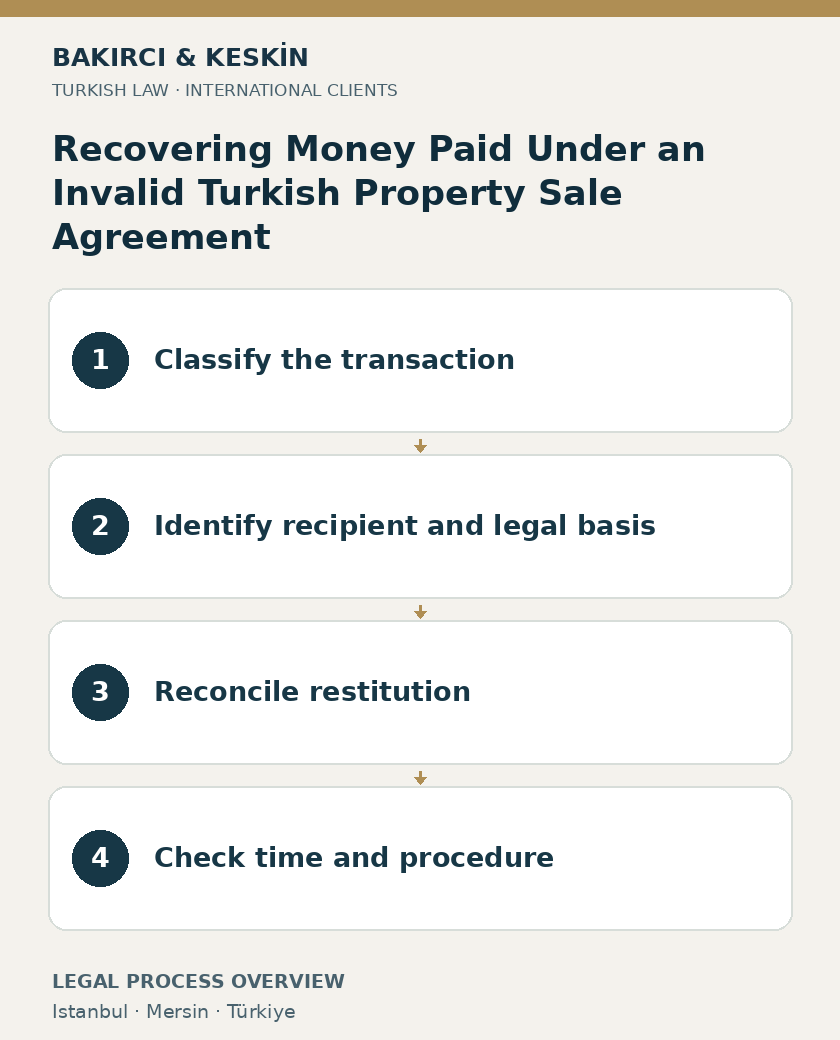
The decisive assessment connects four matters: the transaction’s legal classification, the failure of the payment’s legal basis, the defendant’s receipt of the benefit and the remedy still available within time. Keeping those questions separate makes the case understandable without assuming that either an informal contract or an overseas payment decides the outcome alone.
Keep alternative legal positions and payment records coherent
A buyer may initially ask whether title can still be obtained and later decide that recovery is the preferred result. Keep the date and content of that decision in the instruction record. The lawyer must assess the legal effect of earlier notices and any binding election already made. A later change of preference cannot safely be implemented by deleting the earlier correspondence from the file.
Where the seller disputes receipt, compare the bank record with the recipient’s acknowledgment and the contract payment schedule. Where receipt is admitted but a deduction is claimed, ask for the separate basis of the deduction. These are different disputes and require different evidence. A single demand repeating the total without addressing the defendant’s actual position can leave the central issue unexplained.
Maintain a running balance after every payment. Show the original principal, actual repayments, agreed credits and any disputed item in separate columns. Record the evidence supporting each change. If instalments arrive in different currencies, preserve the transfer details and the basis of any agreed conversion. The final litigation or settlement account should be reproducible from the source documents, without relying on a privately estimated exchange rate or an unexplained number in a message.
Frequently asked questions
Does an invalid contract mean I lose every payment?
No. Restitution or another remedy must be assessed under the applicable rules, including Articles 77–82 and any consumer protection.
Can a developer rely on its own failure to use the required form?
Article 41 contains a specific protection for prepaid consumer housing sales. The transaction must first fall within that statutory category.
Is the broker always the defendant?
No. Identify who contracted, who received the money and the legal basis of each person’s responsibility.
Does a cash withdrawal prove the seller was paid?
Not by itself. Evidence must connect the withdrawn money with actual delivery to the relevant recipient.
Can the recipient avoid repayment by saying the money was spent?
Article 79 sets the applicable conditions and distinguishes the recipient’s good faith and anticipated repayment responsibility.
Is every refund claim subject to two years?
No. Article 82 governs unjust-enrichment claims. The correct cause of action and starting point require separate assessment.
Do negotiations stop limitation automatically?
No. Their legal effect must be assessed from the documents and applicable rules.
Should a replacement apartment be recorded as money received?
No. Keep a proposed or conditional replacement separate from actual repayment and completed transfers.
Can I claim money paid by a relative?
The claimant’s entitlement depends on the contract, payment arrangement and ownership of the repayment right. Explain the third-party payment.
What documents are most useful initially?
The complete agreement, payment evidence, current title information, relevant messages and a chronology identifying when performance failed.
Official legal sources
Turkish Code of Obligations No. 6098, Articles 77–82 and 237; Consumer Protection Law No. 6502, Articles 3, 40 and 41. Source review: 26 October 2026. This article explains the statutory framework in English and does not determine the legal classification or outcome of an individual transaction.
Contact information
Do not include confidential documents or identity numbers in an initial message. An enquiry does not establish representation or suspend any legal deadline.
Istanbul and Mersin contact details
Bakırcı & Keskin Law Office is Mersin-based. Turkish matters are handled under the applicable jurisdiction and agreed mandate. The competent court and the scope of representation are assessed for each matter.
Istanbul — Polaris Plaza
Maslak Ahi Evran Caddesi, Polaris Plaza No:21, Floor 9, 34475 Sarıyer/İstanbul, Türkiye.Mersin — Profit İş Merkezi
İhsaniye Mahallesi, 4903. Sokak, Profit İş Merkezi No:23, Floor 3, Office 14, 33070 Akdeniz/Mersin, Türkiye.+90 552 224 43 66 · Contact details in English. An enquiry does not establish representation or suspend a legal deadline.
Istanbul Office – Polaris Plaza, Maslak / Sarıyer
Bakırcı & Keskin Hukuk Bürosu
Maslak Ahi Evran Caddesi, Polaris Plaza No:21, Kat:9, 34475 Sarıyer/İstanbul
Our physical offices in Istanbul and Mersin coordinate matters throughout Turkey, subject to jurisdiction and the local steps required for each case. Please specify your preferred office when arranging an in-person appointment.
Open the Istanbul office on Google Maps · Contact and appointments
Contact regarding a legal matter
In your first message, you may briefly state the subject, your country or city, and any relevant notification or recent procedural date. Please do not send identity numbers, medical data, or personal documents. Messaging alone does not constitute legal advice or create a lawyer–client relationship.
Discover more from Bakırcı & Keskin Hukuk Bürosu
Subscribe to get the latest posts sent to your email.