Wrong Name in a Turkish Title Record: Correction Under Civil Code Article 1027
Short answer: Civil Code Article 1027 distinguishes correction with the interested persons’ written consent, judicial correction and simple writing errors corrected by the land registry. Cadastral name errors have a specific administrative route under Article 75 of the Land Registry Regulation, including a mandatory directorate application. Establish that the request identifies the same right holder; a dispute over who owns the property requires a different substantive remedy.
Have a general question about this article? Ask anonymously
Quick summary
| Legal issue | Wrong Name in a Turkish Title Record: Correction Under Civil Code Article 1027 |
|---|---|
| Short answer | Civil Code Article 1027 distinguishes correction with the interested persons’ written consent, judicial correction and simple writing errors corrected by the land registry. Cadastral name errors have a specific administrative route under Article 75 of the Land Registry Regulation, including a mandatory directorate application. Establish that the request identifies the same right holder; a dispute over who owns the property requires a different substantive remedy. |
| Key legislation | Law No. 4721 — Articles 1020, 1025, 1027; Law No. 6100 — Articles 223, 224, 382, 383; Land Registry Regulation — Articles 74, 75, 76 |
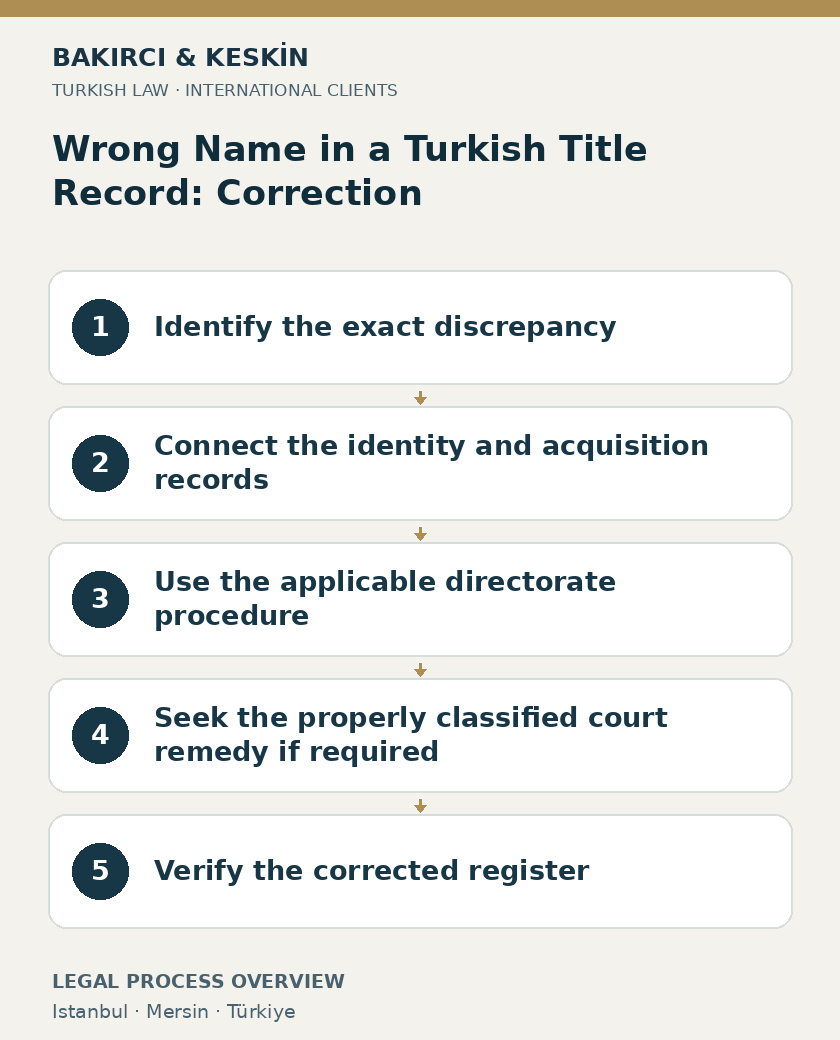
Establish whether the name is wrong or the owner is disputed
A discrepancy in a Turkish land record can concern the spelling of the registered owner’s name, a changed surname, a parent’s name, an outdated identity reference or the identity of the owner itself. These questions require different remedies. The purpose of an identity correction is to identify the same right holder accurately. It must not be used to transfer ownership from one person to another without the legal basis and procedure required for that change.
Begin by writing the disputed entry exactly as it appears. Place the proposed correct entry beside it and identify the document supporting each part. A statement that the title contains “the wrong name” is insufficient when the registry must decide whether the application concerns a transcription error, an update after a lawful name change or a competing claim to the property. Preserve the original spelling, including differences in the order of names and transliteration.
The guide to lost title documents explains how to obtain current records. A fresh copy of an existing erroneous entry does not itself correct the error. Conversely, a name shown differently on a personal online screen does not establish that the underlying land register is wrong. Compare the actual official records before selecting the correction route.
Read the underlying acquisition record as well as the current entry
Civil Code Article 1020 allows a person who makes their interest credible to inspect the relevant registry page and documents and obtain copies. The application should establish that interest through ownership, succession, representation or another lawful basis. The openness of the register does not remove the need to explain why the applicant is entitled to the particular information requested.
For an identity discrepancy, the current title extract is only part of the evidence. Obtain the document on which the relevant registration was based, together with the transaction date and journal reference. The source can show whether the registry transcribed an accurate identity incorrectly or accurately reproduced an error already present in the transaction documents. That distinction matters under the correction provisions of the Land Registry Regulation.
Use the property’s province, district, neighbourhood, block, parcel and independent-unit identifiers consistently. A familiar street address can refer to a building with several owners. If cadastral references have changed, obtain the documentary connection between the former and current references. Correcting a person’s name in the wrong unit would create a new problem rather than resolve the original one.
Build a documented identity chain for an overseas owner
A current passport identifies its holder now. It does not necessarily explain every historical name appearing in an older Turkish acquisition. Assemble the acquisition-era identity document where available, the current identity document and official records connecting any intervening change. A marriage record, name-change decision or other civil-status document must be used for the fact it actually proves. Citizenship, surname and passport-number changes should not be treated as the same event.
Prepare a dated explanation of the differences. Identify which name was legally used at acquisition, when a later change occurred and which authority recorded it. Where two scripts or naming systems are involved, retain the original text and the translation. A translator should not silently replace the historical spelling with the preferred modern spelling. The application needs an intelligible connection between the entries, not an artificially uniform set of papers.
An heir correcting the deceased owner’s identity must also establish the succession link. The fact that the applicant has the same surname or possesses the old deed does not establish sole entitlement. Include the relevant death and heirship records and explain successive deaths where they affect the applicant’s position. The correction request should leave the inheritance shares and the identity of the entitled persons accurate.
Article 1027 separates consent, judicial correction and simple writing errors
Article 1027 states that, without the written consent of interested persons, the land-registry officer can correct an error only by court decision. It also recognises correction through deletion of the old registration and a new registration. Its final paragraph separately authorises the officer to correct simple writing errors on their own initiative under the applicable regulation. The categories should be read together instead of describing every discrepancy as a compulsory lawsuit.
The need for consent depends on whose legal interests the correction affects. An applicant’s statement that a change is harmless cannot bind another right holder whose position would actually be altered. Identify mortgages, ownership interests and other relevant rights before presenting the requested correction. The task is to determine the effect of the particular amendment, rather than assume that every name-related request affects only the applicant.
A court decision is also not a universal substitute for proving the underlying identity. The request must show what is inaccurate and why the proposed correction identifies the proper person. Where the disagreement is actually about ownership, the substantive claim must address that disagreement. Re-labelling an ownership dispute as a spelling correction does not remove the other person’s right to contest the asserted title.
Article 74 directs attention to the source and effect of the error
Article 74 of the Land Registry Regulation distinguishes simple writing errors contrary to the documents from errors originating in documents supplied by interested persons or another authority. It also addresses substantive errors and the written consents required where a correction affects rights acquired after the erroneous entry. The source document and the proposed legal effect therefore need separate examination.
An incorrect supporting document should not be repaired by merely editing its translation or supplying an informal replacement. Establish which authority issued it and how its contents can be properly evidenced or corrected. Where the registry entry accurately reflects that document, the application must explain the source discrepancy. Keep both versions and the official explanation so the history remains verifiable.
The regulation also requires notification of steps taken without the interested persons’ knowledge. Keep the resulting notification and decision in the file. It records what the directorate actually did and can matter if another issue remains disputed. A telephone conversation confirming that the matter is being examined is different from a completed correction shown in the official record.
Article 75 provides a specific route for cadastral identity mistakes
Article 75 concerns name, surname and father’s-name writing errors originating in cadastral work. It distinguishes determinations based on existing documents from determinations made without a deed. The directorate examines the specified records and can use witnesses, the original determination experts and an on-site examination where required. The purpose is to establish that the request comes from the actual right holder.
This mechanism explains why a modern passport alone does not answer every old cadastral discrepancy. The cadastral file can contain information identifying the person in a historical local context. Supply relevant official records and identify available supporting evidence without treating a neighbour’s recollection as conclusive ownership proof. A site inspection and technical report, where used, must connect the factual inquiry to the particular registered property.
Article 75(4) makes an application to the directorate mandatory for corrections under that article. Do not omit this statutory step on the assumption that any record problem should begin directly in court. At the same time, do not describe Article 75 as governing every possible title dispute. Determine whether the actual error falls within its cadastral-information scope, then retain the application and the directorate’s response.
Make a precise application that can receive a precise answer
The request should identify the property, applicant’s legal interest, existing entry, proposed wording, supporting documents and the correction mechanism relied on. Explain whether the problem originates in cadastral work, the later registration or a subsequent lawful change of identity. Attach a short index showing which document establishes each element. This allows the directorate to investigate the actual discrepancy without reconstructing the request from unrelated papers.
Ask for the outcome in a form that can be retained and reviewed. If additional documents are requested, preserve the request and answer it by reference to the missing point. If the application is refused or a disputed issue remains, obtain the reasons and the relevant record. An explanation that “the office would not do it” does not identify the decision, its basis or the appropriate next procedure.
Where a sale, mortgage or inheritance transaction is waiting, tell the professionals involved which identity issue remains unresolved. Do not sign inconsistent declarations merely to keep an appointment. The correction and the later transaction have different completion events. The transaction documents should use the identity established by the verified records, with the historical connection preserved where needed.
Court jurisdiction follows the substance of the requested correction
Code of Civil Procedure Article 382 identifies corrections concerning immovable property that do not create an opposing party or infringe rights as non-contentious matters. Article 383 assigns non-contentious matters to the Civil Court of Peace unless another rule provides otherwise. This is a specific classification, not a rule that every claim affecting a land entry belongs in that court.
Where the application seeks to displace another person’s real right, the litigation has a different substance. Civil Code Article 1025 addresses correction of an improper registration that harms a real right. The appropriate claim, parties and court must follow that substance. The ownership-recovery route must not be replaced with a non-contentious identity request simply because both procedures ultimately affect the register.
Before filing, identify the prior registry application, the exact refusal or unresolved issue and the order needed. The requested ruling should be capable of implementation against the correctly identified entry. Where the issue concerns a deceased owner, the identity finding and the subsequent succession registration remain distinct. A judgment clarifying the name does not itself determine every heirship or partition dispute.
Prepare foreign documents for their intended evidential use
Articles 223 and 224 of the Code of Civil Procedure address translations of foreign-language evidence and authentication of foreign official documents, with treaty provisions preserved. These rules matter when documents are used in Turkish litigation. The registry’s acceptance requirements for an administrative transaction must also be checked for that intended use. A document prepared for a different institution should not be assumed sufficient merely because it carries a stamp.
Authentication and substantive accuracy perform different functions. An apostille or other applicable authentication does not decide whether two differently named persons are the same owner. That conclusion depends on the contents and connection of the evidence. Preserve the complete document, its authentication and its translation together; a cropped signature page or an isolated translated name removes context needed to evaluate the record.
Where the foreign document itself contains an error, establish the proper correction through its issuing system. Do not ask a translator to improve the legal facts. Explain genuine differences through evidence and submit a consistent index. This is particularly useful where a foreign birth record, a later citizenship record and the Turkish acquisition document use different name orders or identifiers.
Limit representation to the required correction and follow-up acts
An owner abroad should distinguish authority to inspect records, request correction, conduct litigation and complete a later disposition. Those tasks can require different powers and supporting documents. The foreign property power-of-attorney guide explains the importance of matching the instrument to its intended use. A correction request does not require an assumption that the representative may sell or mortgage the property.
Review the proposed authority before it is executed overseas. It should identify the actual procedural work and meet the requirements of the institution that will receive it. Keep the signed instrument and any authentication or translation with the application. If a prior representative has relevant records, obtain a documented handover rather than relying on oral assurances about what was submitted.
Instructions should specify the wording sought, the evidence supplied and how the owner will be informed of requests or decisions. This preserves control over the substantive position. A representative should report whether the directorate has accepted the request, asked for more evidence or issued a refusal. Each is a different procedural state with different next steps.
Verify the corrected record and preserve the history
Obtain the resulting official record and compare it with the requested wording. Check the property identifiers, owner’s name and any relevant identifying information. Confirm that the correction concerns the intended entry and that unrelated rights have not been assumed to disappear. A new title copy should be read against the decision and acquisition history, not treated as self-explanatory evidence that every associated problem is resolved.
Keep the original error, application, evidence, decision and corrected record in one chronological file. Article 76 of the Land Registry Regulation requires the correction documents to remain in the property file and provides for the relevant correction references. Preserving the owner’s own copy helps explain the history to a future buyer, lender or heir without reconstructing it from memory.
Finally, determine which subsequent tasks remain. A name correction does not itself release a mortgage, change an inheritance share, cancel an unauthorised transfer or amend a separate foreign civil-status record. Use the corrected identity consistently in those later procedures. The completed result is an accurate, evidenced connection between the right holder and the property, with each further legal transaction carried out on its own proper basis.
Frequently asked questions
Does a misspelled name automatically mean I lost ownership?
No. First establish whether the same owner is inaccurately described or whether the entry reflects a competing ownership claim.
Can the registry correct every error without a court?
No. Article 1027 distinguishes written consent, court-ordered correction and simple writing errors corrected under the regulation.
Why does the acquisition document matter?
It shows whether the mistake arose in transcription or was already present in the document supporting registration.
What does Article 75 cover?
It provides a specific procedure for stated identity-writing errors originating in cadastral work, with examination of the relevant evidence.
Must I apply to the directorate under Article 75?
Yes. Article 75(4) makes that application mandatory for corrections within its scope.
Does every correction case belong to the Civil Court of Peace?
No. The non-contentious classification concerns corrections that do not create an opposing party or infringe rights. An ownership dispute requires its own claim and jurisdiction analysis.
Does an apostille prove that two names identify the same person?
No. Authentication and proof of identity continuity are different questions.
Can an heir request correction of the deceased owner’s details?
The applicant must establish the relevant legal interest and succession connection, together with the evidence supporting the correction.
Should a correction power of attorney automatically include sale authority?
No. The authority should match the intended tasks; later dispositions require separate assessment.
What confirms completion?
The decision and resulting official record should be compared with the requested change, with the supporting history preserved.
Official legal sources
- Law No. 4721 — Articles 1020, 1025, 1027
- Law No. 6100 — Articles 223, 224, 382, 383
- Land Registry Regulation — Articles 74, 75, 76
Legal review: 28 October 2026. The official Turkish legislation controls. The correct procedure depends on the documents, the rights affected and the current registry position.
Contact information
Do not include confidential documents or identity numbers in an initial message. An enquiry does not establish representation or suspend any legal deadline.
Istanbul and Mersin contact details
Bakırcı & Keskin Law Office is Mersin-based. Turkish matters are handled under the applicable jurisdiction and agreed mandate. The competent court and the scope of representation are assessed for each matter.
Istanbul — Polaris Plaza
Maslak Ahi Evran Caddesi, Polaris Plaza No:21, Floor 9, 34475 Sarıyer/İstanbul, Türkiye.Mersin — Profit İş Merkezi
İhsaniye Mahallesi, 4903. Sokak, Profit İş Merkezi No:23, Floor 3, Office 14, 33070 Akdeniz/Mersin, Türkiye.+90 552 224 43 66 · Contact details in English. An enquiry does not establish representation or suspend a legal deadline.
Istanbul Office – Polaris Plaza, Maslak / Sarıyer
Bakırcı & Keskin Hukuk Bürosu
Maslak Ahi Evran Caddesi, Polaris Plaza No:21, Kat:9, 34475 Sarıyer/İstanbul
Our physical offices in Istanbul and Mersin coordinate matters throughout Turkey, subject to jurisdiction and the local steps required for each case. Please specify your preferred office when arranging an in-person appointment.
Open the Istanbul office on Google Maps · Contact and appointments
Contact regarding a legal matter
In your first message, you may briefly state the subject, your country or city, and any relevant notification or recent procedural date. Please do not send identity numbers, medical data, or personal documents. Messaging alone does not constitute legal advice or create a lawyer–client relationship.
Discover more from Bakırcı & Keskin Hukuk Bürosu
Subscribe to get the latest posts sent to your email.