A Seller Reserved the Right to Buy Back Your Turkish Property: Repurchase and Annotation
Short answer: An immovable repurchase agreement requires official form under Code of Obligations Article 237. Article 238 limits the agreed right to ten years. Civil Code Article 736 separately makes an annotated repurchase right exercisable against successive owners within its effective period, with an outer ten-year limit from annotation. Review the instrument, both date records, the person entitled to exercise the right and the steps needed to complete the transfer.
Have a general question about this article? Ask anonymously
Quick summary
| Legal issue | A Seller Reserved the Right to Buy Back Your Turkish Property: Repurchase and Annotation |
|---|---|
| Short answer | An immovable repurchase agreement requires official form under Code of Obligations Article 237. Article 238 limits the agreed right to ten years. Civil Code Article 736 separately makes an annotated repurchase right exercisable against successive owners within its effective period, with an outer ten-year limit from annotation. Review the instrument, both date records, the person entitled to exercise the right and the steps needed to complete the transfer. |
| Key legislation | Law No. 4721 — Articles 736; Law No. 6098 — Articles 237, 238, 239, 504; Law No. 6100 — Articles 12, 389, 390 |
Identify a repurchase right before treating the sale as unconditional
A contractual right to buy back Turkish immovable property is called a geri alım hakkı. The starting question is whether the parties created that particular right in a legally valid instrument. An informal promise that the seller can recover the property later, a loan secured by property and a clause giving someone first refusal on a later sale are not interchangeable arrangements. Obtain the complete agreement and identify the legal act it records.
The parties should establish who holds the right, which immovable it concerns, the agreed duration and the conditions for exercise. Use the official parcel and independent-unit information rather than the description used in negotiations. If the property has since been divided, combined or renumbered, trace the relevant changes through the official records. The right cannot be evaluated reliably against a property description that no longer identifies the asset.
For the current owner, the issue is whether a valid outstanding right can require a later transfer. For the person claiming repurchase, it is whether the right was properly created, remains effective and has been exercised as required. Both inquiries need the same documentary foundation, but they are not answered merely by showing that an earlier sale occurred.
Article 237 requires official form for the repurchase agreement
Code of Obligations Article 237 provides that repurchase and purchase-option agreements concerning immovable property are invalid unless drawn up in official form. The rule differs from the same article’s treatment of contractual pre-emption, for which written form is specified. A document headed “option” in English therefore needs legal classification before its formal sufficiency is assessed.
Obtain the official instrument itself and compare it with any private side agreement, translated summary or correspondence. A signed email acknowledging the arrangement should not be assumed to replace the form required to create the right. Nor does the fact that a signature was authenticated necessarily establish that the transaction was drawn up in the official form required for that legal act. The instrument’s actual legal nature matters.
The preliminary property-sale agreement guide explains the wider importance of Article 237. A sale promise and a seller’s retained repurchase right nevertheless have different purposes. The review should identify the particular right established, not import the consequences of one contract into another merely because both involve a future transfer.
The agreed right cannot simply be made perpetual
Article 238 states that contractual pre-emption, repurchase and purchase-option rights can be agreed for a maximum period of ten years and can be annotated in the register for the periods established by law. The contract’s duration must therefore be read against that ceiling. A clause describing the right as indefinite should not be accepted as proof that a perpetual repurchase entitlement exists.
Identify the agreed commencement and expiry provisions and the event by reference to which the parties measured the period. Record the dates from the executed instrument, not from a later recollection of the negotiations. Where a document was amended or replaced, establish the legal form and effect of the later act. Do not assume that an informal extension validly changes a form-sensitive right.
The date a buyer discovered the clause is not automatically a new commencement date. Equally, the date an old title copy was printed does not establish when the right was created. A defensible chronology separates creation of the right, ownership transfer, annotation and any exercise notice. These are different events, even when several occurred during the same transaction.
Article 736 governs enforceability against successive owners
Civil Code Article 736 provides that purchase-option and repurchase rights annotated in the land register can be exercised against every owner within the period shown in the annotation. It also states that the annotation’s effect ends in any event ten years after its entry. The annotation is therefore central when the property has passed from the original contracting owner to someone else.
Read the actual annotation, its date, term and supporting instrument. The contractual duration under Article 238 and the outer duration of the annotation’s effect under Article 736 must not be collapsed into a single date selected for convenience. Both need examination. An annotation cannot be treated as evidence that an underlying right continues beyond the period in which that right legally exists.
If no annotation appears, the analysis must focus on the rights and obligations actually enforceable against the relevant person. A contractual claim against the original counterparty should not be represented as an annotated right binding every later owner. Establish whether an annotation was ever entered, whether it was later removed and the legal effect of the events in the particular chain of title.
Read the price and exercise terms as operative provisions
The agreement must be reviewed for the price or agreed price mechanism, the property to be transferred and the conditions attached to repurchase. A later appraisal is not automatically the price required by the contract. Nor can one party unilaterally replace an agreed calculation with the figure they now prefer. Identify what the valid instrument actually requires and whether a disputed clause needs judicial determination.
Distinguish the act by which the holder exercises the right from the acts required to complete the resulting transfer. The contract can contain relevant notice and performance provisions, but they must be examined for validity and their relationship to the statutory framework. Record the notice’s complete contents, sender, recipient and legally relevant delivery evidence. A statement that “everyone knew” the seller wanted the property back is not an adequate chronology.
Any payment or tender should identify its purpose and the obligation it addresses. Money sent without a clear reference can create a dispute about whether it concerns repurchase, another debt or an advance. Preserve the payment instruction and receipt with the exercise documents. The legal review must connect the asserted exercise and performance to the precise right being relied on.
A later sale requires examination of the continuing annotated right
A buyer examining the property should review annotations together with ownership and encumbrances. A repurchase annotation differs from a mortgage: it is not simply a secured debt that can be disregarded after the sale price is paid to the seller. The buyer needs to understand the right, its term and its possible effect on the intended ownership. A reassuring statement that the property has no bank loan does not answer that question.
The land-registry due-diligence guide provides the broader record-review framework. Here, the particular concern is whether Article 736 allows the holder to exercise the annotated right against the proposed or current owner. Review the executed right and annotation together instead of relying on a shorthand entry in a broker’s description.
Where removal or release of the right is part of an agreed transaction, identify the person entitled to give it and the formal steps required to obtain the promised registry position. A seller’s undertaking to arrange removal is different from a completed removal. The closing documents should state which legal event must occur before the buyer accepts the resulting title position.
Transferability requires both permission and the correct form
Article 239 states that contractual pre-emption, purchase-option and repurchase rights are not transferable unless otherwise agreed, although they pass by inheritance. Read the instrument for any agreement modifying that default. A holder cannot assume they may sell the repurchase right to an outside investor simply because the underlying property can be sold.
If the contract permits assignment, Article 239 requires the transfer to comply with the form prescribed for creating the right. For a repurchase right, Article 237’s official-form requirement therefore remains material. A privately signed assignment should not be treated as effective without addressing that rule. The existence of an agreed permission to transfer and compliance with the required transfer form are separate issues.
Identify the assignment chain and the documents supporting the current claimant’s status. Where more than one person asserts the right, obtain each instrument and any relevant registry record before accepting an exercise notice. The property owner is entitled to a legally coherent explanation of who holds the right. The holder, in turn, needs to demonstrate the capacity in which they are acting.
Death of a party does not answer the duration question
Article 239’s default inheritance rule means that a right can pass through succession, subject to a contrary agreement. The deceased holder’s heirs must establish their entitlement and the relevant representation arrangements. Possession of the original contract by one relative does not establish that the relative alone may exercise or release the inherited right. Check the succession documents and the terms of the right together.
Inheritance does not create a fresh ten-year right merely because the holder died. The existing duration and annotation history remain part of the analysis. Record the death date separately from the contract and annotation dates, and identify any action already taken by the deceased. The heirs need to know what right actually entered the estate and whether the relevant period remains open.
If the owner rather than the holder died, establish the present ownership and the persons or representative entitled to act for the estate. Do not send a notice only to an intermediary who lacks authority to receive it for the proper parties. The legal effectiveness of a communication must be examined against the actual ownership and representation position.
Overseas execution requires authority for the actual transaction
A person abroad may need a representative to obtain records, receive or send notices, negotiate a resolution or complete an immovable disposition. Those functions should be identified separately. Code of Obligations Article 504 requires special authority for specified acts, including settlement and transferring or encumbering immovables. A general power to obtain title documents should not be assumed sufficient for every act involved in repurchase.
Give the representative a complete set of the executed instruments and written instructions about the terms approved. A document authorising signature does not by itself state the client’s commercial decision on price, payment routing or release. Where the intended resolution changes the right, the formal requirements for that change must also be examined. Remote convenience cannot cure an instrument that lacks the required legal form.
Foreign-language material should be translated accurately for its intended use. Distinguish a working English explanation from the legally operative official text. Preserve all annexes and identify any difference between versions. An omitted duration or price clause can materially alter the reader’s understanding even if the document’s heading is translated correctly.
Match litigation and provisional protection to the disputed right
If exercise or implementation is resisted, identify the legal result sought: recognition of the holder’s entitlement, the appropriate transfer-related relief, removal of an entry or another remedy supported by the circumstances. The court must receive the valid instrument, annotation history, exercise evidence and the relevant ownership record. A claim that simply alleges a broken promise does not explain the statutory and contractual basis of the requested result.
Code of Civil Procedure Article 12 assigns exclusive territorial jurisdiction to the location of the immovable for the real-right and ownership-changing claims it specifies. Where a claim also includes money or another obligation, analyse its procedural relationship to the property claim. The fact that the parties negotiated overseas does not displace the applicable Turkish property-jurisdiction rule.
Any requested provisional protection must satisfy Articles 389 and 390, including identification of the concrete risk and approximate proof of the merits. An annotation and a judicial protective order perform different functions. Do not assume that requesting either automatically grants the other. Read the order actually made and follow the applicable implementation requirements.
Verify the legal outcome rather than the intention to complete
Completion should be evidenced by the relevant official instruments, payment records and resulting registry entries. Compare the achieved ownership and annotation position with the parties’ agreed or adjudicated outcome. A meeting at the registry, a draft release or an instruction to pay is not proof that the corresponding act was completed. Each material step needs its own record.
Where the dispute ends through settlement, identify what happens to the repurchase right and its annotation as well as to the immediate ownership. A document settling the price disagreement but leaving the annotation untouched can leave an unresolved registry question. Likewise, removal of an annotation should not be described as settlement of every independent money claim unless that consequence is legally established.
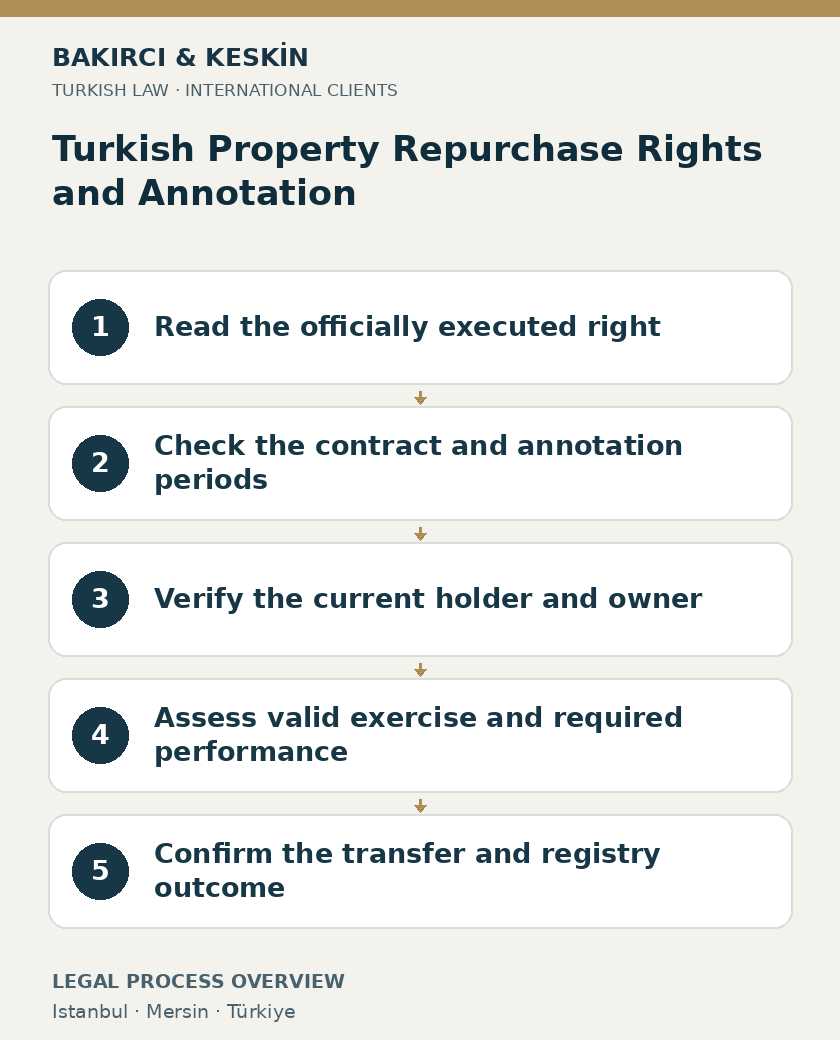
The practical review rests on five connected facts: a validly created right, its remaining duration, the annotation’s effect, the person entitled to exercise it and the acts required for implementation. None should be inferred solely from an English label in a sale file. Reading the instrument and registry history together allows both overseas sellers and buyers to understand the right that actually exists.
Frequently asked questions
What is a Turkish repurchase right?
A contractual geri alım hakkı concerns a right to buy the property back under its valid terms; it differs from a first-refusal clause or mortgage.
Is a private written repurchase agreement enough?
Article 237 requires official form for repurchase agreements concerning immovable property.
Can the right be agreed forever?
Article 238 sets a maximum agreed duration of ten years.
How long can the annotation affect later owners?
Article 736 refers to its stated period and ends its effect in any event ten years after annotation.
Are the contract date and annotation date interchangeable?
No. Identify both and apply the distinct rules to the actual instruments and dates.
Does an annotation bind a later owner?
Within its legally effective scope and period, Article 736 allows the annotated right to be exercised against every owner.
Can the holder assign the right freely?
Not under the default rule. Article 239 requires a contrary agreement permitting transfer, and the transfer must satisfy the creation form.
Does the right pass by inheritance?
Article 239 provides that default, subject to a contrary agreement. Succession does not automatically restart its duration.
Does a general record-access power authorise a repurchase settlement?
It should not be assumed. The actual authority must cover the acts, including any special authority required by Article 504.
What proves completion of repurchase?
Verify the official transfer, payment and registry result, including the treatment of the relevant annotation.
Official legal sources
- Law No. 4721 — Articles 736
- Law No. 6098 — Articles 237, 238, 239, 504
- Law No. 6100 — Articles 12, 389, 390
Legal review: 28 October 2026. The official Turkish legislation controls. Contract duration, annotation duration and exercise requirements must be checked separately.
Contact information
Do not include confidential documents or identity numbers in an initial message. An enquiry does not establish representation or suspend any legal deadline.
Istanbul and Mersin contact details
Bakırcı & Keskin Law Office is Mersin-based. Turkish matters are handled under the applicable jurisdiction and agreed mandate. The competent court and the scope of representation are assessed for each matter.
Istanbul — Polaris Plaza
Maslak Ahi Evran Caddesi, Polaris Plaza No:21, Floor 9, 34475 Sarıyer/İstanbul, Türkiye.Mersin — Profit İş Merkezi
İhsaniye Mahallesi, 4903. Sokak, Profit İş Merkezi No:23, Floor 3, Office 14, 33070 Akdeniz/Mersin, Türkiye.+90 552 224 43 66 · Contact details in English. An enquiry does not establish representation or suspend a legal deadline.
Istanbul Office – Polaris Plaza, Maslak / Sarıyer
Bakırcı & Keskin Hukuk Bürosu
Maslak Ahi Evran Caddesi, Polaris Plaza No:21, Kat:9, 34475 Sarıyer/İstanbul
Our physical offices in Istanbul and Mersin coordinate matters throughout Turkey, subject to jurisdiction and the local steps required for each case. Please specify your preferred office when arranging an in-person appointment.
Open the Istanbul office on Google Maps · Contact and appointments
Contact regarding a legal matter
In your first message, you may briefly state the subject, your country or city, and any relevant notification or recent procedural date. Please do not send identity numbers, medical data, or personal documents. Messaging alone does not constitute legal advice or create a lawyer–client relationship.
Discover more from Bakırcı & Keskin Hukuk Bürosu
Subscribe to get the latest posts sent to your email.