A Foreign Company’s Turkish Tax E-Notification Was Not Opened: Service and Deadlines
Short answer
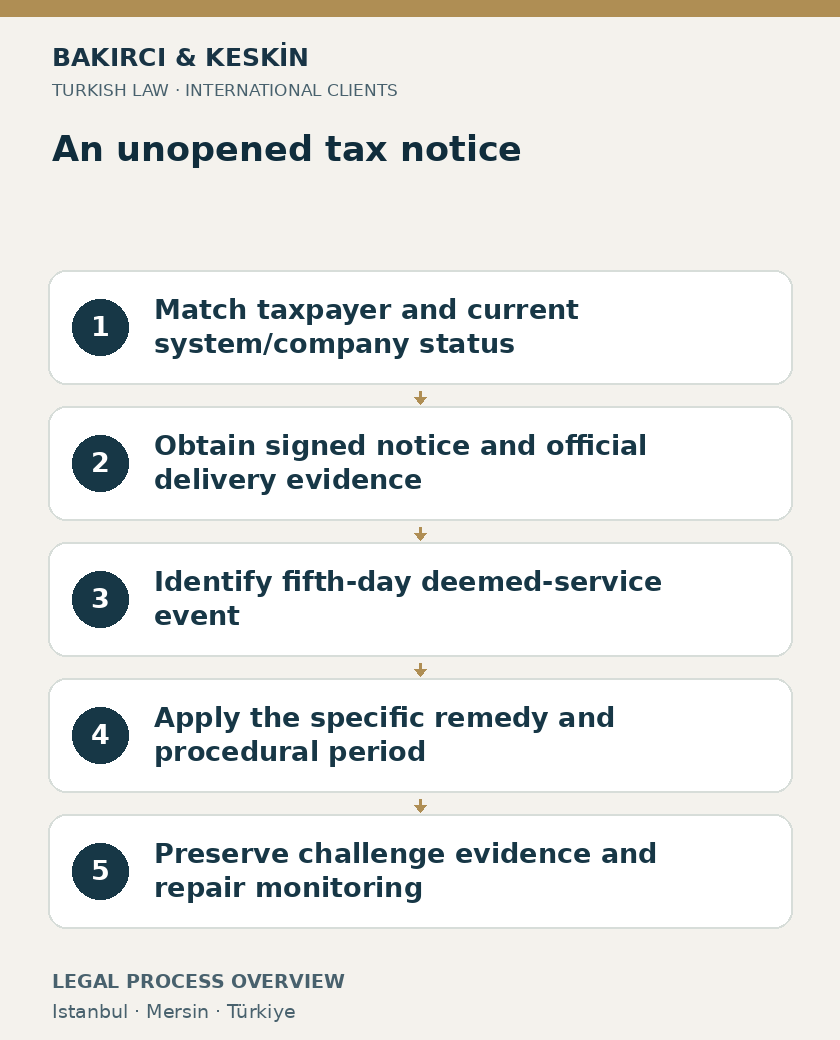
Under current Tax Procedure Law Article 107/A, electronic service is deemed completed at the end of the fifth day following transmission to the recipient through the tax e-notification system. The company’s later opening or internal forwarding date does not ordinarily replace that statutory date. General Communiqué No. 596, effective from 11 October 2026, now governs the system and repeals Communiqué No. 456. A missed SMS or email alert does not affect service time or validity under Article 10(2) of the new communiqué. The actual recipient, delivery record, document type and any special company status must still be checked.
Have a general question about this article? Ask anonymously
Quick summary
| Legal issue | A Foreign Company's Turkish Tax E-Notification Was Not Opened: Service and Deadlines |
|---|---|
| Short answer | Under current Tax Procedure Law Article 107/A, electronic service is deemed completed at the end of the fifth day following transmission to the recipient through the tax e-notification system. The company's later opening or internal forwarding date does not ordinarily replace that statutory date. General Communiqué No. 596, effective from 11 October 2026, now governs the system and repeals Communiqué No. 456. A missed SMS or email alert does not affect service time or validity under Article 10(2) of the new communiqué. The actual recipient, delivery record, document type and any special company status must still be checked. |
| Key legislation | Tax Procedure Law No. 213; Tax Procedure Law General Communiqué No. 596; Administrative Judicial Procedure Law No. 2577 |
Use the current 2026 legal framework
Article 107/A of Tax Procedure Law No. 213 was amended by Law No. 7587, with the relevant change effective from 1 July 2026. The current text identifies mandatory users, voluntary participation, specified exit rules and the deemed-service rule. An assessment of a notice must use the law applicable to the actual event; an older guide can omit material changes even when it correctly remembers the five-day formula.
General Communiqué No. 596 was published and became effective on 11 October 2026. Its Article 15 repeals Communiqué No. 456. The Revenue Administration also provides the official complete PDF of Communiqué No. 596. The new communiqué addresses access, evidence records, alerts, company status and user obligations. Those current provisions should be examined when a foreign business discovers an unopened tax communication.
The relevant system is the Revenue Administration’s tax electronic-notification service within the Digital Tax Office. It should not be confused with an ordinary company inbox, a private registered-email account or another authority’s electronic service platform. Identify where the document was actually delivered and which statutory service regime applies before arguing about whether someone read it.
Identify the taxpayer and the relevant account
Article 107/A includes corporate income-tax taxpayers among mandatory users, alongside other specified categories. A foreign company’s position must therefore be assessed from its actual Turkish taxpayer status and the statutory categories. Foreign incorporation alone does not establish an exemption, while the mere existence of a potential Turkish tax number does not establish every substantive tax obligation.
Match the notice’s legal name, tax number, period and issuing office with the company’s records. A foreign parent, Turkish subsidiary, branch-related taxpayer record and individual shareholder must not be treated as interchangeable recipients. Our guide to foreign-company Turkish tax presence explains the separate nexus question. A service dispute concerns the particular addressee and notification; it does not itself decide the underlying permanent-establishment or assessment merits.
Check whether the relevant account was validly included in the system and whether a status change affected its operation. Preserve registration, activation and later change records. The tax identification guide explains the distinction between an identifier and tax residence or liability. In a notification file, accurate identification allows the delivery evidence to be connected to the right legal person.
Establish the statutory service date
Current Article 107/A provides that electronic service is deemed made at the end of the fifth day following the date on which the notification is transmitted to the recipient through the system. Communiqué No. 596 Article 9(3) describes electronically signed documents as served at the end of the fifth day following arrival in the electronic notification system. The delivery event and its timestamp are therefore central evidence.
The rule does not make service depend on a manager opening the document. Reading it later, forwarding it to foreign headquarters or obtaining a translation does not ordinarily replace the statutory date. Likewise, the provision does not say that opening it earlier advances deemed service to that earlier moment. Preserve both the system-delivery information and any reading record, but apply their distinct legal functions.
The wording is five days, not five business days. Calculate the deemed-service event and the subsequent procedural period separately. A court filing period has its own commencement and holiday rules; simply adding a preferred number of working days to the day someone noticed the message does not apply either rule correctly. Where the official record or status creates a genuine service issue, analyse that issue from the underlying evidence.
Separate courtesy alerts from legal delivery
Article 10(1) of Communiqué No. 596 allows a recipient to request an SMS or email alert at the mobile number or email address supplied when applying or later through the Digital Tax Office. That alert tells the recipient that an electronic notification has been delivered. It is separate from the electronically signed document delivered through the statutory system.
Article 10(2) expressly states that inability to provide those alerts for any reason does not affect the service period or validity. A missing SMS, a filtered email or a departed employee’s alert address therefore does not, by itself, establish that a properly delivered system notification was ineffective. Examine the actual statutory delivery before relying on the alert history.
Keep alert failures in the operational chronology because they can explain how the company discovered the issue and identify a process failure. They should not be presented as a statutory extension that the communiqué expressly excludes. Correct contact information and arrange a reliable monitoring process while the legal team separately assesses the existing notice and any remaining procedural options.
Obtain the notification and evidence records
Download or obtain the complete electronically signed notice and all attachments available through the authorised channel. Record the issuing unit, document reference, tax type, period, amount and stated procedural information. A screenshot displaying an unread-message count is not the notice itself and does not reveal the assessment’s grounds or every attachment delivered with it.
Communiqué No. 596 Article 9(4) requires the Revenue Administration to preserve timestamp-signed event records concerning the system’s operation for thirty years. Article 9(6) provides that electronic-notification evidence records are supplied to the person concerned and competent authorities on request. A disputed delivery chronology should therefore prompt a request for the relevant official evidence, not reliance only on a recollection of when the accountant first mentioned the notice.
Preserve the original electronic files and the records explaining delivery, while using translations as working copies. Identify exactly which technical event each record proves. System arrival, reading, downloading and an email alert are different events. Where a record appears incomplete or inconsistent, state the specific discrepancy and request clarification. Avoid alleging a system failure solely because the company lacks an internal copy.
Classify the notice before calculating a deadline
Not every tax communication has the same remedy or period. An assessment and penalty notice, a request to produce records and a public-debt payment order perform different legal functions. Read the instrument and its legal basis before assigning a deadline. The service date is a necessary starting point, but it does not identify the correct procedural route on its own.
Article 7 of Administrative Judicial Procedure Law No. 2577 provides a thirty-day filing period in tax courts where a special law does not prescribe another period. For tax disputes involving notification, the period runs from the day following the relevant service event. The article also identifies other triggers for particular forms of taxation; it should not be rewritten as a universal rule for every tax-related document.
Article 8 governs the Law’s time calculations, including the rule that holidays count and that a period ending on a holiday extends to the end of the following working day. Its separate judicial-recess provision also requires attention where applicable. Calculate against the actual calendar and instrument. A foreign public holiday, internal travel schedule or ongoing translation is not automatically a Turkish procedural extension.
Address representative and account-access failures
Article 12 of Communiqué No. 596 requires timely, complete and accurate application information and notification of changes to the tax office. It also requires protection of allocated user credentials, prohibits sharing them or leaving them for another person’s use, and requires immediate notification when the recipient learns that third parties have obtained them. Access arrangements must respect those requirements rather than depend on informal circulation of a password.
The communiqué provides specific representation routes for system-related applications. Article 7(5) addresses legal representatives and representatives holding a notarised power of attorney containing special authority for electronic-notification transactions. Article 8 also addresses obtaining credentials through the prescribed processes. A general commercial engagement with an accountant should not be treated as proof of every authority required by those provisions.
A change of adviser should therefore involve a documented review of authorised access, pending notices and contact information. Article 12(2) states that the recipient bears the legal consequences of failing to fulfil the specified duties and that notifications to the tax office take effect when entered in the administration’s records. An internal handover email should not be assumed to change the administration’s record or restart an existing period.
Check liquidation, bankruptcy and system exit
Current Article 107/A and Communiqué No. 596 Article 11 distinguish different exit situations. For legal persons registered in the trade registry, the registry-erasure date is relevant; other legal persons are assessed by their applicable registry. A commercial decision to stop new sales or the departure of a director is not the same event as legal erasure or a prescribed exit from the notification system.
Article 11(3) contains an important company-status rule: electronic notifications through this system are not made to companies entering liquidation or bankruptcy. The provision nevertheless allows voluntary application by appointed liquidators or the bankruptcy administration using the specified forms, followed by credentials provided under Article 8. The actual status, date and any such application must therefore be established before treating an unread notice as routinely valid or routinely invalid.
Keep the company-status documents, tax-office record and any liquidator or bankruptcy-administration application together. A label in correspondence is not proof that the legal condition had occurred by the relevant delivery date. The special rule also shows why account access and service validity require legal review: the fact that a document appears on a screen does not resolve every question concerning the recipient’s status and the authorised service route.
Assess available procedural action
The first task is to determine whether an applicable period remains open on the supported service chronology. A company disputing service should preserve that position with the precise legal ground and evidence, while obtaining advice on the available filing route. The assertion “we did not open it” should not replace analysis of the statutory deemed-service rule, recipient identity or the communiqué’s special provisions.
An administrative request does not have one universal effect on every litigation period. Article 11 of Law No. 2577 sets conditions for a qualifying administrative application made within the litigation period, with suspension and resumption rules that account for time already elapsed. Whether that provision or a special tax procedure applies must be examined for the actual request and measure. Repeated informal correspondence should not be assumed to revive an expired period.
Collection also requires a separate procedural assessment. Article 27(4) provides that tax-court proceedings generally suspend collection of the challenged portion of assessed taxes and related additions and penalties, while expressly identifying exceptions, including collection proceedings and measures based on returns filed with reservation. It is therefore inaccurate to promise that any tax-related lawsuit automatically stops every collection step. Identify the act challenged and any need for a separate stay request.
Review the new transition and registration rules
The amendment does not require every existing user to start again. Tax Procedure Law provisional Article 38 and Communiqué No. 596 provisional Article 1 provide that persons included in the system before 1 July 2026 continue using it without a new application; the communiqué preserves use of their existing credentials. Lack of a new post-amendment application is therefore not, by itself, proof that a former account ceased to operate.
Article 7(1)(a) of the new communiqué requires the listed already-existing mandatory business users who were not included before publication to join by the end of the month following publication. For the 11 October 2026 publication, that is 30 November 2026. Article 7(1)(b) gives the specified newly registered business taxpayers fifteen days following commencement of business. These are enrolment rules, separate from the five-day deemed service of an actual notification.
The detailed categories and exceptions must still be checked. A foreign business should establish whether it is already enrolled, whether a mandatory category applies and whether any exception or special status is relevant. A future enrolment deadline should not be confused with permission to ignore notices already validly delivered through an existing account.
Build a reliable file from abroad
The working file should contain the full notice, original attachments, delivery evidence, taxpayer identity, system status, corporate authority and a dated account of discovery. Add the applicable procedural calculation and identify any unresolved factual issue. This allows the Turkish legal and tax advisers to evaluate the service question and the merits together without confusing them.
Keep the response to the existing notice separate from improvements to future monitoring. Updating an alert address and appointing an authorised contact can prevent further operational failures, but neither proves that an old period has restarted. The legal outcome depends on the applicable rules and documented events, including the new 2026 provisions where they govern the notice.
Frequently asked questions
1. Is an unopened Turkish tax e-notification automatically ineffective?
No. Current Article 107/A uses a deemed-service rule tied to transmission through the system. Opening the document later does not ordinarily replace the statutory service date. Recipient identity and any specific legal defect still require examination.
2. When is electronic service deemed completed?
At the end of the fifth day following transmission to the recipient through the statutory system. Communiqué No. 596 Article 9(3) refers to arrival in the electronic notification system. Preserve the official delivery evidence.
3. Does a missing SMS or email alert extend the period?
No. Article 10(2) of Communiqué No. 596 expressly states that failure to provide those alerts does not affect service time or validity. The underlying system delivery must be checked separately.
4. Is Communiqué No. 456 still the current rule?
No. Communiqué No. 596 became effective on 11 October 2026 and repealed No. 456. Older events require the rules applicable at their dates, while current assessments must account for the new framework.
5. Can the company request official delivery records?
Yes. Article 9(6) provides for electronic-notification evidence records to be supplied to the person concerned and competent authorities on request. Article 9(4) requires preservation of timestamp-signed event records for thirty years.
6. Is every tax challenge subject to thirty days?
No. Article 7 of Law No. 2577 provides thirty days in tax courts where a special law does not prescribe another period. Identify the exact instrument and remedy before calculating its deadline.
7. Do existing users need a new application after the 2026 amendment?
The provisional provisions preserve participation without a new application for those included before 1 July 2026. Communiqué No. 596 permits continued use of their existing credentials.
8. Can the company simply give its password to a new adviser?
Article 12 requires credential protection and prohibits sharing or leaving credentials for another person’s use. Use the prescribed representation and access processes, including the specific authority required for relevant system transactions.
9. Does liquidation affect electronic tax service?
Yes. Article 11(3) states the special rule for companies entering liquidation or bankruptcy and provides for voluntary application by the liquidator or bankruptcy administration. Verify the status date and any such application.
10. Does a lawsuit always stop collection?
No. Article 27(4) distinguishes ordinary assessment disputes from specified exceptions, including collection proceedings. The act challenged and the need for a separate stay must be assessed from the actual case.
Official legal sources
- Tax Procedure Law No. 213 — Articles 107/A, provisional Article 38
- Tax Procedure Law General Communiqué No. 596 — Articles 4, 5, 6, 7, 8, 9(3)–(6), 10, 11(1),(3), 12, 14, 15, 16, provisional Article 1
- Administrative Judicial Procedure Law No. 2577 — Articles 7, 8, 11, 27(4)
Legal sources reviewed on 28 October 2026, including General Communiqué No. 596. The official Turkish legislation controls; individual facts and later amendments must be checked before action.
Contact information
Do not include confidential documents or identity numbers in an initial message. An enquiry does not establish representation or suspend any legal deadline.
Istanbul and Mersin contact details
Bakırcı & Keskin Law Office is Mersin-based. Turkish matters are handled under the applicable jurisdiction and agreed mandate. The competent court and the scope of representation are assessed for each matter.
Istanbul — Polaris Plaza
Maslak Ahi Evran Caddesi, Polaris Plaza No:21, Floor 9, 34475 Sarıyer/İstanbul, Türkiye.Mersin — Profit İş Merkezi
İhsaniye Mahallesi, 4903. Sokak, Profit İş Merkezi No:23, Floor 3, Office 14, 33070 Akdeniz/Mersin, Türkiye.+90 552 224 43 66 · Contact details in English. An enquiry does not establish representation or suspend a legal deadline.
Istanbul Office – Polaris Plaza, Maslak / Sarıyer
Bakırcı & Keskin Hukuk Bürosu
Maslak Ahi Evran Caddesi, Polaris Plaza No:21, Kat:9, 34475 Sarıyer/İstanbul
Our physical offices in Istanbul and Mersin coordinate matters throughout Turkey, subject to jurisdiction and the local steps required for each case. Please specify your preferred office when arranging an in-person appointment.
Open the Istanbul office on Google Maps · Contact and appointments
Contact regarding a legal matter
In your first message, you may briefly state the subject, your country or city, and any relevant notification or recent procedural date. Please do not send identity numbers, medical data, or personal documents. Messaging alone does not constitute legal advice or create a lawyer–client relationship.
Discover more from Bakırcı & Keskin Hukuk Bürosu
Subscribe to get the latest posts sent to your email.