A Foreign Supplier’s Service Invoice in Turkey: Reverse-Charge VAT and the Correct Payer
Short answer: A foreign service invoice can require Turkish VAT even when its issuer has no establishment in Turkey. Under Articles 6(b) and 9 of VAT Law No. 3065, the place of performance, place of benefit, supplier’s presence and recipient’s status determine the treatment. The current VAT General Application Communiqué generally requires the domestic recipient to declare and pay the full VAT on qualifying services from a supplier without the specified Turkish connections. A separate supplier-paid regime applies to electronic services supplied to natural persons who are not VAT taxpayers.
Have a general question about this article? Ask anonymously
Quick summary
| Legal issue | A Foreign Supplier's Service Invoice in Turkey: Reverse-Charge VAT and the Correct Payer |
|---|---|
| Short answer | A foreign service invoice can require Turkish VAT even when its issuer has no establishment in Turkey. Under Articles 6(b) and 9 of VAT Law No. 3065, the place of performance, place of benefit, supplier's presence and recipient's status determine the treatment. The current VAT General Application Communiqué generally requires the domestic recipient to declare and pay the full VAT on qualifying services from a supplier without the specified Turkish connections. A separate supplier-paid regime applies to electronic services supplied to natural persons who are not VAT taxpayers. |
| Key legislation | VAT Law No. 3065; VAT General Application Communiqué, current GIB consolidation; Tax Procedure Law No. 213 |
Identify the transaction before choosing a return
A foreign invoice is a commercial document, not a complete Turkish tax classification. The first question is what the supplier actually undertook to provide. The contract, specification, delivery record and invoice must identify the service and its recipient consistently. A general description such as a group service fee cannot, by itself, establish where the benefit arose or which company received it. The review must connect the charge to the underlying performance rather than treating the country printed on the invoice as decisive.
Article 1 of VAT Law No. 3065 defines taxable transactions, including relevant services and imports. Article 6(b) then supplies the territorial connection for services. Article 9 allocates responsibility in circumstances involving suppliers without the listed Turkish connections. These provisions address different questions. A transaction must first fall within the tax and territorial rules; responsibility for declaring it follows that assessment. Starting with a preferred return form reverses the legal analysis.
The parties must also distinguish VAT from corporate income tax and withholding on payments to nonresidents. The invoice can raise several taxes, each with its own legal conditions. A conclusion on one tax cannot simply be copied into another tax calculation. The site’s corporate tax guide for foreign-owned Turkish companies addresses the separate company-tax framework. This article concerns the VAT responsibility arising from a service supply.
Where the service is performed and used
Article 6(b) treats a service as supplied in Turkey when it is performed in Turkey or benefited from in Turkey. These are alternative territorial connections. Performance abroad does not end the enquiry. The recipient must establish where the result of that performance is used. This requires attention to the actual service, the business activity it supports and the persons or operations receiving its benefit. The legal test concerns the service, not merely the bank account that pays for it.
Section I/C-2.1.2.1.1 of the current VAT General Application Communiqué expressly covers services performed abroad but benefited from in Turkey by the domestic recipient. It also states that no VAT is declared in this capacity where the service is exempt or is both performed abroad and benefited from abroad. These conclusions depend on the relevant facts and legal exemption, rather than a statement on the invoice that the supplier operates overseas.
The supporting file should therefore contain the scope of work, delivery correspondence, access or implementation records and the business allocation used for the charge. Records must explain the actual destination of the benefit. A multinational group should not assume that the entity which centrally settles an invoice is automatically the only recipient. Where the service supports more than one entity or operation, the contractual allocation and actual performance require a documented examination.
Check the foreign supplier’s Turkish presence
The full reverse-charge rule considered here applies to suppliers without a residence, workplace, statutory centre or business centre in Turkey. These conditions come from Article 9 and the implementing communiqué. A foreign incorporation certificate establishes the company’s registered identity abroad; it does not establish the absence of every relevant Turkish connection. The supply arrangement, personnel, premises and actual organisation of the activity must be considered to the extent relevant to those statutory concepts.
The recipient should obtain reliable supplier information instead of relying only on a tax clause drafted at the beginning of the relationship. A change in how the service is delivered can affect the analysis. Existing Turkish registration, a branch or other local activity must be reconciled with the invoice issuer and the particular supply. The enquiry remains tied to the actual legal entity. A separate Turkish group company is not interchangeable with the overseas contracting company.
A corporate-tax permanent-establishment analysis has a different purpose and may also involve a treaty. It does not replace the VAT provisions. The site’s guide to a foreign company’s Turkish workplace and permanent establishment explains that wider nexus issue. For a service invoice, the decision must expressly return to the conditions of VAT Law Article 9 and the applicable communiqué section.
Which recipient must account for VAT?
Under section I/C-2.1.2.1.1, the service supplier is fundamentally the taxpayer, but the domestic recipient benefiting from the qualifying service declares and pays the entire VAT as the responsible person. In English commercial practice this is commonly described as reverse-charge VAT. Turkish documentation uses the concepts of tax responsibility and full withholding. The mechanism transfers the declaration and payment duty for the transaction; it does not erase the taxable service.
The communiqué expressly states that the domestic recipient need not already be an ordinary VAT taxpayer. A person without that ordinary status can still have to account for the service through VAT Return No. 2. Consequently, a purchaser cannot establish exemption merely by saying that it does not submit regular VAT returns. Equally, the existence of a Turkish tax number does not establish that a particular service is taxable. Recipient status and transaction treatment require separate findings.
The full-withholding provision also takes precedence where the same service would otherwise fall within a domestic partial-withholding category. The parties should not apply a familiar domestic withholding fraction without examining the nonresident-supplier rule. The return must identify the correct responsible recipient and transaction. Payment by another group treasury company does not, without the necessary underlying facts, establish that the treasury company is the service beneficiary responsible under this provision.
The electronic-services exception
Article 9 contains a specific rule for electronic services supplied by qualifying nonresident providers to natural persons who are not VAT taxpayers. For those transactions, the provider declares and pays the VAT. Section I/C-2.1.2.1.2 of the communiqué implements this through a special electronic-service-provider registration and VAT Return No. 3. The exception requires attention to both the electronic character of the service and the recipient’s legal and tax status.
The reference to a natural person matters. A company’s lack of ordinary VAT registration does not turn it into a natural-person consumer. The general nonresident-service responsibility and this particular electronic-service regime therefore cannot be selected solely according to whether the customer supplies a VAT number. The provider must establish the recipient category that the legal rule actually describes. The commercial records should support that classification and allow inconsistent customer information to be investigated.
The communiqué further states that electronic services delivered in a way that creates a Turkish workplace are accounted for under the ordinary regime through VAT Return No. 1. It refers to Tax Procedure Law rules for the workplace assessment. It also addresses circumstances in which an intermediary is treated as the electronic service provider. Identifying the real provider from the contract and invoicing arrangement is therefore an essential step before assigning the duty.
Taxable event, currency and amount
Once the responsible person has been identified, the transaction must be assigned to its correct taxable event. Article 10 generally links services to their performance, while also regulating invoices issued before performance and agreed or customary partial performance. An accounts-payable approval date or the date on which overseas headquarters authorises a transfer does not automatically determine the VAT period. The invoice and performance records should be reconciled against the relevant statutory event.
Article 26 requires consideration expressed in foreign currency to be converted into Turkish currency using the current exchange rate at the taxable event. The calculation file should identify the event, the currency amount and the applicable conversion basis. It should not silently substitute the bank’s later settlement amount. Any issue concerning the appropriate rate source or an adjustment must be resolved under the applicable VAT rules and documented consistently with the return.
The rate depends on the legally classified service and any applicable exemption or special treatment. There is no sound basis for describing every foreign invoice as subject to one universal rate. The contract price, taxable consideration and any tax allocation must be checked together. The declaration and payment calendar must likewise be checked for the relevant period, including current administrative extensions, instead of copying a nominal statutory date without verifying its operative application.
Payment and input-tax deduction
Accounting for reverse-charge VAT and claiming an input-tax deduction are separate steps. Section I/C-2.1.1.2 of the communiqué states that VAT Return No. 2 does not permit deductions: the withheld VAT must be declared and paid in full. An existing input-tax balance in the recipient’s ordinary VAT accounts therefore does not itself eliminate the payment to be made through the responsible-person return.
Article 29(1)(ç) specifically addresses VAT declared and paid by persons responsible for withholding. Both declaration and payment are part of that wording. A posting in the ledger or an unpaid assessment is not the same as a completed payment. Any deduction must also satisfy the applicable rules on the recipient’s activity, supporting documents and the period in which the deduction is taken. Article 34 governs documentary and recording requirements, subject to the rules made for the relevant transaction.
The practical file should connect the foreign invoice, VAT Return No. 2, accrual record, actual payment and any deduction in the ordinary return. This prevents the same transaction being treated as paid merely because a finance system marked it ready for payment. A recipient that has no entitlement to deduct cannot acquire that entitlement solely by having a reverse-charge obligation. Nor does a deduction entitlement automatically create a right to a cash refund.
Contract terms and the tax authority
A contract can allocate the economic cost of taxes between supplier and customer. It can require cooperation, supporting documents or reimbursement. That private allocation must be distinguished from the statutory identity of the person responsible to the tax authority. Article 8 of Tax Procedure Law No. 213 states that private agreements concerning tax liability or responsibility do not bind tax offices except where tax law permits otherwise.
Accordingly, a clause stating that the foreign supplier bears all taxes cannot by itself release a domestic recipient from an Article 9 responsibility. The clause may remain relevant to the contractual settlement between the parties. Before withholding an amount from the commercial price or demanding reimbursement, the recipient must read the agreed price and tax provisions and distinguish the contractual claim from the public-law payment duty. Those two accounts should remain intelligible in the records.
The correspondence resolving the invoice should identify the disputed point precisely: taxable territory, supplier presence, recipient status, consideration, exemption, payment or contractual cost. A broad statement that the invoice is foreign is insufficient. Clear issue identification also helps avoid collecting Turkish VAT from a counterparty twice while leaving the statutory return unfiled.
Resolve an invoice dispute with evidence
The most useful review begins with the executed service agreement and actual performance records. The next layer establishes the legal identity and tax status of supplier and recipient. The final layer reconciles invoice, ledger, return and payment. Each document has a different evidential function. A bank transfer proves a movement of funds but does not, by itself, prove where the service was benefited from or that the correct VAT return was submitted.
The evidence should also distinguish an invoice rejected before acceptance from a completed service followed by a price dispute. Those histories raise different factual questions about performance and consideration. Preserve the original documents alongside any corrections so that the tax treatment can be explained without reconstructing the transaction from incomplete accounting entries.
When the foreign supplier disputes the recipient’s treatment, the parties should preserve their respective explanations and the underlying records. A corrected invoice must reflect an actual correction, with the relationship to the original document traceable. Changes to company names, service descriptions or dates should not obscure the historical transaction. The legal assessment must follow the genuine supply and documentary history rather than create a history designed to match a preferred tax result.
Prepare the filing decision
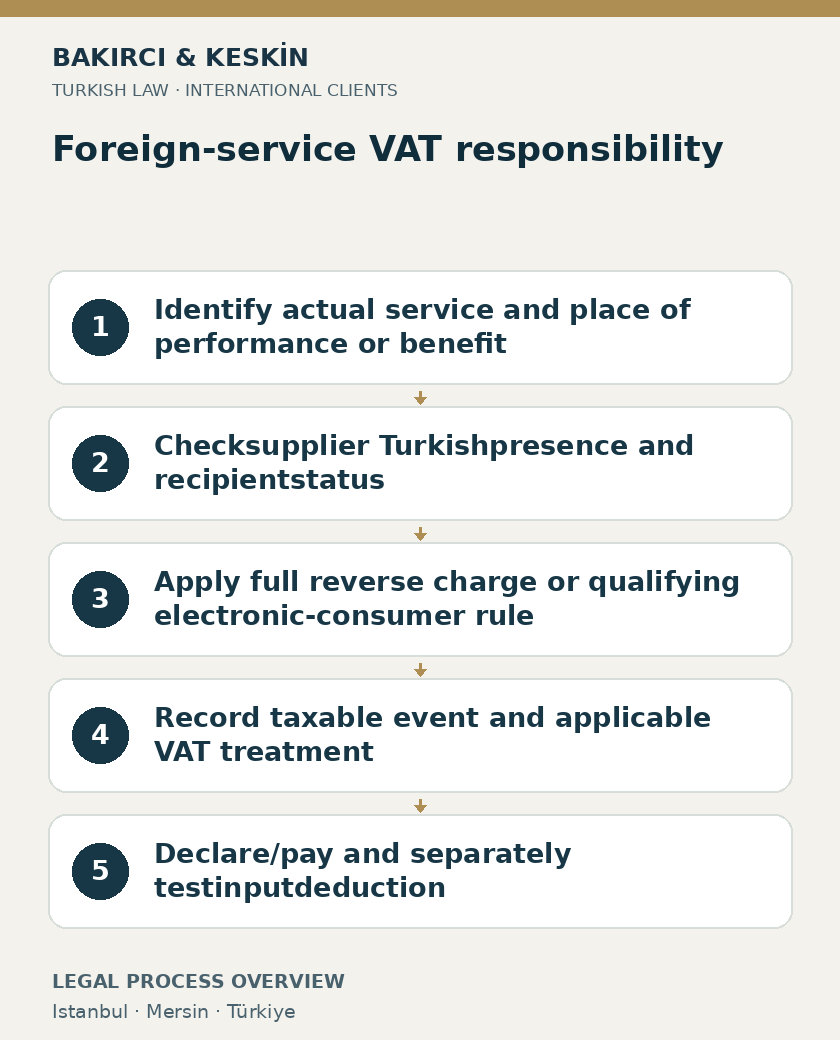
A complete decision records the service classification, territorial connection, supplier’s Turkish presence, recipient category and the resulting declaration route. It then records the taxable event, consideration, applicable tax treatment and payment evidence. Where input deduction is claimed, that claim receives its own documented check. This sequence makes the conclusion reviewable by the company’s advisers and allows later enquiries to be answered from an organised transaction file.
The review should end with named responsibility for the return and a calendar for the actual period concerned. A foreign supplier’s cooperation remains valuable, but the domestic recipient must not confuse an unresolved commercial discussion with suspension of a statutory duty. The objective is an accurate classification supported by the current law and real transaction evidence.
Frequently asked questions
1. Does an invoice issued abroad automatically avoid Turkish VAT?
No. Article 6(b) looks at performance in Turkey or benefit from the service in Turkey. The invoice’s country of issue is not a complete territorial assessment.
2. Can Turkish VAT arise when the supplier has no Turkish office?
Yes. Article 9 and the communiqué specifically regulate qualifying services from suppliers without the listed Turkish connections. The domestic recipient may have to declare and pay the full VAT.
3. Must the recipient already file ordinary VAT returns?
No. The communiqué expressly extends the responsibility to recipients without ordinary VAT taxpayer status. The relevant full-withholding transaction is declared on VAT Return No. 2.
4. Are services performed and benefited from abroad covered by this reverse charge?
The communiqué states that no VAT is declared in this capacity where both performance and benefit occur abroad. The actual service records must support that territorial conclusion.
5. Who pays VAT on electronic services supplied to a private individual?
For the qualifying nonresident electronic services covered by Article 9, supplied to natural persons who are not VAT taxpayers, the provider declares and pays through the special regime. The communiqué provides for VAT Return No. 3.
6. Does a company without VAT registration fall into that consumer exception?
Not merely because it lacks registration. The special rule refers to natural persons who are not VAT taxpayers. A legal-entity recipient must be assessed under the rules applicable to its actual status.
7. Can input VAT be deducted directly on Return No. 2?
No. The communiqué requires the full responsible-person VAT to be declared and paid through that return. Any permissible deduction is assessed separately under the applicable deduction provisions.
8. Is declaring the reverse charge sufficient for a deduction?
Article 29(1)(ç) refers to VAT declared and paid. Documentary, recording, activity and timing conditions also require review; declaration alone is not the complete test.
9. Does a contract making the supplier responsible for taxes bind the tax office?
Article 8 of Tax Procedure Law generally prevents private tax-allocation agreements from binding the tax office unless tax law allows otherwise. The clause can still be relevant between the contracting parties.
10. Should the exchange rate follow the later bank-payment date?
Article 26 links foreign-currency conversion to the taxable event. The correct event under Article 10 and applicable conversion rules must be established; a later payment date cannot automatically replace that analysis.
Official legal sources
- VAT Law No. 3065 — Articles 1, 6(b), 9(1), 10(a)–(c), 26, 29(1)(ç), 34, 40(2)
- VAT General Application Communiqué, current GIB consolidation — Sections I/C-2.1.1.2, I/C-2.1.2.1.1, I/C-2.1.2.1.2
- Tax Procedure Law No. 213 — Articles 8
Legal sources reviewed on 28 October 2026. The official Turkish legislation controls; individual facts and later amendments must be checked before action.
Contact information
Do not include confidential documents or identity numbers in an initial message. An enquiry does not establish representation or suspend any legal deadline.
Istanbul and Mersin contact details
Bakırcı & Keskin Law Office is Mersin-based. Turkish matters are handled under the applicable jurisdiction and agreed mandate. The competent court and the scope of representation are assessed for each matter.
Istanbul — Polaris Plaza
Maslak Ahi Evran Caddesi, Polaris Plaza No:21, Floor 9, 34475 Sarıyer/İstanbul, Türkiye.Mersin — Profit İş Merkezi
İhsaniye Mahallesi, 4903. Sokak, Profit İş Merkezi No:23, Floor 3, Office 14, 33070 Akdeniz/Mersin, Türkiye.+90 552 224 43 66 · Contact details in English. An enquiry does not establish representation or suspend a legal deadline.
Istanbul Office – Polaris Plaza, Maslak / Sarıyer
Bakırcı & Keskin Hukuk Bürosu
Maslak Ahi Evran Caddesi, Polaris Plaza No:21, Kat:9, 34475 Sarıyer/İstanbul
Our physical offices in Istanbul and Mersin coordinate matters throughout Turkey, subject to jurisdiction and the local steps required for each case. Please specify your preferred office when arranging an in-person appointment.
Open the Istanbul office on Google Maps · Contact and appointments
Contact regarding a legal matter
In your first message, you may briefly state the subject, your country or city, and any relevant notification or recent procedural date. Please do not send identity numbers, medical data, or personal documents. Messaging alone does not constitute legal advice or create a lawyer–client relationship.
Discover more from Bakırcı & Keskin Hukuk Bürosu
Subscribe to get the latest posts sent to your email.