Paid a Turkish Judgment Debt? Article 33, Proof of Payment and Stopping Enforcement
Short answer: A debtor who has paid a debt after the judgment must respond through the procedure for judgment enforcement. Article 33 of the Enforcement and Bankruptcy Law distinguishes grounds existing when the enforcement order is served from payment, postponement or limitation arising afterwards. The first route has a seven-day application period and specified documentary requirements; later payment or postponement has its own stricter document rule. Sending an ordinary objection to the enforcement office is not a substitute for the required application to the enforcement court.
Have a general question about this article? Ask anonymously
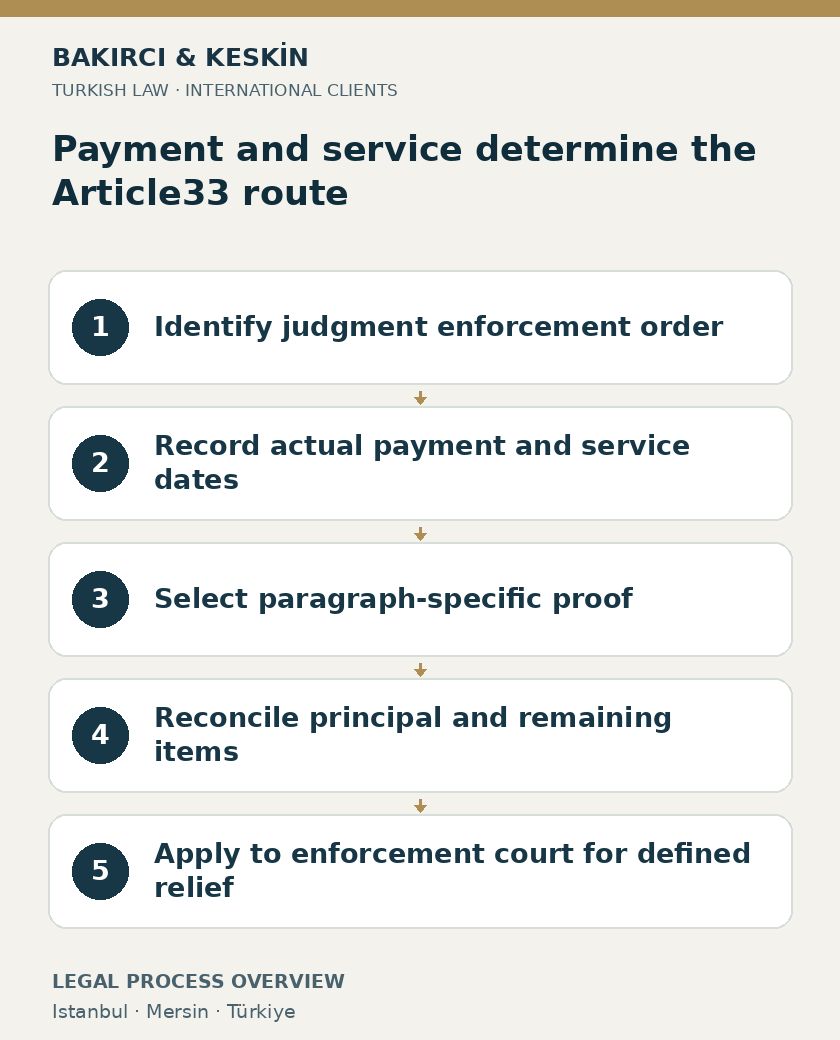
Quick summary
| Legal issue | Paid a Turkish Judgment Debt? Article 33, Proof of Payment and Stopping Enforcement |
|---|---|
| Short answer | A debtor who has paid a debt after the judgment must respond through the procedure for judgment enforcement. Article 33 of the Enforcement and Bankruptcy Law distinguishes grounds existing when the enforcement order is served from payment, postponement or limitation arising afterwards. The first route has a seven-day application period and specified documentary requirements; later payment or postponement has its own stricter document rule. Sending an ordinary objection to the enforcement office is not a substitute for the required application to the enforcement court. |
| Key legislation | Enforcement and Bankruptcy Law No. 2004 — Articles 32, 33, 33/a; Turkish Code of Obligations No. 6098 — Articles 103 |
Identify judgment enforcement before choosing an objection route
A Turkish enforcement document should be classified from its heading, file details and legal basis. An enforcement order based on a judgment, an ordinary payment order without a judgment and an order concerning a negotiable instrument are not interchangeable. An overseas debtor who reads only the amount and a translated demand summary can miss the distinction. Obtain the complete served document, its attachments and the service record before instructing anyone to file an objection.
Enforcement and Bankruptcy Law Article 32 addresses a judgment requiring payment of money or provision of security. The enforcement order identifies what has been awarded and calls for compliance within seven days, together with its statutory warnings. Article 33 supplies the relevant route for specified assertions that the debt has been discharged, payment has been postponed or limitation has occurred. The application is addressed to the enforcement court, not treated as an ordinary Article 62 objection to the enforcement office.
This article focuses on payment after the judgment rather than an attempt to retry the original dispute. The underlying judgment, the payment event and the enforcement account are separate records. The general guide to Turkish debt collection and enforcement explains the different starting routes. Here, the immediate question is how a debtor documents a later discharge and obtains the appropriate procedural result in a judgment-enforcement file.
The payment date and service date determine the Article 33 route
Build a chronology showing the judgment date, the relevant payment or discharge event, service of the enforcement order and the date of the proposed application. Article 33 expressly separates grounds existing at service from grounds arising during the period afterwards. A bank statement downloaded after service does not necessarily prove a payment made after service. The operative date is the event relied upon, not the day on which the debtor first printed the evidence.
For a ground already available when the order is served, the first paragraph permits an application within seven days of service. The second paragraph permits requests based on payment, postponement or limitation arising after service to be made at any time. That wording is not a general permission to revive a missed first-paragraph application by obtaining a newer copy of an older receipt. Identify when the asserted legal ground actually arose.
Service itself must be checked from the official record. An email forwarded by a relative, a bank’s attachment notification and the formal service of the enforcement order can be different events. A service problem requires its own procedural analysis; it should not be assumed from foreign residence alone. Keep the envelope, service certificate and electronic notification record where applicable, and tell counsel when and how the document came to your attention.
A timely first-paragraph application still needs qualifying documents
Under Article 33’s first paragraph, the debtor applies by petition to the enforcement court within the seven-day period and identifies payment, postponement or limitation as the ground. For payment or postponement, the provision requires documentary substantiation in one of the stated forms: an instrument officially prepared by an authorised authority, duly authenticated, or admitted before the enforcement office, enforcement court or a court. A narrative account of repayment does not replace this requirement.
The petition should match each document to the asserted discharge. Identify the judgment and enforcement file, the parties, the amount covered and the payment date. Where only part was paid, request relief corresponding to that part rather than describing the whole judgment as extinguished. The court must be able to relate the instrument to the debt being enforced. A document addressing an unrelated loan between the same people cannot be treated as proof of this judgment’s satisfaction.
The statute’s reference to an admission before specified authorities also matters. An informal statement attributed to the creditor should not be presented as though it were already an admission recorded in the enforcement proceeding. Preserve the actual statement and identify where it was made. Counsel can assess its procedural significance and whether the required admission exists. A favourable outcome should not be promised merely because correspondence suggests that the creditor remembers receiving money.
Payment after service has a distinct documentary rule
Article 33’s second paragraph permits a request at any time where payment, postponement or limitation arises after service of the enforcement order. For payment and postponement, however, it expressly requires documents drawn up or authenticated by a notary, or an enforcement record. This is a specific procedural condition. The phrase “at any time” does not remove the requirement or mean that any attachment to an email is sufficient.
A debtor planning to pay while enforcement is already underway should settle how the payment will be documented in the file. A transfer made directly to a creditor, a payment through the enforcement office and a notarised settlement can generate different records. The objective is to ensure that the actual payment and its scope can be shown through the relevant statutory route. The debtor should not rely on a later promise that someone will eventually arrange suitable paperwork.
Record any continuing instalments accurately. A notarial document agreeing future payments is not proof that all those payments have already occurred. Equally, an enforcement record of a particular amount does not establish satisfaction of a larger balance without calculation. The petition must identify the later event and demonstrate its effect on the enforceable account. A request to stop collection should follow the evidence rather than replace missing evidence with a broad assertion of fairness.
Bank transfers, receipts and acknowledgments answer different questions
A bank record is important evidence of a money movement. It should identify the sender, beneficiary, date, amount, currency and transaction reference, with information about any reversal or return. It does not by itself settle every question about the legal purpose of the transfer or the special document requirements of Article 33. Preserve the complete banking record instead of an edited image that hides the recipient or explanatory text.
Turkish Code of Obligations Article 103 gives the paying debtor a right to request a receipt and, on full payment, return or cancellation of the debt instrument in the circumstances described there. Those substantive documentation rights are useful when arranging repayment. They should not be confused with an assurance that every ordinary receipt necessarily satisfies every paragraph of Article 33. The procedural form and the content both require examination.
The separate guide to receipts and returned debt instruments under Articles 103–105 addresses the closing documentation in detail. For judgment enforcement, retain the connection between that documentation and the judgment being enforced. If a representative received the money, preserve the evidence of authority. If a third party paid, state whose debt was discharged without altering the identity of the actual payer.
A partial payment does not justify an unexplained zero balance
Reconcile the principal awarded, legally recoverable interest, enforcement costs and every credited payment. A transfer equal to the original principal does not automatically answer whether other amounts remain. Conversely, the creditor cannot ignore money properly attributable to the judgment merely because an enforcement file has been opened. The requested correction should be supported by a transparent calculation that another person can reproduce.
The payment date can affect the account, so use the legally relevant date and preserve the underlying evidence. Do not silently convert currencies at an arbitrary current rate or treat bank charges as payments received by the creditor. If the judgment concerns a foreign-currency obligation, identify its terms and the asserted conversion basis. A spreadsheet can display the calculation, but it cannot supply a missing legal entitlement to an interest rate or charge.
Where a document acknowledges only a specified amount, avoid enlarging it into a release of all claims. Read reservations concerning interest, costs or another instalment. The petition should state which entries are conceded, which were discharged and which remain contested on a different basis. That separation permits a focused Article 33 application and prevents a payment dispute from becoming an unsupported demand to cancel the entire enforcement proceeding.
An agreed extension concerns timing rather than extinction
Article 33 also addresses imhal, the granting of additional time. A creditor’s agreement to defer collection can matter even though the debt has not been paid. The debtor must identify the extension’s terms, the affected obligation and the period during which enforcement is said to be premature. A request for more time that the creditor never accepted is different from an established postponement.
The same paragraph-specific evidence distinction applies. An agreement relied upon under the first paragraph and a postponement arising after service must meet the respective statutory requirements. Negotiations, proposed instalment plans and draft documents should be described honestly as such. A creditor’s willingness to discuss terms does not establish a completed agreement. If the extension has expired or its conditions are disputed, that issue belongs in the application rather than being omitted from the chronology.
Limitation is not proved by the payment documents alone
Article 33 includes limitation as a possible ground, and Article 33/a regulates the documentary inquiry into claims that the judgment has become time-barred or that limitation was interrupted or suspended. The enforcement court examines those assertions on the basis of official documents and decides whether enforcement should be postponed or continued. Counting years from a date remembered by the debtor is not an adequate substitute for the complete procedural record.
Article 33/a also provides a specific creditor response after a postponement decision based on limitation becomes final: the creditor may bring the prescribed general-court action within seven days after service of that finality to establish that limitation did not occur. Without that action, the determination specified by the article acquires final-judgment effect. This distinct sequence should not be conflated with the debtor’s initial seven-day Article 33 application or with a payment-based challenge.
Check the appeal and security position after a refusal
Article 33 regulates the debtor’s position when the enforcement court rejects the request. Its text links an appeal within the applicable appeal period to security sufficient to cover the claim, using the forms described in the provision. It also provides an exception where sufficient assets are already attached or are attached at the debtor’s request within that period. The appeal’s availability and the applicable procedural rules must be checked against the actual decision.
Do not assume that a rejected application gives an unlimited extra period or that filing an appeal alone suspends every enforcement step. Obtain the reasoned decision and its service information immediately. Counsel needs the security position, attached-asset records and current enforcement status to assess the next step. An informal assurance that the matter is “being appealed” does not answer whether collection is legally stayed.
If attached assets are relied upon for the statutory security exception, obtain the attachment records and information supporting their sufficiency. The existence of an attachment over an asset does not, without examining its value and relevant encumbrances, establish that the claim is adequately covered. The proposed security and the debt account should use the same identified obligation and amount. A client’s estimate of a property’s market value is not itself the enforcement court’s acceptance of that security.
A separate recovery action is expressly reserved
The final paragraph of Article 33 preserves the debtor’s right, under Article 72, to seek return of money the debtor was compelled to pay despite not owing it. That reservation matters where the narrow enforcement-court route does not resolve the substantive payment dispute. It does not mean that the recovery action is automatically successful or free of its own requirements. The amount actually collected and the reason it was not owed must be established.
Keep the enforcement payment record, distribution record where available, earlier discharge evidence and the decisions already made. A request to postpone enforcement and a claim to recover money already collected seek different results. The appropriate court, time requirements and any preliminary procedural condition for the proposed substantive action require separate assessment. Do not let the existence of a possible later remedy become a reason to ignore the served order now.
Prepare a focused response from abroad
Send the complete enforcement order and service evidence first, followed by the judgment, payment record and any formal acknowledgment or postponement instrument. Explain precisely which event occurred before service and which occurred afterwards. Foreign documents need a document-specific assessment of authentication, translation and their ability to satisfy the Turkish procedural requirement. An apostille concerns authentication; it does not rewrite the document’s substantive content.
The instruction to counsel should identify the requested outcome: recognition of a complete discharge, credit for a partial payment or postponement for an established extension. Continue monitoring the actual file while negotiations take place. A clear chronology, qualifying documents and an accurate balance give the court a legally structured request, while preserving any distinct substantive remedy that the facts support.
Frequently asked questions
Where do I object after receiving a judgment enforcement order?
For the grounds specified in Article 33, the application is made by petition to the enforcement court. An ordinary objection to the enforcement office is a different procedure.
What is the initial Article 33 deadline?
The first paragraph provides seven days from service of the enforcement order. The ground and the service record must be identified accurately.
What if I pay after the enforcement order is served?
The second paragraph permits a request based on that later event at any time, but payment or postponement must be supported by the specified notarial documents or enforcement record.
Does a new copy of an old receipt restart the deadline?
No. A later download or print date does not turn an earlier payment into a payment occurring after service.
Is a bank screenshot always sufficient?
No. Preserve it as evidence, but Article 33 imposes particular documentary requirements. The payment purpose and the statutory form both require review.
Can I challenge only part of the amount?
The application should identify the amount actually discharged and the corresponding requested relief. A partial payment should not be described as full satisfaction without a supporting account.
Does asking for an instalment plan postpone enforcement?
A request alone does not establish an agreed extension. The actual postponement and the relevant Article 33 document requirements must be proved.
Does an appeal automatically protect me after refusal?
Do not assume that it does. Article 33 contains security rules and an attached-assets exception, and the appeal and enforcement position must be assessed from the decision.
Can money already collected be recovered?
Article 33 reserves the Article 72 recovery action for money compelled to be paid although not owed. That action has its own requirements and does not guarantee recovery.
Does living abroad extend the seven-day period automatically?
No automatic extension follows merely from residence abroad. The lawful service date and any specific procedural remedy must be checked promptly.
Official legal sources
- Enforcement and Bankruptcy Law No.2004 — Articles 32, 33, 33/a
- Turkish Code of Obligations No.6098 — Articles 103
Legal sources reviewed on 28 October 2026. The official Turkish legislation controls; individual facts and later amendments must be checked before action.
Contact information
Do not include confidential documents or identity numbers in an initial message. An enquiry does not establish representation or suspend any legal deadline.
Istanbul and Mersin contact details
Bakırcı & Keskin Law Office is Mersin-based. Turkish matters are handled under the applicable jurisdiction and agreed mandate. The competent court and the scope of representation are assessed for each matter.
Istanbul — Polaris Plaza
Maslak Ahi Evran Caddesi, Polaris Plaza No:21, Floor 9, 34475 Sarıyer/İstanbul, Türkiye.Mersin — Profit İş Merkezi
İhsaniye Mahallesi, 4903. Sokak, Profit İş Merkezi No:23, Floor 3, Office 14, 33070 Akdeniz/Mersin, Türkiye.+90 552 224 43 66 · Contact details in English. An enquiry does not establish representation or suspend a legal deadline.
Istanbul Office – Polaris Plaza, Maslak / Sarıyer
Bakırcı & Keskin Hukuk Bürosu
Maslak Ahi Evran Caddesi, Polaris Plaza No:21, Kat:9, 34475 Sarıyer/İstanbul
Our physical offices in Istanbul and Mersin coordinate matters throughout Turkey, subject to jurisdiction and the local steps required for each case. Please specify your preferred office when arranging an in-person appointment.
Open the Istanbul office on Google Maps · Contact and appointments
Contact regarding a legal matter
In your first message, you may briefly state the subject, your country or city, and any relevant notification or recent procedural date. Please do not send identity numbers, medical data, or personal documents. Messaging alone does not constitute legal advice or create a lawyer–client relationship.
Discover more from Bakırcı & Keskin Hukuk Bürosu
Subscribe to get the latest posts sent to your email.