Your Goods Were Seized for Someone Else’s Turkish Debt: Third-Party Ownership Claims
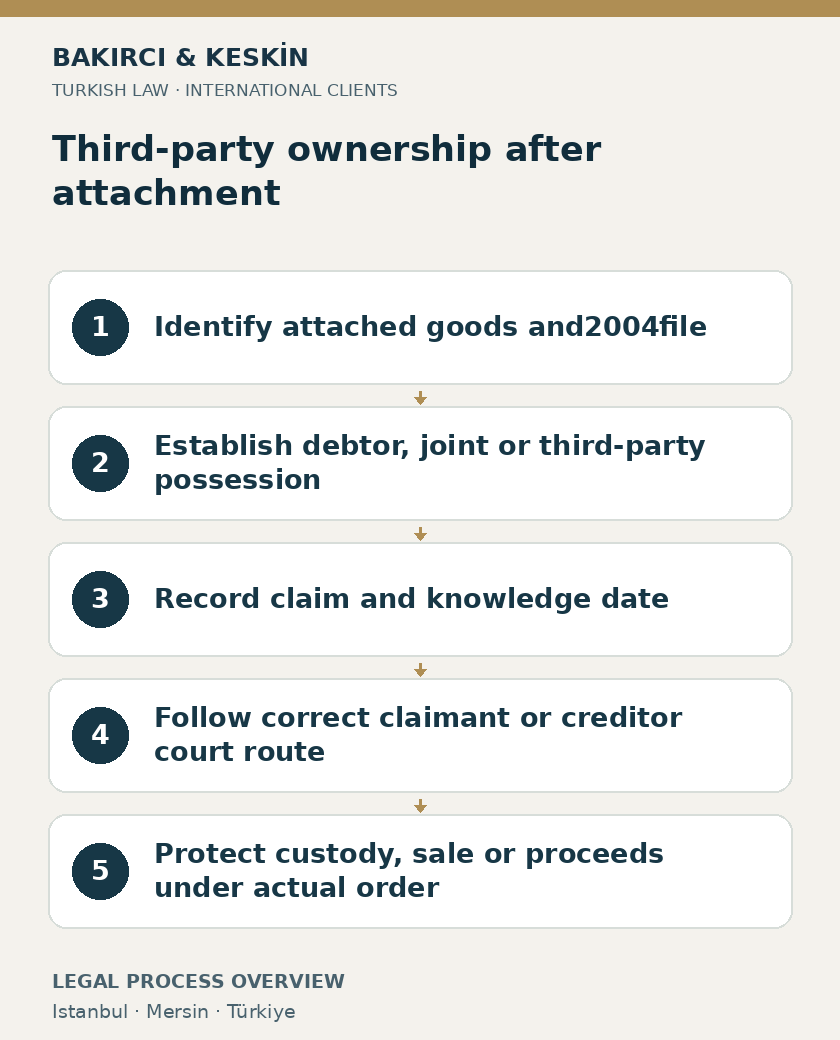
Short answer: An owner abroad whose movable goods are attached for someone else’s debt must establish the correct third-party ownership procedure. Enforcement and Bankruptcy Law Articles 96–97 and 97/a address goods treated as being in the debtor’s possession; Article 99 addresses goods held by a third person asserting ownership or another right in rem. Possession affects who must bring the court action, the relevant seven-day period and the treatment of custody and sale. An invoice alone does not automatically remove an attachment.
Have a general question about this article? Ask anonymously
Quick summary
| Legal issue | Your Goods Were Seized for Someone Else's Turkish Debt: Third-Party Ownership Claims |
|---|---|
| Short answer | An owner abroad whose movable goods are attached for someone else's debt must establish the correct third-party ownership procedure. Enforcement and Bankruptcy Law Articles 96–97 and 97/a address goods treated as being in the debtor's possession; Article 99 addresses goods held by a third person asserting ownership or another right in rem. Possession affects who must bring the court action, the relevant seven-day period and the treatment of custody and sale. An invoice alone does not automatically remove an attachment. |
| Key legislation | Enforcement and Bankruptcy Law No. 2004 — Articles 96, 97, 97/a, 99 |
Identify the asset, claimant and actual enforcement regime
A foreign business can own equipment used by a Turkish counterparty, and an individual abroad can own belongings located in another person’s premises. When those goods are attached, the first task is to identify the particular objects and the proceeding. Record the enforcement office, file number, creditor, debtor, date of attachment and item-level inventory. A message that “the factory was seized” is not enough to establish which property is affected or which legal remedy applies.
This guide concerns third-party claims to movable goods in enforcement governed by Law No. 2004, Articles 96–99. Tax collection under another statute, criminal seizure, bankruptcy separation and a land-title dispute require their own analysis. The Turkish term istihkak also appears in inheritance law, but an inheritance recovery action is not the same proceeding as a third-party claim to an attached machine. The file’s legal basis must be identified before a deadline is selected.
The claimant must assert its own legally relevant right in the goods. A creditor owed money by the debtor does not become the owner of the debtor’s equipment merely because an invoice remains unpaid. Likewise, a shareholder is not automatically the personal owner of company assets. Confirm the legal owner and any other right being asserted, then arrange representation for that person or entity. A claim made in the wrong capacity can obscure an otherwise genuine ownership record.
Possession determines which statutory branch must be examined
Article 97/a presumes that a person holding a movable owns it. Where the debtor and a third person hold the goods together, the article treats them as being in the debtor’s possession. The distinction is therefore not resolved simply by identifying whose name appears on the building’s lease or which company has a sign outside. The actual possession of the attached goods and the statutory presumptions require a factual record.
For shared premises, document who operated the equipment, controlled access, maintained it and had authority to move it. Separate a genuine custody or equipment-use arrangement from a mere description created after attachment. An owner should explain both how ownership was acquired and why the debtor possessed the object. Article 97/a expressly requires the claimant to identify and prove those legal and factual circumstances. Evidence answering only the purchase question may leave the possession question unresolved.
The article also contains specific presumptions for goods in a shared home whose nature clearly indicates that they belong to women, men or children, or whose connection follows from custom, art, profession or occupation. These are statutory presumptions requiring the relevant facts, not an unrestricted rule that every household item belongs to whichever resident asserts ownership. A person challenging the applicable presumption bears the corresponding burden of proof.
Article 96 requires a recorded claim and creates an early deadline
Under Article 96, when the debtor identifies goods in the debtor’s possession as another person’s property or subject to that person’s pledge, or a third person asserts ownership or a pledge, the enforcement office records the matter in the attachment and enforcement minutes and notifies the parties. The claim should therefore identify the particular goods and right clearly enough to be entered into the official record. A private complaint sent only to the creditor is not equivalent to that procedural step.
The enforcement office gives the creditor and debtor three days to state whether they object to the claim. Their silence is treated as acceptance under the article. Preserve the actual notifications and responses; an owner’s assumption that no one objected is not a substitute for checking the file. The procedural consequence follows from the statutory sequence, including the opportunity given to the relevant parties.
Article 96 separately provides that a debtor or third person who learns of the attachment must assert the claim within seven days of that knowledge or lose the ability to advance it in the same proceeding. The article includes deemed-knowledge rules for specified people living with the claimant and business partners. An overseas owner should record actual discovery immediately and disclose who knew earlier. Waiting for a preferred travel date or for informal negotiations to finish can put the claim at risk.
Article 97 separates the initial court decision from the ownership action
If the creditor or debtor objects, Article 97 requires the enforcement officer to send the file promptly to the enforcement court. The court examines the file, holding a hearing if considered necessary, and decides whether enforcement should continue or be postponed. This initial decision is a procedural stage. It should not be confused with a final adjudication that the third person owns the goods.
Article 97 expressly states that the enforcement court’s decision to continue enforcement is final. That procedural finality does not replace the separate ownership action or remove its filing requirement. The claimant must distinguish the continuation decision from the later judgment resolving ownership, and organise the response around the statutory action period.
The third person must bring the ownership action in the enforcement court within seven days from pronouncement or service of the court’s decision as specified in Article 97. Failure to bring the action within that period leads to the statutory consequence of being treated as having abandoned the claim against the creditor. This is a different seven-day clock from the earlier knowledge-based claim period. The file should therefore show each decision and its notification separately.
The debtor’s agreement with the third party does not bind the creditor on ownership. Article 97 expressly requires the third person to prove the claim, while the debtor’s admission has evidential consequences against the debtor. A joint statement that “the machine belongs to the supplier” can be relevant, but it cannot replace the acquisition and possession evidence. The claimant should prepare for an actual contested case rather than rely solely on the debtor’s support.
Article 99 places the action on the creditor in its own circumstances
Article 99 addresses attached goods that are not in the debtor’s possession but are held by a third person asserting ownership or another right in rem. If that person accepts the role of custodian, the goods are not taken into physical protective custody under the stated rule. The enforcement director gives the creditor seven days to bring an ownership action against the third person in the enforcement court. This reverses the litigation initiative compared with the Article 97 route.
If the creditor does not bring the action within the period, the third person’s claim is treated as accepted. If the creditor brings it in time, the goods cannot be sold until the action is resolved. Article 99 also applies where attachment occurred in the third person’s absence and a claim was made in that person’s favour. An overseas owner should obtain the complete attachment record to establish what was asserted and by whom.
These consequences depend on the correct possession classification. A claimant should not simply demand that Article 99 be used because that route places the filing obligation on the creditor. Where the record shows joint possession or possession by the debtor, Article 97/a and the other procedure require examination. Any challenge to the enforcement office’s procedural classification must be assessed promptly from the actual decision and available remedy, without assuming that an ownership assertion suspends every deadline.
Prove the chain of ownership and identify the physical object
The evidence should trace the acquisition of the specific goods. Purchase contracts, supplier invoices, payment records, delivery documents, import records and asset registers can each establish different parts of the history. Serial numbers, manufacturer plates and dated photographs help connect those records with the attached object. A generic invoice describing several similar machines without identifying details may leave a factual gap that needs other evidence.
Then explain the debtor’s possession. An equipment lease, repair arrangement, storage contract or delivery for a defined purpose should be supported by its original records and actual performance. Provide dispatch and return arrangements, maintenance responsibility and communications predating the attachment. The account should show the real transaction rather than a retrospective statement designed to produce a favourable label. Related companies and common personnel require particularly clear separation of ownership and use.
A landlord’s right of retention presents a different substantive question. The existing guide to retention of a tenant’s equipment under Articles 336–338 explains the secured rent and third-party protections. If that security is involved, it must be considered alongside the enforcement procedure. Proof of third-party ownership should not be described as automatically defeating every legally recognised pledge or retention right.
Attachment, removal and sale are separate legal events
An attachment can exist even while goods remain physically at the premises. Article 97/a provides that, in the joint-possession situation, the goods are not taken into protective custody if the third person accepts custodianship. It also permits custody to be taken if the court decides that enforcement should continue under Article 97’s first paragraph. Remaining in physical possession is therefore not proof that the attachment has disappeared.
Article 99’s sale restriction during a timely creditor action is another distinct protection. It should not be rewritten as a universal automatic stay for every third-party assertion under every branch. Under Article 97, the court decides continuation or postponement through the stated procedure. The owner needs the actual order and its scope before deciding what can lawfully happen to the goods.
Do not remove, sell or alter an attached object on the assumption that an ownership invoice overrides the official measure. Preserve its identification and condition and address custody through the enforcement file. An authorised representative collecting goods after release should obtain a clear handover record, including item numbers and condition. A general receipt stating that “all property was returned” may conceal missing or disputed objects.
Article 97 also addresses a person denied an earlier opportunity
A third person who was not given an opportunity to assert the claim under the preceding provisions has a separate route described in Article 97. Within seven days of learning of the attachment, that person can bring an ownership action concerning the goods, or the proceeds if the goods have been sold but the price has not yet been paid to the creditor. Failure to act has the specified consequence within the same enforcement proceeding.
The court must deal urgently with a requested postponement in that situation and can decide without first hearing the other party. If goods are realised before the ownership action is concluded, Article 97 requires a separate decision about withholding the proceeds or paying them to the creditor with or without security according to the circumstances. The sale date and distribution status are therefore essential. A later discovery of the attachment should be supported by evidence, not simply asserted to avoid an earlier missed period.
Postponement can involve security and compensation exposure
Article 97 provides for security when enforcement is postponed, protecting the creditor against potential loss if the ownership claimant ultimately fails. The nature and amount are assessed in light of the evidence. The court refuses postponement where serious reasons support the conclusion that the action is being abused merely to delay sale. A claim should therefore be presented with its genuine ownership basis and urgency, not as a way to buy time for the debtor.
The statute also contains conditional compensation rules. Where postponement follows the ownership action and the action is ultimately dismissed, compensation is linked to the amount whose collection was delayed, with the stated minimum of twenty percent. Where the ownership claim succeeds and the bad faith of the objecting creditor or debtor is established, the article provides a minimum of fifteen percent of the attached property’s value. These consequences have different conditions and calculation bases; losing a disagreement does not automatically prove bad faith.
The creditor may also raise the statutory counterclaim concerning avoidance of the relevant transaction under the conditions stated in Article 97. A genuine transfer history and its timing therefore matter beyond possession alone. The claimant should disclose the relationship with the debtor and the transaction documents fully. Concealing an inconvenient fact can weaken the court’s ability to assess a legitimate claim and the corresponding procedural protection.
Organise the foreign owner’s response around the earliest live deadline
The first package should contain the attachment minutes, notices, court decisions, service records, ownership documents and a dated account of discovery. Add a schedule matching each claimed object to its evidence and current location. Identify whether sale has been scheduled, completed or followed by payment of the proceeds. These facts determine the available procedural work more directly than a general account of the owner’s commercial relationship with the debtor.
Foreign corporate authority, document authentication and Turkish translations should be arranged for their actual intended use. A power of attorney prepared abroad can support representation, but obtaining it does not itself suspend a period already running. Counsel should be told about the attachment immediately so that authority and urgent filing requirements are assessed together. The aim is a timely, item-specific claim supported by a coherent ownership and possession record.
Frequently asked questions
Can goods belonging to a foreign company be challenged after attachment?
A genuine owner can use the applicable third-party claim procedure. Ownership, possession, timing and the enforcement regime must be established; foreign incorporation alone does not resolve them.
Does an invoice automatically lift the attachment?
No. It is evidence to connect with the specific goods, payment, delivery and the reason for the debtor’s possession. The proper procedural claim remains necessary.
Why does joint possession matter?
Article 97/a treats goods held together by the debtor and third person as being in the debtor’s possession, affecting the statutory route and presumptions.
What is the first knowledge-based period?
Article 96 provides seven days from knowledge of attachment for the claim, with specified deemed-knowledge rules. The actual chronology must be recorded.
Is every seven-day period triggered by attachment?
No. Article 97’s court-action period follows the court decision’s pronouncement or service, while Article 99 involves the period given to the creditor. The triggers differ.
Who files under Article 99?
In its specified third-party-possession situation, the enforcement director gives the creditor seven days to sue the third person in the enforcement court.
Does the debtor’s admission bind the creditor?
No. Article 97 requires the third person to prove the claim. The debtor’s admission has its own evidential effect against the debtor.
Can goods stay on site while attached?
The custodianship rules in Articles 97/a and 99 can permit that in their respective circumstances. Physical presence does not mean the attachment has ended.
What if the goods were already sold?
Article 97 includes specified protection involving proceeds before payment to the creditor and court decisions about distribution. Sale and distribution dates must be checked immediately.
Does an ownership claim automatically stop every sale?
No. Article 97 uses a court continuation or postponement decision. Article 99 prohibits sale during a timely creditor action in its own statutory circumstances.
Official legal sources
Legal sources reviewed on 28 October 2026. The official Turkish legislation controls; individual facts and later amendments must be checked before action.
Contact information
Do not include confidential documents or identity numbers in an initial message. An enquiry does not establish representation or suspend any legal deadline.
Istanbul and Mersin contact details
Bakırcı & Keskin Law Office is Mersin-based. Turkish matters are handled under the applicable jurisdiction and agreed mandate. The competent court and the scope of representation are assessed for each matter.
Istanbul — Polaris Plaza
Maslak Ahi Evran Caddesi, Polaris Plaza No:21, Floor 9, 34475 Sarıyer/İstanbul, Türkiye.Mersin — Profit İş Merkezi
İhsaniye Mahallesi, 4903. Sokak, Profit İş Merkezi No:23, Floor 3, Office 14, 33070 Akdeniz/Mersin, Türkiye.+90 552 224 43 66 · Contact details in English. An enquiry does not establish representation or suspend a legal deadline.
Istanbul Office – Polaris Plaza, Maslak / Sarıyer
Bakırcı & Keskin Hukuk Bürosu
Maslak Ahi Evran Caddesi, Polaris Plaza No:21, Kat:9, 34475 Sarıyer/İstanbul
Our physical offices in Istanbul and Mersin coordinate matters throughout Turkey, subject to jurisdiction and the local steps required for each case. Please specify your preferred office when arranging an in-person appointment.
Open the Istanbul office on Google Maps · Contact and appointments
Contact regarding a legal matter
In your first message, you may briefly state the subject, your country or city, and any relevant notification or recent procedural date. Please do not send identity numbers, medical data, or personal documents. Messaging alone does not constitute legal advice or create a lawyer–client relationship.
Discover more from Bakırcı & Keskin Hukuk Bürosu
Subscribe to get the latest posts sent to your email.