A Zoning Fine for Your Turkish Property: Article 42 Liability and the Calculation File
Short answer: An Article 42 zoning fine requires a supported finding of responsibility and a reproducible statutory calculation. Review the actual works, area, building classification, percentage additions and service record. The correct court route must be identified promptly because the general fine remedy and administrative-court procedure have different periods.
Have a general question about this article? Ask anonymously
Quick summary
| Legal issue | A Zoning Fine for Your Turkish Property: Article 42 Liability and the Calculation File |
|---|---|
| Short answer | An Article 42 zoning fine requires a supported finding of responsibility and a reproducible statutory calculation. Review the actual works, area, building classification, percentage additions and service record. The correct court route must be identified promptly because the general fine remedy and administrative-court procedure have different periods. |
| Key legislation | Law No. 3194 — Articles 32, 42, including Law 7579 of 7 May 2026; Law No. 5326 — Articles 3, 8–9, 17, 25–27; Law No. 2577 — Articles 2, 7, 27 |
Start with the penalty decision and its statutory paragraph
A Turkish zoning penalty must be examined as an individual sanction with a defined legal basis, addressee and calculation. A title deed, a construction inspection and a request for payment answer different questions. Article 42 of the Zoning Law, Law No. 3194, contains several penalties, including the familiar calculation for unpermitted or noncompliant construction, penalties for specified statutory duties and provisions concerning unsafe buildings. The correct first step is to identify the particular paragraph relied upon, rather than treating every municipal payment demand as the same offence.
Obtain the complete encümen decision, the inspection or determination record, its photographs and measurements, the permit and approved projects, and the calculation sheet. Include every annex referred to in the decision. A summary sent by a building manager can omit the alleged construction date, the relevant area or an additional percentage. The decision number and date should connect the financial demand to the underlying finding. Preserve the notification documents separately because they can start periods that do not run from the inspection date.
Under Misdemeanours Law No. 5326, Article 25, the sanction record must clearly identify the person, the conduct, the evidence, the decision date and the officials, and explain where and when the conduct occurred. These are practical review points. An allegation that simply identifies a parcel still requires examination of the unlawful works and the evidence connecting the addressee to them.
Registered ownership does not by itself identify the construction offender
The second paragraph of Article 42 addresses the responsible building owner, the construction contractor and the relevant technical supervisors who failed to report the breach within six business days. Its opening paragraph requires sanctions for each responsibility separately. This structure requires attention to the role in which a person is penalised; it does not make the title register an automatic list of everyone who must pay the same sanction.
The Constitutional Court examined the expression concerning the building owner in E.2012/93, K.2013/8, dated 10 January 2013. It explained that the expression refers to the person carrying out the unlawful construction activity, including a tenant or another person where applicable. Penalising the registered owner without investigating who performed that activity would be inconsistent with the provision’s meaning. The court rejected the constitutional challenge on that interpretation, applying the principle of personal responsibility for penalties.
The evidential file should therefore show when the work occurred, who commissioned and performed it, and what responsibilities were undertaken. Construction contracts, invoices, possession records, communications and permit documents can be relevant to those questions. At the same time, Articles 8 and 9 of Law No. 5326 regulate representative or organisational responsibility and intentional or negligent commission. An owner should not assume that appointing a representative, using a company or living abroad creates a general exemption. The challenge must address the applicable responsibility rule and the actual evidence.
Check which calculation method the municipality used
Article 42(2)(a) calculates the base penalty for relevant construction by the affected square metres and the building’s Ministry classification and group. The statutory figures are subject to annual revaluation. Copying the original lira amounts from the statute into a present-day estimate therefore produces an unreliable result. The calculation file should identify the classification, measured area, applicable year and rate, with enough information to reproduce the arithmetic.
The current text also includes the amendment made by Law No. 7579 on 7 May 2026. Where the Ministry adds a new group to a building class, the existing highest group in that class supplies the basis specified by Article 42. A review of a recent sanction must use the version of the provision relevant to the conduct and decision, rather than an older checklist that does not recognise the new group rule. This article deliberately gives no universal 2026 lira total: the statutory inputs differ between files.
Article 42(2)(b) provides a different basis for contraventions that cannot be calculated through construction floor area, including relevant façade, building-element and material breaches. The penalty is twenty percent of the amount determined by the authority using the Ministry unit-price list in force when the offending work was identified. The record must establish why that method applies and identify the priced work. A floor-area calculation and a priced-element calculation should not be exchanged merely because one produces a larger figure.
Audit each percentage increase against a separate factual finding
Article 42(2)(c) lists circumstances that increase the amount derived under paragraph (a) or (b). They include specified ownership and land-use circumstances, danger to life or property, absence of a permit, continued work after a permit has lost validity, and the completion or use of the works. Each increase needs both the correct statutory category and supporting facts. The law directs that the applicable additions be calculated separately by reference to the base amount, rather than by compounding one increased subtotal into the next.
The distinctions between categories matter. Construction without a permit attracts the stated 180 percent addition, while new unpermitted construction in a building that has an occupancy permit has its own 100 percent category. Continued construction despite an invalidated permit has a separate 50 percent category. Completed construction that is unused and completed construction that is used also have different percentages. The calculation should explain the actual permit history and physical condition instead of applying several descriptions without reconciling them.
Article 42 expressly uses the area affected by the breach for the penalty-area calculation. Compare that area with the inspection drawing and approved project. The total area of the property, the complete building and the unlawful addition are not interchangeable concepts. A technical review should identify the relationship between the unlawful work and the area used in the calculation. The legal objection can then address a specific unsupported input, alongside any challenge to the underlying allegation itself.
Understand the land-value addition and the one-month compliance rule
Article 42(2)(ç) adds an amount calculated by multiplying the offending area by the land’s minimum square-metre value used for property tax. The provision applies that addition to the penalties imposed on the responsible building owner and contractor. This requires a separate check of the area and the relevant land-value record. The statutory measure is not simply an estate agent’s estimate of the property’s market value.
The same subparagraph provides a specific consequence where the breach is removed and the building is brought into compliance within one month after notification of the penalty to the person concerned: the addition under subparagraph (ç) is not collected. Both the required corrective result and its timing matter. Retain the notification evidence, the documents identifying the corrective work, and the authority’s verification of compliance. An application saying that correction is intended does not establish that the statutory result occurred.
This rule concerns the identified land-value addition. It should not be described as automatic cancellation of the entire Article 42 sanction. Nor should the compliance month be confused with the period for taking the correct judicial remedy. A person who disputes responsibility or the amount still needs to preserve that challenge in time. The file should track the sanction, the particular noncollection request and any physical compliance procedure as distinct steps with their own evidence.
Separate the fine from demolition and contractual recovery
A financial sanction under Article 42 and action under Article 32 have different legal functions. Article 32 concerns stopping and sealing unlawful construction and the subsequent compliance or demolition process. Paying a penalty does not itself supply a building permit or approve the work. Equally, addressing the physical breach does not automatically resolve every component of the financial decision. Obtain all decisions arising from the same inspection, including a demolition decision where one exists.
This distinction is particularly relevant where a developer, tenant or contractor performed the work. A private agreement allocating responsibility for permits or expenses can be relevant to a claim between those parties, but it does not replace the authority’s duty to identify the proper sanction addressee. Our guide to construction disputes with a Turkish property developer addresses that contractual relationship. The present review concerns the public penalty and its legal calculation.
Article 42 also provides for refund, without interest, of fines collected under its preceding paragraphs to persons convicted under the specified rule referring to Criminal Code Article 184 for the same act. The statutory condition is conviction for that same act. A criminal complaint, an investigation or a general allegation of unsafe work should not be presented as an automatic refund entitlement. The administrative and criminal records must be compared before invoking the provision.
Identify the court route before calculating the challenge deadline
The word “administrative” in an administrative fine does not by itself settle judicial jurisdiction. Articles 3 and 27 of Law No. 5326 provide a general remedy against administrative fines before the criminal judgeship of peace, subject to statutory exceptions. Article 27(1) states a fifteen-day application period from notification or pronouncement. That short period must be considered at the beginning of the review, rather than after an informal exchange with the municipality.
Article 27(8) addresses a different situation: the proceedings giving rise to the sanction also include, concerning the same person, decisions falling within administrative jurisdiction. It directs the illegality allegations concerning the fine to the administrative court in the context specified by that provision. The complete decision file, including any demolition or other administrative decision, therefore matters to forum analysis. The answer cannot safely be selected from the penalty amount or the recipient’s nationality alone.
Where administrative jurisdiction governs and no special period applies, Article 7 of the Administrative Judicial Procedure Law, Law No. 2577, provides the general sixty-day period for an annulment action, running from the day following written notification in the ordinary administrative case. These are alternative procedural frameworks, not a choice of whichever deadline is longer. Identify the operative decisions, the applicable exception and the notification events promptly. A request for clarification should not be assumed to preserve either judicial period without examining its legal effect.
Payment, service and interim protection need separate decisions
Article 26 of Law No. 5326 requires the notification to state the available remedy, competent authority and period clearly. Retain the full notification envelope or electronic record, not just the payment page. A foreign owner’s awareness through a manager and legally effective service are questions to examine from the actual record. The article also contains a specific electronic-service mechanism and deemed-service rule; ordinary email should not be equated with that regulated procedure.
Under Article 17(6), an administrative fine without a payment period specified in its governing law is payable within one month of notification. Payment within the applicable payment period attracts the statutory twenty-five percent reduction, and payment does not affect the right to seek a legal remedy. The payment period and challenge period must therefore be recorded separately. Preserve the receipt and identify which components were collected, particularly where a timely Article 42(2)(ç) compliance claim is being made.
If the case belongs in administrative court, filing it does not automatically suspend the challenged act. Article 27 of Law No. 2577 requires both manifest unlawfulness and damage that would be difficult or impossible to remedy for a stay of execution. The request should address those conditions with the file’s evidence. It is a separate procedural request, not an assumed consequence of disputing the calculation or sending the authority a solicitor’s letter.
Build a review file that answers the disputed legal questions
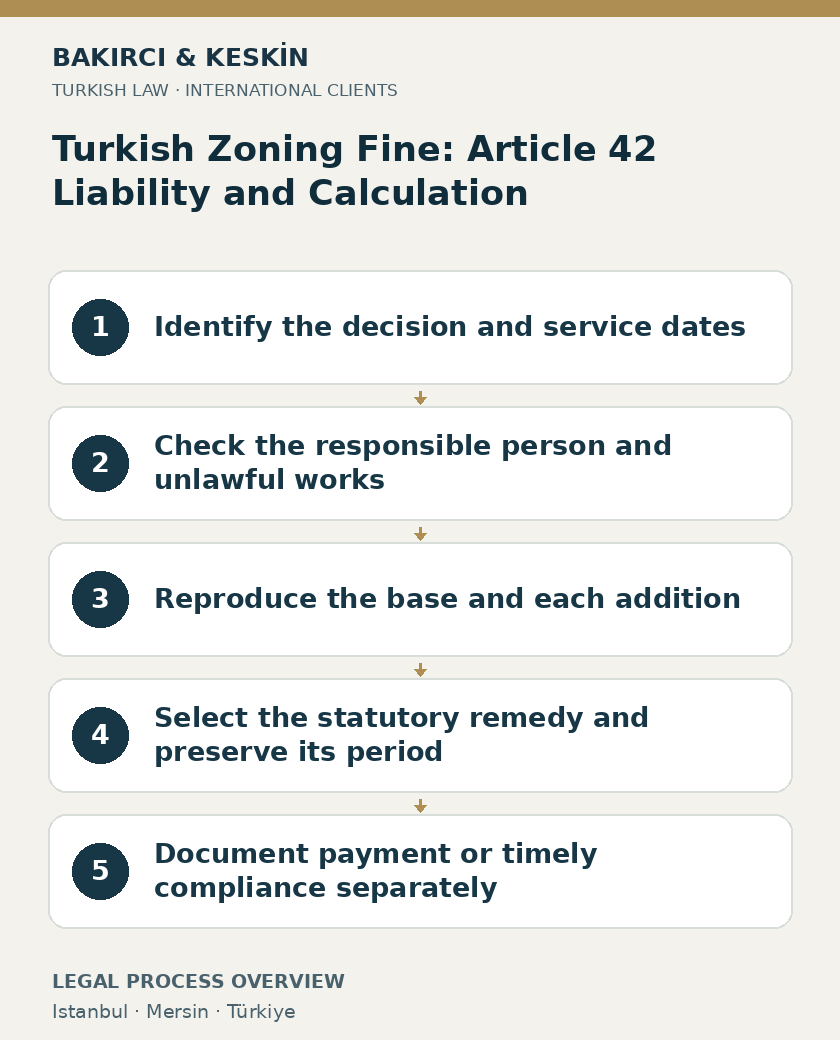
Organise the material around four issues: the responsible person, the alleged work, the statutory calculation and the procedural timetable. A dated construction chronology connects possession and commissioning records to the inspection. A permit comparison identifies the precise deviation. A calculation schedule reproduces the base, additions and land-value component separately. A notification schedule records each decision and service event. This organisation makes it possible to identify which conclusions are supported and which require further technical or documentary evidence. Preserve the original technical drawings alongside any translated explanation so that a reviewer can identify the same dimensions, annotations and project revisions in both versions.
A current registry extract remains useful to identify the property and its rights, but it cannot replace the construction and sanction evidence. The separate guide to Turkish property and land-registry due diligence explains the broader record review. For an Article 42 dispute, keep the review focused on the actual sanction, current statutory rules and the remedy sought. The resulting assessment should state concrete defects and supported correction requests, without promising that foreign ownership, payment or later compliance alone removes the penalty.
Frequently asked questions
Does a Turkish title deed automatically make me liable for a zoning fine?
No. The Article 42 responsibility inquiry must identify the relevant conduct and role. The Constitutional Court’s E.2012/93, K.2013/8 decision explains why registered ownership alone cannot replace investigation of the person responsible for the unlawful construction.
Can a tenant be responsible for unlawful construction?
Yes. The Constitutional Court’s interpretation includes a tenant or other person who carries out the relevant construction activity. The particular evidence and applicable responsibility provisions still have to be examined.
Is the penalty always calculated on the whole building?
Article 42 directs that the area affected by the breach be considered. The inspection, approved projects and calculation must support the area used; the complete parcel or building area is not automatically the correct figure.
Can I calculate a current fine using the original lira figures in Article 42?
The area-based statutory amounts are annually revalued. A current calculation must identify the applicable rate, classification, area and additions rather than copying the original figures.
Are Article 42 percentage increases compounded?
The provision directs that the relevant increases be calculated separately by reference to the amount established under subparagraph (a) or (b). Each applicable increase also needs its own factual basis.
Does correcting the breach within one month cancel the entire fine?
Article 42(2)(ç) provides noncollection of that particular additional component where the breach is removed and the building becomes compliant within one month of notification. It does not state automatic cancellation of the entire sanction.
Does paying a zoning fine legalise the building?
No. The financial sanction and the permit, compliance, stopping or demolition procedures serve different legal functions. Payment itself does not issue a permit or approve the works.
Do I always have sixty days to challenge the penalty?
No. Law No. 5326 contains a fifteen-day general fine remedy, while its Article 27(8) addresses connected administrative decisions. The applicable court and period depend on the complete decision file and governing procedural rules.
Does payment prevent a legal challenge?
Article 17(6) of Law No. 5326 expressly states that payment does not affect the right to seek a remedy. The payment timetable, available reduction and judicial filing period must nevertheless be checked separately.
Does an administrative-court action automatically stop collection or implementation?
Filing an administrative action does not itself suspend the challenged act. A stay of execution under Article 27 of Law No. 2577 requires the statutory conditions, including manifest unlawfulness and difficult-to-remedy or irreparable damage.
Official legal sources
- Law No. 3194 — Articles 32, 42, including Law 7579 of 7 May 2026
- Law No. 5326 — Articles 3, 8–9, 17, 25–27
- Law No. 2577 — Articles 2, 7, 27
Recorded primary-source check dates: 26 October 2026. The official Turkish legislation controls. A new publication-date check is still required.
Contact information
Do not include confidential documents or identity numbers in an initial message. An enquiry does not establish representation or suspend any legal deadline.
Istanbul and Mersin contact details
Bakırcı & Keskin Law Office is Mersin-based. Turkish matters are handled under the applicable jurisdiction and agreed mandate. The competent court and the scope of representation are assessed for each matter.
Istanbul — Polaris Plaza
Maslak Ahi Evran Caddesi, Polaris Plaza No:21, Floor 9, 34475 Sarıyer/İstanbul, Türkiye.Mersin — Profit İş Merkezi
İhsaniye Mahallesi, 4903. Sokak, Profit İş Merkezi No:23, Floor 3, Office 14, 33070 Akdeniz/Mersin, Türkiye.+90 552 224 43 66 · Contact details in English. An enquiry does not establish representation or suspend a legal deadline.
Istanbul Office – Polaris Plaza, Maslak / Sarıyer
Bakırcı & Keskin Hukuk Bürosu
Maslak Ahi Evran Caddesi, Polaris Plaza No:21, Kat:9, 34475 Sarıyer/İstanbul
Our physical offices in Istanbul and Mersin coordinate matters throughout Turkey, subject to jurisdiction and the local steps required for each case. Please specify your preferred office when arranging an in-person appointment.
Open the Istanbul office on Google Maps · Contact and appointments
Contact regarding a legal matter
In your first message, you may briefly state the subject, your country or city, and any relevant notification or recent procedural date. Please do not send identity numbers, medical data, or personal documents. Messaging alone does not constitute legal advice or create a lawyer–client relationship.
Discover more from Bakırcı & Keskin Hukuk Bürosu
Subscribe to get the latest posts sent to your email.