A Turkish Company Promissory Note Was Signed Without Authority: Personal Liability Under TCC 678
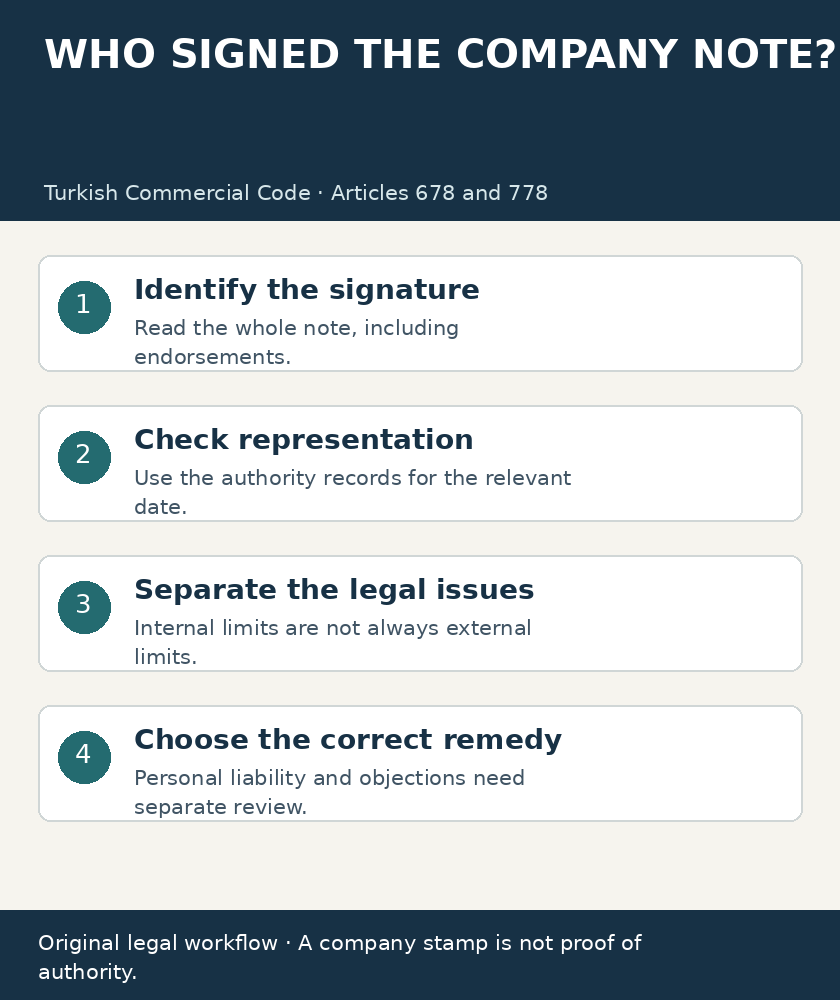
A Turkish company promissory note is not made enforceable against the company merely by placing a company stamp beside a signature. The legal questions are who signed, in whose name the signature was given, and whether that person had the necessary representation authority when the undertaking was made. These questions matter to overseas suppliers accepting deferred payment, foreign shareholders reviewing unexpected company debts, and managers facing enforcement personally.
Have a general question about this article? Ask anonymously
Direct answer
Under Article 678 of the Turkish Commercial Code, a person who signs a negotiable instrument as another person’s representative without authority is personally liable on that instrument. The same rule covers a representative who exceeds the relevant authority. Article 778(2)(e) extends the rule to promissory notes. This does not mean that every breach of an internal company instruction makes the signature unauthorised against third parties: the external representation rules, particularly Article 371, must also be applied.
Quick summary
| Question | Governing distinction |
|---|---|
| Who is exposed under TCC 678? | The actual unauthorised signatory acting in a representative capacity. |
| Does a company stamp establish authority? | No. Authority must be traced to the applicable company and representation rules. |
| Is an internal approval limit always effective against a creditor? | No. TCC 371 protects good-faith third parties against certain internal restrictions. |
| Does the rule apply to a bono? | Yes, through TCC 778(2)(e). |
| Which documents matter? | The original note, signature arrangement, historical registry records, appointment documents and relevant authorisations. |
| Does an objection automatically stop collection? | No. The enforcement route and the particular statutory objection determine its effect. |
1. Identify the instrument and each signature
Article 776 lists the essential elements of a Turkish promissory note: the appropriate designation in the language of the instrument, an unconditional promise to pay a definite sum, maturity, payment place, the named payee, issue date and place, and the maker’s signature. Article 777 supplies specific statutory alternatives for some missing particulars. It does not cure every defective instrument. Before asking who is liable under Article 678, establish that the document is a promissory note to which the negotiable-instrument rules apply.
Next identify the legal role of every signature. A maker’s representative, an endorser and an aval provider do not occupy the same position. A signature beneath a company name must be examined with the instrument as a whole; neither the presence nor the absence of a rubber stamp is a complete legal analysis. Preserve both sides of the note and every attached allonge. A cropped photograph of the signature box can omit an endorsement, a separate guarantee undertaking or wording identifying the represented person.
The foreign creditor should also identify the exact Turkish company rather than relying on a trading name, group logo or an email domain. A subsidiary, its parent, a branch and an individual shareholder are not interchangeable debtors. For the wider recovery process, see our guide to debt collection and enforcement in Turkey from abroad.
2. Understand personal liability under Article 678
Article 678 addresses the person who actually places their signature on an instrument as a representative despite lacking the required authority. The statutory consequence is personal responsibility on the instrument. Article 778(2)(e) makes that rule applicable to a bono. The person does not avoid the statutory consequence simply by saying that they intended to act for the company rather than for themselves.
The provision also states that a signatory who pays obtains the rights that the purportedly represented person would have had. This is a specific instrument-law consequence, not a promise that every payment will be reimbursed by the company. Identify the rights attached to the position represented and the parties against whom those rights exist. A separate employment relationship, mandate or company claim must be analysed under its own rules and evidence.
Conversely, Article 678 does not impose liability on every director, shareholder or employee connected with the business. It focuses on the unauthorised representative who signed. A person whose name appears in a company email or who delivered the note is not automatically the statutory signatory. The creditor must direct the claim at the legally relevant person and support the alleged representative act with the instrument and the authority evidence.
3. Separate actual lack of authority from internal restrictions
The central safeguard against an incorrect conclusion is TCC Article 371. Its third paragraph provides that restrictions on representation authority generally do not operate against good-faith third parties, while recognising the stated exceptions for registered and announced restrictions concerning joint representation or the business of the head office or a branch. Its fourth paragraph also protects recourse to the company where an authorised representative’s act breaches the articles of association or a general-meeting resolution, subject to the statutory good-faith rule.
Accordingly, an internal spending ceiling, an unfulfilled internal approval step and a legally effective requirement for two signatures must not be treated as identical. A company cannot establish the creditor’s defeat merely by producing an internal instruction the creditor was not bound to observe. Nor can a creditor disregard an externally effective representation arrangement merely because the signer described themselves as a manager.
For a Turkish joint-stock company, Articles 370–373 address representation, signing and registration. Article 629(1) refers to the joint-stock-company representation framework for the relevant limited-company matters. Determine the company form and the actual source of authority before selecting the rule. This article concerns responsibility on the note, rather than a general assessment of managerial misconduct or shareholder liability.
4. Check joint signatures and historical registry entries
Where representation must be exercised jointly, the analysis starts with the required combination of signatories and the extent to which the arrangement was registered and announced. The missing signature must be assessed against that actual arrangement. An undated signature circular or an employee’s description of office practice does not establish the representation position on every earlier date.
Obtain records covering the period relevant to the signature: appointment and removal decisions, registry entries, announcement dates, the representation method, and any applicable delegation. The present register may accurately identify today’s managers while failing to answer who could bind the company when the note was signed. Article 373 also contains protections relating to defects in appointment after registration. A retrospective claim that an appointment was internally irregular therefore requires more analysis than reading a current officer list.
Maintain a chronological evidence table identifying the document, the date it proves, and its significance. Distinguish the date written on the instrument from the date on which it was signed or delivered when those facts are genuinely disputed. Do not manufacture certainty from an incomplete chronology. The issue is the evidence-supported legal authority for the transaction, not merely whether the company eventually recorded the debt in its accounts.
5. Distinguish unauthorised representation from forgery
A genuine signature made without authority is different from a forged signature attributed to somebody who never signed. Article 678 concerns the first category. For the second, the authenticity dispute and the rules applicable to the particular proceedings must be addressed. In civil litigation, HMK Articles 208 and 211 govern the relevant handwriting or signature denial and examination process; special bill-enforcement objections require their own procedural analysis.
Article 677, applied to promissory notes through Article 778(2)(d), also preserves the independence of other signatures where one signature is invalid for a specified reason. It is therefore incorrect to assume that one forged or unauthorised signature necessarily eliminates every other signer’s liability. Equally, that independence rule does not turn a forged signature into a genuine undertaking of the person impersonated.
State the disputed fact accurately. A company saying that the signer lacked authority is not making the same allegation as a person denying that the handwriting is theirs. The evidence required, the possible defendants and the procedural consequences differ. Generic allegations of fraud should not replace an identified legal ground and the supporting documents.
6. Build the evidence file before choosing defendants
The starting file should contain the complete original note or the best available copy for initial review, all endorsements and attached pages, historical company records, and the documents relied upon as authority. Add the underlying supply or loan agreement, delivery records, correspondence about issuance, and any payments already made. The underlying documents explain the transaction; they do not dispense with the separate formal and signature requirements governing the note.
Under HMK Article 190, proof follows the applicable burden-of-proof rules. A party should identify the specific fact it needs to establish rather than submitting an undifferentiated folder of company documents. An allegation of lack of authority requires documents addressing authority; an allegation of forged handwriting requires appropriate authenticity material. The same item of evidence may assist one issue without resolving the other.
Preserve the original electronic correspondence with its attachments. A forwarded screenshot is not the same evidence as the original message and file. Do not annotate or alter the only surviving scan of the instrument. Our guide to email and messaging evidence in Turkish civil courts explains why the source files and context should be retained.
7. Respond to the correct enforcement procedure
A creditor may seek the special enforcement route available for negotiable instruments when the statutory requirements are met. Article 167 of the Enforcement and Bankruptcy Law addresses the application and original instrument; Article 168 prescribes the corresponding payment-order framework. Under that framework, the specified objections and complaints include five-day periods, while payment is requested within ten days. These are not the ordinary seven-day objection arrangements for a general payment order.
The five-day routes must be matched to the ground actually advanced: lack of negotiable-instrument status, denial of signature, debt objections and jurisdiction objections are not interchangeable labels. The addressee of the application also matters. A telephone call to the creditor, an email to the bank or a company board resolution does not substitute for the appropriate application to the enforcement court.
Article 169 states that a debt objection does not stop enforcement acts other than sale merely by being lodged. The grounds for a temporary stay or other relief must therefore be considered separately. A debtor abroad should send counsel the payment order and service material immediately, including the envelope or electronic service record. The operative date must be established from the lawful service and procedural record, not from when a colleague informally forwarded a photograph.
8. Check time limits and the underlying transaction separately
The period for opposing an enforcement order is not the same as the limitation period governing the underlying instrument claim. Articles 749–751, applied through Article 778, distinguish the relevant categories of instrument claims. Article 779 equates the promissory-note maker’s responsibility with that of the acceptor of a bill. Identify the signer’s legal position and the claim before selecting the applicable period; do not apply one undifferentiated deadline to every signature on the document.
The sales or loan debt is another separate question. A note handed over in connection with that debt does not automatically replace the original obligation in every case. The parties’ agreement and the relevant rules must be examined. Our guide to a new payment agreement and novation in Turkey addresses that distinction. A defect in company representation on the note does not, by itself, establish that no goods were supplied or no loan was advanced.
Record partial payments against the correct claim and preserve the accounting trail. The creditor cannot obtain double recovery by collecting the same economic debt twice through separate descriptions. On settlement, identify the instrument, the payer, the amount credited and the treatment of the original note. The receipt and return-of-note guide explains the documentation issues after payment.
9. Manage the case from abroad without confusing legal roles
A foreign company pursuing or defending the claim needs evidence of who can instruct Turkish counsel. That is distinct from whether the Turkish debtor’s signatory could issue the note. Keep the two authority files separate. For the creditor’s own representation documents, see foreign-company authority documents for Turkish proceedings.
Foreign-language documents relied upon in a Turkish civil case require translation under HMK Article 223. Foreign official documents also raise Article 224 authentication and treaty questions. An Apostille authenticates the relevant public document’s official origin within its legal scope; it does not decide whether the business transaction is enforceable. A translation likewise does not create an authority that was absent from the underlying document.
When the note was issued or is payable abroad, the conflict-of-laws provisions referred to by TCC Article 778(1)(j) must be considered. A Turkish company name does not establish that every issue concerning an international note is governed by Turkish substantive law. Establish the relevant places and signatures before applying the domestic analysis set out above.
Frequently asked questions
Does a company stamp make a Turkish promissory note binding?
No. The instrument, signature and legally effective representation authority must be examined. The stamp alone does not answer those questions.
Can the person who signed without authority be personally liable?
Yes. TCC Article 678 imposes personal instrument liability on the unauthorised representative who signs; Article 778 applies it to promissory notes.
Does Article 678 apply to an ordinary employee?
The statutory issue is whether the person actually signed as a representative without the necessary authority. Employment status alone neither establishes nor excludes that liability.
Is every breach of an internal approval rule an unauthorised signature?
No. TCC Article 371 protects good-faith third parties against certain internal restrictions. External representation and internal compliance must be distinguished.
Can one manager sign where two signatures are required?
The registered and announced representation arrangement and the actual signatures must be checked. A legally effective joint-signature requirement cannot be replaced by the signer’s job title.
Does one invalid signature invalidate all the others?
No. Article 677 preserves the independence of other signatures in the circumstances it specifies, and Article 778 applies that rule to a bono.
Is a forged signature the same as lack of authority?
No. Forgery disputes whether the attributed person signed at all; unauthorised representation concerns the authority of the person who actually signed.
Can an email to the creditor replace an enforcement objection?
No. The prescribed application must be made to the competent authority within the period applicable to the actual payment order and objection.
Does a debt objection automatically stop all enforcement?
No. Article 169 expressly preserves enforcement acts other than sale unless the appropriate additional relief is obtained under the applicable rules.
Does the foreign creditor have to travel to Turkey for every step?
Documents and initial instructions can be provided remotely, and representation is organised through a valid power of attorney. Any personal procedural requirement is assessed separately.
Türkiye-wide case management
Bakırcı & Keskin Law Office handles Turkish legal matters for clients abroad from its Mersin office. For an initial assessment of a disputed company note, the useful starting materials are the complete instrument, payment order and service record, historical representation documents, and the transaction documents. No conclusion about the proper debtor should be reached from the stamp or a single cropped signature image alone.
Mersin practice and contacting the office
In matters involving Mersin companies or enforcement files, the office reviews both the commercial documentation and the actual procedural file. The same statutory analysis applies to matters elsewhere in Türkiye, subject to the competent court, enforcement office and case-specific jurisdiction. General information in this article does not replace examination of the original instrument and the applicable service dates.
Last updated: 29 October 2026. This article separates the statutory rule from the factual findings that must be proved in an individual case.
Istanbul Office – Polaris Plaza, Maslak / Sarıyer
Bakırcı & Keskin Hukuk Bürosu
Maslak Ahi Evran Caddesi, Polaris Plaza No:21, Kat:9, 34475 Sarıyer/İstanbul
Our physical offices in Istanbul and Mersin coordinate matters throughout Turkey, subject to jurisdiction and the local steps required for each case. Please specify your preferred office when arranging an in-person appointment.
Open the Istanbul office on Google Maps · Contact and appointments
Contact regarding a legal matter
In your first message, you may briefly state the subject, your country or city, and any relevant notification or recent procedural date. Please do not send identity numbers, medical data, or personal documents. Messaging alone does not constitute legal advice or create a lawyer–client relationship.
Discover more from Bakırcı & Keskin Hukuk Bürosu
Subscribe to get the latest posts sent to your email.
