Does a New Payment Agreement Cancel the Old Debt in Turkey? TCO Articles 133–134
A new repayment document does not automatically erase an existing debt under Turkish law. Article 133 of the Turkish Code of Obligations requires the parties’ express intention to extinguish an existing obligation through a new one. It specifically states that issuing a negotiable-instrument undertaking, a new debt instrument or a new suretyship document is not novation without that intention. Article 134 provides a separate rule for current accounts: merely recording items does not novate them, while closing the account and acceptance of its balance by the other party produces the statutory result. Identifying the legal effect of a restructuring document is therefore essential before asserting that the original claim or its security has disappeared.
Have a general question about this article? Ask anonymously
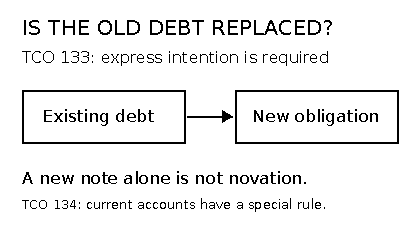
The Article 133 test: a new obligation and express replacement intention
Novation, or yenileme, addresses the replacement of an existing debt by a new obligation. The first paragraph of Article 133 of Law No. 6098 requires express intention directed to that result. The provision does not equate every commercial change with extinction of the original obligation. The key question is whether the parties agreed that the old debt would end through creation of the new one.
Identify the existing obligation precisely before analysing the replacement. Record the debtor, creditor, legal basis, amount, currency, maturity and any security. Then identify the new obligation and the language linking it to discharge of the old debt. An agreement describing future instalments without addressing the continued existence of the original claim does not answer the statutory question by its heading alone.
The intention must be that of the parties, not simply the interpretation preferred by the person now facing collection. Equally, a creditor cannot disregard an express replacement arrangement merely because the old invoice remains visible in its accounting software. The contract and the documents evidencing assent must be examined alongside the account records.
A new promissory note is not, by itself, payment or novation
Article 133 expressly names the assumption of a negotiable-instrument obligation for an existing debt. Without express novation intention, that act is not treated as replacing the original obligation. The same paragraph covers a new debt instrument and a new suretyship instrument. Receiving more paperwork therefore does not necessarily mean that the creditor has abandoned the original transaction.
Distinguish three different events: issuing the instrument, transferring it to the creditor and actually paying the obligation. Keep the original instrument, any delivery receipt and the agreement describing why it was given. A note handed over as additional security has a different stated purpose from a document explicitly accepted as part of an arrangement extinguishing and replacing the old debt.
This does not authorise double recovery. The records must show all actual payments and the amount still outstanding. Nor does Article 133 determine every defence or procedural rule relating to a negotiable instrument. The instrument’s validity, holder, endorsements, maturity and the enforcement route remain separate questions. A conclusion about absence of novation is not a complete opinion on how every document can be enforced.
Changing a due date is different from extinguishing the debt
A repayment arrangement should be read clause by clause. It can postpone maturity, change the instalment timetable, acknowledge a balance, reduce a disputed amount, introduce security or contain an express replacement agreement. Those effects should not be combined into a single assumption that a new signing date always creates an entirely new debt.
Look for the operative treatment of the old obligation. Does the document preserve the original claim subject to revised payment dates? Does it state that an earlier obligation is discharged and another takes its place? Does any discharge depend on actual payment? Does it settle only selected invoices? These are questions to answer from the signed wording, not model clauses that can be inserted without considering the transaction.
A payment schedule can therefore matter greatly without establishing novation. It can change the dates on which performance is expected and provide evidence concerning the amount acknowledged. The fact that a document has an important legal effect does not mean that its effect is necessarily the one described by Article 133. The original and revised arrangements should remain available for comparison.
Read a settlement’s release and default provisions together
A settlement can resolve a contested account and prescribe a reduced payment. The legal analysis must identify whether it contains a release, a replacement obligation, an amendment or a combination of provisions. Article 132 addresses release of a debt through an agreement between the parties; Article 133 addresses extinction through a new obligation. These are neighbouring but different mechanisms.
Pay particular attention to the relationship between performance and discharge. A clause providing a release after full payment should not be described as an immediate unconditional release. Conversely, an express immediate discharge should not be ignored merely because the creditor expected timely performance of the new undertaking. The wording dealing with default and any revival of claims must be examined with the rest of the settlement and applicable mandatory rules.
Where the agreement was concluded through mediation or recorded in proceedings, its procedural status requires additional analysis. Our guide to Turkish mediation settlements signed from abroad addresses authority, execution and enforcement questions. A heading such as settlement does not itself establish either novation or the availability of a particular enforcement document.
Why accessory rights must be checked before signing
Article 131 states the general consequence of extinction of the principal obligation: accessory rights and duties such as pledge, suretyship, interest and a contractual penalty also end. That rule makes classification of a restructuring important for both sides. A creditor who intends to preserve security should not assume that the old instruments remain unaffected after the principal debt has genuinely been extinguished.
The same article specifically addresses accrued interest and contractual penalties. Those claims can be preserved by agreement, by a reservation notified no later than performance, or by circumstances showing that they were reserved. Special provisions on immovable pledges, negotiable instruments and concordat are expressly reserved. These qualifications prevent the general rule from being reduced to a claim that every related right always disappears in exactly the same way.
Prepare a security schedule before completion. It should identify each instrument, its beneficiary and grantor, the debt it secures and the required consent or form for any change. An individual surety has a legal position separate from that of the principal debtor. A lender and borrower cannot simply assume that their private restructuring binds every third-party security provider on new terms.
For individual personal security, the suretyship form and consent guide and the suretyship duration guide explain the separate requirements. A document describing security as renewed still needs to satisfy the rules governing that security. The novation analysis does not replace those safeguards.
Article 134: posting an item to a current account is insufficient
The first paragraph of Article 134 states that merely recording separate items in a current account does not mean the debt has been novated. Entering an invoice into a ledger, renumbering it or including it in a running statement therefore cannot alone establish the statutory result. The party relying on novation needs to identify something more than an internal accounting entry.
The second paragraph gives the relevant statutory sequence: the account is closed and the result is accepted by the other party. In that situation the debt is novated. Both elements matter. A unilateral statement prepared by one party is not, simply because it is labelled a closing statement, proof of acceptance by the other.
It is also necessary to establish that the relationship is legally the relevant current-account arrangement. Businesses use the expression current account loosely for many customer ledgers and bank statements. Article 134 should not be applied mechanically to every spreadsheet bearing that label. The agreement, the nature of the reciprocal entries and applicable commercial-account rules must be examined before relying on the closing-balance provision.
Security for a current-account item has an express statutory protection
Article 134’s final paragraph states that where one of the items has security, closing the account and accepting the result do not extinguish that security unless otherwise agreed. This is an important qualification within the current-account novation rule itself. It should be read with the general accessory-right framework rather than omitted from an explanation of the accepted balance.
Identify the secured item and its relationship with the balance. Retain the document creating the security and any agreement departing from the default rule. A reference to a general collateral package does not specify which account entry was secured. Nor should security for an unrelated claim be assumed to secure every balance merely because the same creditor holds it.
The scope, validity and enforceability of the security still require their own review. Article 134 preserves the described security by default; it does not validate an instrument that failed its original formation requirements. It also does not answer every issue concerning the amount recoverable, expiry, the security provider’s defences or the procedure for realisation.
Do not confuse novation with assignment or a change of debtor
Assignment of a receivable changes the person entitled to the claim. Debt assumption concerns the debtor-side arrangement. Transfer of a contract changes the contractual position under its own rules. These transactions must be distinguished from extinction of an old obligation through a new one, even when the same commercial restructuring contains more than one of them.
The guides on receivables assignment, debt assumption and contract transfer and accession explain the respective mechanisms. Their consent and form requirements should not be bypassed by choosing the English word novation as a convenient label.
In cross-border documents, terminology deserves particular care. An English-language agreement can use novation to describe a party substitution. The Turkish-law assessment must identify the legal result intended and the rules actually governing it. First determine the applicable law, then classify the arrangement; do not import an English legal meaning into Article 133 without that analysis.
Build an evidence record that separates documents from payment
The review file should contain the original debt agreement, invoices or other source documents, the new instrument, the repayment or settlement agreement and evidence of assent. Add bank records and an allocation of each payment. This permits the legal reviewer to distinguish the existence of another paper claim from an actual reduction or discharge of the outstanding balance.
For a current account, add the governing agreement, detailed entries, closing statement and the evidence relied on as acceptance. Identify who accepted and in what capacity. For security, add the original security instruments and later amendments. Missing attachments can change the interpretation of an otherwise apparently clear one-page arrangement.
Use a chronology showing the original maturity, the later agreement, delivery of instruments, payments and any enforcement steps. Do not erase the original record after executing an amendment. The earlier document remains essential to deciding what changed and whether a creditor is attempting to enforce an obligation that has been replaced.
Separate the merits from an existing procedural deadline
A party asserting novation should identify the exact agreement and the old claim said to have ended. A creditor resisting that assertion should identify the reservation or the absence of express replacement intention on which it relies. Neither position is established merely by repeating the phrase new agreement. The statutory test and the relevant wording must be connected directly.
Where a claim or payment order has already been served, provide the complete document and service record with the contracts. The procedural response depends on the route being used. Negotiating another instalment schedule does not itself file a defence, withdraw proceedings or suspend the applicable time limit. Our enforcement guide for overseas clients provides the broader procedural starting point.
Frequently asked questions
Does signing a new payment plan automatically cancel the original debt?
No. Article 133 requires express intention to extinguish the existing obligation through a new one. Read the operative provisions, including any discharge conditions, rather than assuming that a new date or instalment table establishes novation.
Does issuing a promissory note establish novation?
Not by itself. Article 133 expressly excludes automatic novation from a negotiable-instrument undertaking, a new debt instrument or a new suretyship instrument without the parties’ express novation intention.
Is novation the same as paying the creditor?
No. Novation replaces an existing obligation with a new one. Payment concerns performance. The file must separately record the new agreement and all sums actually received so that no amount is recovered twice.
Does the word renewal prove the old debt ended?
No. Determine the parties’ intended legal result from the complete agreement. A renewal label can describe revised payment dates or security arrangements without answering the express-intention requirement in Article 133.
Can the original security disappear after genuine novation?
Article 131 links accessory rights to the principal obligation’s existence, subject to its qualifications and special rules. Security must be reviewed instrument by instrument; its survival should not be assumed after the secured debt has ended.
Does recording an invoice in a current account novate it?
No. Article 134 states that merely recording items in a current account does not produce novation. The account relationship and the further statutory requirements must be established.
What does Article 134 require for current-account novation?
It identifies closing the account and acceptance of the resulting balance by the other party. A unilateral ledger entry or statement alone does not establish both elements.
Does acceptance of the current-account balance end every security?
No. Article 134 preserves security for an account item despite closing and acceptance unless otherwise agreed. The secured item and any contrary agreement must be identified.
Is replacing a contracting party always Article 133 novation?
No. Contract transfer is regulated separately by Article 205. A cross-border document’s terminology must be matched to its actual legal effect and governing law rather than treated as conclusive.
What records should be sent for a restructuring review?
Send the original agreement, replacement or amendment, instruments, payment records, relevant account acceptance and security documents. Include any served claim and its service date, using a confidential channel agreed with the office.
Official sources
Law No. 6098, particularly Articles 19 and 131–134; official Ministry text, page 26, containing the novation provisions. The Turkish statutory text controls; the English discussion is explanatory.
Istanbul and Mersin offices
For an English-language assessment of a repayment or replacement agreement, identify the original debt, the later signing date and any urgent enforcement document through the English contact section. Our Mersin-based practice coordinates Turkish matters from Mersin and Istanbul. Arrange a confidential channel before transmitting financial records.
Istanbul — Polaris Plaza
Maslak Ahi Evran Caddesi, Polaris Plaza No:21, Floor 9, 34475 Sarıyer/İstanbul.
Mersin — Profit İş Merkezi
İhsaniye Mahallesi, 4903. Sokak, Profit İş Merkezi No:23, Floor 3, Office 14, 33070 Akdeniz/Mersin.
Call +90 552 224 43 66. This article is general information; sending an enquiry does not preserve a procedural deadline or establish representation.
Contact regarding a legal matter
In your first message, you may briefly state the subject, your country or city, and any relevant notification or recent procedural date. Please do not send identity numbers, medical data, or personal documents. Messaging alone does not constitute legal advice or create a lawyer–client relationship.
Discover more from Bakırcı & Keskin Hukuk Bürosu
Subscribe to get the latest posts sent to your email.