A Turkish Company Loses Its Sole Director: Board Vacancies, Replacement and Court Permission Under TCC 363 and 410
Short and clear answer
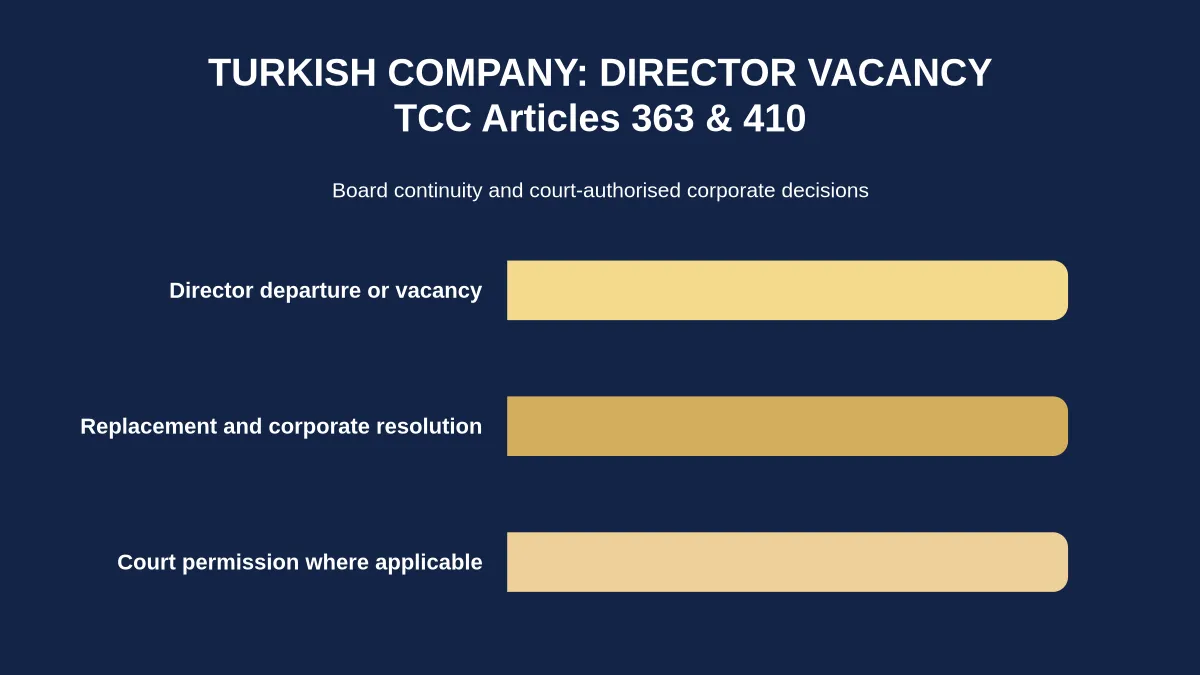
A Turkish company director vacancy is not always filled by the same procedure. In a joint-stock company, Article 363 of Turkish Commercial Code No. 6102 allows an existing board capable of acting to appoint a qualified temporary replacement and submit the appointment to the first general meeting. When the sole director has left, no board remains to make that decision. Article 410(2) provides a different route: a shareholder can obtain court permission to call the general meeting where the board does not exist, is persistently unable to convene, or cannot form a meeting quorum. A foreign parent company’s internal appointment letter does not replace the Turkish corporate procedure.
Have a general question about this article? Ask anonymously
Quick summary
| Problem | Legal route | Document to check first |
|---|---|---|
| Vacancy with a functioning board | TCC 363: temporary replacement and first-meeting approval | Current board composition and articles |
| Sole director gone or board unable to form a quorum | TCC 410(2): court-authorised shareholder call | Proof of vacancy and shareholding |
| Only a corporate director’s human representative changes | TCC 359(2) and 364(1) | Registered corporate member and representative |
| Board term expired | TCC 410(1): express power to call the general meeting | Election resolution and term |
Identify exactly which corporate office is missing
A foreign group can describe several people as its Turkish director: a board member, an employee with a managerial title, a branch manager, an authorised signatory or the natural-person representative of a legal-entity board member. These are not interchangeable. Start with the trade-registry record, the articles of association and the latest election resolution. Record the legal entity’s full registered name and registration number. An English-language organisation chart is useful background, but it does not establish who legally holds the board seat.
The distinction determines who must act. The departure of an employee called country director does not necessarily create a board vacancy. Conversely, a board member can cease to hold office even though the payroll or email directory has not been updated. A foreign shareholder should obtain the Turkish corporate records before sending instructions to the accountant, bank or local staff. Treat the employment file, board appointment and external signing mandate as three separate document sets that may require coordinated, but different, action.
Establish the vacancy and its effective date
Article 363(1) addresses a board seat becoming vacant for any reason. Paragraph two identifies situations in which membership ends automatically, including a bankruptcy decision, restriction of legal capacity, loss of statutory qualifications or loss of qualifications required by the articles. A contested resignation, death, removal or qualification issue should therefore be supported by the document that establishes the event and its effective date. Do not reconstruct the event from an informal group announcement alone.
Timing matters because a person who no longer holds office must not be counted as an available director merely to make a later resolution appear quorate. Keep the resignation and delivery evidence, death record where relevant, removal resolution or other operative documentation in the corporate file. A dispute about the effective date should be identified before circulating a replacement resolution. The review must distinguish proof of the underlying event from later registration and announcement steps; they are not automatically the same date or the same legal question.
What the remaining board can do under Article 363
The statutory temporary-appointment mechanism is commonly described as co-option. The board selects a person meeting the legal requirements, and the appointment goes to the first general meeting for approval. This is an appointment by the Turkish company’s board, not by its foreign shareholder acting alone. The board must itself be able to take a valid decision. Its composition, the articles and the meeting or written-decision rules therefore need examination before relying on Article 363.
Article 390 establishes the ordinary meeting and decision framework, subject to stricter provisions in the articles. It also prohibits directors from voting through another director or attending through a proxy. A replacement proposal signed by a shareholder’s attorney does not become a valid board vote simply because that attorney represents the investor. The file should identify each director who participated, the voting method, the exact proposed appointment and the provision relied upon. Appointment documents cannot cure an absent decision-making organ by describing it as present.
| Element | Question for the file |
|---|---|
| Vacant seat | Which seat became vacant, why and when? |
| Board capable of acting | Can a valid board decision be taken under the code and articles? |
| Eligible replacement | Does the candidate meet statutory and constitutional qualifications? |
| First general meeting | Has the temporary appointment been placed before that meeting? |
| Term | What was the predecessor’s unexpired term? |
Approval does not automatically create a new three-year term
Article 363 distinguishes the temporary appointment from its confirmation. The selected member serves until the general meeting to which the appointment is submitted. If approved, that member completes the predecessor’s term. The general maximum term in Article 362 must not be confused with the particular remaining period attached to a co-opted seat. A resolution should therefore record the predecessor’s original election date and term, rather than casually granting a fresh full term under the label of approval.
The general meeting should be given a coherent record: the vacancy, the board’s selection, the candidate’s qualifications and the approval proposal. Separate any additional election decision from confirmation of the temporary appointment. This avoids inconsistent dates in the minutes, registry application and signing documents. The shareholder vote is not a formality to leave undocumented because the foreign group has already accepted the candidate internally. It is the statutory stage that determines the continuing position of the replacement under Article 363.
Why loss of the sole director requires a different route
When a company has one director and that person ceases to hold office, there is no remaining director to exercise the board’s Article 363 power. The former director’s accountant, employee or shareholder representative does not acquire that power merely because an appointment is urgent. The legal problem is an absent corporate organ. Article 410(2) expressly addresses the absence of a board, persistent inability to convene and inability to form the meeting quorum.
The provision allows a single shareholder, with court permission, to call the general meeting. It is therefore distinct from the minority-percentage mechanism in Articles 411–412. The relevant standing is not established by importing the ten-percent or five-percent thresholds from the ordinary minority-call rules. A shareholder must still prove the Article 410(2) conditions. The court’s permission concerns convening the meeting; it is not a judicial appointment of the applicant as director and does not itself confer authority to sign the company’s contracts.
Build an Article 410(2) application around the actual corporate blockage
The application should identify the company, the applicant’s shareholding and the particular statutory condition that prevents a normal board call. Attach the current articles, relevant registry publications, election resolutions, evidence of the vacancy and the proposed business of the general meeting. A short chronology is particularly useful where directors left on different dates. The requested permission should be connected to restoring a lawful decision-making structure, not expressed as an unlimited power to run the business.
The statute describes the court’s decision as final. That statement concerns the permission decision; it does not eliminate every possible dispute about the subsequently convened meeting, attendance, voting, minutes or resulting appointments. Counsel should settle the competent forum and the required documents before filing and implement the court’s order exactly. The statute does not prescribe a universal court-completion time or guarantee immediate bank access. Article 410 supplies a legal route, not a guaranteed timetable for judicial processing or third-party acceptance.
A corporate director and its human representative are different
Article 359(2) permits a legal entity to be elected to the board and requires the designated natural person acting for that legal entity to be registered and announced with it. Article 364(1) permits the legal-entity board member to replace its registered representative. The corporate member remains distinct from the human individual who attends and votes for it. The departure of that representative should not automatically be described as the disappearance of the corporate board member.
For an overseas parent occupying the board seat, establish who can validly make the parent’s designation and which foreign corporate documents evidence that authority. Then complete the Turkish registration and announcement requirements applicable to the representative. A private email naming a new contact person is not the whole compliance process. Our guide to a foreign legal entity serving as a board member explains that separate structure. Keeping it separate prevents an unnecessary shareholder election or an invalid assumption that an unregistered person can vote.
Expired board terms are not the same as an absent board
Article 410(1) expressly allows the board to call the general meeting even after its term has expired. The purpose of that express calling power must not be expanded into an unrestricted statement that every expired-term board action is valid. Where the immediate problem is renewal of appointments, the election record and the ability to issue a lawful meeting call should be analysed first. It can be a different case from the death or departure of every board member.
Article 416 also recognises a general meeting without the ordinary call procedure where all shareholders or their representatives participate, nobody objects and the statutory full-participation condition continues. This is not permission to ignore representation, minutes or other meeting requirements. Overseas ownership can make full attendance and properly documented representation difficult. A universal meeting should be used only where its actual conditions are satisfied, not as a paper description designed to avoid an unresolved call problem.
Restoring the board does not automatically restore every signature channel
Board membership, representation authority and access to a bank’s electronic system are different matters. Following an appointment, check the company’s representation arrangements, registered signatories, signing combinations and any separately issued powers of attorney. A newly elected director should not assume that a personal online banking login, customs portal role or contractual signing mandate automatically follows from the board seat. Equally, removing a user’s technical access does not itself complete the company’s corporate appointment procedure.
Prepare an implementation schedule naming the responsible person for the registry filing, corporate books, bank notifications and operational permissions. Preserve the old records rather than overwriting them, because the dates can matter for transactions already signed. The guide to foreign board member responsibilities concerns duties and liability; it does not replace the separate proof of authority required for a particular transaction. Avoid representing that a registry update retrospectively validates every act during the vacancy.
The overseas shareholder’s document package and implementation record
The practical file should contain one corporate identity sheet, an accurate ownership record, the current articles, the last election minutes, the vacancy evidence and a board-composition timeline. Add the proposed replacement’s information, the applicable approval route and the draft meeting business. Where foreign documents are used, identify which originals, authentication and Turkish translations the relevant authority requires. Requirements depend on the document and procedure; nationality alone does not supply an automatic exemption or a universal apostille requirement.
After the appointment, reconcile the signed minutes, approval record, registry submission and updated representation documents. Confirm that the same names, dates and terms appear throughout. Retain delivery and filing receipts. The minority shareholder guide provides related but distinct remedies when a functioning company refuses shareholder requests. A board-vacancy file should remain focused on restoring the lawful organ and its ability to act, rather than combining every shareholder dispute into one application.
Preserve records during the management handover
A director replacement is also a record-preservation exercise. Identify who holds the decision book, share register, company correspondence, contract originals and electronic filing credentials. Record which materials are delivered to the incoming management and which remain unavailable. A signed handover inventory can help distinguish an established fact from an unresolved allegation, but it does not itself determine liability for missing documents or confer powers absent from the corporate appointment.
Keep the handover record separate from any settlement, release or resignation wording. The incoming director’s acknowledgement that a box of records was received is not necessarily an acceptance that the accounts are accurate or that all earlier acts were authorised. Likewise, a shareholder’s wish to avoid business interruption does not justify creating minutes for a meeting that never occurred. Preserve the contemporaneous evidence and address any missing authority or disputed transaction through the appropriate legal procedure.
Frequently asked questions
Can the foreign parent appoint a replacement by email?
An internal parent-company email does not replace the Turkish company’s required board or general-meeting decision. First identify whether the change concerns a board seat or only a corporate director’s registered representative.
Who makes a temporary appointment under Article 363?
The board makes the temporary selection and submits it to the first general meeting. The remaining board must be able to take a valid decision under the statute and the articles.
Can staff replace a deceased sole director?
Staff do not acquire board appointment powers because the director has died. The absence of the board requires the appropriate shareholder-meeting route, including Article 410(2) court permission where applicable.
Does Article 410(2) require a ten-percent shareholding?
It expressly permits a single shareholder to seek permission in the specified board-blockage situations. The minority thresholds in Articles 411–412 must not be substituted for this separate provision.
Does court permission appoint the applicant as director?
No. The permission allows the general meeting to be called. The subsequent election and other corporate formalities remain separate steps.
How long does a confirmed replacement serve?
Under Article 363, a replacement approved by the general meeting completes the predecessor’s term. Approval of a temporary appointment is not automatically a new three-year election.
Can an expired-term board call the meeting?
Article 410(1) expressly preserves the board’s ability to call the general meeting despite expiry. That express calling power should not be treated as blanket authority for unrelated acts.
Can all shareholders meet without an ordinary call?
Article 416 allows this only under its conditions, including participation of all shareholders or their representatives, absence of objection and continuing full participation. Other meeting rules remain relevant.
Can a director vote through an attorney?
Article 390(2) prohibits board members from voting for one another or attending through proxies. Shareholder representation at a general meeting is a different legal capacity.
Is changing a corporate director’s representative a new election?
The corporate director and its designated natural person are distinct. Articles 359(2) and 364(1) govern the representative structure; the required Turkish registration and announcement must still be addressed.
Does election automatically grant online bank access?
No automatic technical access should be assumed. Review corporate representation, signing mandates and the bank’s implementation requirements separately from board membership.
Does the same procedure apply to a Turkish limited company?
This guide addresses joint-stock companies. A limited company’s management structure and replacement procedure must be assessed under the provisions applicable to that company form.
Contact regarding a legal matter
In your first message, you may briefly state the subject, your country or city, and any relevant notification or recent procedural date. Please do not send identity numbers, medical data, or personal documents. Messaging alone does not constitute legal advice or create a lawyer–client relationship.
Discover more from Bakırcı & Keskin Hukuk Bürosu
Subscribe to get the latest posts sent to your email.