Turkish Clinic Published Your Before-and-After Photos: Withdraw Consent and Request Removal Under Article 7
Short and direct answer: Article 7(1)(c) of Türkiye’s Health Services Promotion and Information Regulation of 12 November 2025 permits a patient to withdraw permission to share their medical photographs at any time, without a procedural requirement or condition. The healthcare facility or relevant professional must process and conclude that withdrawal immediately. Article 7(1)(b) separately requires explicit consent for using patient images, and the patient has the right to see the proposed image in advance. This differs from consent to the treatment itself and from the general thirty-day response period for a separate data-controller application under Law No. 6698.
Have a general question about this article? Ask anonymously
This guide addresses foreign patients whose dental, cosmetic, hair-transplant or other treatment photographs were published by a Turkish clinic on social media, an advertising site or a medical-tourism channel. It explains the specific withdrawal and removal rights, consent evidence, rules for before-and-after photographs, overseas communications and distinct data-protection remedies without assuming that all clinical records must be erased or that every sponsored foreign-facing post is prohibited.
Quick summary
| Primary regulation | Health Services Promotion and Information Regulation, Official Gazette No. 33075, 12 November 2025 |
|---|---|
| Images and consent | Article 7(1)(b): explicit patient or legal-representative consent, including the Annex 1 visual-content form |
| Withdrawal | Article 7(1)(c): at any time and without conditions; request processed immediately |
| Refusal of permission | Article 7(1)(ç): diagnosis, treatment and charges must not change |
| Foreign-facing channels | Article 8: special rules for authorized international health tourism |
| Data-protection procedure | Law No. 6698 Articles 11, 13 and 14 — distinct request and complaint timelines |
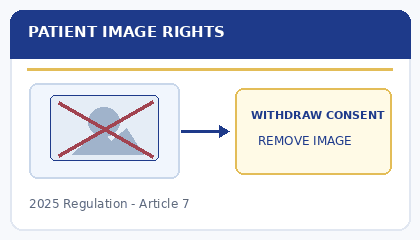
Treatment consent and consent to publish photographs are different decisions
A foreign patient can agree to an operation in Türkiye while refusing to appear in the clinic’s advertising or social media. The regulation on health-services promotion and information, published on 12 November 2025 in Official Gazette No. 33075, addresses the use of patient images in Article 7. Article 7(1)(b) requires explicit consent from the patient or the legally relevant representative for the use of images belonging to the patient, consistently with patient-rights rules. This is a separate legal question from whether the patient accepted a medical intervention.
A clinic should not infer image-publication consent from payment, attendance at a consultation, consent to clinical photography for diagnosis, or an electronic treatment-consent verification. The patient may have allowed the doctor to photograph a treatment site for healthcare records without agreeing to a public marketing post. The file should identify the actual document or electronic permission said to authorize the specific public use. An ordinary procedure-consent form should not be described as the special visual-recording and processing consent form without inspecting what it says.
The newer 2026 regulation on obtaining informed medical consent electronically concerns the treatment decision and its verification workflow. It does not abolish Article 7’s rules for promotional images. The two forms and purposes should be separated in a complaint. A patient challenging both the intervention and social-media publicity should create separate factual chronologies and should avoid treating a disputed promotional photograph as the only evidence of what happened during clinical treatment.
Article 7 explicitly refers to the visual-recording and processing consent form
Article 7(1)(b) states that explicit consent for the patient’s image can be obtained in writing or electronically using the Visual Content Recording and Processing Consent Form included in Annex 1 of the regulation. A professional assessment should obtain a copy of the actual form as completed, the date, the channel of collection and the images or uses presented to the patient. Saying ‘the patient consented online’ does not identify the content, purpose or person who gave that consent.
Where a patient was a minor or legally restricted person, the relevant parent or guardian may be the person required to consent under the stated provision. The clinic should identify the legal authority of the representative, rather than rely on an unrelated companion or staff member. The evidence should make clear whether the person whose image appears is the patient who gave consent and whether any separate persons in a photograph were also included.
A patient already abroad should retain copies of any forms sent by email or through a clinic portal, including original messages and attachments. The form’s language and the actual explanation can be relevant to whether consent was informed and specific. Avoid assuming that every translated summary matches the original Turkish document. If the clinic cites a contract signed through a treatment broker, request the full version and the specific authorization it claims for public image use.
The patient has a right to view the proposed image before publication
Article 7(1)(c) expressly recognizes the patient’s right to see the image intended for publication beforehand. This is a meaningful protection, not simply permission to place a camera in the consultation room. A clinic seeking to rely on consent should preserve the evidence of which image or video was shown to the patient and when. The patient should identify whether the posted photograph was the version previously viewed or materially different.
The distinction matters when an image is cropped, combined with another photo, given a caption, placed next to an alleged treatment outcome, or used for a different campaign. The regulation separately imposes restrictions concerning misleading content, technology-based changes and the conditions under which before-and-after images are made. A patient seeing a private diagnostic photo does not automatically prove review of the later social-media composition and accompanying statements.
For a dispute, preserve screenshots of the original post, including the account name, publication date, caption, video cover, URL and visible presentation. Where feasible, retain the underlying file through a reliable evidence process without further public dissemination of sensitive images. The aim is to establish precisely what was posted and whether it matched a previously reviewed and consented use.
Permission to share can be withdrawn at any time without conditions
Article 7(1)(c) expressly permits the patient, or the relevant parent or guardian, to withdraw permission to share visual content at any time without being subject to a procedure or condition. This is one of the clearest rules in the 2025 instrument. A clinic cannot accurately describe the permission as irrevocable merely because a marketing campaign has started or because an agency has already received a payment to publish the images.
The same paragraph requires the healthcare facility or healthcare professional to take the withdrawal request into account immediately and to conclude the process. This is a direct sector-specific obligation. The institution should not confuse it with the separate thirty-day outside limit for responding to an application under the general Personal Data Protection Law No. 6698. A patient seeking immediate removal of a promotional photograph should cite the specific Article 7 rule and preserve evidence of when withdrawal was communicated.
The wording should also not be misrepresented as a promise that every archived copy elsewhere on the internet will disappear instantly. The institution must act regarding the uses it controls and the applicable legal process. Where a third-party account or platform is involved, identify who originally published, commissioned or reposted the content, what permissions were given and what steps are necessary to stop continued dissemination. An unverified claim of universal deletion is not an adequate confirmation.
Refusing promotional use must not change treatment or the charge
Article 7(1)(ç) requires patients who do not give permission for use of their images to be informed and assured that their diagnosis, treatment and charges will not change because of that decision. The rule directly addresses pressure to trade privacy for healthcare. A patient should not be told that the agreed medical price increases, treatment quality declines or access to medically necessary follow-up depends on consenting to before-and-after advertising.
Article 7(1)(d) also prohibits payments, discounts or gifts given in return for permission to use visual content. This rule must be read alongside the other advertising provisions, including the specific Article 8 rules for authorized international health tourism. Do not turn a contractual price reduction into an automatic explanation that the patient gave valid consent to every subsequent image use.
A patient alleging pressure should preserve the written quotation, invoice, booking messages and any communications linking an image-release form to a price or service. The legal question is the actual condition imposed and the rule engaged, not the patient’s general satisfaction with the treatment. Complaints about treatment performance and complaints about image publication can be pursued on their separate evidence and legal bases.
Before-and-after images face technical and timing restrictions
Article 7(1)(e) requires images and videos used for promotion or information to reflect actual settings and techniques without misleading makeup or technological modification of the visual content afterward. Article 7(1)(f) requires images before and after a medical procedure to be made under the same environmental and technical conditions and to display both the procedure date and the image-capture dates. These are concrete rules, not merely a general instruction to be truthful.
The patient can preserve the relevant screenshots and compare visible dates, lighting, framing and presentation. A difference does not automatically prove unlawful post-processing, but it identifies an issue to examine against the statutory requirements. Any expert evaluation of images should distinguish normal photographic limitations from a claimed prohibited alteration. Neither the patient nor the clinic should create a fabricated technical report to support a desired conclusion.
Article 7(1)(g) requires identification of whether shared images belong to the relevant healthcare professional and a real patient, or come from a source that must be stated. Article 7(1)(ğ) also restricts promotional images using patient or relative thanks or satisfaction, and requires publication interactions such as comments, likes and reshares to be disabled. These detailed duties remain important even where the patient signed a release.
Some categories of patient imagery remain restricted even with a release
Article 7(1)(h) prohibits sharing images of patients during a medical intervention, procedure or operation. Article 7(1)(ı) addresses images of intimate body areas contrary to general morality and restricts content unrelated to the procedure and relevant body region. The healthcare organization must therefore consider more than whether the patient consented: the content itself must meet the additional rules of the regulation.
The patient should avoid reposting intimate or invasive imagery publicly to prove a complaint. Preserve it in a secure evidentiary form and communicate through appropriate restricted channels. A legal file should describe the publication without exposing the patient’s private health situation unnecessarily. Where a platform report is made, the patient should use the privacy reporting process while maintaining a verified record of the original post for possible legal proceedings.
Article 7(1)(i) states that the healthcare facility or relevant professional must make the image publication itself and is not relieved of responsibility simply because someone else actually posted it. This is important when the social-media account belongs to a contractor, marketing team or intermediary. The circumstances and legal relationships still require examination, but outsourcing publication does not, under the article, simply eliminate the regulated provider’s responsibility.
Foreign-facing health-tourism advertising has a specific Article 8 regime
Article 8 of the 2025 regulation contains a special framework for licensed international health-tourism facilities and intermediaries. It contemplates separate foreign-facing websites or social-media channels, subject to identified conditions. Its advertising and sponsorship rules differ in certain respects from general domestic restrictions. Therefore a legal article should not claim that every sponsored image directed to a foreign audience is categorically prohibited.
Article 8 still requires respect for patient privacy and, for the stated patient stories and feedback, evidence of explicit patient consent. Article 8(4) provides for the remaining provisions of the regulation to apply on matters not specifically regulated in its international health-tourism section. The existence of an overseas marketing channel is not, by itself, a complete answer to the patient who withdraws permission to share their image under Article 7.
A complaint should identify whether the site or account was actually operated as an authorized foreign-targeted health-tourism channel, whether authorization was displayed, and which entity published the image. Avoid assuming that an English caption or foreign domain name establishes compliance. The authorization, target settings, the identity of the healthcare facility and the actual image consent are separate items to verify.
Personal data rights under Law No. 6698 remain available
Article 6 of the 2025 regulation expressly requires compliance with the Personal Data Protection Law No. 6698 and the rules on personal health data. A patient’s identifiable treatment photograph may involve personal data, including sensitive health-related information depending on what it reveals and the processing context. The applicable legal basis, transparency, purpose and security duties therefore need examination beyond the marketing-consent form itself.
Article 11 of Law No. 6698 provides data-subject rights, including obtaining information about processing and, under its conditions, requesting deletion or destruction. Article 13 establishes an application route to the data controller, with a response as soon as possible and at most within thirty days. Article 14 provides a complaint route to the Personal Data Protection Board after the required application, subject to the stated thirty-day-from-response and absolute sixty-day-from-application periods.
The distinction between the two frameworks is critical. Article 7(1)(c) of the health-promotion regulation requires the facility to process and conclude a withdrawal immediately. The thirty-day period under Article 13 of Law No. 6698 is the outer time frame for the data-controller response in that separate procedural channel. Patients should cite both legal bases where relevant rather than tell the clinic it can leave a withdrawn promotional photograph publicly visible for thirty days.
Preserve proof before making a removal request
Because digital posts can be changed quickly, preserve evidence showing the material while it is public. Record the exact page address, account name, post date, screenshot with visible identifiers, captions, hashtags, advertising presentation and any linked pages using the image. Keep a secure record of the clinic’s response and the patient’s original consent or withdrawal communication. Do not circulate sensitive screenshots to unrelated groups simply to build pressure.
A lawyer can prepare a dated chronology distinguishing the first publication, discovery by the patient, withdrawal, acknowledgment and reported removal. A statement that the clinic ‘never had permission’ is a different factual allegation from saying permission was initially given and later withdrawn. Both can lead to legitimate legal questions, but the evidence must identify which occurred. The legal record should not retroactively alter the date when the patient acted.
After requesting removal, check the original address and any known controlled accounts, then preserve a second record showing what changed. If a preview or cached search result persists, document that separately from the active publication under the clinic’s control. A legal demand should be precise about the material and locations sought to be removed, rather than claim an unverified right to delete the entire internet or every lawful clinical record.
How to send a focused withdrawal and removal notice
The request should identify the patient securely, specify the exact posts and accounts, state clearly that consent to promotional image sharing is withdrawn, and refer to Article 7(1)(c) of the regulation dated 12 November 2025. Ask the healthcare institution and the responsible professional to stop the identified publication, process the withdrawal immediately, and confirm the actions taken. A copy of the contested image can be sent through a secure channel instead of an open social-media comment.
If the patient also invokes Law No. 6698, the data-controller application should separately state the personal-data request and use an application method recognized under the relevant rules. Retain proof of dispatch and receipt. Where an agent or intermediary posted the material, identify the relevant controllers and the role of the healthcare facility. Do not assume that a complaint to one generic social-media inbox is necessarily a formal application to every legally relevant data controller.
The institution’s reply should be evaluated against the actual withdrawal and the specific legal duties. A vague assurance that the content ‘will be checked later’ is not the same as documented action. Equally, the patient should not assert a completed deletion when only one post was removed but other identified controlled uses remain. Accurate follow-up can help distinguish a meaningful resolution from an incomplete one.
Withdrawal of advertising permission does not automatically erase the medical file
A patient may want promotional use stopped while still needing medical records for follow-up care, insurance or a later legal claim. The legal purposes are different. The 2025 regulation concerns image use for promotion and information, while healthcare documentation and personal-data retention can be subject to other lawful requirements. Withdrawing a marketing release should not be described as a universal order to destroy every clinically necessary image or health record, regardless of legal retention obligations.
A person already abroad should preserve copies of treatment plans, discharge reports, clinical photographs needed to evaluate the procedure and communications about revisions or complications. The patient can challenge unauthorized publication without undermining the existence of evidence relevant to treatment. A clinic also needs to distinguish images maintained for lawful treatment records from those reproduced publicly to attract patients.
Where a data subject separately requests erasure under Law No. 6698, the applicable grounds and exceptions must be assessed rather than assuming all health information has one retention rule. A properly scoped instruction can demand removal from marketing channels while seeking lawful access to the medical file. This helps protect both privacy and the patient’s ability to pursue any separate treatment-related claim.
Regulatory complaint, data complaint and compensation are different remedies
A patient may present an alleged breach of the health-promotion regulation to the competent provincial health administration and may pursue the data-protection route under Law No. 6698 where its requirements are met. Article 10 and following provisions of the 2025 regulation deal with monitoring and administrative consequences through the identified authorities. A complaint about the publication and a demand for damages are not legally the same claim.
Article 14(3) of Law No. 6698 preserves rights to seek compensation under general provisions where personal rights have been infringed. However, the fact that a photograph was posted does not itself prove a particular monetary sum, causation or the correct court. The type of injury, responsible legal person, available evidence, applicable law and procedure must be established. Avoid promising a standard payment for every unlawful social-media image.
Where the patient also alleges negligent dental or cosmetic treatment, handle that separate claim using the medical and contractual records. A privacy complaint cannot replace expert evidence about clinical standards or a properly established causal link to injury. Likewise, a clinic’s willingness to remove images does not automatically settle a separate refund or malpractice dispute unless a valid agreement actually resolves those claims.
Steps for a patient who has already returned overseas
An overseas patient should preserve the contested post and consent history, then send a clear withdrawal to the healthcare facility through a verifiable channel. The request can be made without traveling solely to announce the withdrawal. The article itself does not create a universal procedure requiring attendance at the clinic. Secure remote communication and proper identification can facilitate factual investigation and representation.
If the patient does not speak Turkish, keep the original text and a reliable translation of the request. List exact URLs, the patient’s name and the procedure without unnecessarily broadcasting sensitive medical details. For a data-controller request, use an authorized application method and track the formal dates. For the sector-specific request under Article 7(1)(c), clearly identify the immediate withdrawal duty and record the clinic’s actions.
Bakırcı & Keskin Hukuk Bürosu manages Turkish legal matters from its physical office in Mersin and works with clients abroad using appropriate representation. The correct response depends on whether consent existed, whether it was withdrawn, where the material remained public and which legal persons controlled its use. No legal result or monetary recovery should be promised without the relevant records.
Frequently asked questions
Can a Turkish clinic publish before-and-after photos just because I accepted treatment?
No. Article 7(1)(b) separately requires explicit permission for use of the patient’s images under the specified form and patient-rights conditions.
Can I withdraw permission after the clinic already published my photo?
Yes. Article 7(1)(c) permits withdrawal at any time without procedure or conditions and requires the responsible facility or professional to process and conclude it immediately.
Does the clinic have thirty days to leave the photo online after withdrawal?
The sector-specific Article 7 withdrawal duty is immediate. Law No. 6698 Article 13’s thirty-day outside response period applies to the separate data-controller request process.
Must I approve the actual photo before it is used?
Article 7(1)(c) recognizes the patient’s right to see the proposed visual content before it is shared.
Can the clinic offer a discount in exchange for using my image?
Article 7(1)(d) prohibits payment, discounts and gifts in exchange for permission to use patient visual content.
Can refusing a photo release increase my treatment bill?
Article 7(1)(ç) requires patients to be informed and assured that treatment, diagnosis and charges will not change because image-use permission was refused.
Do before-and-after images have to use comparable conditions and dates?
Article 7(1)(f) requires the same environmental and technical conditions, and identification of the procedure date and the dates the photographs were taken.
Can a marketing agency avoid the clinic’s responsibility?
Article 7(1)(i) makes the regulated provider responsible for its required visual publication even if someone else posts it; the actual roles still require examination.
Can an authorized medical-tourism clinic run foreign-language sponsored advertising?
Article 8 contains a special regime for authorized foreign-targeted promotion under stated conditions. It does not eliminate the need to comply with applicable patient consent and privacy rules.
Does withdrawing permission mean all clinical photographs must be destroyed?
Not automatically. Promotional use must be distinguished from medical-record processing and any separate lawful retention requirements.
What is the general KVKK complaint timeline after contacting a controller?
Article 14 generally provides thirty days after learning the controller’s response, and in any event no more than sixty days from the application, after exhausting the Article 13 request route.
Can an overseas patient request removal without returning to Türkiye?
Article 7 does not require a personal visit merely to withdraw image-sharing permission. A secure, verifiable request and legally appropriate representation may be used.
Related English legal guides
- Disputing electronic medical consent under the 2026 regulation
- Obtaining dental records after returning abroad
- KVKK data requests for foreign residents
- Hair transplant dispute and treatment records
- Cosmetic plastic surgery complication claims
- Health tourism clinic and intermediary disputes
Author and professional responsibility
Author: Av. Halil Bakırcı, Bakırcı & Keskin Hukuk Bürosu. The firm’s physical offices are in Istanbul and Mersin and Turkish legal files can be managed nationwide for overseas clients through proper representation and remote communication. This is a general legal guide and does not find wrongdoing by any identified clinic or guarantee compensation or removal from every third-party cache.
Istanbul Office – Polaris Plaza, Maslak / Sarıyer
Bakırcı & Keskin Hukuk Bürosu
Maslak Ahi Evran Caddesi, Polaris Plaza No:21, Kat:9, 34475 Sarıyer/İstanbul
Our physical offices in Istanbul and Mersin coordinate matters throughout Turkey, subject to jurisdiction and the local steps required for each case. Please specify your preferred office when arranging an in-person appointment.
Open the Istanbul office on Google Maps · Contact and appointments
Contact regarding a legal matter
In your first message, you may briefly state the subject, your country or city, and any relevant notification or recent procedural date. Please do not send identity numbers, medical data, or personal documents. Messaging alone does not constitute legal advice or create a lawyer–client relationship.
Discover more from Bakırcı & Keskin Hukuk Bürosu
Subscribe to get the latest posts sent to your email.
