Five Percent Interest on Turkish Road Freight Claims: CMR Article 27 Written Demands, Start Dates and Currency
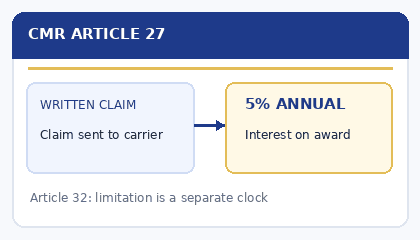
Short and direct answer: CMR Article 27(1) provides five-percent annual interest on compensation payable under the Convention. Interest begins when the written compensation claim is sent to the carrier or, if there was no written claim, when legal proceedings are instituted. The written claim also raises separate limitation issues under Article 32, which must not be conflated with the interest start date. Article 27(2) deals with currency conversion where the compensation calculation is in a different currency from the country of payment.
Have a general question about this article? Ask anonymously
International buyers, freight carriers and insurers dealing with Turkish road freight must separate the treaty interest calculation from the principal compensation claim, domestic statutory interest, written reservations under Article 30 and limitation under Article 32. This guide addresses the Article 27 interest problem in detail rather than offering a general introduction to cargo damage or claiming that the domestic Turkish interest rate automatically governs international road-transport compensation.
Quick summary
| Rate | Five percent per annum under CMR Article 27(1) |
|---|---|
| Starting event | Written compensation claim sent to the carrier, otherwise institution of proceedings |
| Currency conversion | Article 27(2) for the relevant valuation amounts |
| Separate limitation rule | Article 32(2) written-claim suspension and response documentation |
| Ordinary liability limits | Articles 23 and 25, subject to applicable treaty exceptions |
| Key evidence | Written claim, transmission proof, loss calculation and actual payment dates |
The five-percent treaty rule is not an ordinary Turkish legal-interest quote
Article 27(1) of the CMR Convention entitles a claimant to interest on compensation payable under the Convention at five percent per annum. That rule must be distinguished from the general Turkish statutory or commercial interest provisions that apply to other types of debt. A foreign buyer requesting damages for an international road shipment should not automatically import a domestic interest percentage merely because the carrier has an office in Türkiye or the claim will be pursued there. The first task is to establish that the compensation arises from carriage governed by the CMR.
CMR Article 1 identifies the principal scope conditions: goods carried by road for reward with taking-over and designated-delivery places in different countries and at least one Contracting State. That is different from a purely domestic road carriage or a separate unpaid sale invoice. A legal demand needs to identify the transport contract, carrier, origin, delivery destination and nature of the loss so that the correct compensation and interest provisions can be selected.
The five-percent figure is an annual rate attached to compensation due under the treaty. It is not a five-percent deduction from principal, an automatic monthly rate or a penalty multiplied by the number of transport legs. The amount of compensation itself remains subject to liability, value, declared interest and ceiling rules in the relevant provisions. Accurate interest accounting begins only after the legal basis and compensable amount have been identified.
Article 27 gives two starting events
Under Article 27(1), interest accrues from the date on which the written claim was sent to the carrier. If no such written claim was made, interest accrues from the date legal proceedings were instituted. These are different legal routes. The claimant should not substitute the shipment date, the date of a delayed delivery, or the day an insurer first opened a case as the starting date without connecting it to the treaty’s written-claim or proceedings language.
A properly documented claim history should identify the date a written demand was sent, the intended carrier recipient, the method of transmission, and the goods and compensation issue described. The treaty specifically refers to a claim sent in writing, while Article 32 contains separate rules concerning suspension of limitation and proof of receipt. Sending and receipt should be recorded independently rather than assumed to be identical, particularly where the claimant wants to rely on both provisions.
Where no earlier written claim exists, retain a filed copy of the court application or arbitration document and evidence showing when proceedings were instituted under the applicable procedural rules. An appointment with counsel or a private estimate of loss is not the same event. A demand should make clear which start date is used and why. The burden of creating a reliable chronology is simpler to manage before several years of correspondence have accumulated.
What should a written CMR compensation demand contain?
The purpose of the Article 27 demand is to identify the claim for compensation arising out of the transport. A professionally prepared written notice should name the claimant and carrier, describe the shipment and incident, identify the consignment note, state the loss or damage asserted, and request payment with enough detail to make the claim intelligible. An itemized amount or a reasoned provisional calculation should be included where the evidence permits it, together with an explanation of further technical assessment still required.
Document the transmission rather than merely saving an unsigned draft. Relevant proof may include the final email and its delivery metadata, postal record, registered letter, carrier portal acknowledgement, or other reliable written-channel evidence. If an agent receives the document, record the legal basis on which that person was entitled to receive claims for the carrier. A name on a business card or an email address from a freight forwarder does not by itself settle every question of legal representation.
Do not label every operational complaint an Article 27 compensation claim without analysing its contents. A telephone call asking for the driver’s location, a delivery booking message, a preliminary photograph with no explanation and a payment demand for an unrelated sale invoice concern different subjects. The actual writing must be evaluated. If the first message was inadequate, the legal analysis should identify the later writing that clearly asserted the CMR compensation claim rather than invent an earlier date.
Do not confuse Article 27 interest with Article 32 limitation suspension
Article 32(2) provides a separate legal effect for a written claim: it suspends the limitation period until the carrier rejects it by written notice and returns the attached documents. The party relying on receipt, rejection and return must be prepared to prove the relevant events. A written demand therefore has two potential roles—interest start date under Article 27 and limitation suspension under Article 32—but the wording and proof requirements of those provisions must each be addressed.
An example of the distinction is a claim sent in writing by the shipper and later rejected by the carrier. The interest issue involves Article 27’s stated starting event. Limitation involves when a sufficient written claim was made, its legally relevant receipt, the carrier’s written rejection, and the return of attached documents. The two timelines should not be merged simply because they concern the same letter. Article 32 also states that repeated claims with the same object do not suspend limitation again.
The basic limitation period is generally one year under Article 32, with a three-year period for wilful misconduct or equivalent default under the law of the forum. The period begins at different events according to the type of claim; for partial loss, damage and delay, it starts with delivery under Article 32(1)(a). A claimant should therefore prepare both a limitation schedule and an interest schedule and never assume that the five-percent rule extends or revives a barred claim.
Interest is calculated on a legally supported compensation amount
The treaty rate cannot repair an unsupported principal demand. Compensation for total or partial loss is governed by Article 23, which includes the value of goods at the place and time of taking over and a relevant weight-based ceiling. Damage to delivered goods is measured by diminution of value under Article 25 and its specific limits. Delay is assessed through the separate Article 23(5) rule, which requires proof of loss from delay and ordinarily caps such compensation at the carriage charges.
Where the shipment was partly damaged, the file should identify the damaged units, their relevant value and the evidence of depreciation. Interest then relates to compensation ultimately payable, not merely to the total commercial invoice for all goods in the consignment. Where a settlement or judgment determines an amount, the calculation must be reconciled with that operative instrument, the payments and the relevant accrual period.
Payments already made and amounts properly credited should be tracked by date, currency and legal purpose. A principal amount that changed during the interest period cannot be treated as constant without explanation. Likewise, an insurer’s payment to a party may require examination of whether the underlying compensation claim was assigned or otherwise affected. Do not simply add five percent annually on top of an invoice balance after it has already been discharged.
Article 27(2) is a separate currency-conversion rule
Article 27(2) addresses situations in which the amounts on which compensation is calculated are not expressed in the currency of the country where payment is claimed. It directs conversion at the exchange rate applicable on the day and at the place of payment of compensation. A claim that begins with an invoice in euros and is pursued in another currency must therefore distinguish valuation, the treaty’s currency-conversion rule, and the exact currency in which the claim is stated.
The SDR weight-based limitation introduced by the 1978 Protocol is also a separate conversion question. The treaty protocol defines the SDR unit and its approach to converting the limit into national currency. An interest schedule should not mechanically treat a figure in SDR as if it were already denominated in Turkish lira, euros or pounds. Identify the award currency and each legitimate exchange-rate source, without silently mixing currency units in one calculation.
Where a judgment, arbitral award or settlement fixes a payment currency or conversion method, read it carefully. The Article 27 explanation in a general article cannot rewrite binding relief already granted. The professional account should display original-value currency, compensation currency, SDR cap where relevant, any conversion and interest result as distinct fields. That structure helps clients abroad understand why two apparently similar calculations can produce different figures.
Worked illustration: rate, time and payment records
Suppose a CMR carrier is ultimately liable for compensation equal to EUR 60,000 and the identified Article 27 start event precedes payment by an assumed 120-day period. To illustrate arithmetic only, five percent annual simple interest using an expressly assumed actual-days-over-365 convention gives EUR 60,000 × 0.05 × 120 ÷ 365, or approximately EUR 986.30. The illustration is not a claim that the Convention fixes an exclusive universal day-count convention or that every dispute has the same legally relevant 120-day period.
Before preparing a real account, verify the written-claim or proceedings date, any intervening payments, the start and end dates and the terms of any court order. A claimant should not continue charging interest on a sum that was lawfully satisfied, nor should a defendant ignore an unpaid remainder. If a settlement divided principal and interest, preserve its wording. Calculations should distinguish contractual freight, CMR compensation, interest and procedural costs so that the recipient can understand what is being demanded.
The most common arithmetic errors are applying five percent each month, applying the interest to the full value of an unaffected consignment, failing to adjust for partial payments, and mixing currency conversions without identifying the dates. A well-prepared spreadsheet contains the rate as an annual decimal, the legally determined number of days, the relevant principal for that period, the calculation convention used and each payment. These are transparent inputs, not a substitute for the legal decision on entitlement.
Delay claims have a separate compensation cap but share the Article 27 interest question
Under Article 23(5), loss caused by delay is compensable when proved, but the compensation ordinarily does not exceed the carriage charges. Article 30(3) separately requires a written reservation within 21 days from the time the goods were placed at the consignee’s disposal for a delay compensation claim. These rules should be examined before choosing the principal amount on which Article 27 interest is requested.
A buyer whose factory production was interrupted by a late delivery may have substantial alleged business losses, but the treaty’s ordinary delay limit and any relevant valid declaration under Article 26 must be addressed. The mere fact that claimed losses greatly exceed freight charges does not by itself remove the cap. Article 29 may have consequences for wilful misconduct or its legally equivalent default, but that requires its own rigorous proof.
Once the lawfully recoverable delay compensation is assessed, Article 27’s interest rule can be considered as a separate financial addition. The claimant should not quote a large business interruption figure and apply interest to it without first establishing that the compensation is payable under the Convention. The 21-day notice rule is also different from the written-claim and limitation issues, so all three must be shown in a deadline table.
Article 29 allegations cannot replace proof
Article 29 provides that a carrier loses the benefit of certain limitations and exclusions if damage was caused by its wilful misconduct or by a default that the law of the court or tribunal seized considers equivalent. Paragraph 2 addresses qualifying conduct of the carrier’s agents, servants and other persons used in the carriage. The provision can materially affect the size of the principal compensation but does not mean every large or unexplained loss automatically counts as misconduct.
Article 27’s five-percent interest rule should not be treated as an automatic substitute for pleading Article 29 or other statutory relief. A claimant alleging conduct that removes limitations must preserve the precise acts, persons, instructions, warnings and consequences relevant to the legal threshold. A defendant should retain operational evidence that addresses the allegation. Neither side should rely on a fabricated court decision or unsupported assertion of deliberate misconduct.
Even where Article 29 is raised, identify what monetary relief is sought and the source of that relief. The applicable forum law may play a role in assessing equivalent default, whereas the treaty specifies its interest framework for compensation payable. The legal file should separate the proof of misconduct, the resulting compensation rules, the written-claim date, and the calculation of interest.
Send the demand to the legally relevant carrier
International road transport can involve a contracting carrier, subcontracted operator, freight forwarder and successive carriers. The name on a truck door is not always the name of the contractual carrier. Article 3 makes the carrier responsible for qualifying acts and omissions of persons whose services it uses for the transport. Articles 34–40 govern certain successive-carrier arrangements. A written claim addressed to the wrong entity can create proof and procedural disputes.
Obtain the consignment note, carriage booking, invoices, carrier conditions, company identifiers and records of who accepted the goods. When several carriers are involved, assess the proper defendants under Article 36 and the contractual structure. The Article 27 written claim should clearly identify the compensation and be directed to the relevant legal person through an appropriate channel.
Where a claims agent communicates for the carrier, preserve its written authority and the carrier’s acknowledgement. Avoid assuming that a driver or terminal employee can accept all formal demands for every legal entity participating in the operation. In a complex case, sending a well-supported demand to the correct carrier while preserving evidence of transmission is more useful than relying on an informal verbal promise by an intermediary.
Jurisdiction and arbitration remain independent questions
Article 31 provides specified court options for CMR transport disputes, including certain connections with the defendant’s business, the taking-over place and the designated delivery place, as well as an agreed forum of a Contracting State. Article 33 allows an arbitration clause if it requires application of the CMR. Those provisions determine where disputes can be brought; they do not decide whether the claimant has proved the loss or the correct Article 27 starting date.
A foreign business should identify the agreement, jurisdiction provision and service record before filing. The legal proceedings date may be the fallback start date under Article 27 when no written compensation claim was sent. It is therefore important to document the actual institution of proceedings rather than use the date the claim was prepared or the day negotiations failed.
Article 31 also affects certain related enforcement issues, but a general guide cannot replace an assessment of the court’s competence and the transport facts. A properly prepared file includes both a compensation calculation and a procedural plan. The rate of interest is only one component of a viable action and cannot independently make the wrong forum appropriate.
A single chronology makes the interest claim auditable
Create a schedule beginning with the carriage agreement and taking over of goods, followed by delivery, discovery of loss or damage, the Article 30 reservation, written compensation claim, any rejection and return of documents, institution of proceedings, payments and final compensation decision. Record the date and evidence for each event. Where a document has several dates, distinguish preparation, sending, receipt and legal effect rather than choose the most advantageous date without justification.
A finance worksheet should separately show the supported compensation principal, interest start event, annual five-percent rate, calculation periods, payment adjustments and currency conversions. Explain where Article 23, 25 or a valid Article 24 or 26 declaration affects the principal. A carrier can challenge the computation with the same inputs instead of rejecting the entire claim on the ground that the total figure is unfamiliar.
For overseas clients, preserve originals and reliable digital copies of contracts, consignment notes, delivery records, surveys, written demands, replies and transfer receipts. Bakırcı & Keskin Hukuk Bürosu operates from physical offices in Istanbul and Mersin and can coordinate Turkish matters nationwide through appropriate representation. Legal advice on a specific claim must address the current documents and governing forum rather than promise a recovery based on a headline rate.
Frequently asked questions
What is the interest rate on compensation payable under CMR Article 27?
Five percent per annum, as stated in Article 27(1), on compensation payable under the Convention.
When does the five-percent interest begin?
From the date the written compensation claim was sent to the carrier, or if no such claim was made, from institution of legal proceedings under Article 27(1).
Does interest automatically start when the truck is late?
No. Article 27 identifies a written claim or the institution of proceedings, not mere delay or booking date.
Can a Turkish domestic legal-interest rate automatically replace the CMR five-percent rule?
Not in a claim to which the treaty’s Article 27 rate applies. The law governing the particular obligation must be identified.
Does a telephone call qualify as the Article 27 written claim?
A telephone call is not itself a written claim. Preserve the actual writing sent to the carrier and evidence of transmission.
Is the Article 27 written claim the same as Article 32 limitation suspension?
No. They are separate provisions with distinct effects and proof requirements, although the same writing may be relevant to both.
How does a written claim affect the limitation period?
Article 32(2) provides a specified suspension until written rejection and return of attached documents, subject to its terms and proof rules.
Does sending a second identical claim suspend limitation again?
Article 32(2) states that later claims with the same object do not suspend the running of limitation again.
Is interest calculated on the total invoice for all goods?
Only on compensation actually payable. The principal may be limited by Articles 23 or 25 and the relevant loss or damage evidence.
Which exchange-rate rule matters when compensation is in another currency?
Article 27(2) addresses conversion of the compensation valuation amounts by reference to the day and place of payment; SDR cap conversion has separate protocol rules.
Can a late-delivery claim recover interest on unlimited consequential damages?
No. The recoverable principal must first satisfy the CMR delay provisions, including the ordinary Article 23(5) freight-charge cap and any applicable exceptions.
What documents should an overseas claimant provide?
The carriage contract, consignment note, damage or delay evidence, written demand and transmission record, carrier replies, payment records, and any court or arbitration papers.
Related English legal guides
- CMR Article 25: partial cargo damage and the compensation cap
- CMR cargo damage notices and liability limits
- Road freight delay: notice and damages
- International transport contracts: CMR application
- Power of attorney for lawyers from abroad
Author and office
Author: Av. Halil Bakırcı, Bakırcı & Keskin Hukuk Bürosu. The firm has physical offices in Istanbul and Mersin and may manage cases throughout Türkiye through appropriate representation, including communication with clients residing abroad. This publication provides general legal information, not a guarantee of interest or recovery in any identified case.
Istanbul Office – Polaris Plaza, Maslak / Sarıyer
Bakırcı & Keskin Hukuk Bürosu
Maslak Ahi Evran Caddesi, Polaris Plaza No:21, Kat:9, 34475 Sarıyer/İstanbul
Our physical offices in Istanbul and Mersin coordinate matters throughout Turkey, subject to jurisdiction and the local steps required for each case. Please specify your preferred office when arranging an in-person appointment.
Open the Istanbul office on Google Maps · Contact and appointments
Contact regarding a legal matter
In your first message, you may briefly state the subject, your country or city, and any relevant notification or recent procedural date. Please do not send identity numbers, medical data, or personal documents. Messaging alone does not constitute legal advice or create a lawyer–client relationship.
Discover more from Bakırcı & Keskin Hukuk Bürosu
Subscribe to get the latest posts sent to your email.
