Flood Damage in Turkey: Reclaiming Emergency Storage Costs and Insurer Advances Under TCC 1448
Legal research update: 30 October 2026. English guidance for non-resident property owners and foreign companies with Turkish insurance claims.
Have a general question about this article? Ask anonymously
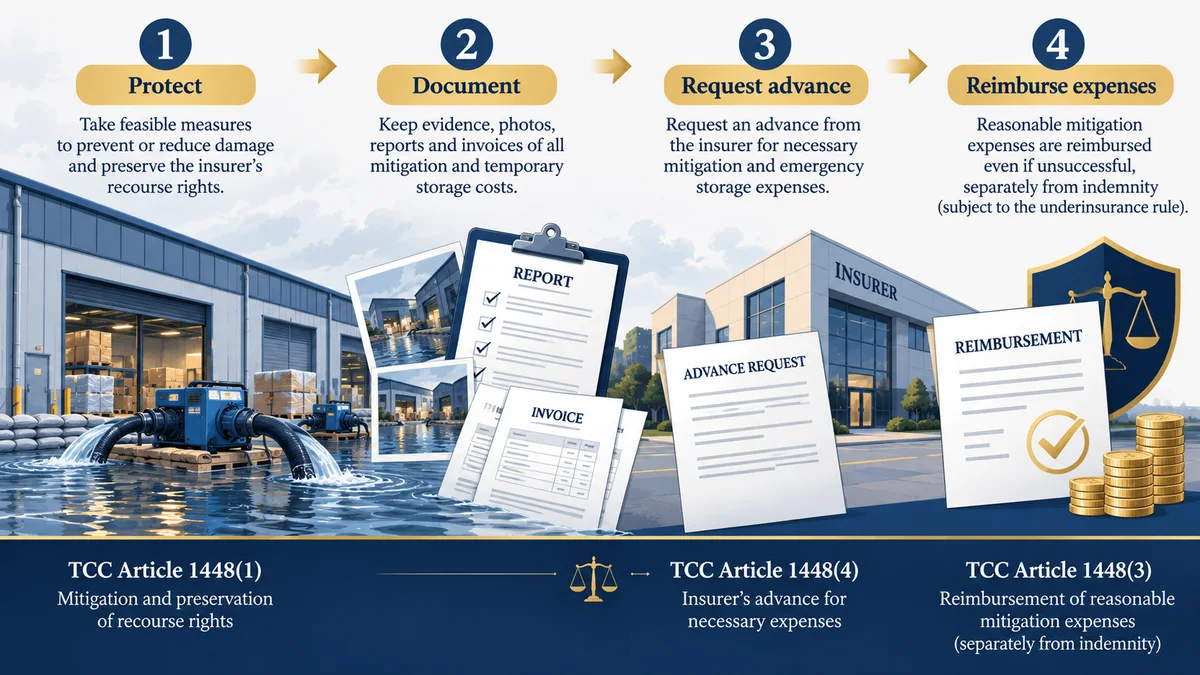
Direct Answer: The Claim Has Two Distinct Parts
Under Article 1448(3) of Turkish Commercial Code No. 6102, the insurer must reimburse reasonable expenses incurred by the policyholder in performing the statutory duty to prevent or reduce loss, even if the measures prove ineffective. Those expenses are reimbursed separately from the insurance compensation or insurance sum. Article 1448(4) also obliges the insurer, at the policyholder’s request, to pay the necessary amount as an advance towards those expenses. Neither paragraph authorises unlimited repairs or a guaranteed payment for a risk not insured by the contract.
This distinction is important to owners living abroad. A warehouse in Mersin can flood while its owner is in London, and a manager may urgently arrange pumping, temporary storage and security. The question is not simply whether the insurer ultimately accepts every element of the principal damage claim. The immediate legal inquiry is whether the action was taken in response to an insured risk or a high probability of its occurrence, was reasonably necessary to contain loss or protect the insurer’s recourse rights, and is supported by an accurate cost record. The advance and the underlying compensation must be accounted for as different requests.
Quick Legal Summary
| Issue | Governing law | Document to prepare |
|---|---|---|
| Emergency loss prevention or limitation | TCC 1448(1) | Incident chronology and measures taken |
| Alleged failure to protect the property | TCC 1448(2) | Evidence of actual adverse impact and degree of fault |
| Reimbursement of reasonable expenses | TCC 1448(3) | Invoices, proof of purpose and payment |
| Advance towards necessary costs | TCC 1448(4) | Cost estimate and written advance request |
| Notice of the insured event | TCC 1446 | Notice and proof of receipt |
| Inspection and information | TCC 1447 | Inventory, photographs and access record |
| Underinsurance | TCC 1448(3), referencing TCC 1462 | Sum insured and insurable value at loss |
For every row, identify the relevant person as policyholder, insured, loss payee or a separately authorised representative. Those descriptions are not interchangeable. In particular, the person holding title to property is not necessarily the person who concluded the insurance contract.
When the Duty Begins Before the Flood Has Fully Occurred
Article 1448(1) applies both when an insured risk has occurred and when the probability of its occurrence is high. A prevention measure therefore need not await completed destruction of the stock. If a burst pipe is still pouring water into a loading area, stopping the inflow can qualify as loss prevention; if water has already reached packaging, moving the goods to dry storage can qualify as loss limitation. The statutory language does not support an absolute instruction to leave the premises untouched until an adjuster arrives.
Assess the position using what could reasonably be known at the decision time. Meteorological warnings, access restrictions, photographs, security reports and technical advice help explain the threat. Do not retrospectively treat every unsuccessful measure as negligent. The law uses an ability-based standard: the policyholder must act within the means available, not undertake dangerous work or possess technical expertise that only an emergency contractor has. Calling an emergency service, securing access and retaining independent records may be the legally relevant response when direct intervention would be unsafe.
What Emergency Expenditure Can Be Analysed Under Article 1448(3)?
Common costs include pumping water, temporary weatherproofing, rental of dry storage space, urgent relocation of temperature-sensitive stock, safe disposal of a continuing hazard, emergency electricity isolation by licensed staff, short-term security needed to prevent further theft, and professional equipment used to stop continuing damage. Each is an example of an activity to evaluate, not a statutory list automatically approved for payment. The policyholder must link the work to one of Article 1448’s purposes and demonstrate that the price was reasonable in the circumstances.
Separate containment from permanent improvement. Repairing a temporary hole in a roof to exclude rain differs from replacing an entire roof with a premium material. Storing stock temporarily to prevent further loss differs from upgrading the warehouse’s permanent refrigeration system. Such distinctions matter because Article 1448(3) concerns expenses incurred in fulfilling the duty created by paragraph (1), while final repair cost and the replacement of damaged property raise separate indemnity and policy-coverage questions.
The Insurer Must Reimburse Reasonable Measures Even When They Fail
The third paragraph expressly states that reasonable expenditure is reimbursable even where the preventive or mitigating measure has been ineffective. For a property owner abroad, this prevents a superficial rejection merely because a second flood destroyed goods after the policyholder paid for emergency pumps. The legal assessment still requires proof that the measure was reasonable when ordered and that it addressed the statutory purposes. It does not transform every expense described as ’emergency’ into a payable sum.
Record the anticipated harm, who recommended the intervention, available alternatives, timing, cost and outcome. A contractor’s written note explaining why pumping was necessary provides more value than a bare invoice saying ‘services rendered’. Likewise, a contemporaneous photograph of stock being moved can show why temporary storage was required. If the insurer argues that the step was wasteful, identify the information available before it was undertaken rather than relying only on its eventual failure.
The Advance Right Under Article 1448(4)
Article 1448(4) goes beyond a right to ask for reimbursement after spending personal funds. It obliges the insurer, upon the policyholder’s request, to pay the necessary amount as an advance to cover expenses within the scope of that article. The text does not contain a fixed number of days in which every advance must be paid. It is therefore incorrect to describe it as a general seven-day or fourteen-day automatic payout rule. A strong request states the event, imminent deterioration, proposed intervention, expected cost and account details, and asks for a written response through the insurer’s proper channel.
A foreign owner may be unable to send a bank transfer immediately because of time differences, international compliance checks or a blocked payment card. Those circumstances do not replace proof that an Article 1448 expense is necessary. They explain why the statutory advance mechanism is operationally valuable. Preserve the original request, its timestamp, evidence that the insurer received it and any explanation for a refusal or reduction. Ask whether an advance will be paid to the contractor or the authorised policyholder, and document that payment arrangement without misidentifying the person entitled to receive the funds.
Do Not Confuse Emergency Expenses with the Principal Insurance Indemnity
An insured building may suffer damaged fittings, lost rent and emergency cleanup expense. The first two raise the applicable property or business-interruption coverage and exclusions. The third requires an Article 1448 analysis if it was incurred to protect the insured interest or the insurer’s rights. Article 1448(3) directs reimbursement of appropriate expenses separately from the indemnity or sum insured; that distinction should be visible in a claim schedule and a payment receipt.
Use separate headings in the submission: original material damage, any separately covered consequential loss, mitigation expenses, claims-assessment expenses if relevant, and any advance already received. Mixing these items into one headline figure makes it easier for the insurer to argue that the claim exceeds a policy limit without identifying which cost is subject to which legal provision. Distinguish an advance from final settlement, and do not describe a provisional payment as a waiver of remaining rights unless its terms lawfully provide that effect.
The Underinsurance Rule and Article 1462
Article 1448(3) expressly directs corresponding application of Article 1462 in cases of underinsurance. The consequence is not that a policyholder can ignore the relationship between insured value and insured amount when seeking mitigation costs. Determine the value of the insured interest and the sum insured under the policy at the relevant time, then ask how the statutory underinsurance mechanism affects the expense. A simple statement that all recovery expenses are always paid in full regardless of underinsurance would contradict the statutory cross-reference.
Collect the policy schedule, endorsements, property valuation, inventory and loss-day evidence. Currency differences and changes in stock value can make the calculation contentious, especially for foreign-owned warehouses. Do not invent a currency conversion date or percentage without identifying the applicable contract and calculation. The law supplies the legal rule, while the accounting must be established from the actual values.
A Reduction for Inaction Is Not an Automatic Forfeiture
Article 1448(2) concerns breach of the obligation that produces a situation adverse to the insurer. In that event the payable compensation is reduced according to the degree of the policyholder’s fault. The insurer therefore needs more than a generic accusation that the policyholder failed to attend the flooded premises. Identify the preventive action realistically available, what the policyholder knew, why the alleged omission mattered and how the adverse effect is connected to the omission.
A person in another country can arrange on-site assistance through a professional manager, licensed contractor or tenant. Overseas residence is not itself an exemption from Article 1448, but neither does it create an obligation to travel across continents during an emergency where competent local action was arranged. Preserve delegation instructions and messages showing when a manager was called, what access was available and how quickly safe measures were authorised.
Conflicting Instructions from Two Insurers
Article 1448(1) expressly addresses the case of multiple insurers giving mutually inconsistent instructions. The policyholder must consider the instruction most suitable for reducing the loss and preserving rights of recourse against third parties. This is a statutory decision rule—not an invitation to disregard both companies or always follow whichever is cheaper. For example, one insurer may ask that damaged stock remain untouched for assessment while another requests immediate transfer to cold storage. The policyholder must consider preservation needs, the risk of further loss and the implications for recovering from a culpable carrier or contractor.
Write to each insurer promptly, record the conflict, explain the objective harm posed by delay and seek a workable joint arrangement. When time prevents a joint answer, document the reason the selected action better satisfies Article 1448. Do not destroy physical evidence that can safely be retained, and do not let valuable goods deteriorate solely to avoid choosing between incompatible instructions. The evidence file should reflect the actual order of communications.
Protecting Recourse Against a Negligent Contractor or Carrier
Article 1448(1) also aims to preserve the insurer’s possible recourse rights against responsible third parties. A flood may be connected to a contractor’s defective installation, a neighbouring premises’ drainage failure or an incident involving transport or storage. The first report should identify witnesses, machinery, entry records and the suspected cause without presenting suspicions as established fault. Keep signed contractor documents and originals of relevant digital records.
Under TCC Article 1472, a property insurer that indemnifies a loss can acquire the insured’s rights against a responsible third party to the extent of payment. An improvised release given to a contractor during cleanup can therefore interfere with rights that will matter after indemnity. Distinguish a receipt for emergency access or payment from a substantive release of liability. Before accepting a settlement, identify the exact claim being discharged, the parties signing and whether insurer rights have attached.
Preserve Evidence Without Obstructing Safety
Article 1447 requires the policyholder after the insured event to provide necessary information and documents reasonably obtainable for determining the event and loss, and to permit investigation at relevant premises subject to the statute’s conditions. This duty coexists with Article 1448’s mitigation obligation. It is not a rule that broken machinery must remain hazardous or that an owner may never remove flooded items before an adjuster attends. Safety and evidential preservation must both be considered.
Photograph the full scene before major changes, then record each stage of safe removal. Keep damaged samples, labels, serial numbers and a chain-of-custody record where practical. Obtain contractor identity and invoices. Preserve electronic invoices, CCTV files and maintenance logs without altering them. Where there is a dispute about the source of flooding, an independent technical inspection may be appropriate. The evidential value lies in verifiable contemporaneous material, not merely a polished report prepared after every item has been discarded.
Separate Article 1446 Notice from Article 1448 Measures
The notice of an insured event and the duty to mitigate are not the same obligation. Article 1446 regulates notice of the materialisation of risk and the consequences of late notice. Article 1448 deals with prevention, reduction and preservation of recourse. A policyholder who promptly notifies the insurer must still take feasible loss-reduction measures. Conversely, paying for emergency pumping does not eliminate the need to make the contractual and statutory notification through an appropriate channel.
For international clients, proof of notice matters. Keep copies of the claims portal submission, support reference, telephone record, email headers and acknowledgments. If a local manager first reports the claim, clarify whether the manager had proper authority and make sure the insurer has the correct policy number and insured property. Maintain the legal chronology separately from informal messages to a broker.
Article 1426 Assessment Expenses Have a Different Function
Do not automatically put every expert bill under Article 1448. TCC Article 1426 separately regulates expenses of determining the insured event and the scope of compensation within its statutory conditions. A forensic engineer retained to quantify existing roof damage can serve a different purpose from a contractor hired to place temporary waterproof covering before another storm. A single visit might produce both kinds of work, in which case the invoice should identify the actual services rather than forcing them into an arbitrary category.
Our related English guide, Recovering Surveyor, Expert and Evidence Costs Under TCC Article 1426, addresses assessment expenses in depth. This guide is deliberately narrower: its primary concern is reasonable emergency expenditure, the advance right and the practical evidence needed to establish compliance with Article 1448. Separate legal bases help prevent repeated billing and make the insurer’s calculation auditable.
A Document Package for a Policyholder Outside Türkiye
Organise the file into six groups. The first contains the insurance policy, endorsements, premium receipts and the names of policyholder and insured. The second identifies the property and risk: title or lease, location, loss date and incident narrative. The third contains notification evidence under Article 1446 and inspection correspondence under Article 1447. The fourth documents mitigation decisions: dated photographs, emergency calls, third-party advice, access records and insurer instructions. The fifth includes quotations, invoices, proof of payment and a clear explanation of which expenditure belongs to Article 1448(3). The sixth sets out any Article 1448(4) advance request and the insurer’s response.
For an overseas company, also obtain evidence that the person instructing Turkish counsel is authorised to act for the company. A bank account statement identifying a payment recipient does not by itself establish legal authority to compromise a claim. Translate material foreign-language documents accurately where required, keep original electronic files and avoid sending unrelated personal information to insurers or counterparties.
How to Address an Insurer’s Written Refusal
Request the refusal in writing and isolate the reasons. A finding that the flood peril was excluded is different from a contention that pumping was unnecessary, a challenge to the amount of an invoice, an underinsurance calculation or an allegation that the policyholder’s conduct worsened the loss. Each reason requires its own legal and evidential response. Ask the insurer to identify the policy clause, article and facts relied upon, then match those assertions against the chronological record.
If the refusal concerns the advance, the submission should emphasise the forward-looking need and cost estimate under Article 1448(4), rather than merely demanding that a past invoice be reimbursed. If the dispute concerns an amount already spent, establish reasonableness, purpose and payment under Article 1448(3). If the insurer alleges breach, address the actual adverse consequence and degree of fault under Article 1448(2). This disciplined presentation is more effective than alleging bad faith without showing which statutory obligation was left unperformed.
Commercial Mediation, Arbitration and Court Proceedings
Before filing a Turkish court action, classify the claim and examine mandatory pre-suit procedures. TCC Article 5/A regulates mediation as a condition of action for specified commercial monetary disputes. A policyholder should not assume every insurance dispute follows the same jurisdictional and pre-action route without checking its commercial or consumer character and the precise relief sought. The chosen procedure must reflect the parties and underlying insurance contract.
The Turkish Insurance Arbitration Commission provides a separate dispute-resolution system subject to statutory and institutional requirements. The Commission publishes its member insurer list and its application instructions. Membership, the relevant insured risk, a prior written claim to the insurer and any special compulsory-insurance rules must be reviewed before claiming eligibility. Do not promise automatic admission to arbitration or universal fixed processing times. Preserve any mediation, litigation and arbitration limitation issues separately; an email complaint is not a substitute for a required formal proceeding.
A Worked Evidence Example Without Invented Results
A foreign company stores replacement parts in a Turkish warehouse. After a severe flood warning and water ingress, its local manager orders urgent pumps and rents temporary elevated storage. The company informs the insurer and requests an advance for the remaining relocation cost. The insurer later argues that it did not authorise the storage. The correct analysis begins with Article 1448(1): what risk existed, what measures were available, and were they reasonably aimed at limiting loss? Next examine Article 1448(3): what expenses were actually incurred and whether they were reasonable even if the flooding later continued. Then address Article 1448(4): was a request made for the amount necessary to perform the remaining work?
If the insurer responds that one crate had already been destroyed before relocation, the claim schedule must not portray the rescue expense as a claim to replace that crate. Conversely, if stock relocation reduced additional damage, that evidence supports the purpose and reasonableness of the measure but does not dispense with proof of price. No hypothetical court result is assumed in this example. The court or competent tribunal must determine the actual evidence and policy terms.
Common Errors in International Emergency Claims
The first error is treating all emergency expenses as ordinary property-repair costs and allowing them to disappear inside a single settlement line. The second is omitting the separate advance right until after the contractor has stopped work for lack of funds. The third is relying on an undocumented instruction given by telephone. The fourth is disregarding another insurer’s instructions without explaining why one course better reduced the damage or preserved recourse. The fifth is disposing of every damaged item before the loss can be examined. The sixth is assigning a foreign manager the power to compromise rights without checking corporate authority.
Finally, do not copy amounts from the policy’s sum insured into the loss report without a supporting calculation. When Article 1462 underinsurance is raised, identify the values that support the proposed ratio. Avoid invented case-law quotations. Article 1448 is unusually explicit about the two cost rights; accurate application of its four paragraphs provides a stronger basis than broad unsupported assurances that the insurer must pay every invoice.
Official Statutes, Further Reading and Legal Contact
Primary legislation: Turkish Commercial Code No. 6102, particularly Articles 1446–1448, 1462 and 1472; Turkish Grand National Assembly record for Law No. 6102; and the Insurance Book of the Turkish Commercial Code supplied by the Insurance Association of Türkiye. Current consolidated statutory text controls over summaries and translations.
Related English analyses: Turkish insurer pre-contract disclosure duties under Article 1423, Insurance claim assessment expenses under Article 1426, and Claims when a neighbour’s excavation causes Turkish property damage. Each examines a distinct legal problem. If you need representation concerning flood damage at Turkish property, see the contact details of Bakırcı & Keskin Hukuk Bürosu and provide the policy, claim reference and urgent dates. Work across Türkiye is coordinated according to the mandate and competent forum. This article is educational information and not a conclusion about any unseen insurance file.
Frequently Asked Questions
Does Turkish law require me to prevent further insured loss?
Yes. Article 1448(1) requires the policyholder to take measures within their means when the risk occurs or is highly likely, to prevent, reduce or avoid increased loss and preserve the insurer’s recourse rights.
Can an insurer reject every rescue bill because the flood continued?
No. Article 1448(3) expressly recognises reimbursement of reasonable expenditure even if the measures are ineffective. The claimant must still establish purpose, reasonableness and the statutory conditions.
Can I request money before hiring the pumping contractor?
Article 1448(4) obliges the insurer, upon request, to advance the necessary amount for relevant expenses. Specify the proposed action, urgency and cost.
Is the cost advance subject to a statutory seven-day deadline?
Article 1448(4) contains no universal seven-day payment deadline. The request and evidence should be documented; separate contract or procedure rules require their own analysis.
Are mitigation expenses automatically included in the property damage limit?
Article 1448(3) treats appropriate mitigation expenses separately from the indemnity or insurance amount and directs corresponding application of Article 1462 in underinsurance cases. The policy and insured values still matter.
What if I receive conflicting instructions from two insurers?
Article 1448(1) calls for the instruction most suitable for reducing loss and preserving recourse rights. Record the conflict and the reason for choosing the action taken.
Does living abroad excuse failure to act?
No general exemption arises from living abroad. The statutory standard concerns what measures were possible; properly instructed local contractors and managers may be relevant evidence.
Can the insurer reduce payment merely because no photographs were taken?
A claimed reduction under Article 1448(2) requires an adverse consequence caused by breach and an assessment of fault. Evidence gaps should be distinguished from a proved failure to mitigate.
Do I need to keep damaged goods after emergency removal?
Article 1447 addresses information and investigation duties. Preserve evidence where safe and practicable; emergency safety measures should be recorded rather than deferred automatically.
Are expert assessment costs identical to mitigation expenses?
No. Assessment expenses engage Article 1426, while prevention and loss limitation engage Article 1448. Allocate mixed invoices to the actual functions performed.
Can I release a negligent contractor from liability during cleanup?
A release can compromise third-party rights relevant to insurer recourse, including Article 1472 subrogation after indemnification. Identify the rights affected before signing.
Can the dispute be filed immediately with the Insurance Arbitration Commission?
Eligibility and initial complaint requirements must be checked. The Commission publishes member insurers and application procedures, and special compulsory-insurance rules can alter that analysis.
Istanbul and Mersin offices
Bakırcı & Keskin Hukuk Bürosu maintains physical offices in Istanbul and Mersin. For assistance with this Turkish-law matter, use the English-language contact information and provide the relevant court, enforcement or company records and any approaching deadline.
Istanbul Office — Maslak / Sarıyer
Ahi Evran Caddesi, Polaris Plaza No:21, Kat:9, 34475 Sarıyer / İstanbul.
Mersin Office — Akdeniz
İhsaniye Mahallesi, 4903. Sokak, Profit İş Merkezi No:23, Kat:3, Daire:14, 33070 Akdeniz / Mersin.
Contact regarding a legal matter
In your first message, you may briefly state the subject, your country or city, and any relevant notification or recent procedural date. Please do not send identity numbers, medical data, or personal documents. Messaging alone does not constitute legal advice or create a lawyer–client relationship.
Discover more from Bakırcı & Keskin Hukuk Bürosu
Subscribe to get the latest posts sent to your email.
