Your Turkish Insurer Paid a Partial Claim and Cancelled the Policy: TCC Article 1428
Short answer
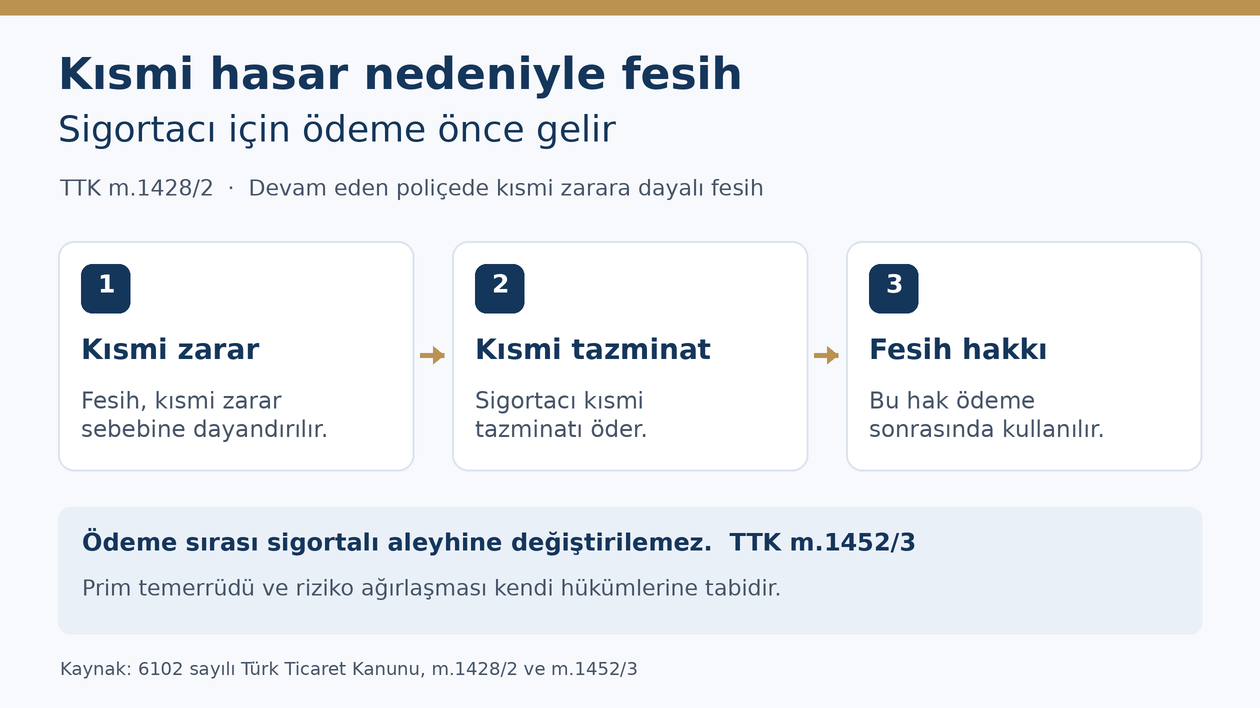
Article 1428(1) of Turkish Commercial Code No. 6102 provides that, outside liability insurance and unless the contract stipulates otherwise, partial indemnity payments during the policy period reduce the sum insured. Under Article 1428(2), both parties can terminate the contract in a partial-loss case, but the insurer can exercise termination only after making its partial indemnity payment. A loss assessment, promised payment and actual compensation transfer must be distinguished.
Have a general question about this article? Ask anonymously
Quick summary
| Legal basis | Turkish Commercial Code No. 6102, Article 1428 |
|---|---|
| Non-liability cover | Paid partial indemnity reduces sum insured unless otherwise agreed |
| Liability insurance | Expressly excluded from first-paragraph default |
| Partial loss | Both parties can terminate under Article 1428(2) |
| Insurer’s sequence | Termination right can be exercised after payment |
| Related provisions | Articles 1427, 1461 and 1462 |
The statutory issue after a partial insurance payment
A property owner may receive money after a fire, flood, storm or another insured event and then find that the insurer has sent a termination notice or reduced the remaining insurance sum. Turkish Commercial Code Article 1428 governs both the effect of partial indemnity payments on coverage and the ability to terminate following a partial loss. Those are distinct questions, although an insurer’s letter may address both in one paragraph.
The analysis must begin with the type of insurance and the actual event. A payment described as ‘partial’ may be an interim advance, final compensation for one component or a settlement of the whole insured loss at a discounted figure. It cannot be classified solely from its label. Read the payment correspondence, insurer’s decision and the policy schedule before calculating the remaining cover or reviewing an attempted termination.
Article 1428 should be read with Article 1427 on maturity and advance payments, Article 1461 on the insurance sum and Article 1462 on underinsurance. A reduction of insured sum because indemnity was paid does not mean the original property was underinsured. Each provision addresses a different circumstance and should not be merged into an unexplained ‘loss adjustment’.
The express exception for liability insurance in Article 1428(1)
Article 1428(1) excludes liability insurance from its default rule that partial payments reduce the insurance sum. This express exception matters because liability cover can have policy limits, aggregate structures and multiple claims whose operation may be governed by the specific insurance arrangement and other statutory provisions. A property-insurance conclusion cannot simply be transplanted into an employer’s liability or professional liability policy.
Identify the policy’s legal class and the interest protected. A policy that contains both property-damage and liability sections may require a coverage-by-coverage analysis. The fact that one contract has a single cover page and premium does not establish that every component follows the same rule. Obtain all general and special conditions and the actual paid claim heading.
Where a mixed cover is disputed, ask the insurer to identify which clause it applied to which section. Do not assume that the liability-insurance exception removes every contractual aggregate limit or that every property loss must reduce the amount regardless of the agreed wording. Article 1428(1) supplies a default rule with a stated exclusion and a contractual override.
When does a partial payment reduce the sum insured?
For insurance other than liability insurance, the first paragraph says that partial indemnity payments made during the insurance period are deducted from the insurance sum unless there is a contrary agreement. The wording points to actual payments. It is important not to mistake a notified claim, a loss assessment or an internal reserve for a compensation payment already made.
Suppose, as an illustration only, a property insurance contract specifies a TRY 4,000,000 sum insured and the insurer pays TRY 600,000 in final partial indemnity during the relevant period. Absent a contrary contractual rule, the Article 1428(1) starting calculation leaves TRY 3,400,000 as the remaining insurance sum. The illustration does not answer whether another claim is covered, whether the policy has per-item limits or whether the initial insurance sum was sufficient.
To verify the calculation, record each payment date, amount, underlying insured event and covered item. A bank credit does not necessarily show whether the money is an Article 1427 advance, reimbursement of assessment expenditure under Article 1426 or partial final insurance indemnity. Check the accompanying legal description and settlement documents before deducting the amount.
The parties can agree differently about reinstatement of cover
The phrase ‘unless otherwise agreed’ in Article 1428(1) means that the statutory reduction of the sum insured is not an immutable outcome for every non-liability insurance contract. The policy may provide a different arrangement for restoration or continuation of the sum insured. The actual terms determine whether and how such a mechanism operates.
Look for a provision concerning automatic reinstatement, additional premium, renewal of a sublimit, aggregate sum or conditions after a partial loss. An insurer’s standard website description is not enough; compare the wording actually incorporated into the policy and every endorsement. Establish whether the condition is applicable to the particular class of damage and whether a triggering step was fulfilled.
An overseas owner should obtain written confirmation of the post-loss sum and any effective renewal or reinstatement. The fact that the insurer took the original recurring premium is not by itself proof that the full sum was reinstated. A new schedule or clear endorsement avoids a later dispute about what was still insured when another event occurred.
Article 1428(2) allows termination in partial-loss cases
Article 1428(2) states that the parties can terminate an insurance contract in cases of partial loss. This does not by itself determine whether every notice used a valid method, whether other contract-specific requirements are satisfied or what happens to any already accrued claim. The legal basis and operative notice must be inspected rather than treating the word cancellation as decisive.
The right is not exclusively the insurer’s. The wording refers to both parties, making it necessary to identify who exercised the right and when. Where the policyholder claims termination, review the actual declaration and its legal effect separately from an insurer’s termination notice. The existence of a partial loss should be supported by the claim evidence and not simply assumed because a small amount of money was paid.
Termination is different from an ordinary policy reaching its scheduled expiry date, cancellation for non-payment of premium or termination after a material increase in risk under Article 1445. Each route has separate prerequisites and consequences. A letter citing the wrong legal route should be analysed according to the facts and operative law rather than reclassified without explanation.
The insurer’s termination right comes only after compensation payment
The last sentence of Article 1428(2) expressly restricts the insurer: it may exercise its right to terminate after making the partial indemnity payment. That is the key protective sequence. A statement that the insurer has ‘approved’ compensation is not necessarily proof that it paid it. A promise to transfer money after the policyholder accepts cancellation raises a different issue from actual payment before termination.
Collect the compensation confirmation and bank transfer data alongside the insurer’s termination notice. Establish when payment was made and when the termination was communicated. If a repairer was paid directly under the policy’s permitted performance structure, the nature and completion of the insurer’s indemnity performance require careful documentation.
An insurer cannot justify ignoring Article 1428(2)’s express sequence by inserting an unsupported administrative label such as ‘file closing’. However, the claimant should not assume that receiving one payment under one covered event means the policy was automatically terminated; the legal effect of any termination notice and the policy’s post-loss continuation remain separate questions.
A three-month investigation advance is not always a final partial indemnity
Article 1427(3) provides an advance on insurance indemnity or benefit when the insurer’s investigation remains unfinished three months after the legally relevant risk notice, calculated from the promptly determined damage or benefit. That advance is ultimately deducted from the final payment. It should be recorded separately from a final partial indemnity under Article 1428.
If an insurer labels a transfer as an advance, obtain the calculation and statutory basis for that classification. If it calls an amount final compensation for one discrete component, identify the part of the event and the effect on the remaining insurance sum. The legal substance and actual supporting records matter more than an internal account code.
A foreign owner should not sign a document declaring the claim fully settled merely to receive money described as an advance without reading the terms. A waiver or full settlement has consequences beyond payment classification. Keep the statutory timing under Article 1427 and any later Article 1428 termination sequence in distinct parts of the file.
What happens if another insured event occurs during the same policy year?
Where the original insurance period remains in force after a partial claim, a later insured event may raise the question of the remaining sum insured under Article 1428(1). The initial payment ledger, any reinstatement endorsement and the legal status of the policy at the second event become essential. An owner abroad should not simply assume the original face amount still applies.
Assess each event separately. Identify the relevant date, property, covered peril, limit, deductible, any sum-reduction mechanism and payments made. A second loss can have its own causation and assessment questions. Treating two unrelated events as one combined claim can obscure the operation of the insurance period and the legal impact of the first payment.
If the insurer already exercised a valid termination, a second event after termination may raise a coverage dispute of a different kind. The date and effectiveness of that termination, whether the required first payment occurred and any later agreement to continue coverage must be verified from primary documents.
A reduced insurance sum is distinct from underinsurance
Article 1460 defines the value of the insured interest, while Article 1461 concerns the insurer’s upper liability limit and Article 1462 regulates certain partial losses where the insurance sum is below the insured value. A reduction of the sum insured after a payment can affect future financial protection, but it is not itself the underinsurance calculation for an earlier event.
A policyholder should identify the insurance sum immediately before the first event, any payment made, the remaining sum and any subsequent valuation or reinstatement. Do not simply insert the reduced sum into a retrospective underinsurance formula for the earlier loss. The applicable times and contract valuation method determine which numbers can lawfully be compared.
Our English underinsurance guide under Article 1462 explains the different proportional-loss rule. The Article 1428 question here is how paid partial indemnity changes the ongoing policy’s available insurance sum unless the parties agreed otherwise.
How to test a disputed termination notice
Read the original document stating the insurer terminates the contract. Check its date, recipient, policy number, reason, statutory or contractual clause, effective date and method of communication. Do not use only an internal screenshot or a verbal account from a broker. The real record should establish that a legally operative declaration occurred.
Where the insurer relies on Article 1428(2), insist on proof of the qualifying partial loss and earlier partial indemnity payment. Where it relies instead on premium non-payment, risk aggravation or another ground, require identification of that distinct regime. It is not adequate to apply whichever ground produces the insurer’s preferred result without matching its conditions.
The policyholder’s own correspondence may also contain a termination request or agreement. Distinguish mutual agreement from the unilateral statutory right. If an overseas insured person believes the policy remains active, request an explicit written position as to the continuation and sum insured, and seek advice before any new loss occurs.
A payment reconciliation that avoids double counting
Prepare a chronological table of every insurance payment: date, currency, gross amount, beneficiary, insured event, legal head, associated invoice and receipt. Separate principal indemnity, advance, assessment expenses, protective expenses, premium return and any payment from a liable third party. Each may have different legal consequences, including under Articles 1426, 1427, 1428, 1448 and 1472.
For a partial-indemnity reduction, identify only the payments to which Article 1428(1) properly applies. Reconcile the sum originally insured against those payments and any contractual reinstatement. Do not automatically subtract an amount that was merely proposed, or count the same final indemnity twice because it was paid in several instalments.
Where an insurer issued a single lump-sum payment covering several items, request an allocation statement and compare it with the settlement documentation. The claimant’s record should disclose unresolved components openly rather than create a fictitious precision. This is particularly important for foreign-currency policies, where conversion rates and dates may affect the apparent amounts.
Protecting Turkish property and business cover while living abroad
Foreign property owners frequently learn about policy changes only after a local manager forwards a short message. Establish a durable communication channel with the actual insurer and retain renewal and claim documents. The manager’s statement that the policy is ‘still insured’ is not a substitute for the policy schedule, payment ledger or a clear post-loss continuation endorsement.
An overseas company should identify who within its group has authority to receive insurer notifications and agree to a settlement or cancellation. The legal insured party, policyholder and person paying the premium may differ. Keep corporate authority documents and the relevant policy in the same indexed file, and avoid relying on assumptions derived solely from common ownership.
If there is a dispute, instructions to counsel can be organised remotely. The specific power of attorney, choice of tribunal and legal capacity of the claimant still require review. Turkish insurance arbitration and court procedures are distinct from the statutory rule determining when an insurer may exercise a termination right.
A properly framed written objection to termination
A written objection should first state the specific partial-loss event and insurance contract, then identify when and what compensation was paid. Quote the insurer’s purported termination and demonstrate whether Article 1428(2)’s required sequence occurred. Attach bank proof, claim correspondence and the complete original notice rather than only the policyholder’s recollection.
If the dispute concerns a reduced insurance sum, produce the original schedule, all qualifying payment records, any contractual override and the insurer’s revised calculation. Request correction of the insured balance where the deduction was not supported by Article 1428(1) or the operative agreement. Distinguish that relief from a request to invalidate a termination.
Where a monetary claim is also disputed, prepare a separate schedule of the remaining unpaid loss, contractual exclusions and any relevant advance. The general insurance-payment provisions, proof of the event and forum requirements continue to matter. A successful challenge to one termination ground does not itself decide every disputed loss item.
Final statutory checklist for a foreign policyholder
Identify whether the policy is liability insurance or another insurance category, and whether a contrary agreement changes the Article 1428(1) default. Establish the original sum insured, all actual partial indemnity payments during the term and the remaining insured amount. Do not classify a promise, reserve or disputed advance as final compensation without examining the evidence.
Check whether a partial loss occurred and which party purported to terminate. If the insurer exercised Article 1428(2), prove the actual indemnity payment preceded its termination act. Compare all operative dates and keep the letter, transmission evidence and bank records. Review other termination grounds separately instead of attributing them silently to Article 1428.
Finally, obtain an up-to-date written confirmation of coverage and remaining sum after the event. Link each assertion to a statutory clause, policy term or original exhibit. The result should be an accurate legal account of the policy following partial loss, not a blanket assurance that every payout ends the policy or that every insurer cancellation is valid.
Frequently asked questions
Does Article 1428 apply identically to liability insurance?
No. Article 1428(1) expressly excludes liability insurance from its default rule about reducing the sum insured after partial payments.
Do partial insurance payments always reduce the sum insured?
For non-liability insurance, the default is deduction of partial indemnity payments during the term unless the contract agrees otherwise.
Can a policy waive the reduction and reinstate full cover?
Article 1428(1) permits a contrary contractual agreement. The actual cover and reinstatement terms must be checked.
Can the insurer terminate before paying a partial claim?
Under Article 1428(2), the insurer may exercise the partial-loss termination right only after paying partial indemnity.
Does the policyholder also have a termination right after a partial loss?
Article 1428(2) states that the parties can terminate in partial-loss cases, subject to applicable legal requirements.
Is a claim reserve an actual compensation payment?
No. An internal reserve is not, merely by its existence, proof of indemnity paid to the insured.
Is an Article 1427 advance always treated as a final Article 1428 payment?
No automatic conclusion follows. Determine the actual legal nature of each payment and how the contract records it.
What if a second insured event occurs later?
Check the contract’s continuing status, remaining sum insured, prior partial payments and any reinstatement endorsement.
Is reducing cover after payment the same as underinsurance?
No. Article 1462’s partial-loss proportion addresses a different question from Article 1428’s post-payment reduction.
What should a foreign owner request from the insurer?
The full payment ledger, revised insured sum, termination notice, proof of its timing and any reinstatement endorsement.
Does paying a claim automatically terminate the entire policy?
No. Article 1428(2) gives a termination right in partial-loss cases; payment alone is not every requisite operative termination step.
What law and source control?
Turkish Commercial Code No. 6102, particularly Article 1428(1)–(2), read with the policy and related insurance provisions.
Official sources and related content
Primary law: Law No. 6102. Insurance arbitration: official application guidance. Related English guides: Article 1427 payment and advances, Article 1462 underinsurance, Article 1472 subrogation after payment, managing a case without travel.
Contact and office
Mersin office map · +90 552 224 43 66 · English-language contact. An initial message does not establish legal representation or suspend any claim deadline.
Istanbul Office – Polaris Plaza, Maslak / Sarıyer
Bakırcı & Keskin Hukuk Bürosu
Maslak Ahi Evran Caddesi, Polaris Plaza No:21, Kat:9, 34475 Sarıyer/İstanbul
Our physical offices in Istanbul and Mersin coordinate matters throughout Turkey, subject to jurisdiction and the local steps required for each case. Please specify your preferred office when arranging an in-person appointment.
Open the Istanbul office on Google Maps · Contact and appointments
Contact regarding a legal matter
In your first message, you may briefly state the subject, your country or city, and any relevant notification or recent procedural date. Please do not send identity numbers, medical data, or personal documents. Messaging alone does not constitute legal advice or create a lawyer–client relationship.
Discover more from Bakırcı & Keskin Hukuk Bürosu
Subscribe to get the latest posts sent to your email.