Turkish Board Chair Refuses a Meeting: The 30-Day Rule and Direct Call Under TCC 392(7)
Short and clear answer
A Turkish board meeting cannot always be blocked indefinitely by an unresponsive chair. Under Article 392(7) of Turkish Commercial Code No. 6102, as amended by Law No. 7511, a written request from the majority of board members requires the chair to call the board so that the meeting takes place within thirty days after receipt. If the board is not called within that period, or the chair or deputy chair cannot be reached, the requesting members can make the call directly. The company’s articles can provide a different calling procedure. The power to call a meeting does not remove the meeting and decision quorums in Article 390(1).
Have a general question about this article? Ask anonymously
This guide concerns the board of a Turkish joint-stock company, an A.Ş. It is not the shareholder minority procedure for convening a general meeting, and it is not a rule allowing a shareholder’s overseas lawyer to cast a director’s vote. The identity of the requesting directors, the written demand, receipt evidence and the actual meeting arrangements determine which statutory route is available.
Quick summary
| Question | Rule or document |
|---|---|
| Can one director request a meeting? | Yes: Article 392(7) preserves the individual written-request right. |
| What triggers the express thirty-day mechanism? | A written request by the majority of board members. |
| Must the meeting itself fall within thirty days? | The amended wording requires a call for a meeting within that period. |
| Can the requesting members call directly? | Check the statutory non-call or unreachability condition and the articles. |
| Does direct calling lower the voting threshold? | No: Article 390(1) remains applicable. |
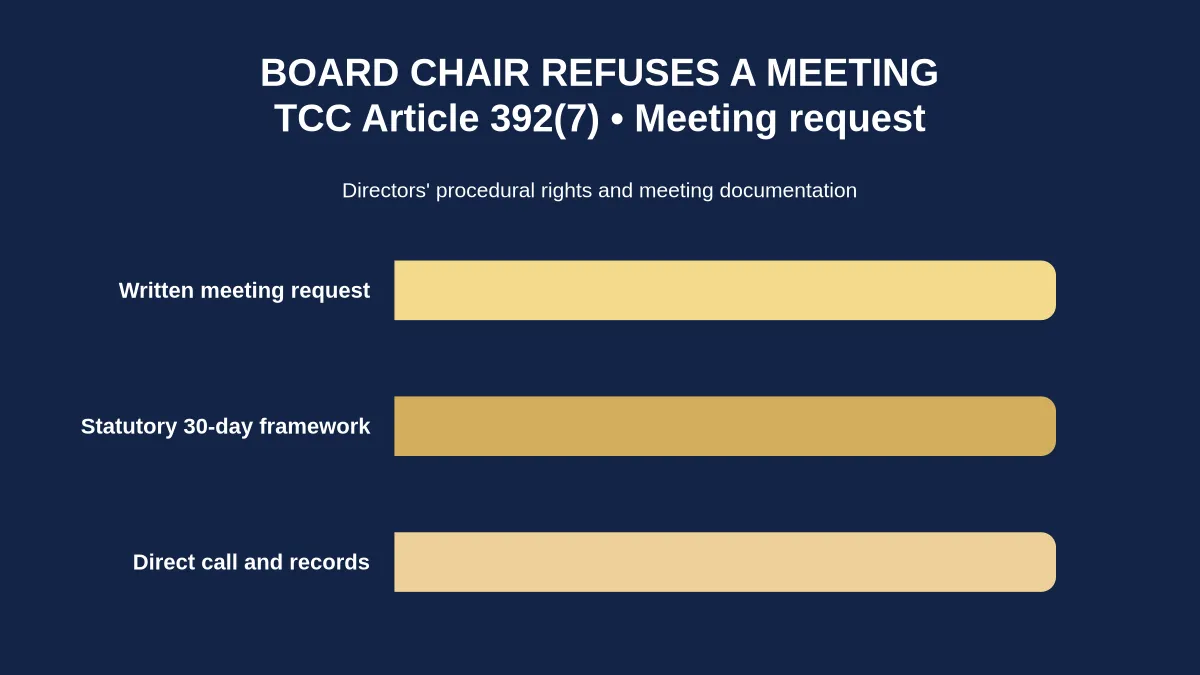
What changed: an individual request and a majority mechanism
Article 392(7) begins with the right of every board member to ask the chair in writing to convene a meeting. The 2024 amendment adds more than a general statement that the chair should cooperate. It specifies what follows from a majority request, identifies a thirty-day period, and provides a direct-call route when its conditions exist. A memorandum based only on the original 2011 provision misses those additions and can leave an overseas director with an incomplete account of the available procedure.
The individual right and the majority mechanism must nevertheless remain distinct. One director can make the written request, but that fact alone does not establish the majority required for the express thirty-day mechanism. The request should say who makes it and in which capacity. The analysis should then identify the relevant statutory sentence, rather than treating every unsuccessful email as an automatic authority for any person to convene the board. The articles also need review because the amended provision expressly permits a different calling procedure there.
A board-member right is not the same as shareholder control
The relevant participants are the Turkish company’s board members. A shareholder holding most of the capital does not personally become a majority of the board merely because it controls the investment. The same distinction applies to a foreign parent company’s chief executive, finance director or legal department. Their commercial concerns may explain why a meeting is needed, but the request must be attributable to persons entitled to exercise the board-member right.
A legal entity can itself hold a board seat through its designated natural-person representative under Article 359(2). Where that structure exists, examine the current registration and the representative authorised to act for the corporate member. Do not collect signatures from several employees of the same corporate director and count them as separate board seats. The guide to foreign legal-entity board members explains that structure. This capacity check should precede circulation of the demand and should be preserved in the meeting file.
Prove the requesting majority before relying on it
Prepare a current board list from the election decisions, registry records and any subsequent changes. Check whether a member has resigned, died, been removed or lost the qualifications required for office. A historic registry extract and an internal mailing list can diverge. Where the effectiveness of a departure is disputed, record the dispute and examine its effect before presenting a headcount as conclusive. A company cannot solve a doubtful membership issue merely by counting the signatures most convenient to one faction.
The majority in Article 392(7) is a majority of board members, not a majority of share capital or of those who answered a particular message. For an undisputed five-member board, three members constitute that majority; for an undisputed seven-member board, four do. These arithmetic illustrations do not resolve vacancies, contested appointments or stricter constitutional requirements. The file should state the board composition used, the source of that information and the members joining the request. Preserve the actual written approvals rather than relying on a later summary that everyone agreed.
Write a request that identifies the meeting and its business
The demand should identify the company, the requesting directors and the request that the chair convene the board. It should describe the business requiring consideration and the documents the directors need. This is a practical evidential recommendation, not an assertion that the statute contains a universal model form. A request about an urgent financing obligation, a statutory filing or a disputed contract should make that subject intelligible without unnecessarily disclosing unrelated confidential material.
Keep the signed or otherwise legally supportable written version and the transmission record together. An English translation for the foreign directors can assist coordination, but it should not introduce different agenda wording or a different proposed decision from the Turkish version used in the corporate file. The delivery method must be selected with proof in mind. Do not assume that an informal chat notification, a forwarded screenshot or an employee’s assurance establishes both the contents of the demand and receipt by the person addressed.
The receipt date and meeting date are separate facts
The statutory period is tied to the date the written majority request reaches the chair. Record that event, not just the date printed on the letter or the date on which a draft was circulated internally. The amended wording requires the chair to call the board so that the meeting is held within thirty days from receipt. It should not be reduced to a permission to issue a notice on the final day for an unspecified meeting months later.
The corporate record should therefore show the demand date, delivery date, any acknowledgement, the chair’s response, the date of the call and the proposed meeting date. Counsel should assess the applicable time-calculation rules and the company’s own provisions before treating a calendar entry as the final legal deadline. Do not backdate a request or reconstruct a receipt date merely because a transaction is urgent. Where delivery is contested, preserve the original transmission evidence and assess that dispute expressly.
When the requesting members make the call themselves
Article 392(7) provides for a direct call by the requesting members when the board is not called within the prescribed period, or where the chair or deputy chair cannot be reached. The direct-call power belongs to the requesting members under the statutory mechanism; it is not a general invitation for an outside adviser, employee or shareholder to convene the board in their own name. The call should identify the legal basis relied on and the directors exercising it.
Unreachability should not be treated as a synonym for disagreement. A chair who rejects the proposed transaction but remains contactable presents a different evidential situation from an officer who cannot be reached. Preserve attempted communications, returned messages and other relevant records without collecting unnecessary personal information. Do not manufacture repeated contact attempts after the event to disguise the real chronology. The board’s decisions will be easier to defend where the call file explains the actual trigger and does not substitute allegations about motives for evidence of the statutory condition.
The articles can prescribe a different calling procedure
The amendment expressly permits a different meeting-call procedure in the articles of association. Obtain the current registered text and amendments before relying exclusively on a statutory checklist. An internal group policy, a shareholders’ agreement and the company’s articles are different documents. The existence of a private promise about board consultation does not automatically mean that it has become the corporate procedure authorised by Article 392(7).
Read the relevant clauses as a complete system: who calls, how requests are delivered, which notice arrangements apply and whether special rules address absence of the chair. A disputed clause requires a legal assessment; neither ignoring it nor declaring it valid simply because it appears in a document is sufficient. Keep the version used in the file. A later amendment should not be substituted for the provisions that governed the request and call when those acts occurred.
A valid call is only the beginning: Article 390 still governs
Article 392(7) expressly preserves the meeting and decision quorums in Article 390(1) for a meeting called this way. Under that provision, absent a stricter rule in the articles, the board convenes with a majority of its full membership and decides by a majority of those present. The same paragraph applies the rule to electronic board meetings. The right to make the call does not establish attendance, approval of the agenda item or authority to disregard a higher constitutional threshold.
Article 390(2) also prohibits members from voting for one another or participating through proxies. An overseas director cannot simply send a lawyer to occupy the seat and vote as if the lawyer were the director. Article 390(3) addresses a tied vote: the matter moves to the next meeting, and a repeated tie means rejection of the proposal. Record attendance and the vote on each decision. Do not describe the chair’s failure to call as automatic approval of the proposal or as a transfer of all corporate powers to the requesting members.
Overseas participation and written resolutions need their own checks
A director’s location abroad does not dispense with the applicable participation rules. An electronic meeting requires the legal and technical arrangements applicable to that procedure; an ordinary video call should not automatically be labelled a compliant statutory electronic board meeting. Set out how each member will participate and how identity, attendance, discussion and voting will be recorded. Time-zone coordination is an operational matter, but the corporate record must still identify the actual meeting and decision dates consistently.
Article 390(4) provides a separate written-resolution mechanism where no member requests a meeting and its other conditions are satisfied. It requires a written proposal circulated to all board members and the requisite written approvals, with the prescribed decision-book treatment. A live demand for a meeting must not be ignored simply to convert the dispute into a paper vote. Choose the procedure that the actual circumstances permit. Do not combine selected signatures from different proposal versions and present them as agreement on one resolution.
Build a compact evidence file rather than a long accusation
The useful record is a chronological set: board composition, relevant articles, the written request, individual participation in the majority request, delivery proof, responses, the statutory trigger for direct calling, notices, participation records and signed decisions. Add the documents actually considered by the board. This allows a later reviewer to follow the route from the original request to the final resolution without relying on recollection or a contentious narrative prepared after a dispute began.
Keep a separate record of implementation. A board decision to authorise a transaction is different from the later signature of a contract, a bank instruction or a registry filing. Identify the authorised signatories and any external formalities. The board-member liability guide addresses related duties and responsibility. It does not replace the procedural evidence needed to show that a particular meeting was validly called and that a particular decision was properly adopted.
Do not confuse the call with information-rights or shareholder remedies
Other paragraphs of Article 392 regulate directors’ information and inspection rights, including a distinct route when access is refused. A meeting request can be accompanied by a document request, but the legal conditions and next steps should be identified separately. Likewise, Articles 411–412 concern minority shareholders seeking a general meeting, not directors seeking a board meeting. The minority shareholder guide covers that different corporate organ.
If the problem is that the company has no functioning board at all, examine the vacancy and general-meeting route rather than pretending that a nonexistent majority can sign a demand. Our director-vacancy guide explains Articles 363 and 410. The immediate legal task is to identify the blockage correctly: an unresponsive chair, a disputed information request, a missing organ and a shareholder voting dispute are not four names for the same procedure.
Frequently asked questions
Can one director ask for a Turkish board meeting?
Yes. Article 392(7) gives each director an individual written-request right. The express thirty-day majority mechanism requires the separate majority condition to be established.
When does the thirty-day period begin?
The amended provision ties it to receipt of the majority’s written request by the chair. The date on an undelivered draft is not proof of that receipt.
Is sending a notice within thirty days enough?
The wording requires a call for the meeting to take place within thirty days from receipt. It should not be read as an unlimited extension merely because a notice was issued.
Who can call directly under the new mechanism?
The requesting board members can make the direct call when the statutory conditions are satisfied, subject to examination of any different procedure in the articles.
Does a majority shareholder count as a board majority?
No. The relevant majority concerns board members. Capital ownership and a board seat are different legal capacities.
Is disagreement the same as being unreachable?
No. Record the actual communications and the statutory condition relied upon. A substantive objection does not, by itself, prove that an officer could not be contacted.
Can the articles set another calling procedure?
Yes, Article 392(7) expressly permits a different procedure in the articles. Obtain and review the operative text before making the call.
Does direct calling reduce the quorum?
No. The provision preserves Article 390(1). The applicable meeting and decision thresholds remain separate requirements.
Can an overseas director send an attorney to vote?
Article 390(2) prohibits proxy participation and voting for another board member. Shareholder representation at a general meeting is a different matter.
What happens if the board vote is tied?
Article 390(3) sends the matter to the next meeting. If the tie repeats, the proposal is treated as rejected.
Can a written resolution bypass a requested meeting?
The Article 390(4) written-resolution route requires that no member request a meeting, together with its other conditions. A meeting demand must be addressed rather than ignored.
Does this procedure apply to a limited company’s managers?
This guide addresses the joint-stock-company board. The rules applicable to a limited company’s management and decision-making require a separate assessment.
Contact regarding a legal matter
In your first message, you may briefly state the subject, your country or city, and any relevant notification or recent procedural date. Please do not send identity numbers, medical data, or personal documents. Messaging alone does not constitute legal advice or create a lawyer–client relationship.
Discover more from Bakırcı & Keskin Hukuk Bürosu
Subscribe to get the latest posts sent to your email.