A Turkish Company Has No Statutory Auditor: Court Appointment, Resignation and Replacement Under TCC 399
Short and clear answer
A company that has no statutory auditor in Turkey must identify why the appointment is missing and use the corresponding procedure in Article 399 of Turkish Commercial Code No. 6102. The general meeting ordinarily elects the auditor for each financial period. If no auditor has been selected by the statutory fourth-month threshold, the board, any board member or any shareholder can request appointment by the commercial court at the company’s registered seat. The court-appointment mechanism also covers specified failures affecting an auditor already selected, including refusal, termination, invalid appointment, inability to perform or obstruction.
Have a general question about this article? Ask anonymously
Where the auditor gives the termination notice addressed by Article 399(9), the board must immediately select a temporary auditor and submit the appointment to the general meeting for approval. This is not a general permission to dismiss an incumbent auditor and appoint a preferred replacement. Court appointment, temporary replacement and removal for personal just cause are different statutory routes. A foreign parent company’s group-audit arrangements do not automatically satisfy the Turkish subsidiary’s appointment requirements.
Quick summary
| Situation | Relevant route | Essential evidence |
|---|---|---|
| No auditor selected by the fourth-month threshold | Article 399(6): court appointment | Financial period and appointment records |
| Selected auditor refuses, cannot act or is obstructed | Article 399(6): assess the specified statutory ground | Refusal, restriction or inability evidence |
| Auditor gives the termination notice contemplated by paragraph nine | Immediate temporary board selection and general-meeting approval | Written reasoned notice and replacement decision |
| Company dislikes the incumbent’s opinion | No unrestricted dismissal power | Distinguish report disagreement from lawful removal grounds |
| Court-appointed auditor’s fee and expense advance | Article 399(7): court determination and three-working-day objection | The court’s fee and advance order |
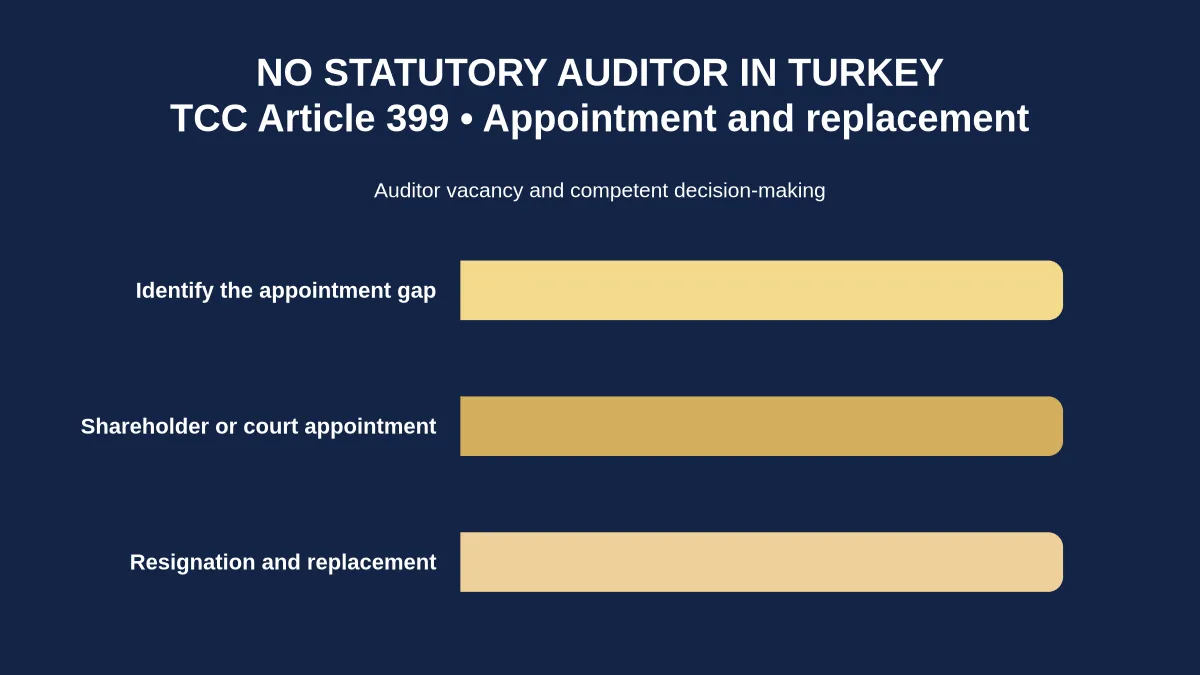
Confirm which audit obligation has been left unfulfilled
The first step is to identify the Turkish entity and the financial period concerned. A parent company, subsidiary and branch are not interchangeable, even when the group uses one commercial name. Obtain the trade-registry information and the company’s accounting-period records. Then establish the audit regime applicable to that entity. This article does not assume that every Turkish company is subject to the same independent-audit requirement or that every engagement described as an audit is the statutory appointment governed by Article 399.
A tax review, internal audit, acquisition due diligence or voluntary reporting exercise can exist alongside the statutory financial-statement audit. The absence of a consultant appointed for one of those exercises does not automatically activate Article 399. Conversely, the existence of a group finance team or an external accountant does not prove that a statutory auditor has been duly selected. Build the response around the actual legal obligation and appointment records, rather than the job titles used in internal correspondence.
The ordinary appointment is a general-meeting decision
Article 399(1) assigns the election of the company’s auditor to its general meeting and the group auditor’s election to the parent’s general meeting. Selection is required for each financial period and, in any event, before the end of the period in which the auditor will perform the task. After selection, the board must arrange registration without delay and the required announcement in the Turkish Trade Registry Gazette and on the website. These steps should be documented separately from commercial discussions about the engagement fee.
An audit proposal, a signed engagement contract and the corporate election are different records. A foreign shareholder should ask for all relevant documents rather than accepting an invoice as evidence of a valid appointment. Check the selected auditor’s identity against the contracting party and the person or firm recorded in the announcement. Where the financial period, company name or appointed entity differs between documents, resolve the discrepancy before assuming that the appointment covers the intended audit.
No appointment by the fourth-month threshold: the statutory court route
Article 399(6) supplies a court-appointment route where no auditor has been selected by the fourth month of the financial period. The relevant reference is the company’s financial period, not a universal date copied from another company’s calendar. The provision must also be distinguished from Article 399(1)’s requirement to select the auditor before the period ends. The fourth-month mechanism is not a reason to postpone the ordinary selection or a statement that the audit requirement disappears after a missed date.
Prepare a chronology identifying the period, meetings held, proposed election and any absence of a valid selection. Attach the records needed to establish that chronology. A shareholder deadlock, administrative oversight and a failed election can all produce a missing auditor, but they do not provide identical evidence. The application should explain the specific statutory condition relied upon. It should not merely state that the foreign parent wants a different audit firm or that the incumbent’s proposed fee is inconvenient.
Any shareholder is not the same as a statutory minority group
For the paragraph-six court appointment, the statute names the board, each board member and any shareholder as potential applicants. This differs from the ten-percent or five-percent minority thresholds associated with the paragraph-four removal route. A small shareholder should not be told that an otherwise available paragraph-six application necessarily requires assembling ten percent of the capital. Equally, an employee or overseas group adviser does not obtain shareholder standing simply because that person has been managing the audit timetable.
Prove the applicant’s capacity with the relevant corporate records. Where the shareholder is a foreign legal entity, identify who is authorised to instruct Turkish counsel and sign the necessary documents for that entity. Keep the shareholder’s legal personality distinct from the Turkish company whose auditor is to be appointed. The guide to foreign company authority documents for Turkish courts addresses that representation file. It does not replace the separate proof that the Article 399 condition exists.
The court mechanism also addresses failures after an election
Article 399(6) is not confined to a company that never voted on an auditor. It also addresses the selected auditor’s refusal of the task or termination of the agreement, cancellation or nullity of the appointment decision, inability to perform for legal or other reasons, and obstruction of the auditor’s work. These are separate grounds. The applicant should identify the actual problem and supply the corresponding record rather than describing every dispute as a resignation.
For example, an appointment decision and a written refusal establish different facts from a report of denied access to the books. A decision affecting the validity of the election needs its own procedural documents. Where performance is obstructed, record what was requested, by whom, when and how access was denied. The appointment mechanism must not be used to conceal the company’s own continuing failure to make the audit possible. A new auditor will still require the information and lawful access necessary for the work.
A statutory auditor cannot simply abandon the engagement at will
Article 399(8) restricts termination by the auditor to just cause or the filing of a removal action against the auditor. The termination must be written and reasoned. The provision expressly states that disagreement about the opinion’s content, the company’s restriction of the audit and refusal to issue an opinion are not, in themselves, just cause for this termination route. It is therefore unsafe to accept an informal message saying that the parties have agreed to stop as a complete account of the statutory position.
The auditor must also present the results obtained up to termination to the general meeting in a report complying with Article 402. That obligation preserves the work already done; the company’s file should not lose the findings merely because the engagement relationship has broken down. Examine the notice, stated grounds and prior work separately. A dispute over the notice’s validity requires assessment on its documents, while the company must still address continuity of its audit obligation.
The board’s immediate temporary selection after termination
Paragraph nine requires the board, on the termination notice contemplated there, to select a temporary auditor immediately. The board must inform the general meeting of the notice and submit the selected auditor for approval. The temporary mechanism is thus linked to a particular termination situation. It is not a general replacement power allowing management to bypass the general meeting or the judicial removal requirements whenever it prefers a different audit firm.
Record the notice received, the board’s decision, the selected auditor’s eligibility and the submission to the general meeting. The timing should be real and supported by contemporaneous documents. Do not treat the board’s temporary selection as approval by the shareholders or assume that an overseas parent’s procurement approval performs both functions. Where several statutory routes appear relevant, counsel should identify how the court-appointment mechanism and temporary appointment operate in the actual circumstances rather than omit one from the analysis.
The court determines remuneration and the expense advance
Under Article 399(7), when the court appoints the auditor, it determines remuneration by reference to comparable work and the advance to be deposited for likely expenses. The provision allows an objection to those amounts within three working days and describes the court’s decision as final. That short period concerns the remuneration and advance issue; it must not be confused with the separate three-week period for the auditor-removal action under paragraph five.
The company and applicant should keep the court’s order, notification record, payment directions and payment receipt together. A budget dispute should be assessed promptly rather than left until the audit is expected to begin. This guide does not state a fixed court-appointed audit fee because Article 399 requires a case-specific determination. A foreign group’s ordinary annual audit budget or a quotation from a different jurisdiction does not itself establish the amount that the Turkish court must set.
The group auditor is not automatically the subsidiary’s elected auditor
Article 399(3) provides a particular rule for the auditor selected for the parent’s financial statements to act as group auditor where another group auditor is not selected. That rule should not be converted into a statement that every Turkish subsidiary automatically has a valid local statutory appointment whenever the overseas parent signs a global audit engagement. Identify the corporate entity covered by the election and the scope of each report.
A multinational audit team may coordinate evidence, timetables and consolidation adjustments across jurisdictions. The Turkish company must still establish its own compliance with the appointment and audit requirements applicable to it. Prepare a document table distinguishing the parent engagement, subsidiary election, local engagement, registration and final report. The Article 199 affiliation-report guide concerns another Turkish group-company duty. Neither that report nor a parent-level consolidation package substitutes for an auditor appointment required under Article 399.
Check the specific TMSF trusteeship provision
Law No. 7069 added a special rule to Article 399(6) for companies whose trusteeship is carried out by the Savings Deposit Insurance Fund, TMSF. In the specified absence-of-election situation by the fourth month, the statutory text provides for appointment on the company’s board proposal through the stated ministerial authority and permits delegation to the Fund Board. This special provision means that the ordinary court-appointment description must not be presented as exceptionless.
Obtain the actual trusteeship and authority documents before treating a company as subject to that regime. Financial distress, a shareholder dispute or the appointment of some other interim officer does not by itself establish TMSF trusteeship. This article identifies the exception without asserting that a particular unreviewed company falls within it. For an ordinary foreign-owned company outside the special regime, foreign ownership alone does not displace Article 399’s ordinary corporate and judicial routes.
Audit continuity requires more than a replacement name
After the appointment, assemble the final corporate decision or court order, the relevant engagement documentation, the auditor’s acceptance, registration and announcement evidence, and the records required for the work. Preserve the outgoing auditor’s notice and findings. Identify the person responsible for providing books, financial statements and other requested material. An appointment made on paper but followed by continued denial of records does not solve the underlying audit failure.
Separate an appointment problem from an opinion problem. A validly appointed auditor may issue an adverse opinion or disclaimer, which requires the distinct response explained in our Article 403 adverse-opinion guide. Similarly, the minority shareholder guide addresses other rights that do not replace paragraph-six standing. A complete legal file identifies the precise defect, uses the proper route and records how a functioning audit relationship was restored.
Frequently asked questions
Does the audit obligation end when the auditor resigns?
No. The Public Oversight Authority confirms that termination does not discharge the company’s audit obligation. The replacement procedure must be addressed under Article 399.
Who normally elects the statutory auditor?
The company’s general meeting ordinarily elects its auditor for each financial period. The board then handles the statutory registration and announcement steps.
Can one shareholder seek a court appointment?
Article 399(6) names any shareholder, each director and the board. Its standing rules differ from the minority thresholds for a removal action under paragraph four.
Which court appoints the auditor under the ordinary route?
The provision refers to the commercial court of first instance at the company’s registered seat. The specific statutory condition and applicant’s capacity must be established.
Is the fourth-month rule always an April deadline?
The statute refers to the company’s financial period. Establish that period before assigning calendar dates; do not copy another company’s timetable.
Does the court route cover an auditor who refuses the task?
Yes. Paragraph six expressly addresses refusal and other specified failures after selection, including inability to perform and obstruction. Preserve evidence of the particular ground.
Can the board temporarily replace an auditor after termination?
Paragraph nine requires immediate temporary selection in the termination situation it addresses, followed by informing the general meeting and seeking its approval of the replacement.
Is disagreement with the audit opinion a free termination right?
No. Article 399(8) expressly distinguishes disagreement over the opinion’s content from just cause for the auditor’s termination. Company removal powers are also restricted.
Must the outgoing auditor report its findings?
Article 399(8) requires results obtained up to termination to be submitted to the general meeting through a report complying with Article 402.
How long is the objection period for court-set fees?
Article 399(7) specifies three working days for objections to the remuneration and advance. It is a different period from the three-week removal-action deadline.
Does the global group engagement appoint the Turkish subsidiary’s auditor?
That must not be assumed. The local corporate election, applicable audit regime and scope of the engagement require separate verification.
Is there a special rule for TMSF trusteeship?
Yes. The addition to Article 399(6) governs the specified no-election situation in companies under TMSF trusteeship. Verify the actual trusteeship basis before applying it.
Contact regarding a legal matter
In your first message, you may briefly state the subject, your country or city, and any relevant notification or recent procedural date. Please do not send identity numbers, medical data, or personal documents. Messaging alone does not constitute legal advice or create a lawyer–client relationship.
Discover more from Bakırcı & Keskin Hukuk Bürosu
Subscribe to get the latest posts sent to your email.