Adverse Audit Opinion in Turkey: Four Working Days, Board Election and the Six-Month Correction Duty Under TCC 403
Short and clear answer
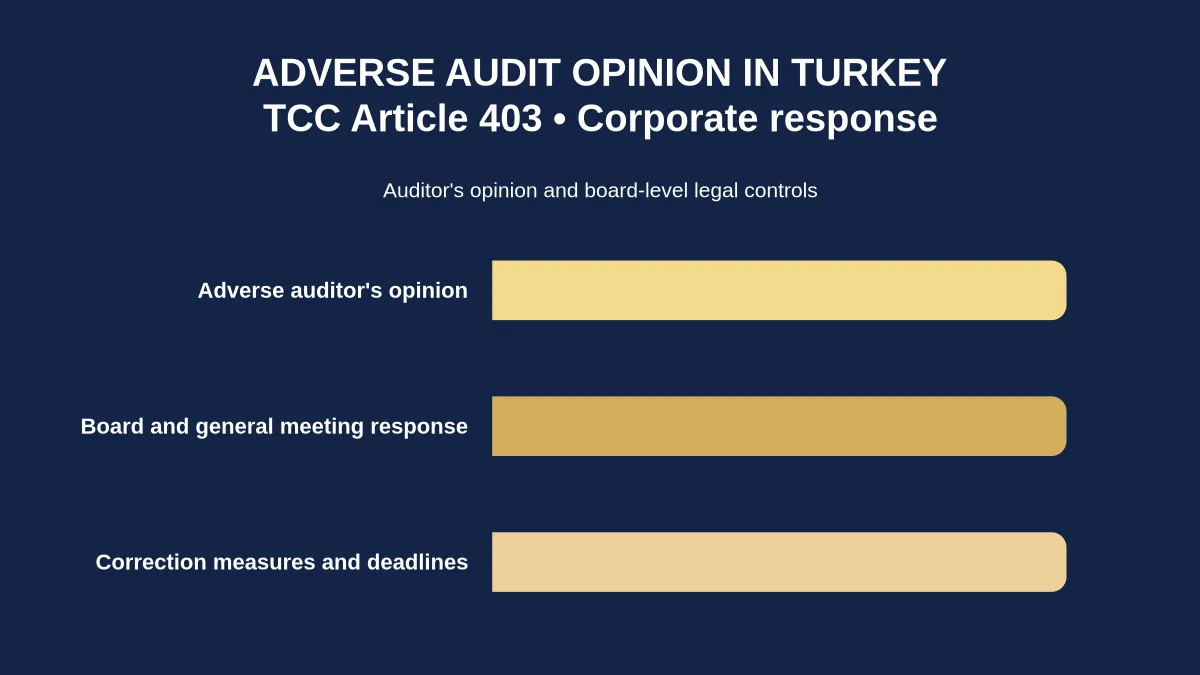
An adverse audit opinion in Turkey triggers a defined corporate response under Article 403(5) of Turkish Commercial Code No. 6102. For an ordinary joint-stock company subject to the relevant statutory audit regime, the board must call the general meeting within four working days after the opinion is delivered to it. The general meeting elects a new board. Unless the articles provide otherwise, the previous directors can be re-elected. The new board must have compliant financial statements prepared within six months and submit them to the general meeting together with the audit report.
Have a general question about this article? Ask anonymously
A disclaimer of opinion has the consequences of an adverse opinion under Article 403(4). A qualified opinion is different: Article 403(5) requires the general meeting to decide the necessary measures and corrections. The statute also contains a specific trustee-company exception in paragraph six. Identifying the actual opinion and the applicable regime comes before selecting the next corporate step.
Quick summary
| Audit outcome or event | Corporate consequence |
|---|---|
| Adverse opinion delivered to the board | Call the general meeting within four working days. |
| General meeting under Article 403(5) | Elect a new board; former members can be re-elected unless the articles prohibit it. |
| New board’s corrective duty | Compliant financial statements and audit report must go to the general meeting within six months. |
| Disclaimer of opinion | Article 403(4) attaches the consequences of an adverse opinion. |
| Qualified opinion | The general meeting decides necessary measures and corrections. |
| Special trustee-company regime | Check the specific exception in Article 403(6). |
Classify the signed opinion before treating it as a corporate trigger
Start with the final report issued for the relevant Turkish company’s financial statements. Identify the legal entity, accounting period, auditor, report date and opinion category. An adverse opinion, a qualified opinion and a disclaimer are not interchangeable labels for an uncomfortable audit. The reason for modification matters to the corrective work, while the statutory classification determines the Article 403 response. A translated management summary should not replace examination of the signed report.
Distinguish the statutory financial-statement audit from a tax inspection, an internal-control review, a due-diligence report or a parent company’s reporting questionnaire. This guide does not say that every Turkish A.Ş. is subject to the same audit requirement. Establish the applicable audit regime first. A warning in an accountant’s email may deserve immediate attention without being the particular opinion contemplated by Article 403. Conversely, describing a formal adverse opinion as a routine year-end comment does not remove the duties attached to it.
The board’s receipt is a fact that needs evidence
Article 403(5) connects the four-working-day period to delivery of the opinion to the board. The report date, its circulation to a foreign parent and its delivery to the Turkish board can be different events. Preserve the covering letter, electronic transmission record, acknowledgement and any corporate receipt entry. A later internal translation does not automatically become the starting date merely because the overseas shareholder first understood the problem then.
Record who received the document and in which capacity, particularly where the group uses a central finance function or a shared email address. Counsel should assess the legal significance of the actual delivery arrangements rather than adopting the date most convenient for the timetable. The company’s response file should contain the complete final opinion, not only the signature page or an excerpt. Where there are revised reports, retain their sequence and the auditor’s explanation so that the corporate response is tied to the correct document.
Four working days means making the call, not holding the meeting
The provision requires the board to call the general meeting within four working days. It does not say that all shareholders must assemble and finish the election within those four days. The call, the required notices and the eventual meeting are separate stages. This distinction is especially important where shareholders live abroad and where representation documents or other meeting formalities must be arranged. A realistic meeting schedule still has to respect the applicable rules for convening the general meeting.
Prepare the board’s calling decision and the meeting business promptly. The company should not wait for its foreign parent’s next monthly investment committee before addressing a statutory duty imposed on the Turkish board. Nor should it backdate minutes to make the call appear timely. Keep the decision, notice content, publication or delivery records and the proposed election documentation together. The date of a discussion with counsel is not a substitute for evidence that the required corporate call was actually made.
A new board must be elected, but previous members are not automatically barred
The general meeting elects a new board under Article 403(5). The same paragraph expressly allows the previous directors to be re-elected unless the articles of association provide otherwise. Accordingly, the phrase new board does not necessarily require a completely different set of individuals. The articles, the election resolution and the candidates’ eligibility must still be checked. A foreign shareholder should avoid assuming either that every incumbent must leave permanently or that no election is needed because the shareholder intends to retain the same people.
Older commentary based on the original 2011 version can misstate this process. The operative paragraph was replaced in 2012. The current response must be built on that amended text, not on an unamended account of automatic resignation or a blanket inability to decide financial matters. Retain the election minutes and update the relevant corporate and registration records. Re-election does not, by itself, release anyone from responsibility for earlier conduct or certify the accuracy of the statements that attracted the adverse opinion.
The six-month duty concerns compliant statements and a further audit report
The new board must have financial statements prepared in accordance with the law, the articles and the relevant standards, and submit them with the audit report to the general meeting within the statutory six-month period. This is a substantive corrective obligation. Appointing a new director, changing the accounting software or commissioning a consultant is not by itself completion of that obligation. The corrected statements and the accompanying audit report must be identifiable, final documents in the corporate file.
Translate the auditor’s findings into a documented corrective work plan. Assign responsibility for each issue, identify the missing records or accounting work, and preserve the supporting material used for the correction. The legal adviser and the accounting or audit professionals have different roles: corporate procedure cannot manufacture audit evidence, and a bookkeeping adjustment cannot replace the required shareholder process. A proposed remediation timetable should allow the audit work and the general-meeting submission to be completed, not merely started, within the applicable statutory framework.
Keep the earlier and corrected versions separately. Explain which balances, disclosures or other matters changed and why, without obscuring the original report. The objective is a traceable correction supported by records, not a cleaner-looking document with no explanation. Where an overseas parent requests a parallel reporting package, reconcile the versions so that the Turkish statutory documents are not confused with a management-only consolidation spreadsheet.
A qualified opinion requires a different analysis
Article 403(5) separately addresses a qualified opinion by requiring the general meeting to decide the necessary measures and corrections. It would be inaccurate to transfer the adverse-opinion board-election sequence automatically to every qualified report. Read the auditor’s explanation of the qualification, including its subject and scope, and identify what correction or measure is required. The corporate decision should address those issues rather than merely recording that the report was received.
The distinction does not mean a qualification can be ignored. The statute attaches an express general-meeting response to it. The board should ensure that the shareholders receive a clear explanation and that the implementation responsibilities are recorded. A decision stating only that management will consider the matter later is not a reliable substitute for identifying the actual measures adopted. Whether a proposed response is sufficient depends on the particular qualification and the governing requirements.
A disclaimer is not a neutral result without consequences
Article 403(4) deals with circumstances in which uncertainty in the books or significant restrictions prevent an audit and conclusions in accordance with the relevant provisions. It permits the auditor to disclaim an opinion with reasons and states that the disclaimer produces the consequences of an adverse opinion. A company therefore cannot treat the absence of a positive or negative substantive conclusion as proof that no corporate response is required.
Identify the reasons for the disclaimer and the records or access that were unavailable. Do not assume that replacing the contact person or sending a short management assurance resolves a limitation on the audit. The board’s duty to provide the necessary audit opportunities under Article 401 is a separate part of the legal framework. The resulting evidence may also matter to other claims, but the Article 403 response should not be delayed simply because responsibility for the missing information is disputed.
Foreign parent approval does not substitute for the Turkish process
A foreign parent can receive the report, fund corrective work and coordinate its own reporting obligations. It does not thereby replace the Turkish company’s board or general meeting. Identify the capacity in which each person signs: director of the subsidiary, representative of its corporate shareholder, group finance employee or outside adviser. A parent-level approval of the remediation budget is not the subsidiary’s election resolution, and an overseas audit opinion is not automatically the statutory opinion on the Turkish entity’s accounts.
Prepare a bilingual chronology and document index for the overseas shareholder. It should identify the opinion delivered, the relevant dates, the call, the election, the corrective assignments and the final submission. Preserve the original Turkish corporate documents and use translations that maintain the same opinion category and legal effect. The affiliation-report guide under Article 199 covers a separate group-company reporting duty. Compliance with that duty does not discharge the Article 403 process.
Disagreement does not create an unrestricted right to dismiss the auditor
An adverse opinion can lead to a dispute with the auditor, but the statutory appointment and removal framework in Article 399 remains relevant. The Public Oversight Authority expressly warns against treating an appointed statutory auditor as freely dismissible at any time. A company should not assume that obtaining a more favourable report from someone else retrospectively eliminates the consequences of the report already issued. Establish the legal route for any proposed change and preserve the existing audit record.
Article 399(8) also distinguishes a lawful termination by the auditor from disagreement over the opinion’s contents. A corporate response should therefore separate three questions: what Article 403 requires now, whether a lawful auditor replacement procedure exists, and whether there is a distinct dispute concerning the audit work. Our guide to an auditor’s fraud-related findings in a subsidiary concerns another statutory remedy. It should not be confused with the ordinary adverse-opinion response.
The trustee-company exception is specific, not a general escape clause
Article 403(6) excludes the application of paragraph five while the trustee’s duties continue in companies covered by its specified criminal-procedure trusteeship regime, involving appointment under Article 133 of the Code of Criminal Procedure for the terrorism-related grounds stated in the provision. This exception must be checked where the company’s management is subject to that regime. It is not a general exemption for every company with an interim manager, insolvency professional or court-appointed person.
For an ordinary foreign-owned A.Ş., the existence of foreign shareholders, financial difficulty or a disagreement among directors does not establish that exception. Obtain the actual appointment decision and examine its statutory basis before relying on paragraph six. This guide explains the ordinary corporate sequence and identifies the exception so that it is not overlooked; it does not classify an unreviewed company as falling within or outside a special trusteeship regime.
A practical response file for directors and overseas shareholders
Collect the audit engagement and final report, the receipt evidence, current articles, board composition, shareholder and representation records, the calling decision, notice evidence, meeting minutes and election documents. Add the corrective plan, the records supplied to the auditor, the revised statements, the further audit report and proof of submission to the general meeting. Keep communications about access restrictions or unresolved findings in a separate indexed section.
The final review should reconcile dates and capacities across those materials. It should also separate compliance with the response procedure from questions of director liability, auditor responsibility or contractual consequences under a financing agreement. None of those issues is answered merely by saying that an adverse opinion exists. The foreign board-member responsibility guide and the minority shareholder guide provide related reading without replacing a document-specific assessment.
Frequently asked questions
What must the board do after an adverse opinion?
Under the ordinary Article 403(5) regime, it must call the general meeting within four working days after delivery of the opinion to the board. The later election and corrective work are separate statutory steps.
Must the general meeting finish within four working days?
No. The four-working-day requirement concerns calling the meeting. The meeting itself must be convened through the applicable corporate procedure.
Can the previous directors be re-elected?
Yes, unless the articles provide otherwise. Article 403(5) expressly preserves that possibility while still requiring the new election.
What must the new board complete within six months?
It must have compliant financial statements prepared and submit them with the audit report to the general meeting. Merely appointing a consultant does not complete the duty.
Does a disclaimer have no legal consequence?
No. Article 403(4) attaches the consequences of an adverse opinion to a disclaimer. The absence of a substantive opinion is not an automatic exemption.
Is a qualified opinion treated identically?
No. For a qualified opinion, Article 403(5) requires the general meeting to decide the necessary measures and corrections. Classify the actual report first.
Does delivery to the foreign parent start the same clock?
The statute refers to delivery to the board. Examine the actual recipient, capacity and transmission evidence; parent circulation and board delivery should not be assumed to be identical events.
Can the company simply dismiss an unfavourable auditor?
The statutory auditor-removal and replacement rules in Article 399 must be followed. Disliking a report does not create an unrestricted dismissal power.
Does re-election release former directors from liability?
Re-election is not, by itself, a determination that earlier conduct was lawful or a release from responsibility. Those issues require their own legal analysis.
Is every Turkish joint-stock company covered by the same audit duty?
No universal audit-scope assumption should be made. Establish the company’s applicable statutory audit regime before applying this response guide.
What is the exception in Article 403(6)?
It concerns the specified criminal-procedure trusteeship regime and suspends paragraph five while the trustee’s duties continue. It is not a general exception for all court-appointed managers.
Which official guidance confirms the ordinary sequence?
The Public Oversight Authority’s supervision guidance, printed page 88, explains the four-working-day call, new election, possible re-election and six-month corrective submission.
Contact regarding a legal matter
In your first message, you may briefly state the subject, your country or city, and any relevant notification or recent procedural date. Please do not send identity numbers, medical data, or personal documents. Messaging alone does not constitute legal advice or create a lawyer–client relationship.
Discover more from Bakırcı & Keskin Hukuk Bürosu
Subscribe to get the latest posts sent to your email.