Izmir Trade-Fair Machine Damaged Before ATA Carnet Re-Export: Customs and Evidence
Case-specific customs and civil-procedure guide · Legal text review: 30 October 2026
Have a general question about this article? Ask anonymously
Direct answer
An exhibition machine admitted to Turkey on an ATA carnet cannot simply be abandoned in Izmir after an accident. Preserve the goods and evidence, check the authorised period of stay, approach the competent customs office about a lawful end to temporary admission, and assess separate contractual, insurance and court-evidence rights. A claim that the machine is irretrievably lost under Customs Law Article 186 must be proved; it is not automatic.
Short summary and statutory matrix
Separate the customs treatment of the damaged machine from claims against the actual responsible company. Each question has different evidence and deadlines.
| Question | Relevant provisions | Required record |
|---|---|---|
| ATA entry, permitted stay | Customs Law No. 4458 and Ministry guidance | Carnet, customs endorsements, granted stay and serial list |
| Loss versus repair | Customs Law 4458 Art. 186 | Independent technical evidence and causal record |
| Customs non-compliance | Customs Law 4458 Arts. 238 and 241 | Authority decision, notification and movement record |
| Objection to customs decision | Customs Law 4458 Art. 242 | Decision, service and submitted objection |
| Contract or tort compensation | Code of Obligations 6098 Arts. 112 and 49 | Contract, duty, causation, quantified loss |
| Judicial evidence preservation | Code of Civil Procedure 6100 Art. 400 | Specific threatened evidence, expert questions |
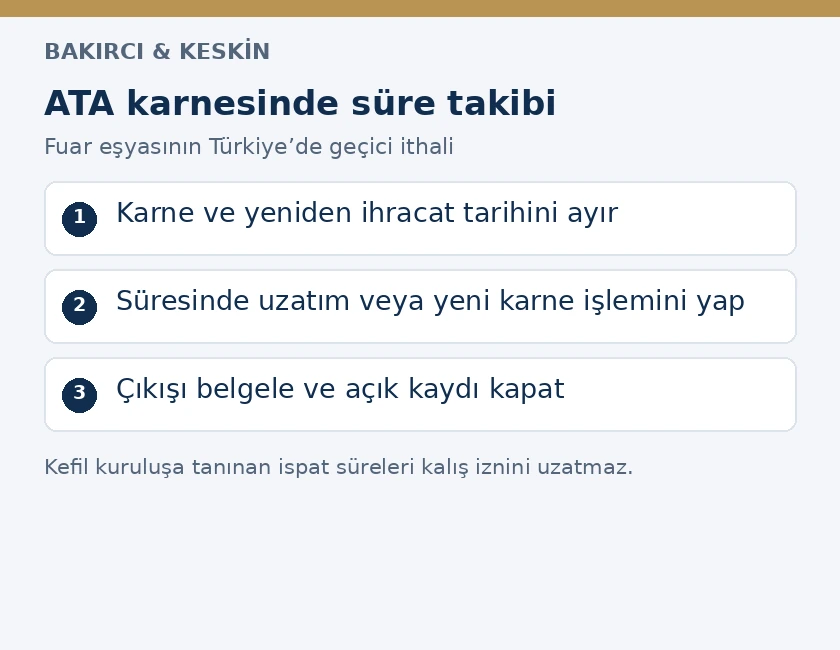
The immediate legal question is not merely the repair bill
A foreign exhibitor may find that a demonstration machine has suffered a serious electrical or mechanical failure during an exhibition in Izmir. Before asking who will pay for repairs, its representatives must identify the customs status of the machine. If the equipment entered under an ATA carnet, the duty to resolve that temporary-admission procedure does not disappear because an insurance claim has begun. The contract claim, the customs question, and the preservation of technical evidence must be handled as separate but coordinated workstreams. A demand for money from a stand contractor is not an official permission to keep goods in Turkey, and a customs reply does not establish which private company caused the damage. An effective lawyer’s file begins with the actual documents, physical location and dates rather than an assumption that one authority will settle everything.
Why the location in Izmir changes the evidence plan
The customs entry office, the exhibition venue in Izmir, the warehouse holding the machine after the event and the planned exit point may all be different. The firm should map those places and collect the movement records linking them. A case in Izmir may involve the Aegean regional customs administration, a local storage operator, an exhibition organiser and a foreign owner with no Turkish branch. Local physical inspection can be important because a machine that is dismantled and shipped overseas may no longer be available to an expert appointed in Turkey. Nevertheless, the nearest court or authority is not automatically competent merely because the item currently stands nearby. Jurisdiction depends on the actual procedural request and applicable rules. Counsel should record the identity of the importing person, each contracting party and the legal representative before preparing any filing.
Check whether a valid ATA carnet was accepted at entry
Not all machinery temporarily brought into Turkey uses the ATA system. Some equipment is covered by a different temporary-import declaration or by another lawful procedure. The Ministry of Trade explains that a convention-compliant and accepted ATA carnet can operate as a customs declaration, with its registration serving as the relevant temporary-import approval. The exhibitor should therefore obtain the entire carnet, not merely a photograph of its cover. The general list, importation voucher, counterfoil, entry customs endorsement and any transit references need to be inspected together. The expert should compare the declared model and serial numbers with the damaged equipment and listed accessories. An invoice stating a commercial value does not by itself prove that each installed tool or component was separately admitted. If the carnet was not accepted, a lawyer should not present it as the operative legal basis simply because the business expected it to be used.
Separate the authorised stay from carnet validity
An ATA carnet has a validity period, but the customs authority may have granted a particular period of stay within that validity. The Ministry’s guidance states that the permitted period depends on the applicable temporary-import notification and cannot exceed the carnet’s validity. Therefore, the deadline table needs both dates and the original customs record. When the event is delayed or the damaged machine cannot be moved, a written request for the appropriate extension or treatment should be evaluated while the permitted period remains open. The Ministry also explains that a current carnet cannot simply be extended beyond its validity; a newly issued carnet may be relevant under the prescribed procedure. A warehouse manager’s message promising free storage, or an organiser’s agreement to keep the machine overnight, has no power to amend the customs authorisation. The general maximum for certain temporary imports is not a replacement for ATA-specific time rules.
Distinguish scratches, repairable failure and permanent destruction
A stopped controller, cracked casing and crushed structural frame are different factual situations. The machine may be repairable with a replacement component, unusable for the planned fair but functional in another context, or irretrievably destroyed. This distinction affects customs and civil claims. Article 186 of Customs Law No. 4458 contains a qualified rule concerning destruction or irreversible loss related to specified causes, including the item’s characteristics, unforeseen events, force majeure or customs permission. It is not a blanket exemption whenever a manufacturer or insurer describes an incident as a total loss. The statutory elements, including the cause of the failure to fulfil an obligation and the nature of the loss, require proof. Parties should avoid calling the same machine irretrievable in a customs application while asserting that a cheap repair would fully restore it in a compensation claim, unless the difference in context is explained with evidence.
Preserve an unaltered technical baseline
Before a technician resets the controller, removes wiring or replaces a circuit board, photograph the machine from all sides and its current position. Preserve the serial-number plate, model, power supply, display error codes, connectors, protective devices and any relevant transport damage. If safe operation requires disconnection from the electrical system, document why and when that step was taken. Request event reports and legitimate copies of available access or camera records through the appropriate channels. A meaningful chronology should state when equipment was last known to work, who operated it, the first observed symptom, and every intervention afterwards. This protects the parties against hindsight. It also makes later technical testimony testable. A signed report compiled weeks after an event is not a substitute for contemporaneous records. Preserve original digital files with metadata and create annotated copies separately rather than overwriting the evidence itself.
Create a custody trail from the stand to the warehouse
A machine may pass between the manufacturer, freight agent, stand-building company, electrician, exhibitor, demonstration operator, dismantling contractor and warehouse. Each transfer should be logged with time, location, name, serial number, accessories and visible condition. If a protective seal or crate number is relevant, record it. When a damaged component is removed, label it and keep a signed handover record identifying where it is stored. Avoid relying on messages that merely say the machine has been collected without identifying what was collected. The customs declaration and commercial documents should be matched to the custody file because a missing listed accessory can leave an unresolved customs identity issue even if the main apparatus later leaves Turkey. A solicitor or Turkish attorney may organise the evidence, but a technical specialist should determine what the physical traces actually establish. Each professional’s conclusion should be attributed to its proper source.
Keep customs obligations distinct from insurance instructions
A surveyor appointed by an insurer may ask for salvage, sale of residual parts or destruction of a machine. Such instructions can be commercially reasonable under a policy but cannot replace an authorisation required from Turkish customs. The owner should disclose the temporary-import status to the insurer and record whether salvage rights have been assigned. A settlement figure may be calculated from insured value, depreciated value or policy conditions, none of which automatically determines customs value or liability. Before accepting payment, examine releases, subrogation rights, deductibles and duties to preserve the damaged object. A settlement with the organiser may affect the insured’s rights as well. The practical safeguard is a written matrix listing each proposed act, the authority or contractual party whose consent is needed, and proof of that consent. No actor should quietly remove the machine from customs supervision because another actor agreed to pay for it.
What customs-approved closure may involve
The Ministry of Trade explains that temporarily imported goods must be re-exported with identity verification or placed under another authorised customs procedure or treatment within the allowed period. Depending on the case, this can include re-export, a new customs regime, a free-zone procedure, destruction or abandonment under applicable rules. These are alternatives requiring proper treatment, not a list of unilateral commercial options. A damaged but movable machine might still be re-exported. A machine that is dangerous to transport might need inspection and a different approved path. A company wishing to keep parts in Turkey should identify their status rather than describing them as worthless scrap. Prepare a written proposal to the appropriate customs office with the carnet details, location, technical report and requested form of closure. Keep the official record of the result and reconcile it with the issuing organisation’s requirements. Without closure evidence, the file is not complete.
Do not assume Article 186 will resolve repairable damage
Article 186 concerns a defined legal question: whether particular failures to comply with customs-related obligations that result from statutorily recognised destruction or irretrievable loss generate customs debt. A practical lawyer’s checklist starts by asking precisely which customs obligation was not performed. It then identifies the damaged item, the causal event, whether it remains capable of recovery, what the expert has actually observed and which statutory ground is asserted. A general statement that repair is expensive may explain a commercial write-off but may not prove irreversible loss under the provision. If the incident reflects normal wear, an internal manufacturing defect or human error, it should be analysed against the exact requirements rather than described automatically as force majeure. Even if a customs-debt argument succeeds, the procedure for residues and associated records remains important. A private expert report helps prove facts but does not bind the customs authority.
How penalties or additional assessments can arise
The Ministry warns that failure to re-export goods or subject them to a new approved treatment within the authorised period can lead to penalties under Article 238 or Article 241 of Customs Law No. 4458, depending on the facts and provision applicable. Where goods are outside customs supervision, additional customs debt may arise. No serious legal explanation should promise that a particular fixed fine is the only possible consequence of a missed exit. The authority’s actual decision needs review for legal basis, assessed amount, taxable event and identity of the liable party. A freight forwarder’s invoice for storage or its assertion that a penalty is inevitable does not prove a formal customs assessment. The company should record all notices and who received them, whether they were formally served, and any administrative actions already taken. If the carnet remains open while the insurer debates payment, keep the public-law deadline visible to the company’s board.
Administrative objection is a separate legal track
Where the customs administration issues a covered penalty, tax or administrative decision, Article 242 of Customs Law No. 4458 governs the administrative objection process. The provision includes a fifteen-day objection period from legally relevant notification, subject to the decision and current applicable procedural rules. A lawyer must identify the decision’s exact category and its appeal instructions, not take a date from an informal email. A complaint against an exhibition organiser cannot replace an administrative customs objection. Likewise, a notice to an insurance company does not preserve a statutory right to challenge a customs penalty. The file should contain the notice, legal service date, the applicable provision, authority to sign, proposed grounds and proof of timely submission. Later recourse to an administrative or tax court depends on the procedural position, the decision and special statutory requirements. Treat the customs route and any damages lawsuit as two calendars with separate responsible professionals.
Identify each contract before alleging a breach
The foreign machine owner may not have a direct contract with the company that installed the stand. Obtain the exhibition registration terms, installation contract, electrical-supply scope, technical supervision agreement, storage and handling terms, carriage contract, lease agreement and repair instructions. Note every party’s legal name, signatory authority and exact obligation. If a trade-fair organiser only arranged venue space, attributing the technician’s wiring error to that organiser requires a legal and evidentiary bridge. Conversely, a service contractor’s contractual duty may be substantial even though it never appeared on customs documents. Contractual liability under Article 112 of Turkish Code of Obligations No. 6098 requires analysis of an obligation, non-performance or defective performance, causation and damage under the statutory regime. An extra-contractual claim under Article 49 proceeds on a different legal foundation. Do not use the terms interchangeably or assert that either route guarantees recovery.
Document the cause of damage scientifically
For a damaged demonstration machine, a competent expert can investigate whether the failure arose from installation, power irregularity, inadequate packing, transport impact, manufacturing defect, operation outside specifications or another cause. A report should identify tested components, measurement conditions, comparison standards, instruments used and limitations. If original controller logs were reset, say so rather than inventing a complete timeline. If multiple causes remain plausible, set out what evidence might distinguish them. Legal representatives need a causation narrative supported by physical facts, not a conclusion chosen to match the desired defendant. Distinguish the machine’s condition at delivery, at initial setup, during demonstration and at dismantling. When the machine was shown publicly, witnesses may describe symptoms but cannot always provide reliable opinions about internal electrical failure. A useful report separates observation, inference and unverified assumption. It can also explain whether a safe inspection can occur under the applicable customs supervision.
Court preservation of evidence under Article 400
Article 400 of Turkish Code of Civil Procedure No. 6100 permits preservation of evidence concerning facts in a pending case or a case to be filed, including inspection, expert assessment or witness testimony, where there is the requisite legal interest. The provision addresses circumstances in which evidence may disappear or become substantially more difficult to obtain if not preserved promptly. A machine awaiting urgent repair, overseas shipment or lawful destruction may raise exactly this practical problem, but the request still needs a concrete explanation of urgency and relevance. The petition should identify the machine and location, parties as far as known, matters to establish and proposed expert disciplines. The court determines whether and how to grant the request. A private surveyor’s note does not become a court-ordered preservation report merely because the surveyor is professionally qualified. Any inspection plan must also comply with customs-control requirements and workplace safety.
Ask useful questions of a court-appointed expert
An application simply requesting determination of all loss may be less useful than a list of specific technical questions. Which serial-numbered components are present? Does the machine show evidence of an electrical surge or physical impact? Can it be safely operated? Are controller fault records intact and authentic? Which interventions occurred after the reported failure? What repair would restore the declared function and what is the supported cost? Would replacement change the identity of goods described in the carnet? The expert should also distinguish necessary repairs from discretionary upgrades. The lawyer can then separately analyse whether technical findings support breach of contract, negligence, a customs submission or a particular damages item. Experts should not be asked to declare Article 186 automatically applicable; that is a legal issue informed by technical facts. Preserve the cost estimate and its assumptions so the defendant, insurer and court can test it.
Replacement parts and repairs have customs consequences
Repairing an imported exhibition machine may involve bringing a new controller or motor from abroad, retaining the old component in Izmir, or shipping the entire apparatus to its manufacturer. Each step may change what is physically present and therefore what customs identity records must show. A replacement part shipped separately is not silently included in the original carnet. Determine the proper customs status, approval and supporting paperwork before goods enter or leave. Keep every removed component in a documented location until its treatment is settled. An insurer’s written consent to repair is helpful for the policy claim but does not replace customs permission where one is legally required. Technicians arriving from abroad may face separate immigration or work-authorisation requirements. The label exhibition service should not be treated as a universal exemption. The company should synchronise repair timing with preservation needs, the statutory deadline and the authority’s instructions.
Document a safe and lawful re-export
When repairable or damaged goods are to be re-exported, their exit file should contain the full item list, serial numbers, photographs of packing, cargo handover records and the endorsed customs documents required by the particular procedure. The freight forwarder must know whether any listed accessories or broken components will remain behind. A courier receipt saying machinery collected does not establish that Turkish customs has closed the carnet. Similarly, an invoice for the outbound freight does not prove the exit endorsement exists. Keep the relevant customs exit record and check whether the foreign issuing organisation requires a particular counterfoil or reconciliation. If a component is omitted because an insurer has salvage rights, do not conceal the omission; arrange its lawful customs treatment. This is particularly important when the machine contains multiple detachable numbered instruments. A complete documentary chain can later protect the foreign owner against a demand based on alleged non-re-export.
Measure financial loss without inflating the claim
A claim for equipment damage should distinguish repair cost, reduced value, total replacement cost, additional storage, emergency transport, loss of exhibition use and any separately substantiated lost business. Some items may overlap or be excluded under the actual contract or insurance policy. A quotation for a new upgraded machine may not measure the value of an older damaged model. Keep accounting evidence, manufacturer specifications and actual invoices. If the equipment was intended only for demonstration and remained unsold, avoid representing the full price as automatically lost revenue. Record what mitigation steps were reasonably available and why an alternative was rejected. The customs expense analysis should be kept separate because the legal basis for reimbursement from a defendant must still be demonstrated. The lawyer should examine causation, proof and any applicable contractual limitation before quantifying each claim, with no promise of a particular recovery.
Foreign-language records and representative authority
The manufacturer may supply Chinese manuals, the insurer English policy notes, a German technician’s statement, and Turkish customs notices. Maintain an index identifying the original version and the translation used for each assertion. Do not let translation change an engineer’s tentative opinion into an unconditional admission of responsibility. When an authority requires a formal Turkish-language translation, comply with that procedure rather than assuming a free-form bilingual summary is sufficient. Cross-border ownership and corporate representation also matter. Identify the person legally authorised to instruct Turkish counsel, approve a customs treatment, transfer salvage or settle the damages claim. An exhibition employee who signed the delivery receipt does not necessarily possess those broader powers. Personal data and commercially confidential equipment configurations should be shared only on a lawful, need-to-know basis. Consistency across languages makes the file auditable and reduces misunderstandings when the overseas board reviews deadlines.
A practical first-week evidence and deadlines register
The company’s initial register should have two columns of action owners. For customs, enter the carnet number, declared items, entry endorsement, permitted stay, validity, customs office, current location, proposed outcome and any decision or objection deadline. For the civil case, enter each contractor, the exact contractual duty, date of possession, technical evidence, loss item, insurer’s role and any urgency for court preservation. Assign a person to obtain each missing original document and a date for review, instead of leaving unknown facts hidden behind confident statements. Preserve records of every notice sent and received. If the equipment must be moved for safety, note the legal and technical justification and keep a custody receipt. At the end of the week, the lawyer should be able to explain which issues have been verified, which require expert evidence, and which public or private deadlines cannot wait for commercial negotiations.
When and how the file should be considered closed
Customs closure, a final insurance payment and a settlement with a contractor may occur at different dates. A case should not be marked finished simply because the exhibitor received money or the machine left the venue. Keep proof of the customs-authorised final treatment, any unresolved duty or penalty objection, physical disposal or re-export, retained components and the status of each private claim. If goods were destroyed under an approved procedure, preserve the official document rather than a warehouse note. If re-exported, retain evidence of final customs treatment instead of relying only on carrier dispatch records. The final report should separately identify open rights and obligations, original documents returned to the owner, any proceedings still pending and amounts paid or reserved. Responsible closure is a compliance task as well as a litigation task. No conclusion about success should be represented as a prediction of how a court or customs authority will decide another matter.
Official legislation, agency guidance and further reading
The Ministry of Trade guidance dated 23 June 2026 explains accepted ATA carnets, permitted stays, ways of closing temporary admission, and the possible Article 238 or 241 consequences. See also the Ministry’s temporary-import notification index, the official Customs Regulation, the official Civil Procedure Code, the official Code of Obligations and the Aegean customs administration. Review the actual consolidated Customs Law and procedure applicable to the particular notice.
Related but distinct guides address ATA carnet re-export deadline; missing ATA counterfoil; temporary import of production moulds; industrial extension documentation; Izmir CNC controller evidence. They do not replace examination of this particular damaged machine.
Twelve frequently asked questions
May a damaged exhibition machine simply remain in Izmir?
Not without resolving the authorised temporary-import status. Damage is evidence, not automatic customs permission.
Does damage cancel the ATA carnet?
No. The carnet and relevant customs treatment must still be closed or lawfully addressed.
Is the carnet expiry always the authorised stay?
No. Check the actual granted period as well as the carnet’s validity.
Can the organiser extend the customs deadline?
No. Any applicable extension or new treatment requires the proper customs procedure.
Does Article 186 cover every repairable malfunction?
No. The statutory conditions for destruction or irretrievable loss and their causes must be proved.
Can an insurer authorise scrapping under customs law?
An insurance approval is not a substitute for required customs authorisation.
Can a machine be re-exported while damaged?
That depends on safety, identity verification and the lawful exit procedure; the competent authority must be consulted.
May a court preserve technical evidence before suit?
Article 400 of the Code of Civil Procedure allows qualifying evidence-preservation requests where legal interest exists.
Will a civil complaint suspend customs objection time?
No. The customs administrative route and civil damages proceedings are distinct.
What customs provisions may govern an overstay penalty?
The Ministry refers to Article 238 or Article 241 depending on the facts and decision.
Is a freight receipt enough to close an ATA carnet?
Not by itself. Keep the required customs exit and closure records.
Must a foreign exhibitor have an Izmir law-firm branch?
No. The place of physical office, representation, customs competence and court jurisdiction are separate matters.
Istanbul Office – Polaris Plaza, Maslak / Sarıyer
Bakırcı & Keskin Hukuk Bürosu
Maslak Ahi Evran Caddesi, Polaris Plaza No:21, Kat:9, 34475 Sarıyer/İstanbul
Our physical offices in Istanbul and Mersin coordinate matters throughout Turkey, subject to jurisdiction and the local steps required for each case. Please specify your preferred office when arranging an in-person appointment.
Open the Istanbul office on Google Maps · Contact and appointments
Contact regarding a legal matter
In your first message, you may briefly state the subject, your country or city, and any relevant notification or recent procedural date. Please do not send identity numbers, medical data, or personal documents. Messaging alone does not constitute legal advice or create a lawyer–client relationship.
Discover more from Bakırcı & Keskin Hukuk Bürosu
Subscribe to get the latest posts sent to your email.
