Personal Guarantees in Turkey: Handwriting, Spousal Consent and TCO Article 603
A personal guarantee connected with Turkey requires more than a signature below the word “guarantor”. Where Turkish suretyship rules apply, Article 583 of the Turkish Code of Obligations requires a written undertaking and specified statements in the surety’s own handwriting. Article 584 separately regulates a married surety’s spouse’s written consent and defines exceptions. Article 603 extends the rules on form, capacity and spousal consent to other personal security contracts given by individuals. A document’s English label therefore cannot settle its validity. This guide explains the documents and statutory distinctions that creditors, individual guarantors and foreign business owners must examine before signing or enforcing personal security.
Have a general question about this article? Ask anonymously
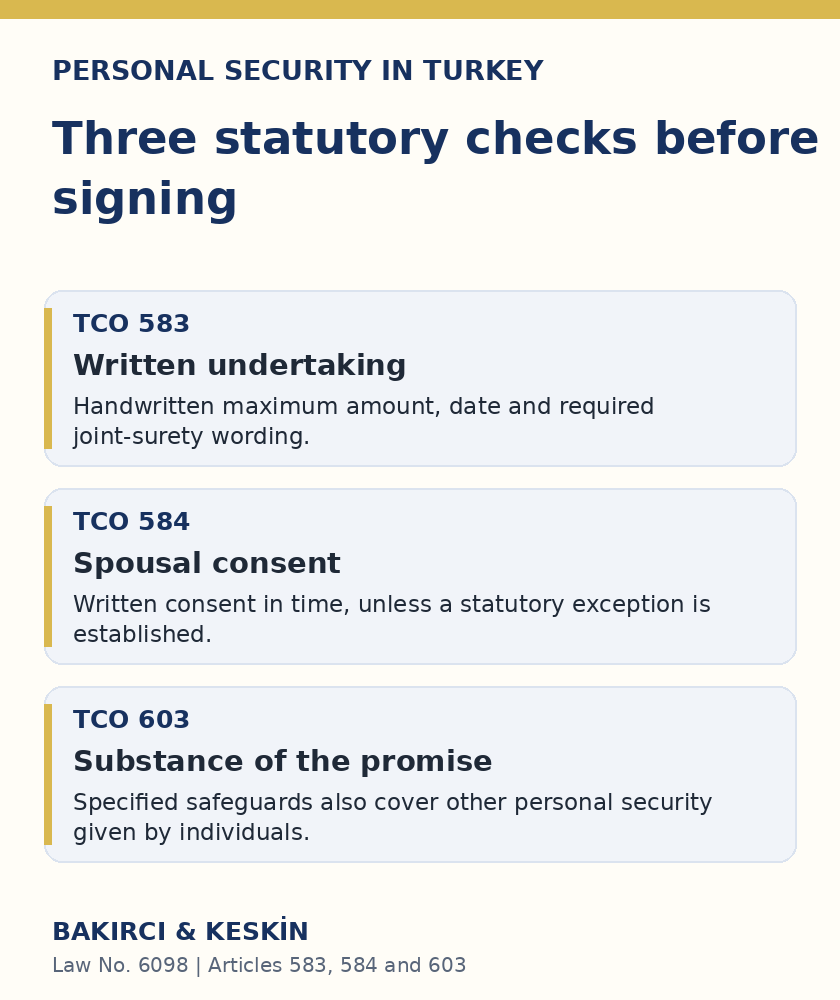
Identify the individual obligation before checking the signature
The starting point is the obligation the individual actually undertakes. A company signs its own supply or credit contract through an authorised representative. That representative does not become an individual surety simply because their signature appears on the company’s contract. A separate promise to answer for the company’s debt needs its own legal analysis. Identify the capacity written beside each signature, the named borrower, the beneficiary and the undertaking’s connection with the principal debt.
Article 581 defines suretyship by reference to the surety’s personal responsibility to the creditor for the consequences of the debtor’s non-performance. Article 582 addresses the underlying obligation and permits security for a future or conditional obligation subject to its statutory requirements. An independent undertaking concerning a third person’s performance has a different starting point under Article 128. These classifications affect the rights available after default; they should be established from the whole agreement, its annexes and the parties’ actual intention under Article 19.
The relevant statutory text is the Turkish Code of Obligations, Law No. 6098. Review Articles 19, 128 and 581–584 together instead of translating every English “guarantee” as the same Turkish legal instrument. Our guide to contract disputes involving international clients explains the broader document review.
Article 583: the maximum amount, date and joint-surety wording
Article 583 makes written form a validity requirement for suretyship. The agreement must state the maximum amount for which the surety is responsible and the date of the suretyship. The individual surety must write that maximum amount and date personally by hand. Where the undertaking is joint and several suretyship, the individual must also handwrite that status or wording expressing the same meaning. A printed box marked “joint guarantor” does not by itself demonstrate compliance with the handwriting requirement.
The maximum amount identifies the agreed ceiling of the security. It should be distinguished from the principal loan balance, a revolving credit facility limit, estimated interest and the total requested in a later demand. A creditor should be able to identify the handwritten ceiling without reconstructing it from an unrelated account statement. The execution date is equally important: it connects the undertaking to the spouse-consent record, the signatory’s legal status and later amendments.
Keep the signed original, all continuation pages and the annex identifying the secured transaction. A photograph of a signature page detached from the liability clause leaves unanswered questions about the document signed. A notarisation, witness signature or company stamp should never be treated as a substitute for a statutory field that Article 583 requires the surety to complete personally. The formal requirements concern the undertaking itself, not merely proof that somebody signed a page.
Article 584: whose consent is required and when
For a married individual, Article 584 requires the other spouse’s written consent unless a statutory exception applies. That consent must exist before the suretyship agreement is concluded or, at the latest, when it is concluded. A creditor reviewing a completed transaction should therefore examine both dates. A later letter saying that the spouse knew about the borrowing is not evidence that the statutory timing requirement was satisfied at execution.
The first paragraph expressly addresses a judicial separation order and a legal entitlement to live separately. Those circumstances must be established from the relevant family-law facts and documents. Different addresses, overseas employment or an informal statement that the spouses lead separate lives does not identify the legal basis required by the provision. Conversely, the review must not overlook a qualifying judicial or legal situation merely because the person remains recorded as married.
The consent relates to the spouse becoming surety. It should identify the relevant transaction sufficiently to connect it with the undertaking under review. Keep the consent alongside the security agreement, identity records and dated execution evidence. Signing a loan application as a witness, attending a business meeting or receiving copies of correspondence does not answer the separate statutory question of written spousal consent.
Commercial exceptions require an actual connection with the business
Article 584’s third paragraph removes the spousal-consent requirement for specified business and credit situations. It covers a proprietor of a commercial enterprise registered in the trade registry giving suretyship in connection with that enterprise. It also covers a shareholder or manager of a commercial company giving suretyship in connection with that company. The person’s status and the relationship between the security and the relevant business must both be established.
For a foreign shareholder, the useful records include the company’s exact registered identity, the shareholding or management record at the relevant date, and the contract showing whose business obligation is secured. A title on a business card is not the same evidence as an appointment record. A person’s involvement in one company does not automatically establish that a guarantee for another legal entity falls within the exception.
The paragraph also includes registered tradespeople and artisans giving security connected with their professional activities, credit falling within Law No. 5570, and the specified cooperative-credit arrangements. Each category has its own statutory description. The practical task is to match the transaction to a defined category, not to replace Article 584 with the general statement that commercial guarantees never need a spouse’s consent. The business exception concerns consent; it does not dispense with Article 583’s distinct formal requirements.
Article 603: renaming personal security does not remove the safeguards
Article 603 applies the suretyship provisions on form, capacity to become surety and spousal consent to other contracts under which individuals give personal security under a different name. It prevents the analysis ending with a heading such as “independent guarantee”, “payment commitment” or “personal undertaking”. The protected question is the substance of the individual’s personal-security obligation.
Its wording is also limited. Article 603 does not say that every provision governing suretyship automatically applies to every guarantee. The specified extension concerns form, capacity and consent. Rights concerning enforcement order, recourse, duration and accessory liability require classification and the provisions governing the particular obligation. A useful review therefore identifies the applicable safeguards separately from the other legal consequences of the instrument.
The provision refers to natural persons. A guarantee given by a company raises its own questions of corporate representation, authority and the contract’s terms. A director signing for that company and the same director giving personal security occupy different legal positions. Both signatures must be analysed according to the capacity in which they were made.
Amendments: increased exposure needs a fresh formal review
Article 583 expressly provides that later changes increasing the surety’s liability take effect only if the form required for suretyship is observed. Changing the amount in a spreadsheet or signing a general facility amendment does not answer whether the individual security was validly increased. Compare the old undertaking with the exact change: the ceiling, secured debts, liability category and signing dates all matter.
Article 584 addresses later changes separately. Its consent exemption for amendments concerns changes that do not increase the amount for which the surety is responsible, convert ordinary suretyship into joint and several suretyship, or substantially reduce safeguards benefiting the surety. A change affecting one of those protected features must be reviewed under the consent rule, including any applicable statutory exception.
An extension, refinancing, replacement borrower or new credit arrangement should therefore be reviewed from the complete document chain. First identify whether the parties amended the same undertaking or created another obligation. Then examine the applicable form and consent requirements. The commercial description “renewal” cannot replace that sequence, and a valid original security document does not prove that every later increase is covered.
Signing abroad and choosing foreign law
A foreign address, foreign nationality or English-language document does not resolve which legal system governs a personal undertaking. The applicable-law analysis precedes the domestic Article 583–603 analysis. Law No. 5718 contains rules on contractual obligations, legal capacity and the form of legal transactions; these questions must be identified separately. A Turkish creditor or a proposed Turkish enforcement proceeding does not alone establish the answer to every one of them.
For an overseas execution, preserve the document actually signed, the signatory’s capacity, the execution location and the governing-law clause. Identify any special authority used to sign for another person. Article 583 itself imposes the same form conditions on special authority to become surety in one’s name and on a promise to provide suretyship. A general power of attorney should therefore not be accepted without checking its scope and form.
Our international-contract governing-law guide explains the Article 24 framework. The official Law No. 5718 should be consulted for the relevant conflict rules. Authentication and translation help establish a foreign document; they do not themselves decide the underlying undertaking’s validity.
Review an existing demand in two separate stages
The first stage asks whether the personal-security obligation was validly created and amended. The second asks whether the creditor’s current demand falls within it. A valid signature does not establish the principal debtor’s default, the outstanding balance, the secured ceiling, the applicable interest or compliance with the rules for pursuing that type of surety. Match the demand to the secured debt rather than to the creditor’s total customer balance.
Place every served court or enforcement document at the front of the file with its service record. Raising a substantive formal defect and meeting the procedural deadline for the particular proceeding are separate tasks. Correspondence with a creditor does not replace the necessary response to a payment order or claim. Our Turkish debt collection and enforcement guide distinguishes the main routes and explains why the document served determines the procedural response.
Documents that make the review usable
Provide the full original security agreement, the underlying transaction, every amendment, the handwritten pages, the spouse’s written consent where applicable, and the records supporting any exception. Add a chronology recording execution, credit use, amendments, default notices and service of proceedings. Identify the exact person or entity in each role: debtor, creditor, surety, corporate representative and consenting spouse.
Where business status is relied on, provide the registry and appointment or shareholding evidence relevant to execution. Where separation is relied on, identify its legal basis and the supporting decision or record. Retain the source-language documents alongside translations. This package allows a Turkish-law review to address each statutory element directly without treating a missing document as proof either of validity or invalidity.
Frequently asked questions
Does every personal guarantee in Turkey require notarisation?
Article 583 requires written form and specified handwritten statements for suretyship; it does not make notarisation the general validity requirement for every surety agreement. The transaction, any representative authority and applicable special rules still need examination. A notarised signature does not replace the statutory handwritten maximum amount, date or required joint-surety wording.
Can my spouse consent after I have signed?
Article 584 requires the written consent before or no later than conclusion of the suretyship. A document signed later does not establish compliance with that timing rule. First determine whether consent was required for the transaction or whether a defined statutory exception applied at execution.
Does a shareholder always need spousal consent for company borrowing?
Article 584 provides an exception for a shareholder or manager giving suretyship in connection with the relevant commercial company. The company relationship and the signatory’s status must be documented. The exception does not remove Article 583’s separate formal requirements and does not cover every unrelated personal undertaking by a shareholder.
Can an English guarantee avoid the Turkish handwriting rules?
The language or title of the document does not decide the issue. Where the relevant Turkish rules apply, Article 603 extends the specified safeguards to personal security given by individuals under other names. Cross-border applicable-law and form questions require separate examination before applying that rule.
Does Article 603 make every guarantee a suretyship?
No. Article 603 expressly extends the provisions concerning form, capacity and spousal consent to other personal-security contracts given by individuals. It does not state that all suretyship provisions govern every other security contract. The classification remains important for other rights and liabilities.
Can a creditor increase the surety ceiling through a loan amendment?
Article 583 requires compliance with suretyship form for a later change increasing the surety’s liability. Article 584 also regulates spousal consent to protected changes. A facility amendment should be compared with the personal undertaking and any applicable exception; increasing the borrower’s facility does not by itself answer the surety’s position.
Does signing as a company director make me personally liable?
A signature made on behalf of a company must be distinguished from a personal-security undertaking. Examine the signature capacity and the contractual obligations. The director’s corporate signature alone does not identify a separate suretyship promise, while an additional personal undertaking requires its own validity analysis.
What should I send after receiving a demand under a guarantee?
Send the complete signed undertaking, underlying debt agreement, amendments, payment records, consent or exemption evidence, and the demand. Include every court or enforcement document and its service record. These documents permit separate review of formation, the amount claimed and the procedural response deadline.
Official legal sources
Turkish Code of Obligations No. 6098, especially Articles 19, 128, 581–584 and 603; Ministry of Labour and Social Security official text; and Private International and Procedural Law No. 5718, especially Articles 7, 9 and 24. English explanations on this page are explanatory translations; the Turkish statutory text controls.
Istanbul and Mersin offices
Istanbul — Polaris Plaza
Maslak Ahi Evran Caddesi, Polaris Plaza No:21, Floor 9, 34475 Sarıyer/İstanbul. Istanbul office information.
Mersin — Profit İş Merkezi
Our practice is based in Mersin, with offices in Mersin and Istanbul and case management throughout Türkiye. For a personal-security review, use the English contact section to state the subject and any urgent response deadline. Agree a suitable confidential channel before sending guarantees, identity records or other private documents.
İhsaniye Mahallesi, 4903. Sokak, Profit İş Merkezi No:23, Floor 3, Office 14, 33070 Akdeniz/Mersin, Türkiye.
Contact regarding a legal matter
In your first message, you may briefly state the subject, your country or city, and any relevant notification or recent procedural date. Please do not send identity numbers, medical data, or personal documents. Messaging alone does not constitute legal advice or create a lawyer–client relationship.
Discover more from Bakırcı & Keskin Hukuk Bürosu
Subscribe to get the latest posts sent to your email.