Pursuing a Surety in Turkey: Ordinary and Joint Suretyship Under TCO 585–586
A Turkish creditor’s right to pursue a surety depends on the type of suretyship and the security supporting the debt. Article 585 of the Turkish Code of Obligations regulates ordinary suretyship. Article 586 regulates joint and several suretyship. The second category permits direct pursuit in defined circumstances, but it does not eliminate every condition or every right to prior realisation of collateral. A sound enforcement review identifies the principal debtor’s default, the notices already sent, the kind of pledge or mortgage and the maximum secured amount before deciding which person to pursue.
Have a general question about this article? Ask anonymously
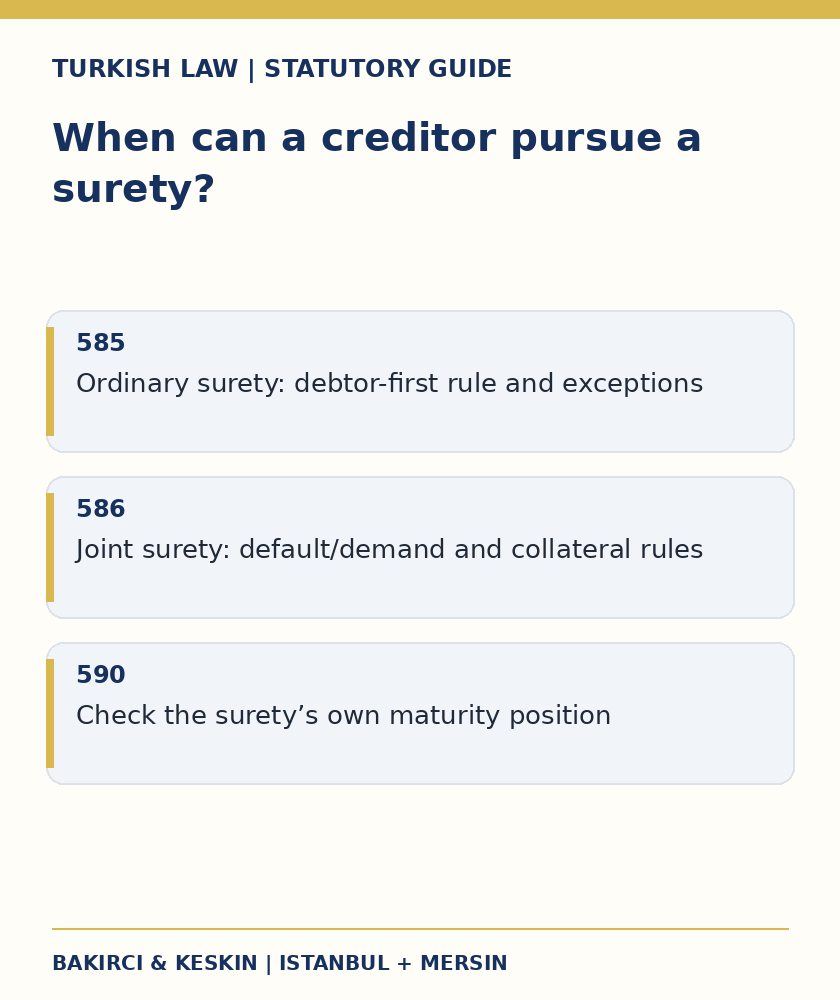
Ordinary suretyship starts with the principal debtor
Under Article 585 of Law No. 6098, the creditor cannot ordinarily pursue an ordinary surety without first proceeding against the principal debtor. The article then lists the situations permitting direct recourse. The creditor must identify the relevant exception and its supporting record; a statement that collecting from the debtor would be inconvenient does not establish a statutory ground.
The listed circumstances are a definitive certificate of inability to pay following enforcement against the debtor; enforcement against the debtor in Turkey becoming impossible or substantially more difficult; a bankruptcy decision concerning the debtor; and the granting of a concordat moratorium. Those are distinct events. A late invoice, temporary cash shortage or informal restructuring discussion does not automatically establish bankruptcy or a judicial concordat moratorium.
Read the actual security wording before applying this framework. The creditor’s demand letter may use the everyday expression “guarantor” for several legally different positions. The signed undertaking determines whether the person agreed ordinary suretyship, joint and several suretyship or another form of personal security. The contract’s validity, including its required handwritten elements, is a preliminary question separate from the conditions for pursuing a valid undertaking.
Existing collateral changes the ordinary-surety analysis
Article 585 also addresses a debt secured by a pledge at or before the time of suretyship. An ordinary surety can demand that the creditor first obtain payment from that collateral. The creditor therefore needs a security chronology: identify when the pledge was created and whether it secures the debt covered by the suretyship. A mortgage securing an unrelated borrowing is not automatically collateral for the claim under review.
This prior-realisation rule has its own statutory exceptions. Article 585 states that it does not apply where the debtor has been declared bankrupt or granted a concordat moratorium. The existence of collateral and the occurrence of a formal insolvency event must consequently be checked together. Treating every pledged debt as permanently immune from a claim against the surety would misstate the provision.
The rule also differs from a promise expressly limited to covering a shortfall. Article 585 separately describes direct recourse under that arrangement, including a definitive inability-to-pay certificate, impossibility of enforcement in Turkey and confirmation of a concordat. The agreement can require prior recourse to the principal debtor in those circumstances. The distinction between a moratorium and a confirmed concordat should be preserved when reading these separate parts of the article.
Joint and several suretyship still has statutory entry conditions
Article 586 permits pursuit of a joint and several surety without first pursuing the principal debtor or realising a mortgage over immovable property. That entitlement is tied to the principal debtor being late in performance and a demand remaining unsuccessful, or to the debtor being clearly unable to pay. The article should not be reduced to the phrase “the bank can pursue anybody immediately”.
For the default-and-demand route, retain the contract provision establishing maturity, the account or performance records, the demand, proof of delivery and evidence that it remained unsuccessful. For the inability-to-pay route, identify the evidence supporting that specific condition. A creditor who relies on a legal exception should not describe the evidence merely as general commercial dissatisfaction or an internal risk rating.
The underlying debt and the surety’s position also require separate maturity analysis. Article 590 provides that bankruptcy-related acceleration of the principal debt does not permit pursuit of the surety before the agreed maturity. Where maturity depends on a prior notice containing a period, the period for the suretyship obligation begins when notice is given to the surety. The notice record must therefore identify its addressee and legal function.
A possessory pledge is not the same as an immovable mortgage
Article 586 distinguishes immovable mortgages from possessory pledges over movables and pledges over receivables. Where the debt is secured by either of the latter two forms, the creditor cannot ordinarily turn to the surety before realising the pledged security. It is incorrect to take the first paragraph’s reference to immovable mortgages and apply it indiscriminately to all collateral.
The second paragraph permits earlier pursuit where a judge has determined in advance that realisation will not cover the claim in full, or where the debtor is bankrupt or has been granted a concordat moratorium. An internal lender valuation is not the judicial determination specified in the first exception. Identify the order, the collateral assessed and the debt to which the order relates.
The document review should describe each security precisely: property type, pledgor, creation date, secured obligation, priority and current status. Copies of land-registry entries, pledge agreements and relevant notices allow the legal classification to be checked. Referring to everything as “a guarantee” conceals distinctions that directly affect the order in which the creditor can act.
The surety ceiling remains relevant in every category
Article 589 limits a surety’s responsibility to the maximum amount stated in the suretyship agreement. Unless the agreement provides otherwise, and within that maximum, it covers principal, the legal consequences of the debtor’s fault or default, qualifying costs, and contractual interest for one accrued year and the current year; it also addresses the corresponding interest on principal lent against bonds. The facility limit, the amount advanced and the handwritten surety limit should therefore be recorded as separate figures.
The same article requires an express agreement before the surety is responsible for debts predating conclusion of the suretyship. It also declares ineffective agreements making the surety responsible for the loss caused by invalidity of the principal obligation and for contractual penalties. These provisions prevent the creditor’s entire account balance from being assumed recoverable merely because an undertaking contains broad commercial wording.
Prepare a claim reconciliation connecting each sum with its contractual and statutory basis. A payment by the principal debtor must be reflected in the amount still sought. Costs require their own analysis, including Article 589’s notification condition. The ordinary or joint character of suretyship answers an enforcement-order question; it does not expand the maximum exposure or make every claimed item legally recoverable.
Defences and a request to suspend pursuit
Article 591 gives the surety the right and duty to assert the principal debtor’s defences that do not arise from the debtor’s inability to pay, subject to its express exceptions. The principal debtor’s waiver of a defence does not automatically prevent the surety from relying on it. Examine the debt’s existence, performance, limitation and other substantive defences before accepting the creditor’s calculation.
Article 590 also permits a surety, across the different forms of suretyship, to seek judicial suspension of pursuit against provision of real security until the specified realisation and debtor-enforcement stages are reached. It is a court-based mechanism with stated conditions, not an automatic pause created by writing to the creditor. The application, offered security and procedural position require deliberate preparation.
A substantive right and the mechanism for raising it must be kept distinct. If a payment order or claim has already been served, identify the procedure and response deadline from that document. Negotiating a payment schedule does not itself record a formal objection. Nor does an unsigned settlement proposal prove that the creditor withdrew existing enforcement steps.
How foreign parties should prepare the enforcement file
International files first require a governing-law and jurisdiction analysis. The presence of a Turkish debtor or Turkish assets does not resolve every question about a foreign-executed security agreement. Our guide to governing law in international contracts explains that preliminary stage. Once the relevant Turkish suretyship provisions are identified as applicable, the Article 585–590 conditions should be checked against the actual documents.
Provide the principal agreement, complete surety undertaking, maturity provisions, security documents, demands and service evidence. Add insolvency decisions relied on by either side and the current balance reconciliation. Translate the terms consistently: distinguish the principal debtor from the surety, and distinguish a mortgage from a pledge over receivables. An English summary is useful, but the source-language instruments remain necessary for review.
The debt collection and enforcement guide explains the main procedural routes. For a dispute concerning the scope or classification of the agreement, consult the international-client contract dispute guide. Those issues connect with this article, but they do not replace the specific statutory conditions for proceeding against a surety.
A practical sequence before commencing or answering a claim
Start by confirming the parties and a valid personal-security undertaking. Determine whether it is ordinary or joint and several suretyship and identify the principal obligation it secures. Establish the due date and the notices required for the debtor and surety. Then list existing collateral and classify it under the relevant paragraph of Article 585 or 586. Verify any insolvency event or judicial determination being invoked.
Only after those questions should the amount and procedure be finalised. Record the surety ceiling, the remaining principal and the separate basis for interest and costs. For a defending surety, record the same facts alongside available defences and the document triggering the response deadline. This sequence gives both sides a defined legal explanation for the proposed next step without promising a recovery result or treating a security label as proof.
Official statutory references
The legal framework is Turkish Code of Obligations No. 6098, Articles 585–586 on enforcement order and collateral, Article 589 on scope, Article 590 on pursuit and maturity, and Article 591 on defences. The current official consolidated text of the Code provides the Turkish text. These provisions govern different questions and should be read together for the particular undertaking.
Frequently asked questions
Must a creditor always sue the borrower before claiming against a surety?
No. Article 585 establishes the ordinary-surety starting rule and specific exceptions. Article 586 separately permits pursuit of a joint and several surety under its conditions. Identify the valid security type, default and demand evidence, collateral and any relevant insolvency decision before selecting the route.
Does joint and several suretyship remove the need for a demand?
Article 586 requires debtor delay and an unsuccessful demand, or clear inability to pay, for the direct-pursuit rule in its first paragraph. These are statutory conditions. A creditor relying on the inability-to-pay alternative must identify the evidence supporting it; the label alone does not establish the condition.
Can a joint surety require sale of a mortgaged property first?
Article 586 permits the creditor to pursue the joint and several surety without first realising an immovable mortgage when the statutory conditions are met. Different rules apply to possessory movable pledges and receivables pledges. The precise security type must be established before relying on prior realisation.
What changes when a receivable is pledged to the creditor?
Under Article 586’s second paragraph, a receivables pledge ordinarily must be realised first. The paragraph provides exceptions for an advance judicial finding of insufficient coverage, bankruptcy and a concordat moratorium. The file must establish the applicable exception rather than equate every pledged asset with an immovable mortgage.
Does the borrower’s bankruptcy accelerate the surety’s liability?
Article 590 states that even where bankruptcy makes the principal debt due earlier, pursuit of the surety cannot begin before the agreed maturity. Bankruptcy has other effects under Articles 585 and 586, but those effects do not erase this separate timing protection.
Is the surety responsible for every amount in the creditor’s account?
Article 589 imposes the contractual maximum and regulates the covered items. The secured transaction, principal balance, interest, costs, earlier debts and prohibited penalty exposure require separate checks. An account total or facility ceiling is not a substitute for the legally recoverable amount under the suretyship.
Can a surety use a defence the borrower has waived?
Article 591 allows the surety to raise the principal debtor’s qualifying defences despite the debtor’s waiver, subject to the provision’s express exceptions. The surety must examine those defences before payment because failure to raise a known defence can also affect recourse against the debtor.
Does requesting more information stop an enforcement deadline?
A request for the contract, collateral records or balance does not itself constitute the procedural response required by an enforcement or court document. Identify the served document, the service date and the appropriate objection or defence. Information gathering and compliance with the response deadline must proceed together.
Istanbul and Mersin offices
Istanbul — Polaris Plaza
Maslak Ahi Evran Caddesi, Polaris Plaza No:21, Floor 9, 34475 Sarıyer/İstanbul. Istanbul office information.
Mersin — Profit İş Merkezi
Our practice is based in Mersin, with offices in Mersin and Istanbul and case management throughout Türkiye. For an English-language appointment, state the subject of your matter and any approaching procedural date in the English contact section.
İhsaniye Mahallesi, 4903. Sokak, Profit İş Merkezi No:23, Floor 3, Office 14, 33070 Akdeniz/Mersin, Türkiye.
Contact regarding a legal matter
In your first message, you may briefly state the subject, your country or city, and any relevant notification or recent procedural date. Please do not send identity numbers, medical data, or personal documents. Messaging alone does not constitute legal advice or create a lawyer–client relationship.
Discover more from Bakırcı & Keskin Hukuk Bürosu
Subscribe to get the latest posts sent to your email.