Payment Applied to the Wrong Invoice in Turkey: TCO Articles 100–102
A payment reaching the correct creditor does not answer which debt it discharged. Under Turkish Code of Obligations Article 101, a debtor with several debts can identify the debt being paid on the payment date. Without that notification, the creditor’s receipt matters unless the debtor immediately objects. Article 102 supplies the statutory order where there is no legally effective allocation. Article 100 separately regulates part-payment within a debt, including principal, interest, expenses and security. These distinctions are essential when a Turkish supplier leaves the intended invoice unpaid or a lender says that a transfer reduced interest rather than principal.
Have a general question about this article? Ask anonymously
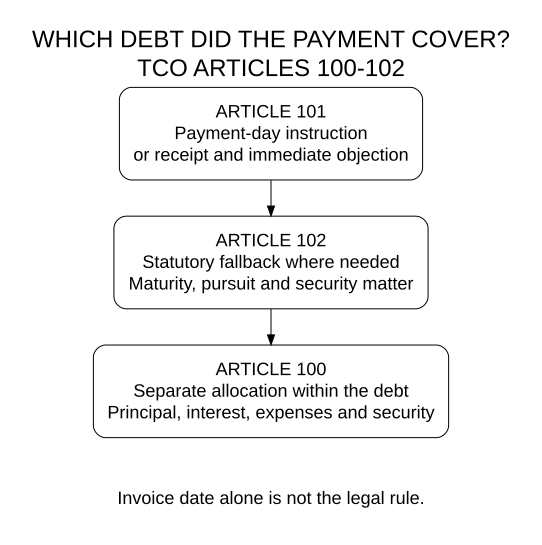
Separate allocation between debts from allocation within one debt
Start by identifying the disagreement precisely. A supplier can receive money against several purchase invoices. A lender can receive a partial payment against one loan comprising principal, accrued interest and expenses. The first situation asks which obligation was paid; the second asks which component or part of the identified obligation was reduced. Articles 101–102 and Article 100 address those questions respectively.
The same payment can require both stages. First identify the debt to which it legally belongs, then determine its treatment within that debt. An accountant’s entry called “general payment” or “principal adjustment” does not eliminate either enquiry. Preserve the payer’s instruction, any allocation agreement, the creditor’s receipt and the account record showing what was actually done.
The governing text is Law No. 6098, Articles 100–105. This article concerns identification and crediting of an actual payment. It does not decide the separate currency-election question under Article 99, which is explained in our foreign-currency debts guide. Keep the two analyses separate when preparing a revised balance.
Article 101: communicate the selected debt on the payment date
Article 101 gives a debtor with several obligations the opportunity to notify the creditor which debt it intends to pay on the payment date. The communication should identify an obligation that can be matched to the money received. A contract reference, invoice number or specified instalment provides a clearer record than an unexplained phrase such as “for account”.
A payment-reference field can form part of the evidence, but its actual content and transmission need examination. Retain the bank confirmation showing the text transmitted and any same-day notice sent directly to the creditor. Where an international bank truncates a reference, the debtor’s internal instruction and the information received by the creditor can differ. Do not assume that a detailed instruction retained by the payer was necessarily delivered in full.
The notification must come from the debtor or someone properly acting for it. A parent company sending money for a subsidiary should identify both the payer and the subsidiary’s obligation. Common ownership does not combine separate companies’ debts into one account. If the creditor uses a collection agent, preserve the authority and the channel through which the allocation was communicated.
A later attempt to rewrite the purpose of a completed transfer should not be confused with the payment-day notification in Article 101. A genuine subsequent agreement can raise its own issues, but it must be established as an agreement. Altering the payer’s spreadsheet after a dispute starts does not prove that the original transfer carried the newly asserted instruction.
The creditor’s receipt and the need for immediate objection
When the debtor has not made a notification, Article 101 treats the payment as made against the debt identified in the creditor’s receipt unless the debtor immediately objects. The receipt is therefore not merely an administrative courtesy. Its wording can have a direct role in identifying the discharged obligation where the debtor left that matter unspecified.
Read the receipt as soon as it arrives and compare it with the payment record. A document describing a different invoice, period or facility should be addressed directly. Preserve the receipt’s delivery date and the objection’s content and delivery evidence. A later pleading saying that the allocation was always disputed is weaker evidence of an immediate response than the original contemporaneous correspondence.
The article uses an immediate-objection requirement; it does not establish a general seven-day or eight-day objection period for this particular situation. Do not import a deadline from invoice law or an enforcement procedure without identifying its separate source. An invoice objection, an objection to allocation in a receipt and a response to a payment order have different objects.
Where the debtor already gave an effective payment-day instruction, the analysis is not reduced to the creditor’s subsequent unilateral bookkeeping choice. Identify the instruction and its relation to the payment before treating the receipt as decisive. At the same time, preserve any contractual allocation clause for review rather than assuming that the default statutory explanation settles every agreed arrangement.
Article 102 supplies an ordered fallback, not an arbitrary choice
Article 102 applies where a legally effective declaration has not been made or the receipt does not clarify the allocation. It first directs the payment to a due debt. If several debts are due, the payment is treated as made against the debt first pursued against the debtor. If none has been pursued, the debt whose maturity came first is selected.
When several debts matured at the same time, allocation is proportional. When no debt has matured, payment is treated as made against the debt with the least security. These final rules are important because a general first-in-first-out ledger does not reproduce the statutory hierarchy. Invoice issue date and contractual maturity are also different fields.
The working schedule must therefore show whether each obligation was due on the payment date, its due date, relevant proceedings and security. Do not substitute the date of the oldest email demand for the date of formal pursuit without examining its legal character. Obtain the enforcement or court records relied on when the creditor asserts priority based on proceedings.
The fallback rules do not give either party an unrestricted right to select the outcome producing the largest outstanding claim or the greatest release of collateral. Apply the relevant step to the established facts. If a fact remains disputed, state the competing factual positions in the reconciliation rather than hiding a legal assumption inside a spreadsheet formula.
Article 100: when a partial payment can be credited to principal
Article 100 gives a debtor who is not late in paying interest or expenses the right to deduct a partial payment from principal. It expressly prohibits an agreement to the contrary. The state of interest and expenses at the time of the payment is therefore central; the mere existence of a loan does not establish that the protected right is unavailable.
Request a breakdown of the interest and expense items said to be overdue. Identify their contractual or statutory basis, the relevant period, due date and any previous payment. An unsupported fee entered retrospectively should not be accepted as a proved overdue expense solely because it appears in the creditor’s computer system. Conversely, ignoring a properly due item does not turn the payment into an automatic principal-only reduction.
Where interest or expenses are overdue, the debtor cannot simply invoke the first paragraph as an unconditional right to dictate a principal-only allocation. The applicable arrangement and the legal treatment of the overdue components must be assessed. Separate that issue from any dispute about the amount or enforceability of the alleged interest itself.
A revised calculation should show the opening principal, lawfully due additional components, the amount received, the allocation and the resulting balance. Do not present gross money received as proof that principal fell by the same amount. The interest calculation for the next period must follow the legally established remaining principal rather than the preferred headline number.
A part-payment cannot be directed unilaterally to the better-secured portion
Article 100’s second paragraph protects the creditor where only part of a claim is covered by suretyship, pledge or another security. The debtor does not have the right to allocate a partial payment to the secured or better-secured part. This is a specific limit on the debtor’s allocation power, distinct from choosing among several separate debts under Article 101.
Identify the scope of the security before deciding whether this rule is engaged. Obtain the personal undertaking, pledge document or other relevant instrument and match it to the claim. A security ceiling and the outstanding debt are different figures. The existence of collateral for one obligation does not establish that all obligations in a supplier relationship are secured in the same way.
The consequence matters particularly when an individual wants a company payment to reduce the part supported by that individual’s suretyship. A bank reference expressing that wish is not, by itself, proof that Article 100 permits the allocation. Any separate creditor agreement or release must be identified expressly. Our personal-guarantee guide addresses the separate validity requirements of the security.
Articles 103–105 make receipts and debt instruments part of the evidence
Article 103 allows the paying debtor to request a receipt and, when the whole debt has been paid, return or cancellation of the debt instrument. Where payment is incomplete or the instrument also grants other rights, the debtor can request a receipt and an entry recording payment on the instrument. The requested documentation should accurately reflect the scope of the performance.
Article 104 attaches presumptions to particular records. An unreserved receipt for a periodic payment, such as interest or rent, supports treatment of earlier periods as performed. A receipt for the entire principal supports the conclusion that interest was also received. Return of the debt instrument supports the conclusion that the debt ended. These are legally significant records, not a reason to conceal a genuine contrary fact or ignore the surrounding evidence.
If the creditor says the debt instrument was lost, Article 105 requires, at the debtor’s request upon payment, an officially drawn or duly authenticated document showing cancellation of the instrument and extinction of the debt. Rules concerning cancellation of negotiable instruments are reserved. A lost promissory note consequently requires a more specific review than a missing copy of an ordinary invoice.
Reconcile the account without rewriting the historical evidence
Create a payment-by-payment reconciliation rather than correcting only the final balance. For each entry retain the actual date, amount received, currency, payer, creditor, instruction, receipt, objection and proposed legal allocation. Link each entry to its source document. Keep returned transfers and bank reversals visible so that an unsuccessful instruction is not counted as completed payment.
Maintain both the creditor’s original statement and the corrected working version. The comparison should show exactly which allocation is disputed and why the change follows from an instruction, receipt, agreement or Article 102. This allows another reviewer to reproduce the result. Overwriting the original ledger erases evidence of the disputed treatment and makes later explanations harder to verify.
A discount, return of goods, damages claim or set-off allegation is not the same event as a cash payment. Record it separately with its own legal basis. Nor does an accounting label called a current account necessarily establish a formal current-account contract. The nature of the relationship and any special statutory regime must be determined before assuming that every individual invoice remains independently allocable.
Respond to an incorrect demand without losing a procedural deadline
A correction request should identify the payment, the intended or legally applicable allocation, the creditor’s contrary entry and the proposed resulting balance. Attach the relevant evidence and ask for a corrected statement. Do not demand deletion of a valid unpaid debt merely because another payment was misallocated. The purpose is an accurate account, not an unexplained reduction.
If an enforcement order or court claim has already been served, address its response requirements separately. Correspondence about a ledger does not automatically stop a procedural deadline. Keep the served document, service record and the reconciliation together. The Turkish enforcement guide for international clients explains why the specific proceeding must be identified before deciding how to respond.
Frequently asked questions
Can I choose which invoice a payment covers?
Article 101 allows a debtor with several debts to notify the creditor on the payment date which debt it intends to pay. Identify the obligation clearly and retain evidence of the notification and actual transfer. Relevant contractual terms must also be examined.
What happens if I leave the payment reference blank?
The creditor’s receipt can identify the debt under Article 101 unless the debtor immediately objects. If no legally effective allocation results, Article 102 provides the statutory order. A blank reference does not automatically mean the oldest invoice was paid.
Is there an eight-day period to challenge the receipt’s allocation?
Article 101 requires an immediate objection in the situation it regulates; it does not specify an eight-day period. Distinguish that issue from any separate invoice objection or procedural deadline and preserve when the receipt and objection were delivered.
Does Article 102 always require first-in-first-out accounting?
No. It distinguishes due debts, the debt first pursued, earliest maturity, simultaneous maturity and the least-secured debt where none is due. A ledger organised only by invoice creation date does not implement all those rules.
How are debts with the same maturity treated?
Under Article 102’s fallback rule, debts maturing at the same time receive proportional allocation. First establish that no effective declaration or clarifying receipt determines the payment and that the relevant maturity conditions are present.
Can I require a part-payment to reduce principal?
Article 100 gives that right where the debtor is not late in paying interest or expenses and prohibits a contrary agreement. Establish the status of those components before applying the rule; a disputed statement needs an itemised review.
Can I insist on paying down the portion covered by my guarantee?
Article 100 does not grant a unilateral right to allocate a partial payment to the secured or better-secured part of a claim. Identify the security’s scope and any separate creditor agreement rather than relying on a transfer description alone.
Should a paid debt instrument be returned?
Article 103 provides for return or cancellation when the whole debt is paid. Partial payment or an instrument carrying other rights requires the receipt and annotation approach stated in that article. Article 105 separately addresses a claimed loss of the instrument.
Does a parent’s payment automatically pay its subsidiary’s invoice?
The legal parties and payment purpose must be established. Group membership does not merge separate obligations. Preserve the instruction showing whose debt the parent paid and the creditor’s acknowledgment and allocation.
Does requesting a ledger correction stop enforcement?
No automatic suspension follows merely from a correction request. Review the served enforcement or court document and its response deadline separately, while preserving the payment and allocation evidence needed for the substantive objection.
Official statutory references
Turkish Code of Obligations No. 6098, Articles 100–105; official Ministry text of the allocation and receipt provisions. The English explanations are not an official translation. The Turkish text and the established facts govern.
Istanbul and Mersin offices
For an English-language payment-allocation review, begin with the disputed transfer date, the invoices involved and any response deadline. The English contact section can be used to arrange a confidential channel for the full reconciliation. Our practice is based in Mersin, with offices in Mersin and Istanbul and coordination throughout Türkiye.
Istanbul — Polaris Plaza
Maslak Ahi Evran Caddesi, Polaris Plaza No:21, Floor 9, 34475 Sarıyer/İstanbul. Istanbul office information.
Mersin — Profit İş Merkezi
İhsaniye Mahallesi, 4903. Sokak, Profit İş Merkezi No:23, Floor 3, Office 14, 33070 Akdeniz/Mersin.
Call +90 552 224 43 66. General legal information; an enquiry does not establish representation or suspend a deadline.
Contact regarding a legal matter
In your first message, you may briefly state the subject, your country or city, and any relevant notification or recent procedural date. Please do not send identity numbers, medical data, or personal documents. Messaging alone does not constitute legal advice or create a lawyer–client relationship.
Discover more from Bakırcı & Keskin Hukuk Bürosu
Subscribe to get the latest posts sent to your email.