Set-Off of Mutual Debts in Turkey: TCO Articles 139–145
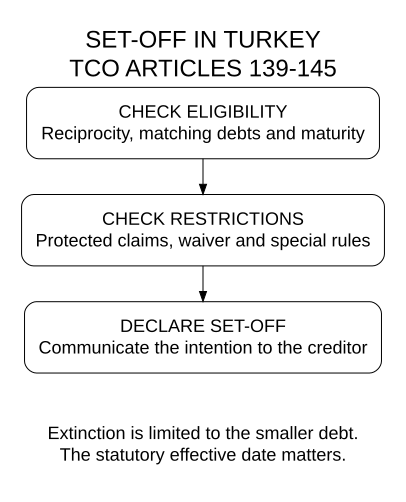
Two unpaid invoices do not cancel each other merely because the same businesses issued them. Turkish Code of Obligations Article 139 permits set-off where the parties owe each other money or identical kinds of performance and the maturity requirements are satisfied. Article 143 requires a declaration of set-off to the creditor. Articles 140–145 add rules for sureties, third-party beneficiaries, bankruptcy, protected claims and advance waiver. Before withholding a payment, identify the two legal parties, the two obligations, their due dates, any contractual restriction and the declaration being relied on.
Have a general question about this article? Ask anonymously
Set-off is different from allocating money that has already been paid
Set-off, called takas in Turkish law, uses a counterclaim to extinguish an opposing debt to the relevant extent. Payment allocation asks which debt an actual payment discharged. A bank transfer credited to the wrong invoice raises the second question; an unpaid supplier claim opposed by an unpaid customer claim raises the first. Confusing the two can produce an account that looks balanced while its legal basis remains unexplained.
Our payment-allocation guide addresses Articles 100–102. This page addresses the distinct conditions in Law No. 6098, Articles 139–145. A discount, credit note, contractual price reduction and agreed account settlement also require their own classification. Not every subtraction recorded by an accountant is the exercise of a statutory set-off right.
In a cross-border relationship, establish the applicable law before using this Turkish-law analysis. A Turkish counterparty, English-language agreement or Turkish bank account does not alone settle that question. Preserve the governing-law and dispute-resolution clauses alongside the account documents. Our international commercial-contract governing-law guide deals with the separate choice-of-law issue.
Article 139 requires reciprocal obligations between the relevant parties
The two claims must be reciprocal. Identify who owns the claim being used and who owes the debt against which it is asserted. A company and its shareholder are separate persons for this purpose. A customer cannot establish reciprocity merely by showing that its supplier and the company owing it money have common management, similar names or the same beneficial owner.
A group payment arrangement needs the actual contractual documents. Check any assignment, assumption of debt, collection mandate or multiparty settlement that is said to connect the obligations. An authorised collection agent does not necessarily own the principal’s claim, and a parent company does not automatically acquire every subsidiary receivable. The correct legal capacities matter as much as the commercial relationship.
Prepare separate identity entries for each obligation: creditor, debtor, agreement, relevant invoice and any subsequent transfer. Use registered legal names rather than only trading brands. If those entries do not establish reciprocity, a simple two-column netting calculation is not enough. The parties might negotiate a different settlement, but that is not proof that unilateral statutory set-off was already available.
The performances must match and the debts must be due
Article 139 refers to reciprocal money debts or other identical performances and requires both debts to be due. A demand for delivery of specific equipment cannot be treated as interchangeable with a money claim merely because the equipment has an estimated value. Establish the obligation actually owed, not the alternative remedy the claimant hopes to obtain later.
For money claims, record the currency, contractual maturity and any condition that must occur before payment becomes due. An invoice’s issue date is not necessarily its due date. An advance invoice, a conditional rebate and a completed-service fee can have different maturity rules. Read the underlying agreement and evidence of the triggering event before treating all three as presently payable.
Different currencies require an additional review of the payment terms and the applicable currency rules. Do not net a dollar amount and a lira amount by selecting an exchange rate without explaining why that conversion is legally available and why the chosen date is appropriate. Our foreign-currency debt guide explains the separate payment-election and proof questions.
The ordinary maturity requirement should also be distinguished from special insolvency rules. Article 142 contains a bankruptcy rule concerning creditors’ claims that are not yet due. A bankruptcy file nevertheless requires review under the relevant enforcement and insolvency provisions; the short rule in Article 142 must not be used to approve every transaction intended to improve a creditor’s position before or after insolvency.
A disputed counterclaim can be asserted, but it still needs proof
Article 139 expressly permits set-off even if one claim is disputed. The other party’s denial therefore does not automatically prevent the argument from being raised. The provision does not, however, establish that the alleged counterclaim exists. Its legal basis, amount, maturity and relationship to the person against whom it is asserted still have to be proved.
For a damages counterclaim, preserve the contract, performance specifications, breach evidence, notices and the calculation connecting the breach to the loss. A self-issued debit note records the issuer’s position; it is not conclusive proof of liability. The same distinction applies to an internal management decision instructing the accounts team to deduct a disputed amount.
A creditor contesting set-off should identify the precise missing element. The dispute might concern the identity of the debtor, the existence of the damage, the amount, maturity, a waiver or the absence of a declaration. A blanket statement that disputed claims can never be set off conflicts with Article 139, while an unexplained deduction ignores the burden of establishing the claim used.
Article 143 requires a declaration to the creditor
Set-off occurs only when the debtor communicates its intention to set off to the creditor. Article 143 makes that declaration necessary. A private spreadsheet, internal board resolution or draft letter that was never communicated does not itself demonstrate completion of the statutory step. The file needs evidence of what was declared and to whom.
A clear notice identifies the opposing claim, the counterclaim being used, their amounts and the extent of set-off asserted. It should distinguish a present declaration from an invitation to negotiate a future settlement. Statements that the debtor hopes the creditor will consider a discount are not necessarily equivalent to declaring the exercise of a set-off right.
Article 143 does not prescribe notarisation as the general condition for every declaration. Nevertheless, authority, agreed notice provisions and reliable proof of communication remain important. Keep the final notice, attachments and delivery record. For a company, verify that the person making the declaration is authorised to act for the company rather than relying solely on an employee’s job title.
Where proceedings have begun, a declaration and a procedurally effective defence must both be addressed. A communication outside court does not replace the response required in the pending case. The pleading must identify the legal effect relied on and the supporting evidence within the applicable procedural framework. Do not assume that an ordinary commercial email automatically stops enforcement.
The effect relates back to when the debts became eligible for set-off
Under Article 143, after the required declaration, the two debts end to the amount of the smaller debt as of the time when they could be set off. This requires two dates in the analysis: the date of the declaration and the date when the legal conditions first coexisted. The statute does not make the larger debt disappear in its entirety merely because a smaller counterclaim was available.
A reconciliation should show the amount extinguished and the remaining balance. Where interest is claimed, the calculation must respect the legally established effective date and the extent of the discharged amount. A ledger that deducts the counterclaim only on the date an accountant entered it can misstate the statutory timing. Conversely, backdating extinction before the debts were eligible is unsupported.
Keep any payments made in the intervening period separately visible. A claim cannot be both collected in cash and used again for the same amount through set-off without accounting for the earlier performance. The final account should allow each extinguishing event to be traced to its legal basis and date rather than merging all credits into a single unexplained deduction.
Time-barred counterclaims have a defined exception
Article 139 permits set-off of a time-barred claim only if it was not already time-barred when it became eligible for set-off. The relevant question is therefore not simply whether limitation has expired today. Identify when the opposing obligations became eligible and the limitation position at that point.
This rule does not generally revive an expired receivable for unrestricted collection. It provides a specified set-off possibility. A party seeking the unpaid excess of its counterclaim must examine that affirmative recovery separately. The distinction becomes important where the counterclaim exceeds the debt it is being used to oppose.
Build the chronology from the obligation’s maturity and the events relevant to limitation, including any legally effective interruption or suspension. Do not substitute the invoice-printing date for the statutory starting point without review. A debt’s limitation period also need not match the period applicable to the other claim. Each obligation requires its own analysis before applying Article 139’s exception.
Protected claims cannot be netted under the ordinary rule alone
Article 144 identifies claims that can be set off only with the creditor’s consent after the set-off right arises. It covers return of deposited property or its value, return or value of property wrongfully taken or retained through deception, and protected support-type claims such as maintenance and employee wages that must be delivered directly because of their special nature.
These protections matter when a party proposes to retain property or income as leverage over a separate claim. A general assertion that both sides owe something does not dispense with Article 144. Identify the protected claim and the required consent rather than assuming a standard commercial netting clause controls every situation.
Employment, maintenance and particular security arrangements can also involve additional mandatory provisions. The general set-off chapter is not a payroll-deduction manual. In particular, a disputed allegation of employee damage should not be converted into an automatic right to withhold all salary. The applicable wage protections and the actual legal basis of any deduction require separate review.
Sureties, third-party beneficiaries and waiver need distinct treatment
Article 140 permits the surety to refrain from paying the creditor while the principal debtor has a right to assert set-off. That is a specific protection for the surety. It does not turn the principal debtor’s counterclaim into the surety’s personal property or establish that the surety has independently declared set-off on the debtor’s behalf.
Article 141 prevents a person who undertakes an obligation for a third party’s benefit from setting off that obligation against a claim it holds against the other contracting party. The third-party benefit cannot simply be collapsed into the contracting parties’ bilateral account. Identify the beneficiary and the promise before applying an ordinary reciprocity calculation.
Article 145 allows advance waiver of the right of set-off. Read no-set-off clauses in the relevant agreement and examine their scope, incorporation and any mandatory-law limits. A general statement that contractual restrictions never matter is incorrect. Equally, the mere presence of a clause does not remove the need to analyse whether it validly governs the claim and party concerned.
Article 143 reserves special commercial practices concerning current accounts. A formal current-account arrangement and an ordinary supplier ledger should not be assumed to be the same legal relationship. Obtain the actual agreement and determine whether a special accounting or netting regime applies before applying general rules line by line.
Prepare a defensible set-off file before withholding payment
The essential file contains the two obligation records, party identities, maturity evidence, limitation chronology, any waiver, the proposed declaration and proof of communication. Add the documents establishing any assignment or representation. The working calculation should state the claimed effective date, extinguished amount and remaining balance. Mark disputed assumptions rather than presenting them as settled inputs.
Finally, distinguish the substantive set-off question from the procedure required to assert it. A served payment order, lawsuit or arbitral notice has its own response requirements. A negotiating position is not a procedural filing. Our debt collection and enforcement guide explains why a cross-border debtor should identify the actual proceeding and service record immediately.
Frequently asked questions
Do mutual invoices cancel automatically?
No. Article 139 sets the conditions and Article 143 requires communication of the intention to set off. The debts must be legally eligible, and only the amount of the smaller debt is extinguished under the statutory effect.
Can I use a claim against the supplier’s parent company?
Not merely because the companies belong to one group. Article 139 requires reciprocity between the relevant legal persons. Any assignment or multiparty arrangement said to establish that connection must be documented and analysed.
Must the creditor admit my damages claim first?
Article 139 permits assertion even where a claim is disputed. That does not prove the claim. Its existence, amount, maturity and the remaining set-off conditions still require evidence.
Is an internal accounting deduction a set-off declaration?
Article 143 requires a declaration to the creditor. A private ledger entry that was not communicated does not itself establish that step. Retain the actual notice and delivery evidence.
Does the effect begin only when the notice is sent?
After the required declaration, Article 143 relates extinction to the time when the debts became eligible for set-off, to the amount of the smaller debt. Establish that date separately from the declaration date.
Can a time-barred claim still be used?
Article 139 permits it only if the claim was not already time-barred when it became eligible for set-off. This exception does not generally restore a right to collect the entire expired claim independently.
Can every wage or maintenance claim be set off?
No. Article 144 protects specified claims and requires creditor consent after the set-off right arises. Additional mandatory employment or support rules must also be considered; the general chapter is not permission for unrestricted deductions.
Can a surety rely on the borrower’s set-off position?
Article 140 allows the surety to refrain from performance while the principal debtor has the right to assert set-off. That protection is distinct from acquiring or independently exercising the debtor’s claim.
Can a contract waive set-off in advance?
Article 145 permits an advance waiver. The clause’s actual wording, incorporation, scope and mandatory-law limits require review before deciding whether it governs the dispute.
Does sending a set-off notice suspend a payment-order deadline?
No automatic suspension follows merely from sending the notice. The substantive defence and the response required in the served proceeding are separate tasks. Preserve the service record and seek the appropriate procedural response.
Official sources and limits of this guide
Turkish Code of Obligations No. 6098, Articles 139–145; official Ministry text of the set-off provisions. English explanations are not an official translation. Insolvency, protected income and special contractual regimes need their own statutory review.
Istanbul and Mersin offices
For a set-off review, identify the two claims, their due dates and any served procedural deadline in your initial enquiry. The English contact section can be used to arrange a confidential document channel. Our Mersin-based practice has offices in Mersin and Istanbul and coordinates matters throughout Türkiye.
Istanbul — Polaris Plaza
Maslak Ahi Evran Caddesi, Polaris Plaza No:21, Floor 9, 34475 Sarıyer/İstanbul. Istanbul office information.
Mersin — Profit İş Merkezi
İhsaniye Mahallesi, 4903. Sokak, Profit İş Merkezi No:23, Floor 3, Office 14, 33070 Akdeniz/Mersin.
Call +90 552 224 43 66. General legal information; an enquiry does not establish representation or suspend a deadline.
Contact regarding a legal matter
In your first message, you may briefly state the subject, your country or city, and any relevant notification or recent procedural date. Please do not send identity numbers, medical data, or personal documents. Messaging alone does not constitute legal advice or create a lawyer–client relationship.
Discover more from Bakırcı & Keskin Hukuk Bürosu
Subscribe to get the latest posts sent to your email.