Liability Exclusion Clauses in Turkey: Gross Fault, Subcontractors and TCO 115–116
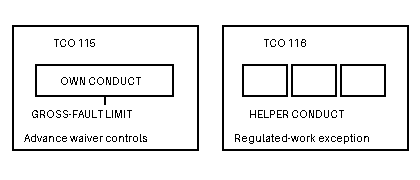
A signed liability waiver does not automatically protect a contracting party from a Turkish damages claim. Article 115 of the Turkish Code of Obligations invalidates an advance agreement excluding responsibility for the debtor’s gross fault. It imposes additional controls for obligations arising from an employment contract and for specialised activities requiring legal or official permission. Article 116 separately addresses harm caused by people entrusted with performance or exercise of a contractual right. Its general permission to exclude helper liability must be read with its regulated-activity exception. The correct analysis separates whose conduct caused the harm, what the clause excludes and which mandatory rule applies.
Have a general question about this article? Ask anonymously
Start with the obligation, not the disclaimer’s heading
The word debtor in these provisions means the person owing the contractual obligation. It is not limited to a borrower who owes money. A supplier owing delivery or a professional owing a defined service can occupy that position. The corresponding creditor is the person entitled to that performance. Identify those roles before applying a rule to a document headed waiver, release or limitation of liability.
Read the executed contract, its incorporated conditions and the scope of work. Establish the promised act and the performance complained of. A genuine definition of a limited service is not necessarily the same thing as an agreement excluding responsibility for performing the promised service badly. Conversely, describing an exclusion as a scope provision does not settle its legal character. Article 19 requires attention to the parties’ real common intention.
The general statutory framework is Law No. 6098, Articles 112–116. This guide concentrates on exclusion agreements and entrusted performance. It does not replace special rules governing a particular insurance, transport, consumer, employment or professional relationship. Those rules must be checked before treating a general commercial disclaimer as decisive.
Article 112 establishes the starting liability rule
Where an obligation is not performed or not properly performed, Article 112 requires the debtor to compensate the resulting loss unless the debtor proves that no fault can be attributed to it. This is the background against which an exclusion clause is assessed. The clause is not examined in isolation from the obligation and alleged non-performance.
The provision’s treatment of fault does not eliminate the need to identify the contract, the breach, the loss and the causal connection relied on. A poor commercial outcome alone does not establish every element of a contractual compensation claim. Equally, a debtor cannot answer a properly identified breach merely by pointing to the absence of an express sentence in the contract repeating the statutory liability rule.
Article 114 states that the debtor is generally responsible for every degree of fault and addresses assessment according to the particular nature of the undertaking. It also makes tort-liability provisions applicable by analogy to contractual breach. The nature of the obligation and the conduct expected under it therefore remain important before deciding what an attempted exclusion would remove.
Article 115 prohibits an advance exclusion for gross fault
The first paragraph of Article 115 makes an agreement concluded in advance to exclude responsibility for the debtor’s gross fault absolutely void. The expression advance agreement is important: the rule controls an attempt to arrange immunity before the relevant liability event. A signature accepting the term does not override that statutory prohibition.
Gross fault should not be reduced to an informal description of how expensive the loss was. The seriousness of the conduct and the size of the damage are different questions. Identify what the debtor did or failed to do, the contractual duty concerned and the evidence relevant to legal classification. Calling every mistake gross fault is no more reliable than treating a small loss as proof that only minor fault occurred.
The wording of the exclusion also matters. A clause excluding every claim, removing a particular category of responsibility or setting a monetary cap can affect liability differently. Review its practical legal effect rather than assuming that a cap is always valid because it is not called a waiver. At the same time, Article 115 should not be paraphrased as automatically invalidating every negotiated limit in every contract.
The employment-contract paragraph is not a rule for every service purchase
Article 115’s second paragraph invalidates advance agreements excluding the debtor’s responsibility for any obligation arising from an employment contract with the creditor. The Turkish statutory expression is hizmet sözleşmesi. Translating it simply as service agreement without explaining the employment context can wrongly extend this particular paragraph to every commercial service supplier.
Classify the legal relationship from its substance. The contract’s title, the invoicing method and the presence of a company name do not alone resolve whether an employment relationship or another contract exists. The relevant contractual obligations and working relationship require examination. A business should not rely on an English independent-contractor label as a complete answer to the statutory classification.
Once the employment-contract rule applies, the question is not merely whether the amount of an exclusion seems reasonable. The paragraph imposes a validity prohibition. A notice or claim should identify that legal ground expressly rather than present the dispute only as a request to reduce an inconvenient term. Other employment protections remain separate and are not displaced by the general discussion here.
Regulated specialised activities receive additional protection
The third paragraph of Article 115 addresses a service, profession or craft requiring expertise that can be carried on only with permission provided by law or the competent authorities. An advance agreement excluding responsibility even for slight fault in that activity is absolutely void. Both the specialised nature and the legally required permission must be established.
A website describing a business as professional or expert is not, by itself, proof of the statutory permission requirement. Identify the activity actually undertaken, the legal permission framework and the person or entity performing it. This prevents the provision from being applied solely because marketing material uses reassuring professional language.
The reverse error is to assume that a licensed provider can sell immunity merely because its customer signed a separate consent form. Consent to a defined activity, acknowledgement of inherent risks and exclusion of liability for legally attributable faulty performance are different matters. The complete form must be interpreted for what it actually does, then tested against the applicable mandatory rules.
Article 116 addresses performance entrusted to other people
Article 116 states that a debtor remains responsible for harm caused to the other party by helpers while carrying out the entrusted work, even where entrusting performance or exercise of a contractual right was lawful. The article refers to people such as household members or employees working with the debtor. Its focus is the function entrusted in the contractual relationship.
A subcontracting arrangement therefore requires analysis of the actual performance chain. Identify the contracting debtor, the helper, the task delegated and the harmful conduct during that task. A separate business can perform entrusted work without becoming the customer’s contractual counterparty. Merely naming a subcontractor on an invoice does not establish that the original debtor’s obligation was transferred to it.
The rule should not be described as liability for every act of every person associated with the business. There must be a connection with the entrusted contractual performance or exercise of the right and the harm to the other party. Conduct unrelated to that work requires its own legal assessment. The factual link should be documented rather than assumed from employment or group membership alone.
Helper liability can generally be limited, but not without qualification
Article 116’s second paragraph permits responsibility for helpers to be wholly or partly excluded by an advance agreement. Omitting this paragraph would produce an inaccurate claim that every helper-liability exclusion is automatically void. Its presence also explains why the debtor’s own-fault rule and the helper rule must not be merged into a single proposition.
The third paragraph imposes an express exception for the specialised activity that requires legal or official permission. In that setting, an agreement excluding responsibility for helpers is absolutely void. The permission and activity analysis must therefore be repeated for the helper exclusion rather than assumed irrelevant because the work was outsourced.
A helper clause also does not automatically dispose of an allegation concerning the contracting debtor’s own conduct. Separate the act attributed to the helper from any distinct breach attributed directly to the debtor. Identify which liability the clause purports to exclude. Article 116’s general permission should not be used as an unexplained route around Article 115’s mandatory control of the debtor’s own gross fault.
Compare the statutory questions before accepting a blanket answer
| Question | Relevant rule | Required distinction |
|---|---|---|
| Does the clause exclude the debtor’s own gross fault? | Article 115, first paragraph | An advance exclusion is absolutely void. |
| Does the obligation arise from an employment contract? | Article 115, second paragraph | Employment is not every commercial service purchase. |
| Is the specialised activity legally permission-dependent? | Article 115, third paragraph | Even advance exclusion for slight fault is prohibited. |
| Was the harmful work entrusted to a helper? | Article 116, first paragraph | Link the conduct to the entrusted contractual function. |
| Was helper liability contractually excluded? | Article 116, second and third paragraphs | General permission and the regulated-activity exception both matter. |
Use this comparison to organise the argument, not as a substitute for reading the agreement. More than one question can arise from the same loss. A demand can allege defective entrusted work and a separate failure by the contracting debtor, while the document contains different exclusions for each. The response should address the actual legal bases rather than rely on one sentence selected from the contract.
Standard terms face incorporation, interpretation and content controls
A pre-written exclusion used across many contracts can fall within Articles 20–25 on general transaction terms. The fact that a customer signed a document does not eliminate that framework. Article 20 also states that a recital asserting that every term was discussed does not, by itself, remove the terms from the statutory category.
Article 21 regulates incorporation of adverse standard terms, including clear information, an opportunity to learn their content and acceptance. Article 23 addresses wording that is unclear or has more than one meaning. Article 25 prohibits standard terms that, contrary to good faith, disadvantage the other party or aggravate its position. These are distinct controls, not one general discretion to rewrite any bargain.
Our standard contract terms guide explains that framework separately. In a liability dispute, identify whether the objection concerns absence of incorporation, interpretation, prohibited content or the specific mandatory rule in Article 115 or 116. A clear contractual term can still encounter a mandatory prohibition; unclear drafting is not the only possible defect.
Invalidity of an exclusion does not automatically decide the whole case
Article 27 addresses mandatory-law invalidity and the effect of a partially invalid contract. The invalidity of one provision generally does not affect the others, subject to the statutory qualification concerning whether the contract would have been concluded without it. Article 22 contains a particular rule for standard terms treated as unwritten. Keep these different consequences distinct.
Defeating an exclusion therefore does not automatically establish a right to cancel the entire transaction, recover every payment and receive every loss claimed. The remaining agreement and the ordinary liability requirements still matter. The legal conclusion should identify the invalid term, the surviving duties and the consequence actually sought.
A post-event settlement requires its own analysis as well. Article 115 concerns advance exclusions; a later agreement addressing an existing dispute is not automatically the same instrument. That does not make every settlement valid or every release unlimited. The wording, authority, applicable form and any special protection must be examined before a payment receipt is treated as a complete discharge.
Preserve evidence of the task, conduct and resulting loss
A useful claim file contains the original scope of work, amendments, the exclusion wording, the performance records and the evidence of the specific damage. Add the documents identifying the helper’s assigned task. Organise the account so that another reviewer can see what the debtor promised, what was delegated and how the alleged failure caused the claimed loss.
Where repair or replacement will change the physical evidence, consider the appropriate evidence-preservation route before the condition disappears. Our evidence preservation guide addresses that separate procedure. Preservation is not a judicial finding that liability has already been established.
Insurance and the underlying responsibility should also be kept separate. An insurer’s acceptance or rejection letter does not, by itself, rewrite the service provider’s contractual duties. Retain the policy and claim response when relevant, but identify the liability basis and loss independently. Do not treat a policy limit as automatically identical to a valid contractual limitation owed to the customer.
Cross-border contracts and urgent response documents
For an international arrangement, establish the applicable law and the competent dispute forum. An English-language exclusion does not automatically import an English-law result into a Turkish-law contract. The governing-law guide explains the preliminary conflict-of-laws question.
Provide the complete correspondence and any served claim with its service record. A letter challenging a waiver is not automatically a defence filed in court or an objection entered in an enforcement proceeding. Keep the merits of the exclusion, the calculation of loss and the procedural response separate so that the contractual debate does not conceal an approaching deadline.
Frequently asked questions
Does my signature make every liability waiver valid?
No. Article 115 imposes mandatory limits on advance exclusions, and Article 116 has a regulated-activity exception for helpers. Standard-term controls and special contract rules must also be considered.
Can the debtor exclude responsibility for its own gross fault in advance?
Article 115’s first paragraph makes that agreement absolutely void. The conduct must be legally classified; the amount of loss alone does not establish the degree of fault.
Does the employment paragraph cover every service supplier?
No. Article 115’s second paragraph concerns obligations arising from an employment contract. A commercial service agreement requires its own classification rather than an automatic translation-based extension of that rule.
What is different about a regulated specialised activity?
Where the specialised service, profession or craft requires legal or official permission, Article 115 prohibits advance exclusion even for slight fault. Article 116 also invalidates exclusion of responsibility for helpers in that setting.
Does lawful subcontracting automatically remove the original debtor’s responsibility?
No. Article 116 addresses harm caused during entrusted contractual work even where the delegation was lawful. The task, the harm and any applicable valid exclusion must be examined.
Are all exclusions for helper conduct prohibited?
No. Article 116 generally permits advance exclusion wholly or partly, but expressly prohibits it for the specified regulated specialised activities. Other applicable controls remain relevant.
Is a liability cap always valid because it is not a complete waiver?
No automatic rule follows from the label. Examine the cap’s legal effect, the responsibility it limits and the mandatory and standard-term rules applicable to the contract.
Does an invalid exclusion establish all the damages claimed?
No. The contract, breach, loss and causal connection still require examination. Removing an exclusion does not itself prove the amount or justify double recovery.
Does a later settlement have the same status as an advance waiver?
They are different questions. Article 115 concerns advance exclusions. A later settlement must be reviewed for its own wording, authority, form and any applicable special protection.
Which documents are needed to assess a subcontractor-related loss?
Provide the customer’s contract, exclusions, scope of work, evidence of the entrusted task, performance records and supported loss calculation. Include any served proceedings and delivery dates.
Official statutory sources
Turkish Code of Obligations No. 6098, Articles 19–27 and 112–116. The official Ministry text, page 22 contains Articles 115–116. This English explanation is not an official translation; the Turkish statutory text governs.
Ask about a liability exclusion
Identify the promised work, the exclusion clause and whether the disputed conduct was the supplier’s own or a helper’s. Mention any urgent deadline without sending confidential records in the initial message.
Istanbul and Mersin offices
Bakırcı & Keskin Law Office is Mersin-based and coordinates Turkish matters from Mersin and Istanbul. Arrange a confidential document channel before transmitting contracts, incident reports or personal information.
Istanbul — Polaris Plaza
Maslak Ahi Evran Caddesi, Polaris Plaza No:21, Floor 9, 34475 Sarıyer/İstanbul. Istanbul office directions.
Mersin — Profit İş Merkezi
İhsaniye Mahallesi, 4903. Sokak, Profit İş Merkezi No:23, Floor 3, Office 14, 33070 Akdeniz/Mersin. Mersin office directions.
Call +90 552 224 43 66. General information; an enquiry does not establish representation or suspend a deadline.
Contact regarding a legal matter
In your first message, you may briefly state the subject, your country or city, and any relevant notification or recent procedural date. Please do not send identity numbers, medical data, or personal documents. Messaging alone does not constitute legal advice or create a lawyer–client relationship.
Discover more from Bakırcı & Keskin Hukuk Bürosu
Subscribe to get the latest posts sent to your email.