Standard Contract Terms in Turkey: Fine Print and Unilateral Changes Under TCO 20–25
Signing a Turkish-law contract does not make every pre-drafted clause immune from statutory control. Articles 20–25 of the Turkish Code of Obligations regulate standard terms: whether a provision qualifies as a standard term, whether it became part of the agreement, how ambiguity is interpreted and whether the drafter can impose adverse unilateral changes. The legislation distinguishes those questions from the validity of the contract as a whole. A useful review identifies the exact clause, its origin, how it was presented and the consequence the drafting party now seeks to enforce.
Have a general question about this article? Ask anonymously
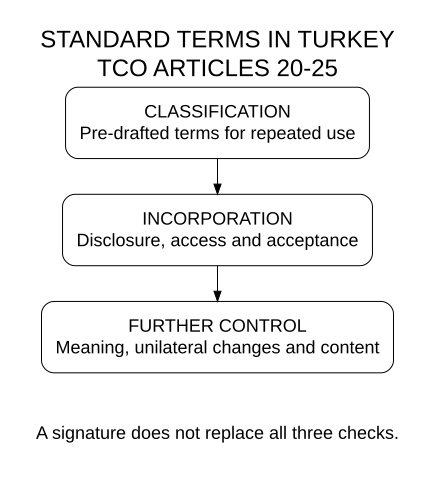
Article 20 focuses on pre-drafted terms intended for repeated use
Article 20 defines standard terms by their preparation and intended use. They are provisions prepared in advance by one party for use in many similar agreements and presented to the other party when contracting. The review should therefore begin with the document’s history, not merely with the page on which the disputed wording appears.
The statute expressly makes the location in the main text or an annex, the extent of the wording, font and form immaterial to classification. A prominently printed provision can still be a standard term. Equally, small type alone does not prove that the Article 20 definition is met. Identify who prepared the clause and the intended repeated use.
Contracts prepared for the same purpose need not be word-for-word identical for their provisions to qualify. Inserting a customer’s name, project number, price or date does not answer whether the liability, variation or termination provisions were pre-drafted for repeated use. Separate the commercial fields completed for the transaction from the standard legal conditions presented with them.
The official basis is Law No. 6098, Articles 20–25. This is a general obligations-law framework; calling a document commercial does not remove the need to examine it. Consumer, employment, financial and other specially regulated contracts also require their applicable special-law review. A conclusion about one provision must not be expanded into an unsupported statement about every contract in a sector.
A statement that every clause was negotiated is not conclusive
Article 20 expressly says that a record stating each standard term was discussed and accepted does not, by itself, prevent classification as standard terms. The same applies whether the statement is placed in the agreement or a separate document. A pre-printed acknowledgment must be distinguished from evidence of an actual discussion about the particular provision.
Preserve exchanged drafts, comments, redlines and negotiation emails. These can show which provisions were proposed, changed, refused or specifically accepted after discussion. A negotiation limited to the price does not establish that every unrelated risk clause was individually negotiated. Conversely, a genuine amendment history should not be ignored merely because the final agreement uses the supplier’s document layout.
A signature, initials on each page and a checkbox record remain relevant evidence of the contracting process. The statutory point is that those features do not replace the Article 20 enquiry. An assessment should describe what they prove and what they do not: authentication, delivery, acceptance and individual negotiation are different questions.
Article 21: adverse standard terms need disclosure, an opportunity to learn and acceptance
For standard terms adverse to the other party to enter the agreement, Article 21 requires the drafter, when the contract is concluded, to provide clear information about their existence and an opportunity to learn their contents, followed by acceptance by the other party. If those conditions are absent, the terms are treated as not written. The timing of disclosure is therefore central.
The transaction file should identify the actual version supplied before or at contracting. Keep the email attachment, document-delivery record or other evidence of access. Sending conditions with the first invoice after a contract has already been formed is not the same event as providing them during formation. The parties’ entire exchange must establish when agreement was reached and which terms were then available.
For online contracting, retain the conditions displayed or linked at the relevant stage, the version date and evidence of the acceptance process. A current website page does not necessarily establish what a customer could read months earlier. This is an evidence point, not a blanket claim that hyperlinks always satisfy or always fail Article 21.
The ability to learn the terms should be assessed using the actual presentation and access facts. A missing attachment, inaccessible file and available readable document are different situations. State the specific failure relied on rather than relying only on the conclusion that the terms were unfair. Incorporation under Article 21 and substantive unfairness under Article 25 are separate grounds.
Terms alien to the contract are also treated as not written
The second paragraph of Article 21 excludes standard terms that are alien to the nature of the contract and the characteristics of the transaction. This requires comparison with the deal actually made. A clause cannot be classified by reading it in isolation while ignoring the agreement’s object, scope and the parties’ exchange.
Identify how the disputed obligation relates to the purchased goods, services or financing. The question is not simply whether the clause is burdensome: an ordinary allocation of a known contractual risk and an unrelated obligation hidden in standard conditions need different analyses. Explain the mismatch between the clause and the transaction when invoking this paragraph.
The remedy should be tied to the particular term. Mark its exact wording and identify the sum, restriction or right claimed under it. A general demand to erase every annex without identifying which provision is alien to the transaction is not a precise Article 21 analysis. Preserve the rest of the contract so the effect of excluding the term can be assessed.
Article 22 keeps the remaining agreement in force
Article 22 provides that provisions other than the standard terms treated as not written retain their validity. The drafter cannot respond that it would not have concluded the contract without the excluded conditions. This is an express rule for the consequence of exclusion, not merely an optional severability provision selected by the supplier.
For a payment dispute, distinguish the disputed charge from the agreed price for performance actually supplied. Exclusion of a particular standard condition does not automatically entitle the other party to keep goods or services without paying every otherwise valid amount. The account must be recalculated using the remaining agreement and applicable legal rules.
Article 22 should also be distinguished from the general partial-invalidity rule in Article 27. The latter concerns a different statutory framework. Do not replace Article 22 with a generic assertion that any invalid provision cancels the entire transaction. Identify the legal defect and the consequence attached to that defect.
Article 23 resolves unclear wording against the drafter
Where a standard term is not clear and understandable or has more than one meaning, Article 23 requires interpretation against the drafter and in favour of the other party. The task is to identify the genuine ambiguity. Quote or reproduce the relevant clause accurately in the legal file and compare its competing meanings with the contract’s structure.
The statute is not a general licence to choose any interpretation that benefits the customer. An inconvenient but clear provision and an ambiguous provision are not the same. A proper objection explains why the wording admits the competing meanings and how the claimed charge, exclusion or obligation depends on the drafter’s preferred reading.
Multilingual contracts need their complete language versions and any precedence clause. A translation inconsistency should be identified precisely, not silently corrected by replacing the original text. Article 23 does not itself determine the governing law, the legal status of every language version or the effect of mandatory language rules. Those questions must be addressed separately before relying on a translation.
Article 24 restricts adverse unilateral changes
Article 24 treats as not written provisions that give the drafter power to change a term or introduce a new rule unilaterally to the other party’s detriment in an agreement containing standard terms. The prohibition applies whether the power appears in that agreement or in a separate contract. Moving a variation power to another page does not, by itself, remove it from the statutory enquiry.
Preserve the original terms, the proposed or implemented amendment and the notice explaining the change. Compare the exact obligations before and after. Identify who purported to exercise the power, what contractual provision it relied on and how the change worsens the other party’s position. A notice that merely cites a website policy is not the underlying legal authority.
A later genuine bilateral agreement and an exercise of a pre-drafted unilateral power are different transactions. Similarly, an agreed method of calculating an amount and an unrestricted right to replace the calculation need separate analysis. The question is the actual legal mechanism, not whether the supplier calls the change a renewal, update or technical adjustment.
Do not assume that objecting to an amendment automatically ends the underlying contract or suspends every payment obligation. Identify the valid continuing obligations and preserve objections to the disputed change. Where a notice sets a response date or legal proceedings have begun, the procedural consequences must be examined independently.
Article 25 controls the substance, not only the drafting process
Article 25 prohibits standard terms that, contrary to good faith, disadvantage the other party or make its position more onerous. A term can therefore require substantive review even after questions about delivery and acceptance have been addressed. The analysis should identify the disadvantage, its contractual context and the reason it conflicts with the statutory standard.
The review is stronger when it connects the clause with its practical effect. Set out the responsibility shifted, the right restricted or the additional burden imposed and compare it with the transaction’s structure. A label such as unfair, unusual or one-sided is a conclusion; the supporting explanation must show why that conclusion follows from the actual provision.
Some clauses also engage a specific mandatory rule outside Articles 20–25. A personal security undertaking, penalty clause, employee obligation or consumer charge requires its own statutory analysis. General-terms control should not be used to skip a more specific rule that directly governs the disputed obligation. Our personal-guarantee guide illustrates the separate formal and consent requirements for that instrument.
Regulated service providers are not excluded merely because they hold permission
Article 20 states that the standard-terms provisions also apply, regardless of their nature, to contracts prepared by persons or organisations providing services under legislation or official permission. A licence or regulatory status is consequently not a universal answer to an objection under this chapter. The contract and challenged term still have to be identified.
At the same time, a mandatory statutory rule must be distinguished from a provider’s own contractual addition. Identify whether the disputed requirement comes directly from legislation, a regulatory decision or the provider’s template. Obtain the cited legal source rather than accepting a general assertion that a regulator required every part of the wording.
Prepare a clause-specific review for a Turkish-law dispute
Use a document index containing the signed agreement, each annex, the version delivered at formation, negotiation correspondence and the later demand or amendment. Record the clause number and requested consequence. Then address classification under Article 20, incorporation under Article 21, effect under Article 22, interpretation under Article 23, unilateral change under Article 24 and content control under Article 25.
The review should not treat all six questions as interchangeable. A term excluded for failure of incorporation does not need to be described inaccurately as a negotiated clause with an unfavourable interpretation. Separate primary and alternative grounds and connect each to evidence. This makes the objection understandable to the counterparty and usable in proceedings.
For an international agreement, also retain the governing-law and forum clauses. Our governing-law guide and foreign-court jurisdiction guide address those separate questions. A letter challenging standard terms does not automatically preserve a court or enforcement response deadline.
Frequently asked questions
Does signing every page prevent a standard-terms challenge?
No automatic immunity follows. Articles 20–25 distinguish classification, incorporation, interpretation and content control. Signatures remain relevant evidence, but they do not remove the need to examine the statutory requirements for the disputed clause.
Are only small-print clauses covered?
No. Article 20 makes font, form, length and placement in the contract or an annex immaterial to classification. Preparation in advance for repeated use is the relevant starting point.
Does saying all terms were negotiated settle the issue?
No. Article 20 expressly states that such a record is not sufficient by itself. Actual drafting and negotiation evidence must be examined for the provision concerned.
Can terms first sent after the deal automatically become binding?
Article 21 requires clear information, an opportunity to learn the content and acceptance at formation for adverse standard terms to enter the contract. Identify when agreement was reached and what was supplied then; later delivery is a different event.
Does excluding one standard term invalidate the entire contract?
Article 22 preserves the remaining provisions and prevents the drafter from arguing it would not have contracted without the excluded term. Other grounds of invalidity require their own analysis.
Who receives the benefit of ambiguous standard wording?
Article 23 requires unclear or multiple-meaning standard terms to be interpreted against the drafter and in favour of the other party. The actual ambiguity must be identified rather than inferred solely from an unfavourable result.
Can a supplier reserve an unlimited adverse amendment power?
Article 24 treats the described unilateral adverse-change powers as not written, including powers placed in a separate agreement. Compare the actual mechanism with a genuine bilateral amendment or agreed calculation method.
Is disclosure enough to make every harsh clause valid?
No. Article 25 separately prohibits standard terms that disadvantage the other party or worsen its position contrary to good faith. Incorporation and substantive control are distinct enquiries.
Are licensed businesses exempt from these provisions?
Article 20 expressly extends the framework to contracts prepared by providers acting under legislation or official permission. A specific mandatory legal requirement must still be distinguished from the provider’s own added clause.
What should an overseas business provide for review?
Provide the final agreement, annexes, terms supplied at formation, exchanged drafts and the later demand or amendment. Identify the disputed clause and any response deadline. Arrange a confidential channel before sending commercial records.
Official statutory source
Turkish Code of Obligations No. 6098, Articles 20–27; official Ministry text of the standard-terms provisions. English explanations are not an official translation. Special legislation and the Turkish statutory wording govern where applicable.
Istanbul and Mersin offices
For an English-language standard-terms review, identify the disputed clause, the contract date and any proposed change or demand. Use the English contact section to arrange a confidential channel for the agreement and drafting history. Our Mersin-based practice has offices in Mersin and Istanbul and coordinates matters throughout Türkiye.
Istanbul — Polaris Plaza
Maslak Ahi Evran Caddesi, Polaris Plaza No:21, Floor 9, 34475 Sarıyer/İstanbul. Istanbul office information.
Mersin — Profit İş Merkezi
İhsaniye Mahallesi, 4903. Sokak, Profit İş Merkezi No:23, Floor 3, Office 14, 33070 Akdeniz/Mersin.
Call +90 552 224 43 66. General legal information; an enquiry does not establish representation or suspend a deadline.
Contact regarding a legal matter
In your first message, you may briefly state the subject, your country or city, and any relevant notification or recent procedural date. Please do not send identity numbers, medical data, or personal documents. Messaging alone does not constitute legal advice or create a lawyer–client relationship.
Discover more from Bakırcı & Keskin Hukuk Bürosu
Subscribe to get the latest posts sent to your email.