Work Done Without Permission in Turkey: Expense Recovery and TCO Articles 526–531
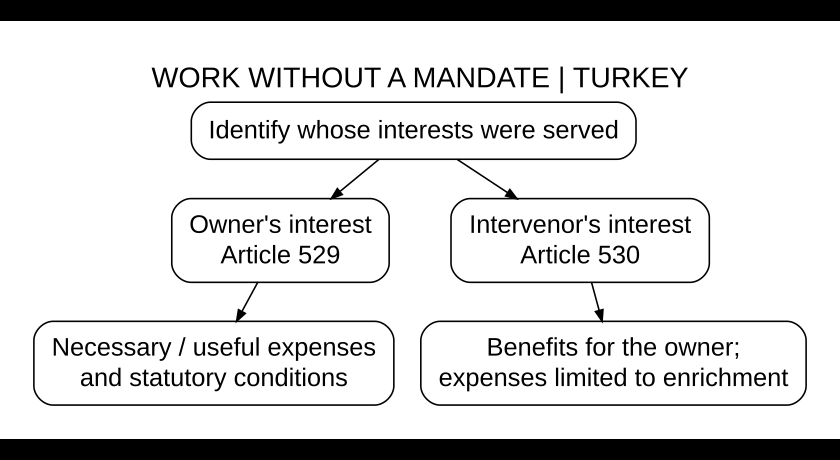
Doing work for another person without an appointment does not automatically create a right to charge any price chosen afterwards. Articles 526–531 of the Turkish Code of Obligations regulate management of another person’s affairs without a mandate. They distinguish work serving that person’s interests from intervention serving the intervenor’s own interests, impose duties of care and address subsequent approval. Necessary and useful expenses can be recoverable under the relevant statutory conditions, even where a carefully undertaken intervention fails to achieve its hoped-for result. That is different from a general right to invoice an unrequested renovation, service or purchase.
Have a general question about this article? Ask anonymously
First establish whether there really was no mandate
The Turkish expression vekâletsiz işgörme concerns work undertaken on another person’s account without a mandate. The absence of a notarised power of attorney is not, on its own, proof that no appointment existed. The parties’ agreement, instructions and conduct must be examined to determine whether the work was actually entrusted to the person who performed it.
Distinguish an instructed service, an employee’s work, a contractor’s agreed obligation and a genuinely unrequested intervention. The rules governing the underlying relationship take priority over an attempt to reclassify inconvenient contractual duties after the event. A contractor cannot establish a separate claim simply by describing an already agreed task as an emergency favour.
For an appointed agent, the agent accounting and handover guide explains the ordinary mandate framework. The present guide concerns the different starting point where the relevant work was not entrusted. It uses owner as shorthand for the person whose affairs were managed; that person need not be the owner of real estate.
Article 526 requires the owner’s interests and presumed wishes to be respected
Article 526 requires a person acting without a mandate for another’s account to conduct the work in that person’s interests and in accordance with that person’s presumed wishes. The provision is not a general licence to substitute the intervenor’s preferences for the owner’s decisions. The purpose, urgency and extent of the intervention need a factual explanation.
Identify the condition or problem that prompted action, the information available and the work actually undertaken. Preserve attempts to communicate, previous instructions relevant to the same matter and the circumstances affecting the choice of action. A later statement that the work was useful does not alone establish why it accorded with the owner’s interests and presumed wishes at the relevant time.
The official basis is Law No. 6098, Article 526. Its reference to presumed wishes is a legal assessment from the circumstances, not permission to invent consent. Express objections and limits known to the intervenor belong in the assessment even where the intervenor considered a different course commercially attractive.
Emergency protection and optional improvements are not the same claim
Work directed at stopping existing harm or a danger of harm must be distinguished from a discretionary improvement. The distinction affects both the explanation for intervention and the liability assessment under Article 527. It also assists in identifying which expenses were necessary or useful in the circumstances under Article 529.
Separate the immediate protective task from additional work performed afterwards. The initial need to prevent deterioration does not automatically justify every subsequent upgrade, replacement or redesign. A detailed invoice should distinguish stabilisation, investigation, permanent repair and optional improvement rather than present them as one inseparable emergency charge.
Special rules can also control access, building alterations, common property and regulated activities. The management-without-mandate provisions do not dispense with those requirements. A person relying on an expense claim should explain the lawful basis of the work rather than assume that a beneficial purpose cures every defect in authority or compliance.
Article 527 imposes responsibility for negligence
The starting rule is that the person acting without a mandate is responsible for every form of negligence. Article 527 adds that liability is assessed more leniently where the work was done to remove harm or a danger of harm facing the owner. This is a qualification in assessing responsibility, not an automatic exemption from all consequences of careless work.
Preserve the records explaining the method chosen and the constraints under which the work occurred. Photographs taken before intervention, reports, communications and receipts can show what was known and why a particular measure was taken. A later successful result does not necessarily answer whether the work was carried out carefully.
Likewise, an unsuccessful result does not automatically establish negligence. The standard must be applied to the actual conduct and relevant circumstances. This is especially important when separating unavoidable loss caused by the original problem from additional damage alleged to have resulted from the intervention itself.
Acting against a lawful prohibition increases the risk
Article 527 separately addresses work performed despite the owner’s express or implied prohibition. Where that prohibition is not contrary to law or morality, the intervenor also becomes responsible for an unexpected event. The statute therefore gives known limits particular importance; an assertion of good intentions does not erase them.
There is an express defence. The intervenor is released from that unexpected-event responsibility by proving that the same damage would have occurred through the unexpected event even if the work had not been performed. Both the extended responsibility and the defence must be considered before assigning the entire loss to one person.
Identify the prohibition precisely. A refusal to authorise a particular alteration is not necessarily a refusal of every protective measure, while silence should not automatically be rewritten as an unlimited approval. Preserve the full exchange, not just the sentence that favours the proposed claim. The relevant questions are what was prohibited, what was done and how the damage arose.
Article 529 governs work carried out in the owner’s interests
When the work is carried out in the owner’s interests, Article 529 requires payment, with interest, of all expenses found necessary and useful in the circumstances. It also requires performance of obligations undertaken through the work and compensation for damage as assessed by the judge. These are distinct consequences with different evidence.
An expense claim should identify the cost, its payment or obligation status and the reason it was necessary or useful. A loss claim should identify the separate damage and its connection with the work. Combining expenses, the intervenor’s asserted profit and unrelated financial loss into a single total obscures the statutory basis of each item.
The text does not create an unrestricted right to choose a professional fee retrospectively. A claim for an agreed remuneration requires proof of the relevant agreement or another applicable legal basis. Article 529’s expense provisions should not be presented as an automatic entitlement to the price of any unrequested service.
Failure to achieve the hoped-for result does not always defeat reimbursement
Article 529 expressly extends its rule to the person who exercised the necessary care while doing the work even where the expected result did not occur. The owner cannot therefore answer every expense demand solely by pointing out that the intervention failed. The statutory care condition and the character of the expenses still require examination.
The intervenor should keep the record of the original problem, the measures taken and the information available when expenditure was incurred. The analysis must distinguish a reasonable but unsuccessful effort from unnecessary work or a careless course of action. A receipt establishes expenditure; it does not by itself establish the required care.
For the owner, a response should identify the actual objection: absence of an owner’s-interest intervention, an unnecessary cost, an inflated amount, lack of care or a separate damage claim. A specific response is more useful than an unexplained rejection of the whole invoice. It also permits agreed items to be separated from the genuinely contested balance.
Article 530 limits reimbursement where the work served the intervenor
Article 530 permits the owner to take the benefits arising from the work even where it was not performed in the owner’s interests. However, the owner’s duty to pay expenses and discharge the intervenor from obligations is limited to the extent of the owner’s enrichment. That limit is materially different from treating every amount spent as automatically recoverable.
Identify the benefit actually obtained and distinguish it from the intervenor’s expenditure. A high cost does not necessarily establish an equally valuable benefit. Nor does the mere presence of an altered item establish the amount by which the owner was enriched. The legal claim requires a supported comparison, not a presumption that cost and benefit are identical.
This provision should also not be described as allowing the owner to retain all benefits while automatically refusing every cost. The owner’s acquisition of the benefit and the limited reimbursement obligation form parts of the same rule. A proper account makes both sides visible and states the valuation issue directly.
Later approval changes the applicable framework
Article 531 provides that the mandate rules apply where the owner approves the work. Identify the approval, its scope and the work to which it relates. Approval of one protective measure should not automatically be treated as acceptance of every later activity or every figure on the intervenor’s final invoice.
A statement acknowledging that work occurred is not necessarily the same as approval of the work. Equally, approval should not be ignored merely because it was communicated after completion. The complete correspondence and conduct require assessment under the applicable declaration and evidence rules.
Once the mandate framework applies, accounting, delivery, expenses and the relevant duties must be considered together. That does not automatically validate a separately prohibited transaction or erase a statutory form requirement governing another act. Article 531 selects the contractual framework for the approved management; it is not a universal cure for every defect.
Unpaid expenses do not authorise unrestricted self-help
Article 529 gives the person who has not recovered expenses a right of separation under unjust-enrichment rules. The express statutory reference matters. It should not be paraphrased as a right to enter premises, dismantle any improvement or seize unrelated property without regard to the legal conditions.
Identify what is proposed to be separated, whether it can lawfully be removed and the relationship between that item and the unpaid expenditure. Preserve the existing condition before any dispute changes the evidence. The evidence-preservation guide addresses a separate procedural route where inspection or alteration threatens relevant proof.
A separation claim, a money claim and a damages claim are different remedies. The demand should identify the outcome sought and its legal basis. Pressure tactics do not establish the right and can create an additional dispute concerning possession, damage or access.
Article 528 contains a specific rule for lack of contractual capacity
Where the person doing the work lacks contractual capacity, Article 528 limits responsibility from the transaction to the extent of enrichment or enrichment disposed of in bad faith. It expressly reserves more extensive liability arising from tort. Capacity therefore cannot be resolved merely by asking whether an invoice was signed.
The person involved, the relevant date and the act performed must be established before applying this provision. A business representative’s lack of authority is a different issue from a person’s lack of contractual capacity. Our unauthorised-representation guide addresses that separate question.
This distinction prevents two overstatements: that every act by an unauthorised person has the same consequence, and that lack of capacity necessarily eliminates every possible claim. Article 528 itself retains a separate tort assessment where its conditions are present.
Build a two-sided record of the intervention
The core file should show why work began, whether any appointment or prohibition existed, what was done, whose interests were served and what the owner received. Add the cost records and any later approval. Keep original instructions and objections alongside the material supporting reimbursement.
For each financial item, identify payment, purpose, necessity or usefulness, and the evidence of benefit. Record damages separately. This makes it possible to apply Article 529 or Article 530 without silently shifting from one legal basis to the other when the calculation becomes inconvenient.
Overseas owners should preserve communications with local managers, neighbours, suppliers and intermediaries, but obtain records lawfully. The electronic-evidence guide explains why complete source records are preferable to isolated screenshots. A translated chronology should retain dates, currency and the identity of the person who actually made each decision.
Keep civil recovery and procedural deadlines distinct
A disagreement over unrequested work does not automatically establish a criminal offence or entitle either side to bypass civil procedures. Identify the claim supported by the facts: reimbursement, delivery of benefits, separation, compensation or an account following approval. The competent forum and any preliminary procedure depend on that legal relationship and requested relief.
A request for invoices or a negotiation about costs does not itself respond to a served lawsuit or payment order. Provide the full served document and service record promptly. The enforcement guide for clients abroad explains why the defence to a claim and the communication between the parties must be handled separately.
Frequently asked questions
Does doing useful work without permission automatically earn a fee?
No. Articles 526–531 distinguish different forms of management and the associated expense and benefit rules. They do not authorise an unrestricted price chosen after the work.
Does absence of a notarised power of attorney prove there was no mandate?
Not by itself. The actual appointment, instructions and relationship must be established. A mandate and authority for a particular formal transaction are different questions.
What standard applies to the unappointed person doing the work?
Article 526 requires respect for the owner’s interests and presumed wishes. Article 527 imposes responsibility for negligence, with a more lenient assessment for work directed at removing harm or danger.
What happens when work is done against a lawful prohibition?
Article 527 extends responsibility to unexpected events, subject to proof that the same damage would have occurred even without the intervention.
Which expenses does Article 529 address?
It concerns necessary and useful expenses, with interest, for work in the owner’s interests, together with the other obligations stated in the article. The connection and amount need evidence.
Does an unsuccessful result always defeat reimbursement?
No. Article 529 preserves its rule for a person who exercised the necessary care even where the expected result did not occur.
How does Article 530 limit the owner’s payment obligation?
Where the work was not in the owner’s interests, the owner can take its benefits but reimbursement and discharge of obligations are limited to the owner’s enrichment.
What is the effect of later approval?
Article 531 applies the mandate rules when the owner approves the work. The approval and its scope must be established rather than assumed from a general acknowledgement.
Can unpaid expenditure justify seizing unrelated property?
No. Article 529’s separation right operates under unjust-enrichment rules. It is not an unrestricted authority to enter premises or take other assets.
What records should be supplied for a review?
Provide the reason for intervention, instructions or objections, work and cost records, evidence of benefit, later approval and any served proceedings with their service dates.
Official legal sources
Turkish Code of Obligations No. 6098, Articles 526–531; official Ministry text, pages 105–106. The Turkish statutory text governs; this is an explanatory English guide.
Ask about unrequested work or expenses
State what was done, whether it was requested or prohibited, and which cost or benefit is disputed. Mention any served deadline without sending sensitive documents in the initial enquiry.
Istanbul and Mersin offices
Bakırcı & Keskin Law Office coordinates Turkish matters from its Mersin and Istanbul offices. Arrange a confidential channel for work records, invoices and dispute documents.
Istanbul — Polaris Plaza
Maslak Ahi Evran Caddesi, Polaris Plaza No:21, Floor 9, 34475 Sarıyer/İstanbul. Istanbul office directions.
Mersin — Profit İş Merkezi
İhsaniye Mahallesi, 4903. Sokak, Profit İş Merkezi No:23, Floor 3, Office 14, 33070 Akdeniz/Mersin. Mersin office directions.
Call +90 552 224 43 66. General information; an enquiry does not establish representation or suspend a deadline.
Contact regarding a legal matter
In your first message, you may briefly state the subject, your country or city, and any relevant notification or recent procedural date. Please do not send identity numbers, medical data, or personal documents. Messaging alone does not constitute legal advice or create a lawyer–client relationship.
Discover more from Bakırcı & Keskin Hukuk Bürosu
Subscribe to get the latest posts sent to your email.