Buying or Selling Through a Commission Agent in Turkey: Price, Credit Risk and TCO 532–546
A commission agent who buys or sells in their own name for another person’s account is not merely an introducer. Article 532 of the Turkish Code of Obligations defines this arrangement for movable goods and negotiable instruments. Articles 533–546 regulate information, care, price instructions, credit sales, counterparty default, remuneration, retention and particular self-dealing transactions. For an overseas principal, the decisive records are the instructions, the actual third-party transaction and the account of proceeds. A commission percentage alone does not explain who bears a failed buyer’s debt or who owns the benefit of a better price.
Have a general question about this article? Ask anonymously
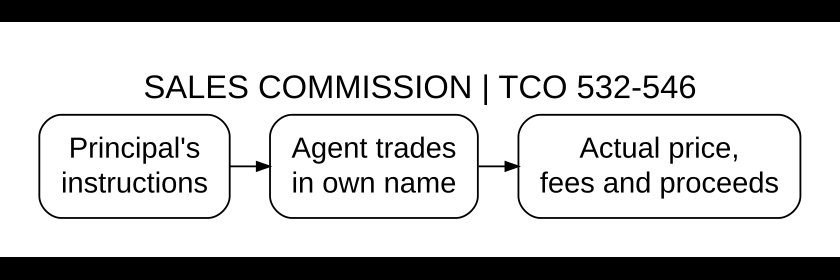
Identify an own-name commission transaction
Under Article 532, the commission agent undertakes, for remuneration, to buy or sell movable goods or negotiable instruments in the agent’s own name but for the principal’s account. Both aspects are important. The person appearing as the contracting buyer or seller is the agent, while the internal economic account belongs to the principal.
This differs from an intermediary who only brings prospective contracting parties together. It also differs from a representative signing directly in the principal’s name or an employee receiving a sales-based wage. The legal character cannot be determined merely because the payment is called commission. Read the undertaking, the transaction documents and the capacity in which signatures were given.
The special rules are in Law No. 6098, Articles 532–546. Article 532 applies mandate rules subject to the commission provisions. Our agent accounting guide explains the general accounting and acquisition framework, which must be read with these more specific trading rules.
The principal must be informed about execution
Article 533 requires the agent to inform the principal about the work and, in particular, immediately notify the principal that the instructions have been carried out. The account should identify the transaction actually made rather than report only that a buyer has been found or that negotiations look promising.
Record the goods, quantity, counterparty, price, payment terms and transaction date. Keep the underlying contract or confirmation with the notice. A summary lacking the actual trading terms can conceal a dispute about whether the instructions were followed, even when the overall transaction was commercially successful.
Article 533 also states that the agent has no duty to insure the contractual subject matter unless instructed by the principal. Insurance should therefore be addressed expressly rather than presumed from the existence of a commission. Identify the required cover, goods, period and evidence that the instruction was fulfilled. A statement that a carrier is insured is not necessarily evidence of the cover the principal requested.
Damaged or perishable goods trigger specific duties
Under Article 534, where goods sent for sale are visibly defective, the agent must take the steps necessary to preserve the principal’s rights against the carrier, have the damage established, protect the goods as far as possible and immediately inform the principal. Negligence in those duties creates responsibility for the resulting loss.
The intake record should show the goods’ condition, packaging, quantities and available delivery documents. Separate the carrier-related claim from any later loss occurring while the agent holds or sells the goods. An undated photograph does not necessarily establish when the damage occurred or which delivery it concerns.
Article 534 also requires the agent to sell goods likely to deteriorate quickly, provided the principal is immediately informed. That rule should be read alongside the actual condition and the preservation duty. It is not an unrestricted authority to dispose of any slow-moving inventory merely because the agent would prefer a faster sale.
Selling below the instructed price requires an explanation under Article 535
An agent selling below the price fixed by the principal must make up the difference unless the agent proves both that failing to sell would have caused the principal greater loss and that circumstances did not allow new instructions to be obtained. The statutory defence contains two elements, not simply a general assertion that the market was difficult.
Preserve the original price instruction, the available offers, the condition of the goods and communications seeking further instructions. Identify why waiting would have caused the claimed greater loss. A later assertion that the achieved price was reasonable does not automatically establish the circumstances described in the defence.
Article 535 additionally makes the agent responsible, where at fault, for other damage caused by acting contrary to instructions. The price shortfall and any further loss should be separately calculated. A claim should explain each item without counting the same economic consequence twice.
A better price is not a hidden commission
The second paragraph of Article 535 prohibits the agent from retaining the difference where the agent buys below the principal’s stated price or sells above it. An instruction fixing a ceiling or minimum is not, by itself, an agreement transferring the favourable difference to the agent.
The account must therefore show the actual trading price, not merely the permitted limit. Keep purchase and sale confirmations, bank records and adjustments together. A principal cannot evaluate the account accurately where the agent reports only that the transaction stayed within the authorised range.
Separate the agreed remuneration from the transaction’s favourable price difference. They have different legal explanations. A fee claim should identify the agreement and earning conditions, while the proceeds account should disclose the underlying transaction honestly.
Credit sales and payment before receipt carry distinct risks
Article 536 makes an agent responsible for loss arising where, without the principal’s permission, goods are sold on credit or the price is paid before the goods are received. The rule concerns a departure from the required payment or delivery position. The transaction’s actual sequence must be established before liability is calculated.
There is an express qualification for credit sales: unless the principal prohibited it, the agent can sell on credit in accordance with commercial custom at the place of sale. The relevant custom and absence of a prohibition must be identified. A general statement that credit is common in business is not a complete explanation of the statutory qualification.
The qualification should not be silently extended into a universal authority to pay every supplier in advance. The text treats credit sales and pre-receipt payment in its own terms. A cross-border purchasing instruction should state whether an advance is permitted, its conditions and the evidence required before funds are released.
The commission agent does not automatically guarantee the buyer
Article 537 generally excludes responsibility for the counterparties’ failure to pay or perform, apart from the unauthorised credit-sale situation. Responsibility does arise where the agent expressly guaranteed performance or local commercial custom requires it. The mere existence of a commission therefore does not make the agent an insurer of every counterparty.
Review the guarantee wording and the underlying transaction. Identify which obligation was guaranteed and any agreed limits. A promise to seek payment is not necessarily the same as an express undertaking to answer for non-payment. The distinction determines whether the principal’s claim concerns a buyer’s debt, the agent’s own breach or a separate guarantee.
An agent who gives the guarantee has a right to additional remuneration for it under Article 537. That additional fee should be distinguished from the ordinary trading commission. The file should establish the guarantee and fee position together rather than assume either unlimited protection without a guarantee or a guaranteed payment obligation from every agent.
Expenses and commission remuneration follow separate provisions
Article 538 allows the agent to claim, with interest, money paid and expenses incurred for the principal’s benefit. Storage and transport charges can be placed on the principal’s account, but the agent cannot charge its own employees’ wages to that account under the provision. Expense categorisation therefore matters.
Article 539 permits a demand for commission after the entrusted work is performed and also where non-performance results from a reason attributable to the principal. Where the work cannot be performed for other reasons, the agent can request only the return for its labour determined by local custom. The reason the transaction failed affects the fee analysis.
Keep the remuneration calculation separate from expenses and proceeds. A settlement account should show the actual transaction amount, permitted reimbursements, earned fees, payments already made and the balance. A single net figure prevents the principal from checking whether the agent has charged the same cost twice or deducted an unearned commission.
Dishonest price reporting can forfeit the fee
Article 540 removes the agent’s right to remuneration where the agent acts contrary to good faith towards the principal, particularly by reporting a purchase price higher than actually paid or a sale price lower than actually obtained. The provision addresses the agent’s conduct, not merely an arithmetic disagreement over a commission rate.
Where the reported price differs from the actual price, the principal also has the statutory right to treat the agent as buyer or seller at the actual price. That consequence requires identification of the transaction and the discrepancy. It should not be described as an automatic result of every incomplete account without establishing the conduct covered by the article.
Retain the third-party confirmations and payment records lawfully. The request for an account should identify the price evidence being compared. A documented difference gives the legal reviewer a concrete issue to investigate; a general allegation of hidden profit does not establish the actual trading terms.
Retention is not unrestricted permission to sell the principal’s assets
Article 541 gives the agent a right of retention over the price of goods sold and the goods bought. The provision must be applied to the identified transaction and claim. It does not state that an agent can seize any unrelated property of the principal or convert every retained item into personal property.
Article 542 supplies a separate court-supervised sale mechanism where goods cannot be sold or the sale instruction is withdrawn and the principal excessively delays taking them back or making other arrangements. The agent can obtain a decision from the court where the goods are located for sale by auction.
The judge can permit a different sale method for exchange-listed goods, goods with a market price or goods of low value compared with the sale expense. The provision also regulates hearing and notice, including an exception to notification of auction time and place where the goods rapidly lose value. These conditions should not be replaced with a private threat to sell immediately at any price.
Self-dealing is permitted only within the relevant framework
Article 543 addresses authorised trading in specified instruments or commercial goods that are exchange-listed or have a market price. Unless the principal gave contrary instructions, the agent can supply its own goods instead of buying or buy for itself the goods entrusted for sale. The applicable values are those at the time of the self-dealing transaction.
The agent retains the right to customary commission fees and expenses in that situation and must notify the principal of the transaction on the same day. The rule is not a general permission to buy any privately valued asset from the principal at a self-selected price. The type of goods, market-price condition, instructions and notice all require verification.
Article 544 treats the agent as self-dealing where, in a situation permitting it to act directly as buyer or seller, it reports execution without naming the other contracting party. A report that omits the counterparty can therefore have a specific statutory consequence, not merely an administrative deficiency.
Revocation timing matters to the self-dealing right
Under Article 545, the right to self-deal ends when news that the principal has withdrawn the mandate reaches the agent. The rule does not apply where the agent sent its execution notice before that news arrived. The chronology of receipt and dispatch is therefore essential.
Preserve the withdrawal communication, delivery record and execution notice with reliable dates. A later summary prepared by one participant should not substitute for those records. The dispute is not resolved merely by comparing the date printed on the original instruction with the date on an invoice.
Revoking an authority and settling the resulting account remain different tasks. Identify goods held, third-party commitments, proceeds and fees in the handover. The revocation guide addresses the separate authority process, while the commission provisions govern the specific trading consequences examined here.
Scope extensions do not remove special transport rules
Article 546 extends the commission framework to specified work involving movable things manufactured from material supplied by the principal and to other qualifying own-name commission transactions. It also addresses traders undertaking such work occasionally. The precise activity still needs classification.
The provision expressly reserves special rules on freight forwarding. A business arranging transport should not be treated as an ordinary goods commission agent solely because it charges a fee called commission. Likewise, our commercial agency compensation guide concerns a different statutory relationship and should not be used to calculate every own-name commission dispute.
The overseas principal’s review file
Provide the engagement, price and credit instructions, actual third-party contracts, notices, insurance instructions, intake records and payment evidence. Add a separate schedule for fees, expenses, retained goods and unpaid buyer claims. The account should distinguish funds received from a claim that remains unpaid.
For a disputed supplier or buyer transaction, identify the governing law of both the commission relationship and the underlying deal. Their legal questions should not be assumed identical. Include any served court or enforcement document and its service date; a request for the agent’s account does not replace the procedural response required in that proceeding.
Frequently asked questions
What distinguishes a commission agent from a mere introducer?
Article 532 concerns buying or selling in the agent’s own name for the principal’s account. An introducer who only brings parties together has a different role.
Must the agent insure the goods automatically?
Article 533 states that insurance is not required without the principal’s instruction. The requested coverage and proof of compliance should be documented.
Can the agent keep a better price than the authorised limit?
Article 535 prohibits retention of the difference when the agent buys below the instructed price or sells above it. The agreed commission is a separate item.
What is the defence to selling below the instructed price?
Article 535 requires proof that not selling would have caused greater loss and that circumstances did not permit new instructions. The two elements must both be addressed.
Does the agent always answer for a buyer’s non-payment?
No. Article 537 distinguishes unauthorised credit sales, an express guarantee and relevant local custom from the general rule excluding automatic responsibility for counterparties’ defaults.
Can the agent charge its employees’ wages as expenses?
Article 538 permits storage and carriage charges on the principal’s account but excludes the agent’s own employees’ wages from that account.
What happens to commission after dishonest price reporting?
Article 540 removes the remuneration right for the specified bad-faith conduct and gives the principal a further right where the reported and actual prices differ.
Can retained goods be sold without following the statutory route?
Retention under Article 541 is distinct from Article 542’s court-supervised sale mechanism. The conditions, sale decision and relevant notices must be examined.
Is every self-dealing transaction prohibited?
Article 543 permits specified market-priced or exchange-listed transactions absent contrary instructions, subject to the statutory valuation and same-day notification rules.
Why does the time of revocation matter?
Article 545 ends the self-dealing right when withdrawal news reaches the agent, with an exception for an execution notice already sent before receipt.
Official legal sources
Turkish Code of Obligations No. 6098, Articles 532–546; official Ministry text, pages 106–109. English terminology is explanatory; the Turkish statutory text governs.
Ask about a commission-agent dispute
Identify whether the dispute concerns price instructions, buyer default, fees or retained goods. State any urgent notice date without attaching confidential commercial records to the initial enquiry.
Istanbul and Mersin offices
Bakırcı & Keskin Law Office is Mersin-based and coordinates Turkish commercial matters from its Istanbul and Mersin offices. Arrange a confidential channel for instructions, trading records and accounts.
Istanbul — Polaris Plaza
Maslak Ahi Evran Caddesi, Polaris Plaza No:21, Floor 9, 34475 Sarıyer/İstanbul. Istanbul office directions.
Mersin — Profit İş Merkezi
İhsaniye Mahallesi, 4903. Sokak, Profit İş Merkezi No:23, Floor 3, Office 14, 33070 Akdeniz/Mersin. Mersin office directions.
Call +90 552 224 43 66. General information; an enquiry does not establish representation or suspend a deadline.
Contact regarding a legal matter
In your first message, you may briefly state the subject, your country or city, and any relevant notification or recent procedural date. Please do not send identity numbers, medical data, or personal documents. Messaging alone does not constitute legal advice or create a lawyer–client relationship.
Discover more from Bakırcı & Keskin Hukuk Bürosu
Subscribe to get the latest posts sent to your email.