Purchased Goods Claimed by Someone Else in Turkey: Seller Liability Under TCO 214–218
A buyer deprived of purchased goods because of a third party’s pre-existing right has a statutory claim against the seller under Article 214 of the Turkish Code of Obligations. The right must have existed when the sale contract was concluded. The buyer’s knowledge, the seller’s disclosure, notification of proceedings and whether the deprivation is total or partial affect the result. A threatening letter alone is not automatically the same as completed deprivation. This guide explains the general Turkish rules for movable sales, including equipment and other goods, rather than treating every ownership dispute as a physical-defect warranty claim.
Have a general question about this article? Ask anonymously
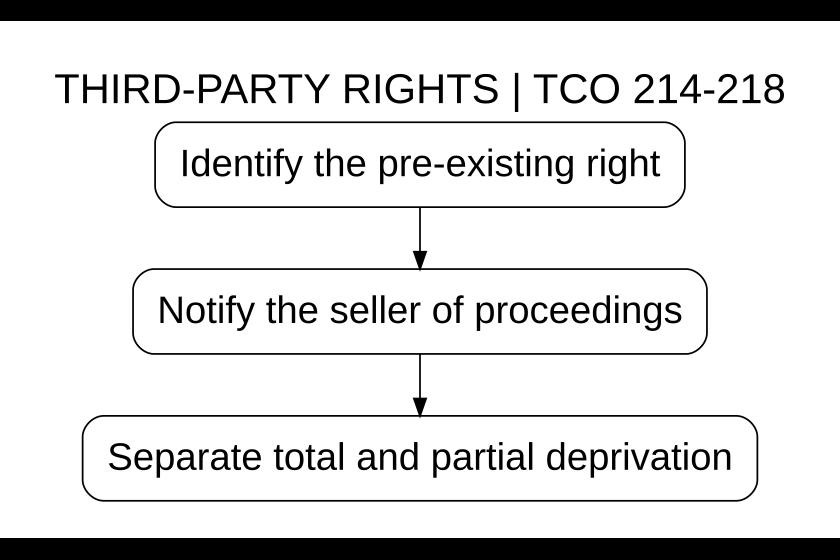
What a third-party rights claim changes
The Turkish expression zapttan sorumluluk describes the seller’s responsibility when an earlier third-party right results in the buyer losing all or part of what was sold. The issue is different from machinery failing to meet its technical specification. A perfectly functioning item can still be affected by another person’s enforceable right.
Start with the asset and the right claimed. Identify the model, serial number, lot, registration or other distinguishing information and obtain the document on which the third party relies. A general allegation that the seller had financial problems does not identify a right over the particular goods. Likewise, a right over a different asset does not establish deprivation of this purchase.
The governing provisions are Law No. 6098, Articles 214–218. They regulate the buyer’s position against the seller. Whether the third party actually owns the item or holds another enforceable property right requires examination of that right’s separate legal basis.
The right must pre-date conclusion of the sale
Article 214 ties liability to a right already existing when the sale contract was made. Record the date of agreement separately from payment, dispatch, delivery and the later assertion of the claim. The relevant chronology cannot be reconstructed accurately by using the invoice date as a substitute for every event.
Keep the original sale agreement and evidence showing when the third party’s right arose. An instrument signed later can record an earlier legal event, while a new obligation arising after the sale can require a different analysis. The document’s date and the date of the right are therefore questions to establish, not facts to assume.
A complete review compares both chains: how the seller acquired or purported to acquire the goods, and how the third party acquired the claimed right. Missing documents should be identified openly. A seller’s assurance that the goods are free of rights is relevant to the contractual record but does not, by itself, disprove an independently established third-party entitlement.
Distinguish a demand, a precautionary restriction and completed deprivation
A third party can make an allegation without having proved it. The buyer should preserve and examine the demand, but should not describe the sale as automatically ended merely because a letter has arrived. Articles 215–216 specifically address steps during a threatened loss and circumstances in which surrender without a judgment preserves recourse.
Identify whether the goods remain in the buyer’s possession, have been restricted by an authority, or have actually been taken on the asserted legal basis. A temporary measure and a final determination can have different effects. The operative document must be read rather than reduced to the word seizure in an informal message.
The immediate response should address both possession and procedure. Preserve the goods lawfully, obtain the complete decision or claim and record service dates. Neither selling the item onward nor surrendering it to an unverified claimant is a substitute for determining what legal obligation exists.
A buyer who knew the risk needs the seller’s additional undertaking
Under Article 214, a seller is not responsible where the buyer knew of the risk of deprivation when the contract was concluded, unless the seller separately undertook that responsibility. The buyer’s actual knowledge and the content of any additional undertaking are consequently central documents in the file.
Read disclosures, schedules and the negotiated allocation together. A statement that an identified right exists differs from a general warning that second-hand goods can involve risk. An undertaking to resolve a specified title problem should not be paraphrased as an unlimited guarantee concerning every unrelated dispute.
The statutory knowledge rule does not permit a reviewer to assume that every experienced business buyer knew every encumbrance. Identify the evidence supporting the knowledge allegation and its timing. Conversely, a buyer should disclose documents that show the risk was discussed instead of presenting the transaction as entirely undisclosed.
Concealment defeats an agreed exclusion of liability
Article 214 declares an agreement excluding or limiting the seller’s responsibility absolutely void where the seller concealed the third party’s right. A waiver clause is therefore not a complete answer without examining disclosure and concealment. The legal issue is not resolved simply by pointing to the buyer’s signature beneath standard conditions.
Preserve the representations made during negotiations, responses to due-diligence questions and the information attached to the contract. A claim of concealment needs its factual basis. The existence of an adverse right does not automatically prove that the seller concealed it, and the seller’s general denial does not establish proper disclosure.
The standard contract terms guide addresses additional controls on pre-written conditions. The title-specific concealment rule should nevertheless be examined directly rather than replaced by a general discussion about unfair small print.
Notify the seller when proceedings are brought against the buyer
Article 215 requires the notified seller, according to the circumstances and procedural rules, to participate alongside the buyer or take the buyer’s place in pursuing and defending the case against the third party. The seller’s duty is connected to notification of the proceedings, not merely an informal statement that a disagreement exists.
Provide the claim, supporting documents, hearing information and service record early enough for an effective defence. Preserve how notification was made. The appropriate procedural notification must be distinguished from a general commercial email; the substantive rule does not dispense with the procedure governing the case.
The buyer should also protect its own response deadline. Sending documents to the seller does not itself file a defence, secure an extension or cause the seller’s lawyer to become the buyer’s representative. The litigation record should identify who is responsible for each required procedural act.
Timely notification affects the seller’s exposure to the judgment
If notification occurs at a time suitable for participation and defence, Article 215 makes the adverse judgment effective for the seller as well, unless it is proved that the judgment resulted from the buyer’s gross fault. This is a defined statutory consequence; it is not a promise that every finding in every unnotified dispute automatically binds the seller.
Where proceedings were not notified for reasons not attributable to the seller, the seller is released to the extent it proves that timely notification would have produced a more favourable judgment. Failure to notify is therefore not accurately described as either always harmless or automatically destroying the whole recourse claim.
Compare the missed opportunity with the actual defence that could have been presented. The statute makes the extent of the proven disadvantage relevant. A seller asserting release should identify that disadvantage, while the buyer should retain the material showing what opportunities for defence were actually available.
Surrender without a judgment does not invariably destroy recourse
Article 216 preserves responsibility where the buyer recognises the third party’s right consistently with good faith and hands over the goods without waiting for judgment. It also preserves responsibility where the buyer proves that it was obliged to surrender them. The provision therefore rejects a universal rule that only a final judgment can support the seller claim.
That does not make every voluntary handover safe. Obtain the documents establishing the right and the reasons for recognising it. Record precisely what was returned, when and to whom. A concession made solely to avoid inconvenience must still be examined against the statutory requirements rather than described automatically as a compulsory surrender.
The article also addresses the buyer who promptly warns the seller to resolve the rights dispute through proceedings, explains that arbitration will otherwise be pursued and, receiving no result, proceeds to arbitration. This recourse rule does not itself establish an arbitration agreement with a third party. Authority, jurisdiction and the actual arbitration arrangement remain separate questions.
Total deprivation ends the sale under Article 217
Where the whole subject of the sale is taken from the buyer, Article 217 treats the sale contract as ended automatically. The statutory event is total deprivation under the applicable framework. An allegation affecting one detachable part should not automatically be classified as loss of the whole sale.
The buyer can request return of the price paid with interest, deducting the value of fruits obtained or neglected. The price-payment history and the relevant benefits therefore belong in the same account. A refund calculation omitting the statutory deduction is not made complete simply by attaching the original invoice.
Automatic contractual ending is different from automatic collection. A bank does not reverse the price merely because Article 217 applies. The seller must perform the resulting obligation, and a disputed or unpaid claim requires the appropriate recovery procedure.
Expenses and damage should be divided into the statutory categories
Article 217 allows recovery of expenditure that cannot be demanded from the third party who deprived the buyer of the goods. It also covers litigation and out-of-court costs other than those that could have been avoided by notifying the seller. The claim should therefore identify the source, purpose and recoverability of each expense.
The buyer may also seek other damage directly resulting from total deprivation. For additional damage beyond that category, the seller is liable unless it proves that no fault can be attributed to it. Keeping those categories distinct prevents the seller’s fault defence from being applied indiscriminately to every element of the account.
Do not count the same expenditure twice or assume that every projected resale margin is established loss. Explain the causal connection and supporting records for each sum. Payments received from a third party, insurer or another responsible person must be reconciled with what remains claimed from the seller.
Partial deprivation ordinarily produces a damages claim
Article 218 applies when part of the goods is taken or the goods are burdened by a limited right in rem. Its starting remedy is compensation for the damage caused by that situation. It does not automatically end the complete sale every time an earlier right affects part of the asset.
The article permits the buyer to ask the judge to end the contract where the circumstances show that the buyer would not have purchased had it known the situation. The original commercial purpose, the significance of the affected part and the negotiations can be relevant to that assessment.
If the court ends the contract on that basis, the buyer must return the part still held together with the benefits obtained up to that point. A claim seeking complete unwinding should therefore address what remains available for return instead of presenting the purchase-price refund as a one-sided consequence.
Prepare one chronology and two connected legal files
The first file establishes the third party’s right and the response to it. The second establishes the sale, disclosure position, notification to the seller and resulting monetary claim. The files are connected, but they answer different questions. Success or failure in the ownership dispute should be translated carefully into the seller-liability framework.
| Issue | Record to preserve |
|---|---|
| Identity of the goods | Contract, serial numbers, inventory and delivery record |
| Earlier right | Instrument or legal record establishing its source and date |
| Knowledge and disclosure | Negotiations, disclosures and any additional seller undertaking |
| Proceedings and notice | Complete claim, service record and effective notification to the seller |
| Deprivation | Judgment, surrender record or evidence of the obligation to hand over |
| Amount | Price paid, benefits, expenses, loss and payments already recovered |
For international sales, determine governing law and any applicable treaty before applying these domestic provisions. The governing-law guide addresses that preliminary inquiry. The electronic-evidence guide explains why original communications should accompany screenshots. Neither preparation step suspends a deadline in already served proceedings.
Frequently asked questions
Does every ownership allegation automatically end the sale?
No. A demand, threatened deprivation and completed total deprivation are different stages. Article 217’s automatic-ending rule concerns total deprivation under the relevant statutory framework.
When must the third party’s right have existed?
Article 214 requires a right existing when the sale contract was concluded. Record that date separately from delivery and the date the claim was asserted.
What if the buyer knew about the risk?
The seller is not responsible under Article 214 unless it additionally undertook responsibility. The buyer’s knowledge at formation and the undertaking’s scope require proof.
Can the seller rely on a waiver after concealing the right?
Article 214 makes an agreement excluding or limiting liability absolutely void where the seller concealed the third party’s right.
Why must proceedings be notified to the seller?
Article 215 regulates participation and defence and the judgment’s consequences for the seller. Notification must allow a meaningful opportunity to defend and comply with the applicable procedure.
Does late or missing notification always destroy the whole claim?
No automatic total loss follows. Article 215 links release in the stated circumstances to the extent the seller proves timely notification would have produced a better judgment.
Must the buyer always wait for a judgment before surrendering goods?
Article 216 preserves responsibility in specified situations without judgment, including good-faith recognition and proof of an obligation to surrender. An unsupported voluntary handover is not automatically sufficient.
What happens to the price after total deprivation?
Article 217 allows return of the paid price with interest, deducting the value of fruits obtained or neglected. Expenses and other damage require their own statutory classification and evidence.
Does partial deprivation automatically cancel everything?
No. Article 218 starts with damages. Judicial ending is available where the circumstances show the buyer would not have bought with knowledge of the situation, with return obligations for what remains.
Is this the same as a technical defect warranty?
No. Articles 214–218 concern deprivation through earlier third-party rights. Defect liability and the legal validity of the asserted property right require separate analysis.
Official statutory sources
Turkish Code of Obligations No. 6098, Articles 214–218; official Ministry text, pages 41–42. This English explanation is not an official translation. Special sale, property and international-law provisions must be examined where applicable.
Ask about a third-party claim over purchased goods
Identify the goods, sale date, asserted right and any served proceedings. Do not send identity numbers or confidential title documents in the initial enquiry.
Istanbul and Mersin offices
Bakırcı & Keskin Law Office is Mersin-based, working throughout Türkiye with an Istanbul and Mersin focus. Agree a confidential channel before sending the documents relevant to your enquiry.
Istanbul — Polaris Plaza
Maslak Ahi Evran Caddesi, Polaris Plaza No:21, Floor 9, 34475 Sarıyer/İstanbul. Istanbul office directions.
Mersin — Profit İş Merkezi
İhsaniye Mahallesi, 4903. Sokak, Profit İş Merkezi No:23, Floor 3, Office 14, 33070 Akdeniz/Mersin. Mersin office directions.
Call +90 552 224 43 66. An enquiry does not establish representation or suspend a legal deadline.
Contact regarding a legal matter
In your first message, you may briefly state the subject, your country or city, and any relevant notification or recent procedural date. Please do not send identity numbers, medical data, or personal documents. Messaging alone does not constitute legal advice or create a lawyer–client relationship.
Discover more from Bakırcı & Keskin Hukuk Bürosu
Subscribe to get the latest posts sent to your email.