Goods Damaged Before Collection or in Transit in Turkey: Who Bears the Sale Risk?
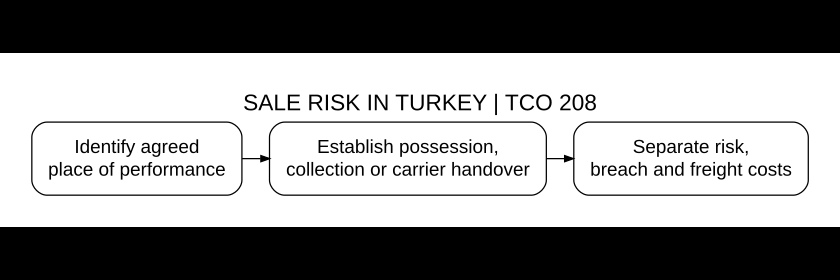
Paying for goods does not, by itself, determine who bears their accidental loss before delivery. Article 208 of the Turkish Code of Obligations generally keeps the benefits and risk of a movable sale with the seller until possession passes. It contains separate rules for a buyer who defaults in taking possession and for goods dispatched, at the buyer’s request, somewhere other than the place of performance. Article 211 allocates transfer and transport expenses. The person paying the freight is therefore not necessarily the person bearing every transit risk, and neither question alone determines whether a carrier or a party in breach must compensate the loss.
Have a general question about this article? Ask anonymously
Begin with the sale contract, not only the damaged shipment
Article 207 defines the seller’s obligation to transfer possession and ownership and the buyer’s obligation to pay the price. Unless an agreement or contrary custom provides otherwise, the parties perform simultaneously. An advance-payment arrangement changes the payment sequence, but a bank transfer alone does not identify the agreed delivery obligation or prove that possession has passed.
Obtain the purchase agreement, accepted quotation, specifications, delivery provisions and subsequent amendments. Identify the actual seller and buyer, particularly when a buying agent, group company or logistics provider communicates for someone else. The party that received a payment and the party that physically stored the goods need not have the same legal role.
The primary provisions are Law No. 6098, Articles 207–211. This article addresses the buyer–seller allocation where Turkish domestic sale rules apply. It does not assume that every international sale, consumer transaction or transport contract follows that framework without further examination.
Article 208 uses possession as the ordinary movable-sale starting point
Subject to exceptions arising from law, the circumstances or particular contractual terms, the benefits and risk remain with the seller until possession is transferred in a movable sale. Signing the purchase agreement and receiving an invoice are therefore different events from the statutory transfer event. A payment confirmation should not be relabelled as a delivery record.
Identify the property with sufficient precision. For a machine, preserve its serial number and the agreed configuration. For stock, preserve batch, quantity and identification records. The risk discussion must concern the goods sold, not merely other goods of the same general description somewhere in the seller’s warehouse.
Possession is a legal concept, and its transfer requires assessment of the actual arrangement. Physical location is important evidence but is not invariably the whole inquiry. Where goods remain with a seller or warehouse under a new holding arrangement, identify the documents and authority establishing that position rather than deciding the issue from an invoice or a photograph alone.
The contract can change the default allocation
Article 208 expressly recognises particular contractual terms as a source of exceptions. Read the complete risk clause together with the performance and delivery provisions. An agreement requiring delivery at the buyer’s premises must not automatically be treated like a collection sale merely because the seller eventually uses a carrier.
Record the version of any incorporated delivery terms. A trade abbreviation without its named place or applicable wording can leave the parties disputing what was accepted. This guide does not supply a substitute definition for every international delivery term. The actual incorporated text and its legal effect must be examined.
The agreement should also distinguish physical handover, inspection, commissioning and contractual acceptance. Those milestones can have different functions. A clause postponing final technical acceptance does not necessarily answer the risk question unless its wording connects the two; conversely, an express risk provision must not be ignored because a standard delivery note was later signed.
Find the place of performance before applying the dispatch exception
Article 208’s dispatch rule refers to shipment away from the place of performance. Article 89 determines that place first by the parties’ express or implied intention. Its default rules distinguish monetary obligations, obligations concerning a specific item and other obligations. The delivery address on a transport booking should therefore be compared with the underlying sale agreement.
For a specific item, Article 89’s default points to the place where it was located when the contract was concluded. For obligations outside the other stated categories, the debtor’s domicile when the obligation arose supplies the default. These are fallback rules, not authority to disregard an agreed destination-delivery undertaking.
A useful file identifies the contractual performance location and the destination requested for transport as separate fields. Where they differ, retain the communication requesting dispatch. Where they are the same, explain why the seller says the statutory rule for sending elsewhere nevertheless applies. That question cannot be answered simply by producing a freight invoice.
Dispatch at the buyer’s request has a specific transfer event
Under Article 208’s third paragraph, where the seller sends the goods at the buyer’s request to a place other than the place of performance, the benefits and risk pass when the goods are handed to the carrier. Both the buyer’s request and the different destination are part of the stated arrangement. The paragraph is not a rule that every seller escapes risk whenever a truck arrives.
Establish the actual handover. A carrier booking, a label printed in advance and a dispatch notification can precede physical acceptance of the goods. Keep the collection receipt, loading record, vehicle or consignment identification and any reservations made at collection. The goods identified in those records must match the sold goods.
Distinguish carrier acceptance from delivery to the buyer. In the specified dispatch arrangement, the statute selects the former as the risk event. That does not eliminate contractual duties concerning the correct goods, documents or other promised performance. The complete dispute can involve both the risk allocation and an independently alleged failure to perform the sale correctly.
A buyer’s collection default can transfer risk without actual collection
Article 208’s second paragraph treats risk as transferred when the buyer defaults in taking possession, as though the transfer had occurred. This is a separate route from carrier handover. The seller relying on it must identify the obligation to collect and the facts establishing default, not only the fact that the goods remained on site.
Article 106 addresses a creditor’s unjustified refusal to accept a properly offered performance or perform the necessary preparatory acts. Proper tender therefore matters. Identify the agreed goods, readiness, time, place and any cooperation required from the buyer. An offer to collect the wrong machine or an incomplete delivery must not automatically be treated as proper performance.
Preserve the collection invitation, evidence that it reached the relevant recipient, the response and the goods’ documented condition. A newly issued storage invoice is not, without the underlying facts, proof that collection default began on the invoice date. The creditor-default guide addresses the wider tender and deposit framework separately.
Risk allocation does not excuse causing the loss
The question whether accidental loss falls on the buyer is different from whether the seller, warehouse or carrier caused compensable damage. A party should not use a risk clause as an unexplained answer to allegations of mishandling, wrong loading instructions or another failure to perform an established duty. Identify the conduct and legal ground relied on.
Prepare two analyses. The first locates the Article 208 risk event and the time of the loss. The second identifies the obligation allegedly breached, the responsible person and the causal connection. Evidence supporting one analysis may also be relevant to the other, but the conclusions are not automatically identical.
The liability-exclusion and contractual-assistant guide explains why an exclusion clause needs its own legal review. An agreed allocation of risk, a limitation of damages and a claim that no breach occurred are different propositions and should be stated separately.
Article 211 allocates expenses without replacing Article 208
Unless an agreement or custom provides otherwise, Article 211 places transfer expenses such as measuring and weighing on the seller. Expenses incurred to take delivery, and transport expenses where goods must move away from the place of performance, fall on the buyer. The provision then addresses particular agreements about expense-free delivery.
Where expense-free transfer is agreed, the seller is treated as having undertaken transport costs. Where transfer without port and customs expenses is agreed, the seller is treated as undertaking export, transit and import taxes, but not the consumption taxes paid when the buyer takes delivery. That final distinction should not disappear from a cost quotation.
These are rules about who bears specified expenses between the parties. They do not, standing alone, establish the risk-transfer moment, the customs authority’s liable person or an insurer’s coverage. A seller paying a carrier and a buyer bearing a defined transit risk are not inherently contradictory positions; the agreement and both statutory provisions must be read together.
A chronology should distinguish each custody stage
| Stage | Record to preserve | Question answered |
|---|---|---|
| Agreement | Accepted terms and specifications | What goods and performance location were agreed? |
| Readiness | Inspection, identification and collection notice | Were the agreed goods properly offered? |
| Dispatch request | The buyer’s instruction | Was shipment elsewhere requested by the buyer? |
| Carrier handover | Collection record and reservations | When and in what condition did custody change? |
| Loss or discovery | Incident record and technical evidence | When did the damage occur, not merely become visible? |
| Buyer receipt | Delivery record and inspection | What arrived and what was reported? |
A discovery date is not necessarily the date damage occurred. Preserve packaging, condition photographs and technical observations that can explain the interval. Do not fill gaps with an assumption that the last person holding the goods necessarily caused every defect.
The carrier claim remains a separate legal relationship
The carrier’s obligation arises from the relevant carriage framework and contract, not solely from Article 208. Identify who contracted for carriage, the consignor, consignee and any party entitled to assert the particular transport claim. The person who bears risk under the sale and the person named on a freight document require a coordinated assessment.
For international road transport, the road-cargo claim guide addresses the separate carriage rules. A sale-risk conclusion does not determine every carrier defence, limitation, reservation or procedural requirement. Do not allow negotiations with the seller to displace the independent checks required for a transport claim.
Keep carrier notices, survey records and the sale correspondence in distinct sections of the same dossier. A letter disputing the price is not necessarily a carrier reservation. An insurer’s survey is evidence of its inspection, not automatically an admission of liability by every party involved in the shipment.
Insurance must match the insured interest and period
Read the actual policy, certificate and endorsements. Establish the insured person, goods, insured journey or storage period and the occurrence being notified. This is a document review, not a presumption that every commercial shipment is comprehensively insured or that the freight price includes cover.
The sale’s risk event can be relevant to the insured interest, but coverage also depends on the insurance arrangement. Keep the policy analysis separate from the assertion that the seller promised to arrange insurance. A failure to supply a promised certificate and a coverage dispute under an existing policy are different claims.
Record compensation already received, salvage proceeds, returned goods and refunds. The remaining claim should show which loss is still unsatisfied and which person is entitled to recover it. A sale, carriage and insurance file can offer different legal routes without creating several independent recoveries for the same economic loss.
Damage before delivery is not always a case of impossibility
Classify the promised performance. The destruction of an identified unique item and damage to part of a larger stock do not automatically create the same legal result. Determine what remains capable of performance and whether the contract requires replacement goods, repair or another agreed response.
The impossibility and advance-refund guide addresses Articles 136–137 and their relationship with responsibility and risk. Merely stating that an accident occurred does not establish every condition for extinguishing the seller’s obligation or retaining a payment.
Delay presents another distinct issue. The commercial late-delivery guide explains the special remedy framework for a fixed commercial delivery period. A buyer should identify whether it seeks correct performance, compensation or an exit from the sale rather than use a risk dispute to leave its remedy unexplained.
Prepare an overseas buyer’s or seller’s claim around the actual allocation
The initial record should contain the sale terms, the performance location, the dispatch instruction, the carrier handover, evidence of loss and the payment account. Add any collection-default correspondence, policy and carrier notices. Translate the relevant source documents without replacing them with an unsupported narrative about who was responsible.
A cross-border sale requires an applicable-law and treaty assessment before this domestic framework is applied. The international-contract governing-law guide addresses that preliminary question. The seller’s Turkish address alone does not resolve every substantive rule.
Where proceedings have been served, include the complete claim and service record. Correspondence about risk, surveys or insurance does not itself supply a procedural response. The final legal position should identify the operative risk event, the independently alleged breach and the precise outstanding remedy.
Frequently asked questions
Does paying the price automatically transfer the risk?
No. Article 208 ordinarily uses transfer of possession for movable sales, subject to its exceptions. Payment and the relevant risk event must be established separately.
Does every shipment transfer risk when a carrier collects it?
Not under an unrestricted Article 208 rule. Its dispatch paragraph concerns goods sent at the buyer’s request somewhere other than the place of performance, with the agreement and legal exceptions also examined.
Why does the place of performance matter?
The dispatch exception distinguishes that place from another destination requested by the buyer. Article 89 first looks to the parties’ express or implied agreement and then its statutory defaults.
Can risk pass while the goods remain uncollected?
Article 208 provides that result when the buyer defaults in taking possession. Proper tender, the collection obligation and the facts establishing default need to be identified.
Does paying freight mean the seller bears every transit loss?
No automatic conclusion follows. Article 211 concerns costs; Article 208 and the applicable agreement determine sale risk. Responsibility for causing damage is another question.
Does a risk clause excuse the seller’s own breach?
A risk allocation does not by itself answer an independently supported breach claim. Identify the duty, conduct, causation and any legally effective limitation separately.
Is printing a shipping label proof of carrier handover?
Not by itself. Preserve the actual collection record, goods identification and any condition reservations. Booking and physical handover are different events.
Does this rule decide the carrier’s liability limit?
No. Carriage liability, reservations and limits arise under the applicable transport framework. The sale-risk analysis must be coordinated with, not substituted for, that review.
Is an invoice enough to prove possession passed?
An invoice alone does not resolve that legal and factual question. Review the delivery or holding arrangement, authority and documents relating to the identified goods.
What should be sent for an English-language review?
Provide the sale terms, performance location, buyer’s dispatch request, custody timeline, condition evidence, payment account and relevant carriage or insurance documents.
Official legal sources
Turkish Code of Obligations No. 6098, Articles 89, 106 and 207–211; official Ministry text, page 40, setting out the sale-risk and expense rules. This English explanation is not an official translation.
Ask about goods damaged before receipt
Identify the goods, agreed delivery place, collection or dispatch date and when the damage was discovered. Do not include confidential documents or account credentials in the initial message.
Istanbul and Mersin offices
Bakırcı & Keskin Law Office is Mersin-based and works throughout Türkiye with an Istanbul and Mersin focus. Arrange a confidential channel for sale, delivery and loss records.
Istanbul — Polaris Plaza
Maslak Ahi Evran Caddesi, Polaris Plaza No:21, Floor 9, 34475 Sarıyer/İstanbul. Istanbul office directions.
Mersin — Profit İş Merkezi
İhsaniye Mahallesi, 4903. Sokak, Profit İş Merkezi No:23, Floor 3, Office 14, 33070 Akdeniz/Mersin. Mersin office directions.
Call +90 552 224 43 66. An enquiry does not establish representation or suspend a legal deadline.
Contact regarding a legal matter
In your first message, you may briefly state the subject, your country or city, and any relevant notification or recent procedural date. Please do not send identity numbers, medical data, or personal documents. Messaging alone does not constitute legal advice or create a lawyer–client relationship.
Discover more from Bakırcı & Keskin Hukuk Bürosu
Subscribe to get the latest posts sent to your email.