Foreign Subpoenas for Business Records in Turkey: Hague Evidence and Article 23
A foreign subpoena does not, merely by arriving at a Turkish company, become a Turkish court order compelling production. A request for judicial assistance must be distinguished from obligations that the issuing court asserts under its own law. Under the 1970 Hague Evidence Convention, Turkey has declared that it will not execute Letters of Request aimed at pre-trial discovery of documents as understood in common-law countries. A recipient must assess both the foreign proceeding and the lawful Turkish evidence route, rather than either ignoring the document or automatically exporting its records.
Have a general question about this article? Ask anonymously
This guide is for foreign businesses, litigation counsel and Turkish record custodians dealing with an incoming request for evidence located in Turkey. For the opposite direction, see our guide to obtaining evidence abroad for a Turkish civil case. The two directions involve different requested-state rules.
1. Identify the document before deciding how to respond
Keep the complete document and the transmission record. Identify the issuing court, case number, parties, addressee, requested acts and stated response date. A subpoena signed by a lawyer, a judicial Letter of Request, an informal cooperation request and a communication from a Turkish authority perform different procedural functions. Their captions are not a substitute for examining their actual origin and content.
Record which legal entity received the document. A Turkish subsidiary, its foreign parent and an employee are not automatically the same recipient. Check the exact corporate name and address, including any former name. Where the request refers to a group brand, identify the entity that actually holds or controls the requested records.
Arrange review in both relevant jurisdictions. Counsel dealing with the foreign proceeding should assess jurisdiction, objections and the deadline asserted there. Turkish counsel should examine the local assistance mechanism and lawful handling of evidence. The absence of an immediately executable Turkish order is not advice to disregard the foreign proceeding or to assume that the foreign court cannot impose consequences within its own jurisdiction.
2. Preserve the records without making an uncontrolled disclosure
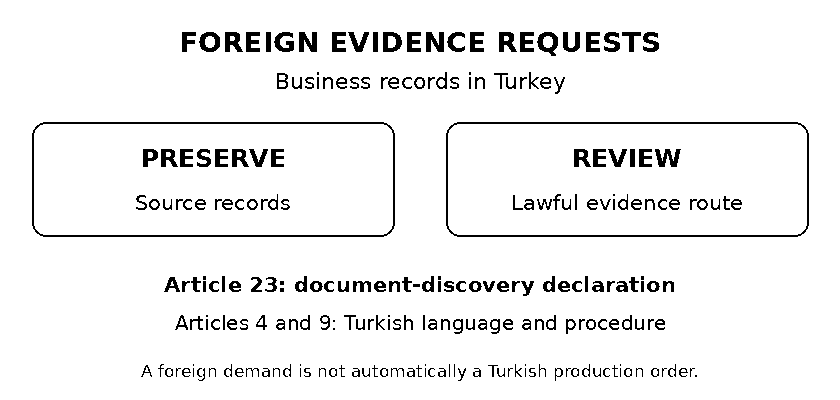
Preservation and production are different decisions. Identify the relevant custodians and systems, preserve the source records and document the steps taken. Do not delete material, change timestamps or move records merely to frustrate a request. Equally, do not send an entire server image abroad before identifying the lawful scope and recipient of the proposed disclosure.
Make an inventory of potentially relevant sources: the contracting entity’s correspondence, accounting system, project files and archived attachments. Record who maintains each source and whether it contains material belonging to unrelated customers or employees. An accurate inventory allows counsel to discuss a specific request rather than make unsupported statements that records either do or do not exist.
Retain originals and work from controlled copies. Preserve the connection between an email and its attachments, and between an accounting export and the system from which it was generated. Our electronic evidence guide explains why context and source records matter. A neatly edited spreadsheet is not necessarily equivalent to the underlying transaction record.
Map physical storage, access rights and legal custody separately. A document accessible from an overseas parent company may still be maintained by a different entity in Turkey. A Turkish employee may have viewing access without authority to release an entire customer archive. Record these distinctions accurately and give both legal teams the same factual account. Do not make contradictory claims about control in different proceedings, and do not assume that the location of a cloud server alone resolves who can lawfully obtain or produce the material.
3. A Hague Letter of Request is a judicial-assistance instrument
Articles 1 and 2 of the 1970 Hague Evidence Convention provide for a judicial authority to request evidence through the designated Central Authority. The evidence must be intended for commenced or contemplated civil or commercial proceedings. A private demand letter is not made into that instrument by attaching a copy of the Convention.
Confirm the relevant treaty relationship before choosing this route. Use the official status table, including any acceptance required for an accession. Do not assume that the appearance of both states on a general treaty list answers every question about their bilateral treaty relationship.
Keep the evidence request separate from service of proceedings, enforcement of a judgment and provisional measures. Article 1 excludes those specified acts from its definition of other judicial acts. A request to preserve or freeze assets therefore needs its own legal basis; the evidence Convention is not a general-purpose order permitting every litigation step in Turkey.
4. Turkey’s Article 23 declaration must be addressed directly
Turkey’s official declarations state that it will not execute Letters of Request issued for obtaining pre-trial discovery of documents as known in common-law countries. This is Turkey’s declared position, not a general summary of what every Hague state permits.
Do not import a different state’s qualified declaration or exceptions into a Turkish request. A practice accepted in another jurisdiction is not proof of Turkish acceptance. Likewise, reducing a request from thousands of records to a smaller number does not by itself settle whether the request still has the excluded discovery purpose.
Examine the actual procedural purpose and the identified evidentiary act. The foreign court and Turkish counsel should assess whether a legally available request can be formulated for the evidence genuinely required. Renaming broad discovery as inspection, or describing it as urgent, does not alter the Convention analysis. The response must explain the real request rather than conceal its purpose behind a different heading.
5. Specificity identifies the evidence; it does not erase the declaration
Article 3 requires information about the authorities, parties, proceeding and evidence sought. For documents, identify the relevant record or property to be inspected. For testimony, identify the person and the questions or subject matter. These requirements help the executing authority understand the task; they are not a promise that every precisely drafted request will be executed.
Connect each requested record to a disputed issue. Identify the custodian, transaction, period and document type with enough information to distinguish responsive material from unrelated business archives. Where the request names an account or project, ensure that the identifier is correct in both the original and Turkish translation.
Explain what is known and what remains uncertain. Do not assert that a particular record exists simply because it would be useful. Where the custodian’s identity is disputed, provide the evidence supporting the proposed identification. A request that repeatedly names the wrong subsidiary cannot be repaired by adding broader language about all related companies.
Separately address Article 23. A well-organised request can still have an excluded discovery purpose. Precision and admissibility of the assistance route are distinct questions and should be treated as such in the application.
6. Prepare a Turkish request or a compliant Turkish translation
Turkey has reserved against the English-or-French default in Article 4(2). Its declaration requires a Chapter I Letter of Request in Turkish or accompanied by a Turkish translation compliant with Article 4. An English document should not be assumed acceptable merely because the parties conduct their business in English.
Article 4(5) identifies who may certify an accompanying translation as correct. Keep the certification connected to the complete translated request. Check names, account identifiers, date ranges, witness questions and the distinction between mandatory and voluntary wording. A translator should not add a power of compulsion that the source document does not contain.
Article 3 removes legalisation or similar formalities for the Letter of Request. Do not turn that provision into a statement that every supporting corporate document or every later use of the evidence is exempt from all authentication rules. The request, supporting exhibits and authority documents serve different functions.
Maintain an aligned index showing the original page and corresponding Turkish page. When the foreign court modifies the request, update the operative translation rather than submitting a mixture of the original and revised instructions.
7. Turkish procedure governs execution under Article 9
Article 9 directs the executing judicial authority to use its own law for methods and procedure. The requesting authority can ask for a special method, which must be followed unless it is incompatible with the executing state’s internal law or impossible for the reasons specified in Article 9. The requesting party should not promise that examination in Turkey will exactly reproduce its home-court deposition practice.
Identify which procedural features are genuinely necessary for the foreign case. An oath, a particular recording format or a defined set of questions should be described in the request rather than assumed. Explain the evidential purpose so the authorities can assess the requested method.
Keep an accurate record of the procedure actually used. If the request asks for a verbatim transcript but a different lawful record is returned, report the difference to foreign counsel. Do not describe the result as a complete deposition merely because a witness was examined. The admissibility and weight of the returned material in the foreign proceeding require assessment there.
8. Compulsion and privilege require separate legal analysis
Article 10 addresses compulsion through the requested authority within the limits of its own law. It does not give a foreign private litigant a free-standing power to search a Turkish office or seize its servers. Identify the competent authority and the actual order before characterising a demand as compulsory in Turkey.
Article 11 protects specified privileges or duties to refuse evidence under the executing state’s law and, under its conditions, the originating state’s law. Where the foreign-law protection is relied on, arrange for it to be identified in the Letter or properly confirmed to the executing authority. An unexplained reference to privilege is not an evidential substitute for that legal analysis.
Review potentially protected records separately. Record the document, parties to the communication and basis of the claimed protection without unnecessarily disclosing its protected substance. Do not assume that every document labelled confidential is privileged, or that forwarding a business document to a lawyer automatically resolves its status. The relevant law and actual function of the communication must be examined.
9. A voluntary interview is not an automatic alternative route
Chapter II separately regulates evidence taken by diplomatic officers, consular agents and commissioners. Turkey has designated its Ministry of Justice as the authority granting the permissions envisaged by Articles 16 and 17. Choosing a hotel meeting room or a video platform does not remove the need to assess the applicable permission and procedure.
Establish the proposed examiner’s capacity, the witness’s nationality, the location of the witness and the purpose of the examination. An ordinary business interview and formal evidence-taking for pending foreign litigation should not be described as identical merely because both involve questions.
Keep the invitation, permission where required and agreed scope in the file. Do not represent voluntary participation as compulsion or suggest that a witness has no right to legal advice. Article 20 recognises legal representation within Chapter II, and Article 21 addresses relevant safeguards. The method must be lawful in the circumstances, not simply convenient to the requesting team.
10. Track the returned evidence and any incomplete execution
Article 13 deals with return of the execution documents through the relevant channel and communication of the reasons for non-execution, including partial non-execution. Distinguish an unexecuted request, a partially fulfilled request and a complete response. Silence in a production bundle should not automatically be reported as proof that a record never existed.
Maintain an execution log showing what was requested, what the authority obtained and what remains outstanding. Preserve seals, certifications, cover letters and the original ordering of exhibits. Where material is translated for the foreign court, keep that translation separate from the official execution record.
Explain discrepancies promptly. A missing attachment, illegible page or incorrect corporate identifier can affect the usefulness of the evidence even when the formal request was accepted. Ask the responsible authority or counsel about the proper correction route; do not privately reconstruct an official record and present the reconstruction as the authority’s original response.
11. Coordinate deadlines, costs and lawful disclosure
The Convention’s requirement of expeditious execution does not supply a fixed completion date for an individual request. Foreign counsel should manage the originating court’s timetable independently, including any application needed there. Sending a request to Turkey does not itself suspend a deadline imposed in the foreign case.
Article 14 distinguishes ordinary execution costs from the stated reimbursable expert, interpreter and special-procedure expenses. Budget translation, legal work and any properly identified procedural expense separately. Do not promise that every cross-border evidence exercise is free, or quote a universal charge unsupported by the actual requested work.
Before production, address the lawful handling of personal, banking and commercially sensitive information in the relevant jurisdictions. Neither the word discovery nor a confidentiality agreement answers every disclosure issue. The review should identify the applicable duty, lawful recipient and permitted scope without treating privacy as an automatic excuse to conceal relevant evidence.
A useful initial file contains the complete demand, receipt date, court details, recipient’s identity, records inventory and any correspondence about extensions or objections. Identify what has already been disclosed. Our international service guide addresses a separate procedural problem; receipt, service, evidence collection and enforcement must not be collapsed into one event.
Frequently asked questions
Does a foreign subpoena automatically operate as a Turkish production order?
No. Its effect in the issuing jurisdiction and the lawful means of obtaining evidence in Turkey are separate questions. Obtain advice on both rather than ignoring the document.
Does Turkey accept ordinary common-law pre-trial document discovery through the Convention?
Turkey has made the Article 23 declaration that it will not execute Letters of Request for that purpose. The actual request must be assessed against that declaration.
Will making the request narrower automatically overcome Article 23?
No. Specificity addresses identification of evidence. It does not by itself change an excluded discovery purpose into an executable request.
Can the Letter of Request be submitted only in English?
Turkey has reserved against the Article 4(2) English-or-French default. A Turkish Letter or a compliant Turkish translation is required under its declaration.
Must the Letter itself be apostilled?
Article 3 provides that no legalisation or similar formality may be required for the Letter of Request. Separate supporting documents require their own assessment.
Can a foreign lawyer personally compel a Turkish witness under Article 10?
Article 10 concerns compulsion by the requested authority within its internal law. It does not confer a private power to compel a witness or seize records.
Should records be deleted while the route is being reviewed?
No. Preserve relevant source records and document the preservation process. Preservation is distinct from the later decision about lawful production.
Can a video call replace the Convention permission requirements?
Not automatically. The examiner, witness, location and purpose must be assessed under the applicable evidence-taking rules, including any necessary permission.
Does sending a Hague request suspend the foreign court deadline?
Not by itself. Counsel in the originating proceeding must address that court’s timetable and any necessary application.
What should be sent to Turkish counsel first?
Provide the complete demand, receipt date, court and case details, identity of the recipient, records inventory and any existing objections or extensions. Use a confidential channel for sensitive exhibits.
Official legal sources
HCCH: 1970 Evidence Convention, especially Articles 1–4, 9–14, 16–17 and 20–23; Turkey’s declarations and reservation; current Convention status table. The originating court’s law must be assessed separately; this guide does not advise a recipient to disregard a foreign court document.
Legal-source review: 26 October 2026. This is an English explanation, not an official translation or a prediction of the outcome of an individual matter.
Contact information
Use a confidential channel for sensitive records. An initial enquiry does not establish representation or suspend a legal deadline.
Istanbul and Mersin contact details
Bakırcı & Keskin Law Office is Mersin-based. Turkish matters are handled under the applicable jurisdiction and agreed mandate. The competent authority is determined by law, not by the address used for correspondence.
Istanbul — Polaris Plaza
Maslak Ahi Evran Caddesi, Polaris Plaza No:21, Floor 9, 34475 Sarıyer/İstanbul, Türkiye.Mersin — Profit İş Merkezi
İhsaniye Mahallesi, 4903. Sokak, Profit İş Merkezi No:23, Floor 3, Office 14, 33070 Akdeniz/Mersin, Türkiye.+90 552 224 43 66 · Contact details in English. An enquiry does not establish representation or suspend a legal deadline.
Istanbul Office – Polaris Plaza, Maslak / Sarıyer
Bakırcı & Keskin Hukuk Bürosu
Maslak Ahi Evran Caddesi, Polaris Plaza No:21, Kat:9, 34475 Sarıyer/İstanbul
Our physical offices in Istanbul and Mersin coordinate matters throughout Turkey, subject to jurisdiction and the local steps required for each case. Please specify your preferred office when arranging an in-person appointment.
Open the Istanbul office on Google Maps · Contact and appointments
Contact regarding a legal matter
In your first message, you may briefly state the subject, your country or city, and any relevant notification or recent procedural date. Please do not send identity numbers, medical data, or personal documents. Messaging alone does not constitute legal advice or create a lawyer–client relationship.
Discover more from Bakırcı & Keskin Hukuk Bürosu
Subscribe to get the latest posts sent to your email.