Ending a Turkish Lease for Important Reasons: Notice and Financial Consequences Under TCO 331
Article 331 of the Turkish Code of Obligations allows either party to end a lease where important reasons make continuation intolerable for that party, but the statutory notice period must still be observed. The judge determines the monetary consequences in light of the circumstances. The provision is therefore neither an unrestricted right to cancel whenever plans change nor a guarantee that the party ending the lease owes nothing. A tenant leaving Turkey or a landlord facing a serious disruption needs a clear account of the reason, notice, intended ending date and financial consequences before treating the rental relationship as closed.
Have a general question about this article? Ask anonymously
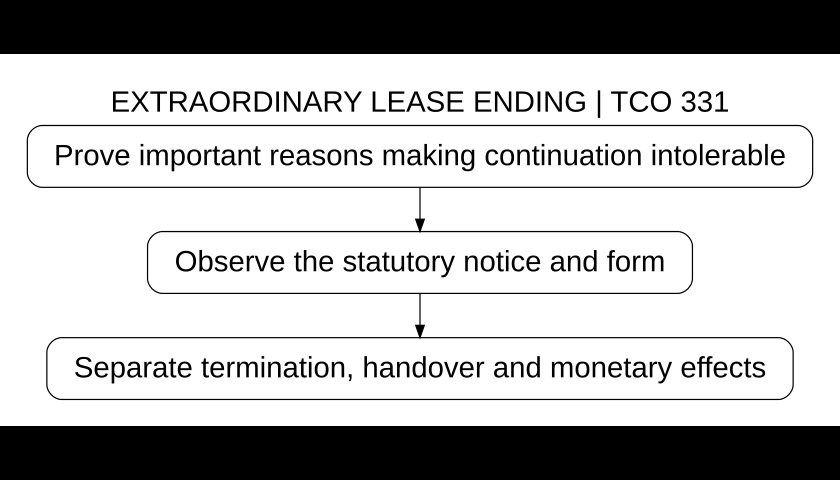
Article 331 requires more than a preference to move
The statutory test is important reasons making continuation intolerable for the party relying on them. Identify the actual event or circumstances and explain their effect on the rental relationship. A statement that the party would now prefer a cheaper property or a different commercial location does not itself demonstrate the statutory threshold.
Article 331 does not supply an exhaustive list in which every illness, employment change, relocation or financial difficulty automatically qualifies. The evidence must establish the reason and its seriousness in the particular relationship. The legal conclusion should not be replaced by the heading used in a notice.
The primary source is Law No. 6098, Article 331. This guide concerns its extraordinary-termination route for property leases. It does not give a medical diagnosis, decide an unidentified factual dispute or turn every change of personal plans into a guaranteed release.
The right belongs to either party, but not on identical assumed facts
The article refers to each party. A tenant and landlord can therefore examine the provision, but each must establish the reasons affecting that party. Proof that the tenant faces a difficulty does not automatically establish the landlord’s independent right to end the agreement, or the reverse.
For residential and roofed-workplace leases, Article 347 also recognises termination where a right under the general provisions can be exercised. That reference must be read with the particular conditions of Article 331. It is not a way to avoid the protected tenancy rules by calling an ordinary wish to obtain a different rent an extraordinary reason.
Identify who is actually a party to the lease. A shareholder, employee living in company-rented accommodation or family member managing correspondence can have a different legal position from the contractual tenant. Establish the relevant party and representative authority before assessing the declaration.
Build an event-and-effect chronology
The file should state what happened, when it happened or became known, and why continued performance became intolerable. Connect each material assertion with an available record. A date on a travel booking proves a planned journey; it does not, by itself, prove every reason for ending the tenancy.
Include the contract’s original purpose and the subsequent communications. What the parties agreed and what changed are central to explaining the dispute. Where a fact was already known or a risk was addressed in the agreement, disclose it rather than present the later development as occurring in a documentary vacuum.
Keep the legal assessment distinct from the evidence. Medical or technical records should be read by the appropriate professionals and handled confidentially. A notice can explain the legally relevant effect without publishing unnecessary intimate details or attaching unrelated personal records to every message.
Extraordinary termination does not mean termination without notice
Article 331 expressly requires compliance with the statutory termination-notice period while permitting termination at any time. For immovable-property leases, Article 329 identifies a three-month notice period. The relevant property and statutory framework must be established before calculating the date.
The distinction between a notice period and an ordinary termination-period endpoint matters. Article 331’s wording is different from ordinary indefinite-lease termination and from Article 333’s express reference to the nearest termination period after a tenant’s death. The extraordinary route must not be turned into either immediate cancellation or an automatic obligation to wait for every ordinary six-month endpoint.
Preserve the effective communication date, the period applied and the proposed ending date. The period-calculation guide explains calendar units and endpoint issues. Dispatch, receipt and the date the sender privately decided to leave are different events.
Residential and roofed-workplace termination notices require writing
Article 348 makes written form a validity requirement for termination notices in residential and roofed-workplace leases. A phone call explaining a difficult situation does not itself establish a notice satisfying that requirement. Preserve the declaration and the evidence relevant to its communication.
The notice should identify the parties, premises, lease, important reasons and intended ending date. It should distinguish the decision to terminate from a request to negotiate an earlier consensual surrender. A recipient needs to understand what legal act is being communicated rather than infer it from a general statement of dissatisfaction.
The writing and signature guide explains why an email conversation, an image of a signature and a qualifying electronic instrument require different assessments. Where a specific notice channel applies to the parties or transaction, that requirement must also be reviewed.
A family-home tenancy has an additional consent question
Article 349 states that a tenant cannot terminate a lease of a family home without the spouse’s express consent. It provides a judicial route where obtaining consent is impossible or the spouse refuses without just cause. An important-reason argument should not simply omit that separate statutory protection.
The same article addresses a spouse becoming a party by notifying the landlord. Obtain any such declaration and determine the current parties. An old lease containing only one signature may not tell the complete story of the present rental relationship.
This is a legal-status and authority review, not a reason to assume that every person sharing a home is married or that every married tenant is renting a family home. Establish the actual facts before asserting that consent was required, obtained or unnecessary.
The judge determines monetary consequences from the circumstances
The second paragraph of Article 331 assigns the monetary consequences of extraordinary termination to judicial assessment in light of the situation and circumstances. It does not prescribe a universal zero-payment result, a fixed six-month payment or automatic liability for the whole remaining contractual term.
Separate rent due under the continuing relationship, the ending date, any claim arising from early termination and sums already paid. A landlord’s projection of the entire future rent is not itself the judicial assessment required by Article 331. A tenant’s description of the reason as justified is also not proof that no financial consequence can arise.
Provide the documents needed to understand the claimed economic effect. Identify the period concerned, expenditure actually incurred, amounts avoided or recovered and the connection with the ending. Do not present an unsupported gross figure as a statutory tariff.
An agreed final account needs precise scope and performance dates
The parties can negotiate the practical and financial close-out, subject to applicable mandatory rules. A useful agreement separates the surrender date, rent through that date, other disputed amounts, deposit treatment and any release. It should state when a release takes effect rather than assume that an unperformed promise has already discharged the claim.
Do not describe the landlord’s acknowledgement of a notice as acceptance of every proposed financial term. Acknowledging receipt, accepting an ending date and settling all money claims are different acts. The complete reply matters, particularly where it expressly reserves a claim.
Similarly, a tenant’s payment of undisputed rent should not automatically be characterised as abandoning the extraordinary-termination position. Keep the purpose of the payment and the outstanding dispute documented. A clear ledger is more useful than an unexplained statement that the account remains open.
Physical departure and Article 325 early return are not Article 331 by themselves
Article 325 concerns return of the premises without complying with the contractual term or termination period. It regulates continuing obligations for a reasonable reletting period and the effect of a suitable replacement tenant. That is a different legal inquiry from proving important reasons and complying with Article 331.
The early-return guide addresses that framework. A tenant handing over keys should identify whether an agreed surrender, effective extraordinary termination or early return is relied on. The same physical event does not automatically establish all three legal grounds.
A replacement proposal can be relevant to resolving the dispute, but it should not be used to conceal an unproved Article 331 allegation. Conversely, a supported extraordinary-termination claim should not be assessed solely by applying a generic reletting estimate without addressing its distinct legal basis.
Hardship, defects, bankruptcy and death have their own provisions
Article 138 concerns adaptation or ending because of qualifying excessive difficulty in performance. Its conditions and remedy structure differ from Article 331. The hardship guide explains that separate route. Increased cost should not be labelled either hardship or an important reason without examining the actual statutory conditions.
Articles 305–306 regulate defects and include a termination route where a significant defect prevents or substantially hinders the agreed use and is not remedied within the relevant period. A repair notice and an Article 331 declaration serve different functions. Preserve the defect reports and communications rather than replacing them with a new general explanation after departure.
Articles 332 and 333 separately address tenant bankruptcy and death. The bankruptcy security guide and tenant-death guide describe those mechanisms. Their notice and participation requirements should not be imported selectively into an Article 331 case.
Record the return of possession independently of the legal argument
Identify the date and person receiving keys, access devices and possession. The record should state whether the landlord accepts return, receives keys for a limited purpose or disputes the proposed surrender. Do not treat leaving keys with an unauthorised intermediary as universally sufficient proof of legal handover.
Articles 334–335 govern return condition and the landlord’s inspection and written-notification duties. Ordinary deterioration from contractual use differs from damage attributable to the tenant. Preserve the initial condition, current inspection and any notice specifying the item alleged to be defective.
A landlord disputing termination should not implement that position through an unrecorded seizure of belongings. A tenant should not destroy or conceal property while contesting a financial claim. Possession, the ending of the lease and any security over goods require their appropriate legal procedures.
A deposit does not automatically become the termination price
Article 342 regulates contractual security for residential and roofed-workplace leases. Establish its amount, holder, secured purpose and applicable release conditions. The tenant’s deposit is not automatically the exact sum due under Article 331, nor is it automatically forfeited when that provision is invoked.
The deposit guide addresses that separate account. A proposed settlement should explain whether the deposit is returned, credited against an admitted balance or remains disputed. Avoid demanding the same sum again after crediting security towards it.
List any surety or other security separately and review its coverage under its own rules. A settlement between landlord and tenant should not be reported as releasing or extending a third person’s undertaking unless the legal basis for that effect has been established.
Leaving Turkey does not complete the legal steps automatically
A flight, change of address or return to another country is a factual event, not a substitute for notice, valid authority or handover. The file should identify who can act locally and which acts that representative is authorised to perform.
Differentiate obtaining records, attending an inspection, receiving a notice and settling claims. A person helping with the move does not automatically have authority to agree a substantial payment or waive the tenant’s position. Retain the representative’s document and the instructions for the particular act.
Keep source-language records with translations and preserve dates in their original form. An English summary should not omit the reason relied on, a reservation of rights or the proposed effective date. The purpose of the review is to establish a legally coherent ending, not merely to translate a message saying that the premises will be empty.
Choose the correct proceeding and preserve served deadlines
Article 18/B(1)(a) of Mediation Law No. 6325 generally requires mediation before a rental-relationship lawsuit, subject to the specified non-judgment enforcement eviction exception. Identify the actual claim, parties and relief before deciding which requirement applies.
The notice period under Article 331 is not a universal deadline for responding to court or enforcement papers. A served claim can require an independent procedural response even while the parties dispute whether the termination notice was effective. Keep the full document and service record.
Article 331’s financial assessment should be supported by the complete chronology, not by an assumption that mediation or correspondence has already resolved the merits. A settlement, judgment and payment are different milestones; record which has actually occurred.
| Part of the file | Question it answers |
|---|---|
| Lease and amendments | Who is bound, what was agreed and which rental rules apply? |
| Reason and supporting records | Why is continuation claimed to be intolerable? |
| Written notice and communication | What was declared and when did the relevant notice period begin? |
| Consent and representation | Were family-home and authority requirements addressed? |
| Rent and loss account | Which monetary consequences are claimed and how are they supported? |
| Handover and security | When was possession returned and what remains to be reconciled? |
Frequently asked questions
Can a tenant cancel immediately merely by citing Article 331?
No. Important reasons making continuation intolerable must be established, and the statutory termination-notice period must be observed.
Can a landlord also rely on the provision?
Article 331 refers to either party. The landlord must establish its own qualifying reason rather than use the provision as an unrestricted substitute for ordinary tenancy protections.
Does moving abroad automatically qualify?
The statute creates no automatic relocation exemption. Establish the actual reason and its effect on continuation; a travel plan alone does not prove the threshold.
What notice period is relevant for immovable property?
Article 329 identifies three months. Article 331’s at-any-time termination wording must be distinguished from ordinary termination-period endpoints and special rules for other events.
Is an oral residential termination notice enough?
Article 348 requires writing for residential and roofed-workplace termination notices. Establish the actual declaration, execution and communication.
Does justified termination always mean no payment?
No. Article 331 leaves monetary consequences to judicial assessment of the circumstances. It does not prescribe a universal zero-payment or fixed compensation amount.
Is returning keys the same as effective extraordinary termination?
No. Physical return, statutory termination and an agreed surrender have different requirements and should be documented separately.
Can a tenant ignore family-home consent requirements?
No. Article 349’s express-consent and judicial-route provisions require assessment where the premises are a family home.
Is the deposit automatically the amount payable on termination?
No. The deposit, rent and monetary consequences of termination have separate bases and must be reconciled without duplicate recovery.
What should an international client provide?
Provide the lease, evidence of the important reason, written notice, communication dates, authority and consent records, financial account and any served proceedings.
Official sources and scope
Turkish Code of Obligations No. 6098, Articles 138, 305–306, 325, 329–335, 342 and 347–349; Mediation Law No. 6325, Article 18/B. This English explanation is not an official translation or a decision that any particular personal event meets Article 331.
Ask about ending a lease for important reasons
State the premises, relevant event, notice date and intended handover. Arrange a confidential channel before sending medical, personal or financial records.
Istanbul and Mersin offices
Bakırcı & Keskin Law Office is Mersin-based and works throughout Türkiye with an Istanbul and Mersin focus.
Istanbul — Polaris Plaza
Maslak Ahi Evran Caddesi, Polaris Plaza No:21, Floor 9, 34475 Sarıyer/İstanbul.
Mersin — Profit İş Merkezi
İhsaniye Mahallesi, 4903. Sokak, Profit İş Merkezi No:23, Floor 3, Office 14, 33070 Akdeniz/Mersin.
Call +90 552 224 43 66. An enquiry does not establish representation or suspend a legal deadline.
Contact regarding a legal matter
In your first message, you may briefly state the subject, your country or city, and any relevant notification or recent procedural date. Please do not send identity numbers, medical data, or personal documents. Messaging alone does not constitute legal advice or create a lawyer–client relationship.
Discover more from Bakırcı & Keskin Hukuk Bürosu
Subscribe to get the latest posts sent to your email.