A Turkish Limited Company Adds New Expulsion Grounds: Unanimity Under Article 621(3)
Short answer
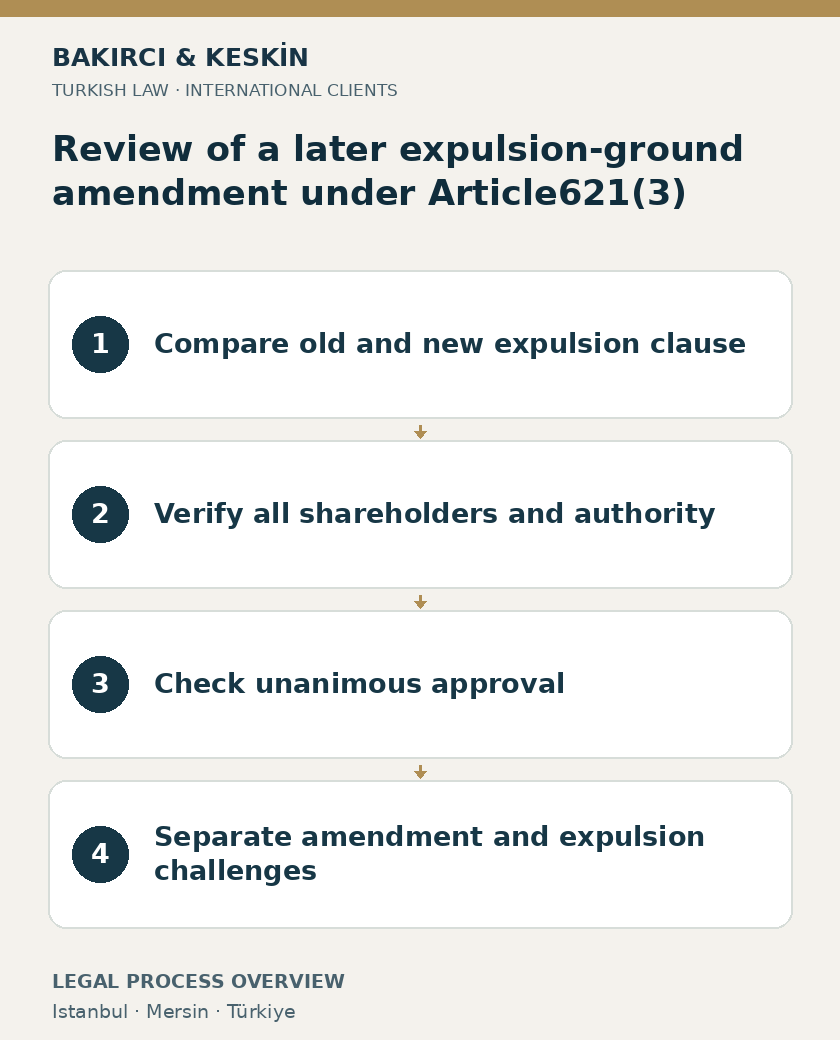
A Turkish limited company cannot add new grounds for expelling a shareholder using the ordinary amendment majority. Article 621(3) of the Turkish Commercial Code requires a unanimous decision at a general-assembly meeting of all shareholders representing the company’s capital. An overseas shareholder’s attendance, representation and actual vote therefore matter. Challenging the amendment and challenging a later expulsion decision are distinct tasks with different statutory starting points for the relevant annulment period.
Have a general question about this article? Ask anonymously
Quick summary
| Legal issue | A Turkish Limited Company Adds New Expulsion Grounds: Unanimity Under Article 621(3) |
|---|---|
| Short answer | A Turkish limited company cannot add new grounds for expelling a shareholder using the ordinary amendment majority. Article 621(3) of the Turkish Commercial Code requires a unanimous decision at a general-assembly meeting of all shareholders representing the company's capital. An overseas shareholder's attendance, representation and actual vote therefore matter. Challenging the amendment and challenging a later expulsion decision are distinct tasks with different statutory starting points for the relevant annulment period. |
| Key legislation | Law No. 6102 — Articles 445–450, 589, 614, 616–617, 620–622, 640, 1527; Law No. 6100 — Articles 389, 390 |
1. Identify what has been added to the company agreement
The first document comparison is between the operative company agreement before the disputed amendment and the wording adopted afterwards. Identify every added ground permitting the general assembly to expel a shareholder. Record the original clause number, the proposed replacement, the resolution date and the registered version. A heading described as a technical update does not answer whether the substance introduces a new basis for involuntary loss of membership.
Commercial Code No. 6102, Article 621(3), addresses grounds inserted subsequently into the company agreement. Article 640(1) supplies the underlying contractual-expulsion mechanism. Read the provisions together: the agreement defines the ground, and the special amendment rule governs its later introduction. The issue examined here is consent to that constitutional change, before considering whether a particular shareholder committed conduct falling within the resulting clause.
Keep other changes separate. A transfer restriction, a voluntary withdrawal right, a management qualification and a contractual expulsion ground can appear in the same amendment package but operate differently. A document giving a shareholder the right to leave does not necessarily give the company power to expel that shareholder. Classification must follow the operative Turkish wording and legal effect, rather than the English heading used in investment correspondence.
Where the amendment expands an existing clause, identify the substantive addition precisely. The comparison should expose the new conduct, condition or consequence said to permit expulsion. Do not assume that preserving the old article number makes the change immaterial. Equally, do not describe every spelling correction as a new expulsion ground. The pleading needs the actual before-and-after text and an explanation of the legal change asserted.
2. The ordinary amendment majority does not replace Article 621(3)
Article 589(1) provides the general company-agreement amendment rule and expressly preserves Article 621. Article 620 similarly makes the ordinary decision majority subject to contrary statutory or contractual provisions. Neither provision supplies a shortcut around the special protection for adding expulsion grounds. Citing an ordinary majority clause in the agreement does not establish that the statutory requirement for this particular amendment was satisfied.
Article 621(3) requires a unanimous decision in a general-assembly meeting of all shareholders representing the company’s capital. The enquiry therefore has two parts: whether the whole shareholder body was represented as required, and whether the amendment received unanimous approval. Unanimity among only the people who attended does not establish participation by all shareholders. An abstention also cannot simply be recorded as an affirmative vote.
Do not substitute Article 621(1)’s qualified majority for this rule. That paragraph governs the listed important decisions, including contractual expulsion itself under paragraph (h). Adopting a new contractual ground is a separate decision governed by paragraph (3). A later vote to apply the ground cannot establish that the earlier constitutional amendment was unanimously adopted. Keep the capital and voting records for each decision separately.
3. A shareholder abroad can be represented, but the authority must be proved
Article 617(3) permits each shareholder to be represented at the general assembly by a person who is or is not a shareholder. Physical residence abroad does not therefore prevent participation through a representative. Obtain the representation document actually used for the disputed meeting. Identify the shareholder represented, the appointed person, the scope of the authority and whether the document was valid for that meeting and decision.
For a foreign corporate shareholder, the authority chain must start with that legal entity. Preserve the corporate document showing who could appoint the representative and the instrument through which the appointment was made. A person employed by the overseas group is not necessarily authorised to vote for the shareholder. Group membership, an email signature or previous attendance does not by itself prove the authority relied upon for unanimous approval.
Separate authority to attend from the instructions concerning the proposed amendment. The court must be able to examine the document used externally and the disputed facts concerning its scope. Do not rewrite instructions retrospectively. Preserve the original instruction, its date and communication record, together with the version of the amendment sent to the representative. A later translation should make the distinction between authority and instructions intelligible without altering either document.
Electronic participation requires its own legal basis. Article 1527(2) recognises electronic general-assembly participation and voting for limited companies where provided in the company agreement, subject to the statutory framework. Paragraphs (3) and (4) prescribe technical and organisational conditions. A video call or an email confirming receipt of papers should not automatically be treated as a compliant electronic vote. Retain the actual participation and identification records.
4. Check the agenda and the decision method actually used
Article 617(2) normally requires a general-assembly invitation at least fifteen days before the meeting. The company agreement can extend the period or shorten it to ten days. Article 617(3) applies the joint-stock-company rules by analogy for matters including invitation, agenda, universal meetings, minutes and unauthorised participation. The invitation review must therefore consider the actual meeting route, rather than assume that every assembly follows identical notice mechanics.
Obtain the agenda and all versions of the proposed amendment supplied with it. Compare what was announced with what was voted upon. An overseas shareholder needs to know whether the dispute concerns absence, defective representation, an undisclosed addition or a vote attributed incorrectly. These are different factual propositions. A clear chronology prevents a general complaint about inadequate communication from concealing the specific failure affecting the proposed new expulsion ground.
Article 617(4) permits written decisions under its conditions, including submission of the same proposal to all shareholders and the absence of a shareholder request for oral deliberation. That general mechanism must be considered alongside Article 621(3)’s specific requirement for the amendment at issue. Circulating papers does not reduce unanimity to majority consent, and silence is not written approval. Do not declare the special rule satisfied merely because an administrator collected some signatures.
5. Test the record said to establish unanimous approval
The record should connect each shareholder to capital held, attendance or representation, and the actual vote on the exact text adopted. Check the attendance list against the shareholder records and proxies. Where a single representative acts for several shareholders, preserve each source of authority and the voting record attributed to each principal. A single signature on the minutes does not explain every underlying mandate.
A statement in the minutes that the resolution passed unanimously is evidence requiring examination alongside the supporting records. Identify any discrepancy: an absent shareholder, a missing proxy, a recorded abstention, an objection or different amendment versions. State the discrepancy factually. Allegations of forged signatures or altered minutes require their own evidential foundation and should not be used as substitutes for obtaining the original documents.
Article 616(1)(a) reserves amendment of the company agreement to the general assembly as a non-transferable power. A management decision cannot replace the required assembly decision merely because managers prepared or filed the amendment. Establish which body made each document. Instructions to a registry adviser, a manager’s implementation resolution and the shareholders’ amendment resolution should not be combined into one undifferentiated corporate approval.
6. Identify the challenged act before calculating a deadline
A resolution adding a new expulsion ground and a later resolution expelling a shareholder are separate acts. Article 622 applies the joint-stock-company rules on annulment and nullity by analogy. Article 445’s annulment rule uses three months from the decision date and identifies the commercial court at the company’s seat. That starting point must be considered for the amendment challenge; it should not be replaced automatically with a date of later discovery abroad.
Article 446 addresses who may seek annulment and the relevant participation or objection conditions. It distinguishes an attending shareholder’s negative vote and recorded opposition from the listed participation defects asserted to have influenced the decision. Preserve the actual meeting objection and proof of exclusion or defective invitation where relevant. The lawyer must connect standing and the pleaded ground to the applicable provision, not merely show disagreement with the commercial outcome.
Article 640(2) separately gives an expelled shareholder three months from notification of the expulsion decision through a notary. An amendment dispute should not be left unattended while waiting for that later notice. Conversely, contesting the amendment does not automatically replace the response required to a later expulsion decision. The wider Article 640 expulsion guide explains that separate procedure.
The legal classification of a resolution alleged to lack the required unanimity also requires attention. Annulment, nullity and non-existence should not be treated as interchangeable labels. Article 447 identifies nullity grounds, while Articles 445–446 govern annulment. Do not assume that describing a serious quorum defect removes every procedural deadline. Obtain advice promptly and frame the appropriate relief against the actual decision and evidence.
7. Registration and temporary protection require separate attention
Article 589(2) requires registration and publication of amendments to the company agreement. Obtain the filing, registered text and publication, then compare them with the resolution actually adopted. Registration records establish what was filed and made public; they do not substitute for the missing shareholder consent being disputed. A complaint about the filing must be coordinated with the legal route challenging the underlying resolution.
Filing proceedings does not itself establish that implementation has stopped. Through the Article 622 framework, Article 449 allows the court to postpone implementation of a challenged resolution after obtaining the management body’s views. Identify the amendment and the concrete implementation step requiring protection. A request should explain its connection to the disputed new ground and provide the relevant corporate documents.
Where general interim-measure provisions are relevant, Civil Procedure Code Articles 389–390 require the statutory danger, a defined request and approximate proof. Do not assume that an amendment dispute justifies disabling every company transaction. The protection sought should address the particular right and risk before the court. An order must then be followed through under its implementation, security and challenge requirements.
8. The unanimity rule does not abolish judicial expulsion for just cause
Article 640(3) preserves the company’s judicial-expulsion route for just cause. Contesting a newly inserted contractual ground does not make that separate statutory route disappear. A shareholder should identify whether management is invoking an agreement clause, bringing a court claim or attempting both. The defence and any temporary request must address the actual proceeding; a successful objection to one document does not decide every other claim.
The current consolidated Code records a material Constitutional Court ruling in footnotes 92 and 93. The decision of 25 December 2025, E.2025/128, K.2025/273, annulled Article 616(1)(h) and the judicial-application wording of Article 621(1)(h) insofar as they concern two-shareholder limited companies. A general statement that every such judicial application requires the unchanged assembly-authorisation majority would therefore be inaccurate.
That limited annulment must not be extended to a different rule. Article 621(3)’s unanimity requirement for subsequently adding contractual expulsion grounds remains in the current legislation reviewed on 26 October 2026. Article 640(3) still refers to the company’s request. This article does not treat the Constitutional Court ruling as permission for an individual shareholder to replace the company in every judicial-expulsion action.
9. Obtain a focused corporate evidence file from abroad
Request the original and amended agreements, the invitation and agenda, proposed texts, attendance list, proxies, signed minutes and registry filing. Add the foreign shareholder’s instructions and communications showing when documents were supplied. Preserve native electronic files alongside readable copies. The essential task is proving who approved which version and under what authority, rather than collecting every document generated by the business.
Article 614 provides the limited-company information and inspection framework. The shareholder information-rights guide explains the request, assembly and court stages. A document request does not automatically stop the amendment-annulment period. Counsel should assess the available proceedings and evidence-production mechanisms while the outstanding records are pursued, particularly where the shareholder first learned of the amendment after its registration.
10. Specify the corporate result sought
The requested outcome should identify the amendment challenged, the ground asserted and any consequential protection needed. A negotiated correction should specify the replacement wording and the corporate steps required to adopt and register it lawfully. An assurance that the clause will never be used leaves the registered text unresolved. Likewise, obtaining a corrected translation does not change an operative Turkish clause.
After a judicial determination, Article 450 addresses the effect of a final annulment or nullity judgment and its corporate registration. Implementation must follow the operative judgment and its legally effective status. Keep any separate expulsion, management or payment dispute visible in the file. Correcting the newly introduced clause should not be described as a judgment on issues that the court was not asked to decide.
Frequently asked questions
Can a majority add a new ground for expelling a shareholder?
Article 621(3) requires unanimity at the general-assembly meeting of all shareholders representing the capital. The ordinary amendment majority does not establish compliance with that special rule.
Is unanimity among shareholders who attended enough?
The statutory requirement concerns all shareholders representing the company’s capital. The attendance or representation record and the actual votes must both be checked; unanimity among only some shareholders is insufficient.
Can an overseas shareholder appoint a representative?
Article 617(3) permits representation by a shareholder or another person. The actual authority document and the foreign corporate shareholder’s authority chain must support the participation and vote relied upon.
Does a video call automatically count as electronic participation?
No. Article 1527 contains a statutory framework for electronic participation, including a company-agreement basis and technical conditions. Preserve the records showing the method actually used.
Is an email acknowledging documents an approval?
Acknowledging receipt and voting for an amendment are different acts. The text, authority and statutory decision method must establish the approval claimed; silence should not be recast as written consent.
When does the amendment-annulment period start?
Article 445’s annulment rule, applied through Article 622, uses three months from the decision date. The precise classification, claimant requirements and relief must be assessed promptly.
Does the later expulsion have the same starting date?
Article 640(2) provides a separate three-month period from notarial notification of the expulsion decision. The amendment and the later expulsion should be recorded and assessed as distinct decisions.
Does registration prove that all shareholders consented?
The registered amendment and publication are necessary evidence, but the claimed unanimous consent must be examined through the resolution, attendance, representation and voting records.
Did the Constitutional Court remove Article 621(3)?
No. The current Code records the limited two-shareholder-company annulment concerning judicial-expulsion authorisation in Articles 616(1)(h) and 621(1)(h). Article 621(3)’s later-insertion rule remains in force.
Does challenging the clause stop its implementation automatically?
Do not assume so. Postponement of implementation under Article 449 or another legally appropriate interim measure requires a separate application and court assessment.
Official legal sources
- Commercial Code No. 6102: Articles 445–450, 589, 614, 616–617, 620–622, 640 and 1527; consolidated footnotes 92–93.
- Civil Procedure Code No. 6100: Articles 389–390.
Legal review date: 26 October 2026. This original English explanation concerns the later introduction of expulsion grounds; the official Turkish legislation governs.
Contact information
Do not include confidential documents or identity numbers in an initial message. An enquiry does not establish representation or suspend any legal deadline.
Mersin physical office and Istanbul appointment information
Bakırcı & Keskin Law Office is Mersin-based. Its physical office is in Mersin; Istanbul contact details are for appointment coordination and do not identify a separately staffed physical office. Turkish matters are handled under the applicable jurisdiction and agreed mandate. The competent court and the scope of representation are assessed for each matter.
Istanbul — Polaris Plaza (appointment coordination only)
Maslak Ahi Evran Caddesi, Polaris Plaza No:21, Floor 9, 34475 Sarıyer/İstanbul, Türkiye.Istanbul location directions (confirm appointment availability before travelling)
Mersin — Profit İş Merkezi
İhsaniye Mahallesi, 4903. Sokak, Profit İş Merkezi No:23, Floor 3, Office 14, 33070 Akdeniz/Mersin, Türkiye.+90 552 224 43 66 · Contact details in English. An enquiry does not establish representation or suspend a legal deadline.
Istanbul Office – Polaris Plaza, Maslak / Sarıyer
Bakırcı & Keskin Hukuk Bürosu
Maslak Ahi Evran Caddesi, Polaris Plaza No:21, Kat:9, 34475 Sarıyer/İstanbul
Our physical offices in Istanbul and Mersin coordinate matters throughout Turkey, subject to jurisdiction and the local steps required for each case. Please specify your preferred office when arranging an in-person appointment.
Open the Istanbul office on Google Maps · Contact and appointments
Contact regarding a legal matter
In your first message, you may briefly state the subject, your country or city, and any relevant notification or recent procedural date. Please do not send identity numbers, medical data, or personal documents. Messaging alone does not constitute legal advice or create a lawyer–client relationship.
Discover more from Bakırcı & Keskin Hukuk Bürosu
Subscribe to get the latest posts sent to your email.