Excluding an Abusive Co-Owner from Turkish Property: Article 696, Voting and Share Value
A Turkish co-owner can be excluded by court judgment where serious breaches of obligations make continuation of the co-ownership intolerable for the other co-owners concerned. Civil Code Article 696 sets that demanding threshold and regulates how the excluded person’s share is dealt with. Unless otherwise agreed, bringing the claim requires a decision by a majority of both shares and co-owners. The majority cannot simply cancel another person’s title by a private vote.
Have a general question about this article? Ask anonymously
This guide concerns an overseas owner facing serious misconduct within shared ownership of Turkish property. It explains the evidence, decision to sue, valuation and possible outcomes, while distinguishing exclusion of a particular co-owner from ordinary disagreements or a general request to end shared ownership.
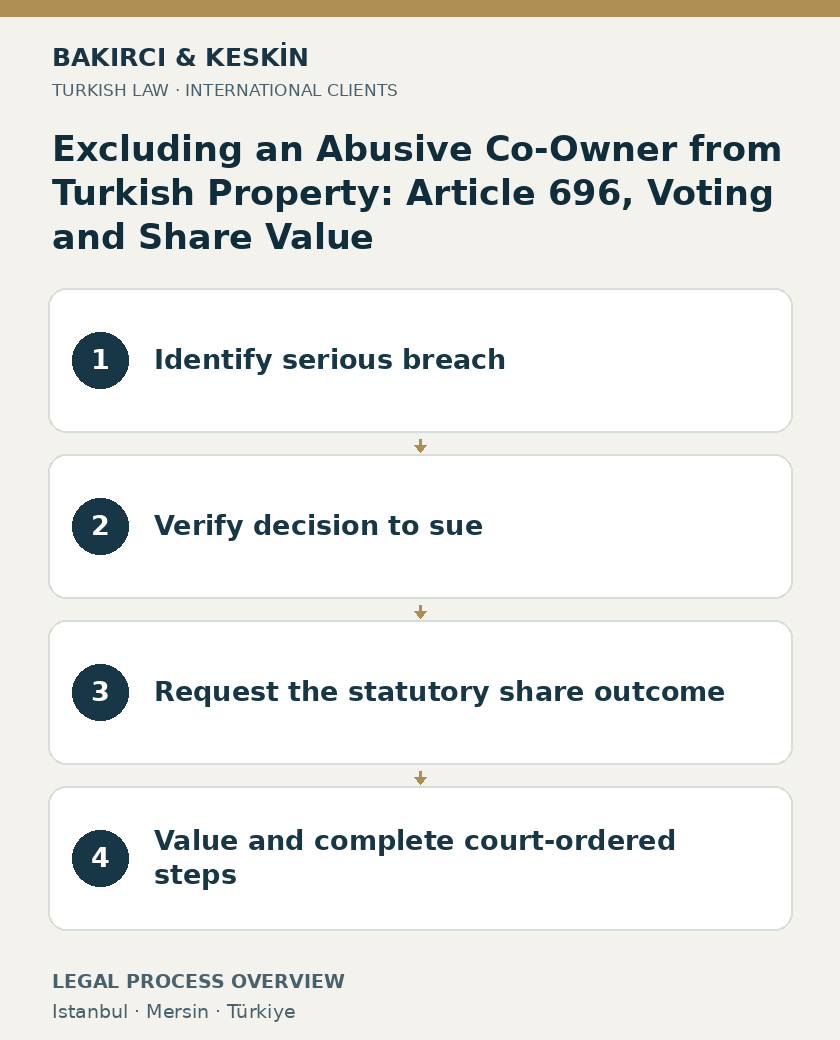
Quick summary
| Legal issue | Excluding an Abusive Co-Owner from Turkish Property: Article 696, Voting and Share Value |
|---|---|
| Short answer | A Turkish co-owner can be excluded by court judgment where serious breaches of obligations make continuation of the co-ownership intolerable for the other co-owners concerned. Civil Code Article 696 sets that demanding threshold and regulates how the excluded person's share is dealt with. Unless otherwise agreed, bringing the claim requires a decision by a majority of both shares and co-owners. The majority cannot simply cancel another person's title by a private vote. |
| Key legislation | Law No. 4721 — Articles 696-697; Law No. 6100 — Articles 12; Law No. 6325 — Articles 17/B(4), 17/B(6) |
Identify the legal form of ownership before selecting Article 696
Obtain the current land-register record and the legal basis of the shared ownership. Identify every co-owner and share. Shared ownership with determined shares, an undivided inheritance estate and ownership of separate condominium units are not interchangeable structures. A familiar English description such as “joint owner” does not answer which Turkish rules govern.
Article 696 is located within the Civil Code’s rules on ownership in shares. The legal analysis should confirm that the particular relationship falls within that framework before applying its voting and remedial provisions. A dispute with the owner of another independent apartment may engage a different statutory regime.
Read any co-ownership or use agreement and relevant court orders. They can explain obligations, agreed use and the decision-making arrangement. Preserve the complete document rather than relying on a summary that one owner supplied. The claim must be built on the actual legal relationship and conduct.
Understand the combined requirements of Article 696
Civil Code Article 696 concerns a co-owner who seriously breaches obligations owed to all or some of the other co-owners and thereby makes continuation of the co-ownership relationship intolerable for them. The seriousness of the breach and its effect on continuation both require examination.
A disagreement about preferences, a single inconvenience or the wish to purchase another person’s share does not itself establish that test. Identify the duty breached, the acts or omissions and their effect on the relationship. The court, not the majority acting privately, determines whether exclusion is justified.
A lawyer should distinguish this remedy from claims for payment, prevention of interference, regulation of use or dissolution of the shared ownership. The most severe remedy is not automatically the appropriate one for every dispute. The chosen claim should correspond to the proven conduct and the statutory conditions.
Examine conduct by the co-owner and persons using through them
Article 696 expressly includes the co-owner’s own behaviour, the behaviour of persons to whom the co-owner has left use of the property, and persons for whose acts the co-owner is responsible. The factual enquiry should therefore identify who did what and how their use or responsibility connects with the defendant.
Do not assume that every visitor’s conduct automatically satisfies the provision. Establish the relationship and the legal relevance of the acts. Where a tenant or another user is involved, obtain the agreement or other evidence showing how occupation was granted.
Record notices sent to the co-owner and the response. They may help explain knowledge, persistence and the effect of the behaviour, but should not be presented as creating an automatic exclusion right. Keep the actual events distinct from conclusions such as “unreasonable” or “impossible to deal with”.
Check both majorities before bringing the case
Unless otherwise agreed, Article 696 makes bringing the action dependent on a decision by a majority of shares and a majority of co-owners. These are two separate calculations. Holding more than half the shares does not, by itself, establish a majority of persons, and a majority of persons does not automatically hold the necessary shares.
Obtain an accurate ownership list at the relevant time and record the decision clearly. Identify who participated, their shares, the proposal decided and any authority used by representatives. A message saying that “most owners agree” should not replace the actual decision evidence.
Review any agreement modifying the decision rule and its legal effect. Do not assume that an informal past practice authorises disregard of the statute. The decision to sue also differs from the court’s final decision to exclude; satisfying the voting requirement does not prove the substantive misconduct.
Build a factual record of the alleged intolerability
Prepare a chronology of specific incidents and connect each one to the obligation allegedly breached. Use dated correspondence, official reports, photographs, management records and witness information where relevant. Identify the source of each statement and distinguish direct observation from hearsay.
Explain the practical impact on use of the property and continuation of the relationship. A file consisting only of insults exchanged between owners may show conflict without establishing the statutory threshold. The evidence should address the conduct relied on and why it makes continuation intolerable.
Include efforts to resolve the problem and the responses where relevant. Avoid manufacturing a history of warnings or omitting an agreement that permitted the disputed use. The electronic evidence guide explains preservation of complete messages rather than selected fragments stripped of context.
Understand the first statutory outcome: physical allocation
If the court finds exclusion justified, Article 696 first addresses whether a part corresponding to the excluded person’s share can be separated from the property. Where possible, the court allocates that separated part to the excluded co-owner, taking it out of the shared ownership relationship.
This is not confiscation. The provision seeks to resolve the intolerable relationship through the specified property consequences. Obtain technical information about whether physical separation is legally and practically possible. The statutory outcome cannot be selected solely from a private sketch that ignores land-use or subdivision restrictions.
Keep the question of justified exclusion separate from the feasibility of division. Strong evidence of misconduct does not establish that a parcel can lawfully be divided. Conversely, easy physical division does not prove the serious breach required to invoke the exclusion remedy.
Request transfer of the share at the correct procedural stage
Where physical separation is not possible, Article 696 permits co-owners who want the share transferred to them at its value on the date of the action to make that request together with the exclusion claim. The timing and content of the requested relief therefore matter.
Identify which claimant or claimants seek the share and in what manner. A later informal statement that somebody will purchase it should not be assumed to cure an omitted procedural request. The pleadings must reflect the intended outcome under the statutory route.
The defendant’s share should not be treated as a freely assignable reward for the claimants’ frustration. The provision requires the value-based process and the court’s decision. A majority resolution agreeing to take the share is not itself a title transfer and does not authorise changing the registry privately.
Prepare for the filing-date valuation and payment requirement
The relevant paragraph uses the share’s value at the date the action is brought. Obtain the information needed for a proper valuation of the particular property and share. A current asking price in an unrelated listing is not a complete substitute for that assessment.
Before judgment, the court sets an appropriate period for payment or deposit of the share value. The claimants seeking transfer should plan for this obligation. A wish to acquire the share without the means to satisfy the required payment does not resolve the statutory process.
Keep financing arrangements separate from the valuation evidence. State who will pay and how the court-ordered payment or deposit will be documented. Do not deduct unrelated claims from the amount unilaterally without a legal basis and the appropriate procedural treatment. Any separate monetary dispute requires its own analysis.
Understand when the residual sale route arises
If a corresponding part cannot be physically separated and no co-owner seeks the share, Article 696 provides that the court gives the defendant a period to transfer it. If it is not transferred within that period, the court orders sale by public auction under the relevant compulsory-enforcement realisation rules.
The provision concerns the excluded person’s share in that sequence. It should not be summarised as an automatic auction of the whole property whenever the owners disagree. Nor does filing the claim itself begin an immediate sale without the statutory and judicial steps.
Review the consequences for the remaining ownership relationship. A sale of the share can introduce a different co-owner; it does not necessarily produce sole ownership for the claimant. The desired commercial outcome and the legal outcome of the available remedy should be compared before proceedings are commenced.
Check the related rule for other holders of use rights
Article 697 applies the exclusion rules by analogy to holders of usufruct, another real right or an annotated personal right of enjoyment over a share. Where the right is not transferable, the provision allows termination against appropriate compensation.
This extension requires identification of the actual right and holder. An ordinary visitor, an informal guest and a holder of a registered or annotated right should not be treated as the same legal category. Obtain the underlying instrument and entry.
The remedy must match the right’s nature. A non-transferable right cannot be dealt with as though it were an ordinary saleable ownership share. The statutory compensation and termination questions require their own pleadings and assessment. Keep this related route separate from an eviction demand based on a different legal relationship.
Align the procedure with the property and relief
Code of Civil Procedure Article 12 supplies the territorial framework for specified immovable-property disputes. The correct court, parties and any applicable pre-action requirement must be determined for the actual claim. The claimant’s foreign address does not displace the legal significance of the property’s location.
If ongoing conduct threatens damage, supply the specific evidence needed to assess interim protection or another immediate remedy. Exclusion proceedings should not be treated as permission to change locks, cut utilities or physically prevent a co-owner from exercising rights before the appropriate legal decision.
Maintain separate accounts of property income, expenses and damage. Those matters can be relevant evidence but may also support separate claims. A clear pleading should explain which facts establish exclusion and which sums are claimed under another legal basis, avoiding an unexplained merger of every disagreement into one demand.
Prepare the overseas owner’s decision and authority
Provide the lawyer with the registry record, co-ownership agreement, decision to sue, incident chronology and supporting evidence. State whether the client seeks acquisition of the defendant’s share and can meet the valuation-based payment requirement. These are material instructions that should not be left until the final hearing.
Review any power of attorney for the intended proceedings and settlement. Authority to obtain records is not necessarily authority to purchase a share, accept a property allocation or release claims. The foreign power-of-attorney guide addresses preparation of property-related mandates.
A negotiated solution should specify the rights transferred, valuation, payment and completion steps. If the parties settle only the use dispute, make that limited scope clear. If they agree a share sale, complete the applicable legal establishment and registration procedure. An ordinary private settlement is not itself registered title. A qualifying property mediation agreement has the distinct route in Law No. 6325 Article 17/B(4) and (6): mandatory judicial enforceability endorsement followed by the registry’s statutory examination and registration without a separate official deed.
The owner should enter the process with a realistic understanding of Article 696: serious misconduct must be established, the decision to sue must be valid, and the share is dealt with through the statutory sequence and compensation rules. That framework protects the integrity of the ownership relationship while providing a remedy for conduct that meets the required threshold.
Prepare a decision pack that separates facts, votes and requested relief
The co-owners’ decision record should identify the property and the proposed claim with sufficient precision. Attach the current share information and explain how each majority was calculated. Preserve the actual responses and representative authority. Do not reconstruct a unanimous decision from silence or treat agreement to discuss the problem as a vote authorising litigation.
The factual annex should identify the incidents relied on without adopting insulting or inflammatory descriptions. Record the date, conduct, affected duty and supporting document. If conduct stopped after a warning, include that fact. If it continued, identify the later evidence. The court needs an accurate account of the relationship, not a collection edited solely to make one person appear objectionable.
Separate the decision to seek exclusion from a request to acquire the share. Article 696 gives the acquisition request a particular place in the claim. The clients should therefore decide whether they seek that outcome and understand the filing-date valuation and payment requirements. A decision pack that leaves this issue unanswered can create avoidable procedural and financial difficulty.
If several co-owners seek acquisition, record their instructions consistently and obtain advice on how the requested allocation should be pleaded. Do not assume that the ownership percentages they currently hold automatically determine every aspect of the proposed acquisition. The claim, funding and intended registry result should correspond to the actual request.
Maintain a separate account of any proposed settlement. A private offer to purchase the share may provide a practical route, but it is not the court’s exclusion judgment and does not prove the statutory threshold. The offer should state price, payment and official transfer steps without coercive measures such as withholding access or utilities. An overseas co-owner can then compare the negotiated transaction with the legal consequences of continuing the case on a properly informed basis.
Check whether the registry has changed before the action is filed and when a settlement is prepared. A share transfer or succession event can affect the ownership list, representation and proposed result. Record the source and date of the updated information. Do not continue calculating the majority from an obsolete list merely because it was correct when discussions began. The legal review should use the ownership position relevant to the procedural act being taken.
Frequently asked questions
Can a majority vote remove a co-owner’s title?
No. Article 696 requires a court decision. The majority decision concerns bringing the claim.
Are both persons and shares counted?
Yes. Unless otherwise agreed, the provision requires a majority of both co-owners and shares.
Is every disagreement enough for exclusion?
No. Serious breach and resulting intolerability of continuation are required.
Can conduct by a person allowed to use the property matter?
Article 696 expressly addresses specified persons using through the co-owner or whose acts the co-owner is responsible for.
Does the excluded owner lose the share without compensation?
No. The statute provides a sequence involving physical allocation, value-based transfer or the specified sale route.
When should a claimant request transfer of the share?
The request described in Article 696 must be made together with the exclusion claim.
Which valuation date does the provision use?
It refers to the share’s value at the date the action is brought.
Does the court automatically auction the entire property?
No. Article 696’s residual route concerns the excluded share under the conditions and sequence stated there.
Can Article 697 affect a usufruct holder?
It extends the rules by analogy to the specified holders of rights over a share, with a special compensation rule for non-transferable rights.
What should an overseas co-owner prepare?
The title record, relevant agreements, valid decision to sue, evidence of the conduct and clear instructions about the desired statutory outcome.
Official legal sources
Civil Code No. 4721, Articles 696–697; Code of Civil Procedure No. 6100, Article 12. Source review: 26 October 2026. The ownership structure, decision rule, proven conduct and requested relief require individual assessment.
Contact information
Do not include confidential documents or identity numbers in an initial message. An enquiry does not establish representation or suspend any legal deadline.
Mersin physical office and Istanbul appointment information
Bakırcı & Keskin Law Office is Mersin-based. Its physical office is in Mersin; Istanbul contact details are for appointment coordination and do not identify a separately staffed physical office. Turkish matters are handled under the applicable jurisdiction and agreed mandate. The competent court and the scope of representation are assessed for each matter.
Istanbul — Polaris Plaza (appointment coordination only)
Maslak Ahi Evran Caddesi, Polaris Plaza No:21, Floor 9, 34475 Sarıyer/İstanbul, Türkiye.Istanbul location directions (confirm appointment availability before travelling)
Mersin — Profit İş Merkezi
İhsaniye Mahallesi, 4903. Sokak, Profit İş Merkezi No:23, Floor 3, Office 14, 33070 Akdeniz/Mersin, Türkiye.+90 552 224 43 66 · Contact details in English. An enquiry does not establish representation or suspend a legal deadline.
Istanbul Office – Polaris Plaza, Maslak / Sarıyer
Bakırcı & Keskin Hukuk Bürosu
Maslak Ahi Evran Caddesi, Polaris Plaza No:21, Kat:9, 34475 Sarıyer/İstanbul
Our physical offices in Istanbul and Mersin coordinate matters throughout Turkey, subject to jurisdiction and the local steps required for each case. Please specify your preferred office when arranging an in-person appointment.
Open the Istanbul office on Google Maps · Contact and appointments
Contact regarding a legal matter
In your first message, you may briefly state the subject, your country or city, and any relevant notification or recent procedural date. Please do not send identity numbers, medical data, or personal documents. Messaging alone does not constitute legal advice or create a lawyer–client relationship.
Discover more from Bakırcı & Keskin Hukuk Bürosu
Subscribe to get the latest posts sent to your email.