An Attached Inheritance Share in Turkey: Trustee Appointment and Partition
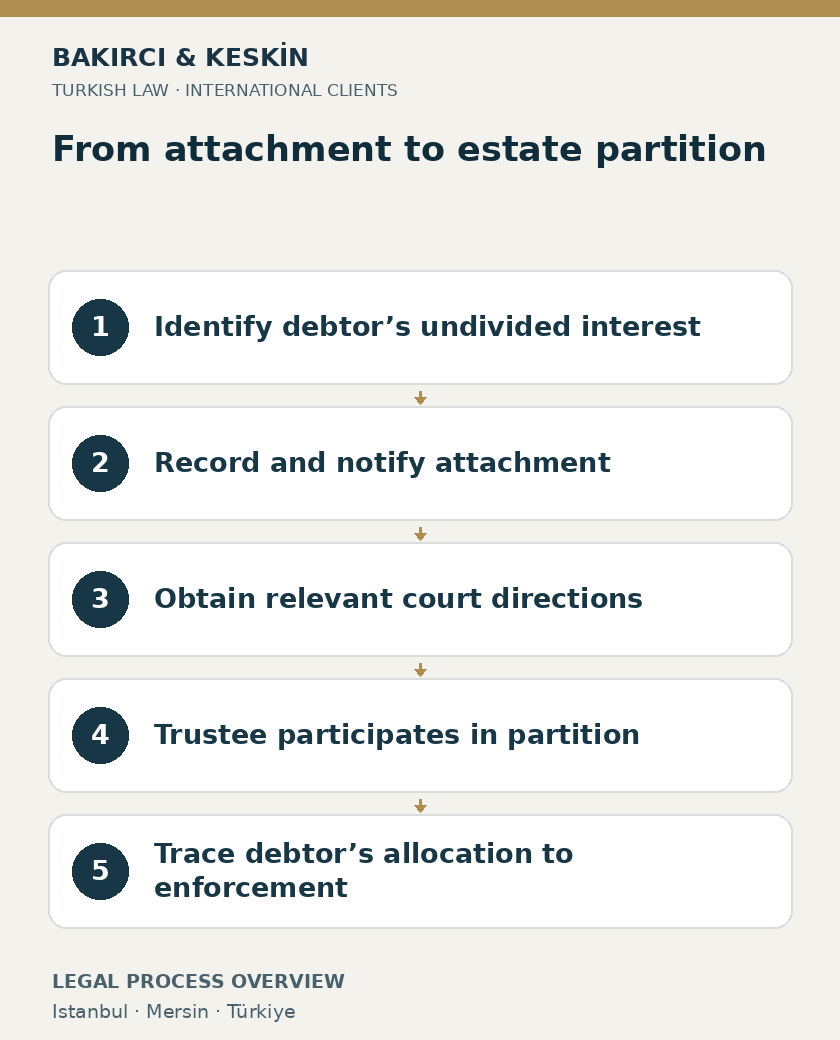
Short answer: Attachment of one heir’s interest in an undivided Turkish estate does not make the creditor owner of the entire estate or of the other heirs’ interests. Civil Code Article 648 allows specified persons, including a creditor who has attached the heir’s share, to request appointment of a trustee to participate in partition in that heir’s place. Enforcement and Bankruptcy Law Articles 94 and 121 separately address attachment of undivided interests and the route for determining how such interests are realised. The attachment, trustee appointment and partition are distinct steps that must be coordinated.
Have a general question about this article? Ask anonymously
Quick summary
| Legal issue | An Attached Inheritance Share in Turkey: Trustee Appointment and Partition |
|---|---|
| Short answer | Attachment of one heir's interest in an undivided Turkish estate does not make the creditor owner of the entire estate or of the other heirs' interests. Civil Code Article 648 allows specified persons, including a creditor who has attached the heir's share, to request appointment of a trustee to participate in partition in that heir's place. Enforcement and Bankruptcy Law Articles 94 and 121 separately address attachment of undivided interests and the route for determining how such interests are realised. The attachment, trustee appointment and partition are distinct steps that must be coordinated. |
| Key legislation | Law No. 4721 — Articles 617, 640, 642, 646, 648; Law No. 2004 — Articles 94, 121; Law No. 5718 — Articles 20, 50, 54, 58 |
An undivided inheritance interest is not a separately owned room or parcel
Under Civil Code Article 640, several heirs form a community covering the estate’s rights and obligations until partition. The heirs hold the estate in undivided community ownership and, subject to lawful representation or management powers, act together concerning estate rights. One heir’s fractional entitlement should not be mistaken for sole ownership of a physically identified part of every asset.
This distinction affects what a creditor attaches. Identify the debtor’s heirship, share, estate and the interest described in the attachment record. A creditor’s personal claim against one heir does not turn into a debt owed by all the heirs merely because the debtor has inherited property. Likewise, an attachment cannot be described as reaching another heir’s independent property without a separate legal basis.
The community-of-heirs guide explains the starting ownership structure. The present issue is how an individual heir’s creditor participates in the process that converts that undivided interest into an identifiable distribution. The attachment and later partition documents must describe the interest consistently.
Article 94 addresses notification and protection of the attached interest
Enforcement and Bankruptcy Law Article 94 expressly refers to an undivided inheritance and interests in property held jointly. It requires the enforcement office to notify relevant third persons whose domiciles are known when such an interest is attached. Where the debtor’s eventual liquidation share in a specific immovable is attached, the enforcement officer notifies the land registry to record the attachment annotation.
Obtain the actual attachment order and notifications. A creditor’s assertion that “the inheritance has been seized” is not an adequate description of the legal act. Check the debtor, claim, estate interest, affected property and the records to which notice has been given. An annotation in a title record must be interpreted according to the right it records, rather than assumed to prohibit every possible step concerning the whole estate.
The attachment stage protects the creditor’s asserted enforcement position but does not by itself determine the final amount available. The debtor’s share, the estate’s debts, the validity of competing rights and the outcome of partition can affect recovery. Keep these questions distinct from whether the enforcement office has properly taken and notified the attachment measure.
Article 648 provides participation in partition through a trustee
Civil Code Article 648 addresses a creditor who has acquired or attached an heir’s share in an opened succession, or holds a certificate of insolvency against the heir, within the wording of the provision. It allows an application to the Civil Court of Peace for appointment of a trustee to participate in partition in the heir’s place. The appointment supplies a legally defined participation route; the creditor does not simply assume the heir’s identity.
The application should identify the statutory basis relied on. Where it is attachment, provide the enforcement records showing the relevant interest. Where another category is invoked, supply the documents supporting that category. The court must be able to connect the applicant, debtor heir and opened succession. A prospective inheritance while the owner is still alive is not the opened inheritance described by Article 648.
Read the appointment order for the trustee’s role and scope. A trustee appointed to participate in partition is not automatically the general administrator of every estate asset or the personal representative of all heirs. The particular appointment must be coordinated with any existing estate representative, executor or official administration. Overlapping labels should not conceal different functions and decision-making powers.
Article 121 concerns how the attached interest is realised
Article 121 of the Enforcement and Bankruptcy Law applies where interests such as an usufruct, undivided inheritance or jointly held property interest need to be sold under the circumstances it describes. The enforcement officer asks the enforcement court how the sale is to be carried out. After inviting interested persons with known domiciles and hearing those who attend, the court can order an auction, appoint an officer for the sale or take another appropriate measure.
This is distinct from the Civil Court of Peace’s Article 648 trustee appointment. Both provisions can be relevant to a creditor’s overall route, but one order should not be assumed to replace every function of the other. Identify what the enforcement file requires, what the court has actually authorised and how any partition proceeding fits within that direction.
Do not promise that every attached inheritance share will be sold directly in one standard manner. The statutory provision places the method before the enforcement court. The actual order and the nature of the interest matter. Equally, the need for judicial direction should not be treated as a reason to leave the file dormant; the responsible party should identify the next required request and monitor the resulting decision.
Other heirs retain their own rights and must be represented correctly
The personal debt of one heir does not erase the other heirs’ entitlements. Their identity, shares, estate claims and participation in the partition must remain accurate. A creditor cannot solve a debtor’s collection problem by treating the entire inherited apartment as if it belonged exclusively to that debtor. The legal route reaches the relevant interest through the applicable ownership and partition rules.
At the same time, the other heirs should not assume that their disagreement prevents any lawful partition forever. Article 642 generally permits an heir to seek partition unless continued community ownership is required by contract or law, and it regulates partition in kind or sale and the potential postponement where immediate partition would substantially diminish value. The creditor-related route must be coordinated with that framework and the relevant orders.
Any proposed settlement must identify whose rights it changes and who has authority to agree. A relative negotiating informally cannot bind every co-heir merely because they collected the estate papers. Where a trustee has been appointed, the trustee’s statutory role and the court’s directions require attention. Keep settlement discussions, valid consent and completed legal acts separately documented.
An unregistered inherited right does not necessarily escape the creditor route
Article 94 also addresses ownership and other real rights acquired through an inheritance not rejected by the debtor, or another cause, but not yet registered in the land or ship register. It allows the creditor to request registration in the debtor’s name and provides for the enforcement office to notify the relevant registry and, where necessary, the court that the creditor can pursue the transaction.
This provision prevents the analysis from stopping at the observation that the deceased’s name remains on the title. The creditor must nevertheless establish the actual inherited right and use the prescribed process. The statute does not authorise a creditor to invent heirship, disregard a valid rejection or rewrite the shares. Obtain the relevant certificates and records before advancing a registration request.
Distinguish this inherited-right route from other acquisition grounds also addressed within Article 94. Different parts of the article concern different rights and steps. A time requirement stated for another registration situation should not be copied indiscriminately into the inheritance application. The request should specify the paragraph and factual situation being relied on.
Resolve the estate’s composition before treating a share as sale proceeds
A partition process requires reliable information about what the estate actually contains. Identify land, bank claims, company interests, movable assets and obligations. Verify the deceased’s ownership rather than including property merely used by the family. A disputed inheritance certificate, missing will or unresolved successive death can affect who participates and the extent of each interest.
Article 646 requires heirs holding estate property or owing money to the deceased to provide complete information in the partition. The disclosure helps establish the assets and claims available for allocation. It is also important where one heir has received rental income or used common property. Those matters must be supported with records and analysed under the relevant rights, not simply deducted from a share without an agreed or adjudicated basis.
The inheritance-partition guide covers the general division mechanisms. An attached interest adds the need to preserve the creditor’s legally established position through those mechanisms. The partition should not be treated as an opportunity to replace an attached valuable entitlement with an unexplained nominal allocation.
Use consistent valuation assumptions when comparing proposed allocations. Record the valuation date, existing mortgages, occupancy and any dispute affecting the asset. Otherwise, two allocations described as equal can rest on different assumptions about liabilities or possession. The trustee and other participants need enough information to assess the distribution actually proposed, rather than comparing headline figures that measure different things.
Track what is allocated to the debtor and how enforcement reaches it
The practical collection question is what property or money is allocated to the debtor heir through the legally effective process. Keep the allocation decision or agreement, valuation evidence, sale records and distribution account together. The creditor’s recovery depends on the resulting rights and the enforcement rules, not merely on a theoretical fraction of the estate’s gross value.
Estate debts and burdens require separate attention. A personal creditor of an heir should not assume priority over every obligation affecting estate property. Conversely, an alleged estate debt should be substantiated rather than accepted as an unexplained deduction that exhausts the debtor’s entitlement. The relevant priority and payment issues must be determined from the actual claims, securities and procedural records.
If money has been paid out, establish the recipient, amount, date and legal basis. If a property has been allocated, check its registration and burdens. A partition order and successful collection are different outcomes. The final report to the creditor or heir should state which event has occurred, what remains to be done and what evidence confirms the current position.
Prepare an application file that connects enforcement and succession
The core documents are the creditor’s enforcement file, the attachment record, notices, relevant title entries, heirship evidence, the death record and information about any existing partition or estate-administration case. Add the insolvency certificate or assignment instrument if that is the Article 648 basis being relied on. A document index should show which item proves each required link.
Verify the identities and addresses of the other interested persons. Article 121 expressly refers to inviting persons whose domiciles are known; an incomplete contact list can create practical difficulties in progressing the application. Where a person has died or their name has changed, update the documentary chain. Do not carry an outdated party list from an older estate document into a new proceeding without review.
Keep the requested orders distinct: attachment-related steps in enforcement, direction concerning realisation, appointment of a partition trustee and the substantive partition process. The court and enforcement office should each be asked to perform the function within their authority. Clear separation in the file prevents an order granted for one purpose from being misrepresented as authority for another.
International connections require coordination, not assumptions
Where execution in Turkey is sought on the basis of a foreign civil judgment, Law No. 5718 Article 50 requires a Turkish enforcement judgment for a decision final under the originating state’s law. Article 54 sets the enforcement conditions. Establish the legal effect being requested: executing the foreign judgment against the debtor is different from producing a foreign record to explain the family relationship. A foreign collection order and the Turkish enforcement file must not be treated as interchangeable documents merely because they identify the same debtor and amount.
Recognition also has a distinct function. Article 58 concerns accepting a foreign judgment as conclusive evidence or res judicata and excludes Article 54(1)(a)’s reciprocity condition from recognition. That distinction matters when a foreign judicial determination is relied on within a Turkish inheritance dispute without seeking execution of its operative order. Identify the finding relied on and the specific effect sought. A translation or authentication establishes neither recognition nor enforcement by itself; it addresses the document’s use, rather than deciding every legal effect asserted for it.
Code of Civil Procedure Articles 223 and 224 separately address translation of foreign-language evidence and authentication of foreign official documents, with treaty provisions preserved. Keep the original document, its complete translation and the relevant authentication together. Explain differing spellings of the debtor’s name, the deceased’s identity and any later change of name through the supporting records. These connections are particularly significant where the foreign debt judgment uses one identity description and the Turkish inheritance certificate uses another. The documents must establish the connection; a representative should not silently alter a name in the translation to make the records appear consistent.
An overseas creditor’s judgment, a foreign heirship document and the nationality of the deceased raise different issues under Law No. 5718. Article 20 supplies the succession conflicts framework; the recognition or enforcement of a foreign judgment requires its own statutory analysis. A foreign order should not be assumed to authorise a Turkish enforcement office directly without examining the effect required in Turkey.
Where heirs reside abroad, arrange representation and lawful service or notification using the correct documents. Translations and authentication should be prepared for the specific intended use. Coordinate the Turkish enforcement and estate records so that a change in one file reaches the other. A creditor’s representative and the family representative should not work from inconsistent versions of the same inheritance certificate.
Bakırcı & Keskin Law Office assists overseas creditors and heirs through Istanbul and Mersin, with Mersin-based services throughout Turkey. The key is to establish the attached interest accurately, obtain the appropriate judicial directions and follow the value through partition to the enforceable result. Attachment is the beginning of that legal route, not proof that the creditor has acquired the entire estate.
Frequently asked questions
Does attachment make the creditor a co-heir?
No. It establishes an enforcement position over the relevant interest. Article 648 provides a distinct route through a trustee participating in partition.
Can the creditor take the other heirs’ shares for one heir’s debt?
The personal debt and attached interest must be identified correctly. Other heirs’ independent rights do not disappear because one heir is indebted.
Which court appoints the Article 648 trustee?
The provision names the Civil Court of Peace. The application must establish the statutory category relied on.
What does the Article 648 trustee do?
The trustee participates in partition in the relevant heir’s place. The appointment should not be treated as unrestricted administration of the whole estate.
Who decides how an undivided interest is realised?
Article 121 directs the enforcement officer to seek the enforcement court’s determination for the interests covered by that provision.
Does an unchanged title in the deceased’s name prevent all action?
Not necessarily. Article 94 provides a route concerning inherited rights acquired but not yet registered, subject to its conditions and procedure.
Can the creditor ignore a valid inheritance rejection?
No. The existence of the debtor’s inherited right must be established. A challenge to rejection has a distinct legal basis, including Article 617 where applicable.
Can an expected inheritance be treated as an opened estate share?
No. Article 648 refers to an opened inheritance. A future expectation while the owner is alive is a different position.
Does the estate’s gross value equal the creditor’s recovery?
No. Ownership, liabilities, burdens, the debtor’s share and the resulting allocation must all be established.
Which records should be checked at the end?
Check the partition or allocation, title or payment records, relevant burdens and the enforcement file to verify what has actually been recovered.
Official legal sources
- Law No. 4721 — Articles 617, 640, 642, 646, 648
- Law No. 2004 — Articles 94, 121
- Law No. 5718 — Articles 20, 50, 54, 58
- Law No. 6100 — Articles 223, 224
Recorded primary-source check dates: 26 October 2026. The official Turkish legislation controls. A new publication-date check is still required.
Contact information
Do not include confidential documents or identity numbers in an initial message. An enquiry does not establish representation or suspend any legal deadline.
Mersin physical office and Istanbul appointment information
Bakırcı & Keskin Law Office is Mersin-based. Its physical office is in Mersin; Istanbul contact details are for appointment coordination and do not identify a separately staffed physical office. Turkish matters are handled under the applicable jurisdiction and agreed mandate. The competent court and the scope of representation are assessed for each matter.
Istanbul — Polaris Plaza (appointment coordination only)
Maslak Ahi Evran Caddesi, Polaris Plaza No:21, Floor 9, 34475 Sarıyer/İstanbul, Türkiye.Istanbul location directions (confirm appointment availability before travelling)
Mersin — Profit İş Merkezi
İhsaniye Mahallesi, 4903. Sokak, Profit İş Merkezi No:23, Floor 3, Office 14, 33070 Akdeniz/Mersin, Türkiye.+90 552 224 43 66 · Contact details in English. An enquiry does not establish representation or suspend a legal deadline.
Istanbul Office – Polaris Plaza, Maslak / Sarıyer
Bakırcı & Keskin Hukuk Bürosu
Maslak Ahi Evran Caddesi, Polaris Plaza No:21, Kat:9, 34475 Sarıyer/İstanbul
Our physical offices in Istanbul and Mersin coordinate matters throughout Turkey, subject to jurisdiction and the local steps required for each case. Please specify your preferred office when arranging an in-person appointment.
Open the Istanbul office on Google Maps · Contact and appointments
Contact regarding a legal matter
In your first message, you may briefly state the subject, your country or city, and any relevant notification or recent procedural date. Please do not send identity numbers, medical data, or personal documents. Messaging alone does not constitute legal advice or create a lawyer–client relationship.
Discover more from Bakırcı & Keskin Hukuk Bürosu
Subscribe to get the latest posts sent to your email.