A Neighbour’s Building Crosses Your Turkish Boundary: Article 725 and the Fifteen-Day Objection
A neighbour’s building crossing onto your Turkish parcel raises a boundary, ownership and remedial question; a building permit does not by itself answer it. Civil Code Article 725 regulates an encroaching structure. Where no supporting servitude exists, its special protection for a good-faith builder depends on cumulative conditions, including the injured owner’s failure to object within fifteen days after learning of the encroachment and circumstances justifying the result. Article 683 separately protects ownership against unlawful interference.
Have a general question about this article? Ask anonymously
For an owner living overseas, the immediate priorities are reliable measurement, preservation of the discovery date and prompt legal assessment of an objection. The fifteen-day wording should not be mistaken for a universal period after which the neighbour automatically owns part of the land.
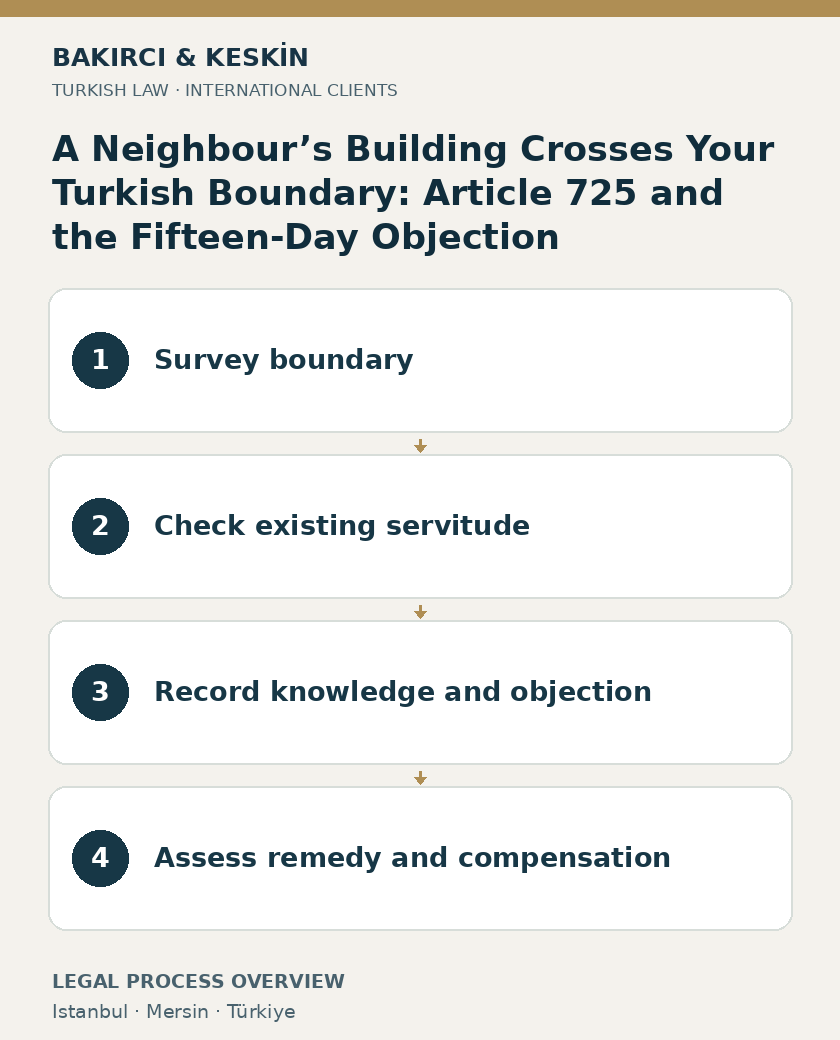
Quick summary
| Legal issue | A Neighbour’s Building Crosses Your Turkish Boundary: Article 725 and the Fifteen-Day Objection |
|---|---|
| Short answer | A neighbour's building crossing onto your Turkish parcel raises a boundary, ownership and remedial question; a building permit does not by itself answer it. Civil Code Article 725 regulates an encroaching structure. Where no supporting servitude exists, its special protection for a good-faith builder depends on cumulative conditions, including the injured owner's failure to object within fifteen days after learning of the encroachment and circumstances justifying the result. Article 683 separately protects ownership against unlawful interference. |
| Key legislation | Law No. 4721 — Articles 683, 725, 739, 780-781; Law No. 6100 — Articles 389-399, 400-406; Law No. 6325 — Articles 18/B(1)(ç) |
Identify what actually crosses the parcel line
Determine whether the dispute concerns a wall, foundation, roof projection, balcony or another structural component. Measure the relevant part and its relationship to the parcel. A photograph can show the appearance of a structure but usually cannot establish a legal boundary on its own. Obtain a survey tied to the cadastral record.
Distinguish a structure physically crossing the boundary from a structure standing entirely on the neighbour’s land but causing noise, vibration, loss of support or another interference. These problems can overlap, but their legal bases differ. An Article 725 analysis should identify the encroaching structure rather than use “encroachment” as a general label for every neighbourhood disagreement.
Record whether construction is proposed, ongoing or complete. Preserve the earliest available site records without pretending that an undated photograph proves the date of completion. The construction stage affects the practical measures available and the urgency of preventing further work.
Establish the boundary using official and technical records
Obtain the current title information and cadastral plan for both properties. Confirm the correct block and parcel numbers, including any subdivision or consolidation. The fence on the ground may not coincide with the legal line. A longstanding informal garden arrangement should not be treated automatically as a cadastral determination.
Ask the technical professional to explain the measurement method, reference points and extent of the alleged crossing. Keep the measured plan with the photographs and official records. A report should distinguish a measurement uncertainty from a confirmed intrusion. Where records conflict, identify the conflict and the procedure required to resolve it.
Civil Code Article 683 gives the owner a claim against unlawful possession and interference within the legal framework. Establishing the claimant’s ownership and the area interfered with is therefore foundational. A demand to remove a structure should be supported by a defensible description of where that structure stands.
Check whether an existing servitude authorises the structure
Article 725 first addresses a structure extending onto another person’s land where the builder has a servitude over the affected land. In that situation, the provision treats the encroaching part as a component of the builder’s property. Obtain the relevant registration and instrument before assuming that the visible crossing is necessarily unauthorised.
Read the scope of any right. A passage right, utility right or informal permission to enter for repairs does not automatically authorise a permanent building extension. Compare the registered right with the actual structure and the part of the land used. The legal question concerns the particular entitlement, not merely whether some servitude appears in the register.
Articles 780 and 781 address registration and official form for establishment of a servitude. If the neighbour relies on a private understanding, the lawyer must assess its legal effect rather than accept it as equivalent to a registered real right. Keep all correspondence about permission and its stated limits.
Understand the fifteen-day wording without overstating it
In the absence of the relevant servitude, Article 725 addresses a special claim by a builder who acted in good faith. One condition is that the injured owner did not object within fifteen days after learning of the encroachment. Preserve the actual discovery circumstances: the message received, inspection, survey or other event through which the owner learned what had happened.
The provision does not say that every boundary claim disappears after fifteen days or that ownership transfers automatically on the sixteenth day. The builder’s good faith and the circumstances justifying the requested result also matter, as does the appropriate legal process. Avoid treating one condition as though it were the entire rule.
Nevertheless, an owner should not postpone legal review while gathering an unnecessarily elaborate file. Supply the evidence available immediately and arrange an appropriate, provable objection with legal assistance. A request for clarification and an unequivocal objection can carry different meanings. Keep the complete notice and proof of its communication.
Examine good faith at the relevant stage of construction
Good faith is a legal requirement, not a courtesy description of the neighbour. Gather the records showing the builder’s knowledge of the boundary, the survey obtained before work, any objections and the approved design. Identify whether the problem was apparent, disputed or brought to the builder’s attention.
A construction company may rely on information from a designer or surveyor, but the consequences require examination of the actual responsibilities and facts. Do not conclude that professional involvement automatically proves or disproves good faith. Similarly, an owner’s absence abroad does not establish that the builder was entitled to proceed.
Preserve evidence of changes after an objection. Continuing a structure after receiving a clear boundary warning is a fact that should be recorded accurately. Avoid altering timestamps or selecting only favourable fragments. The court must assess the real sequence and the statutory conditions of the right asserted.
Distinguish the available remedies and their consequences
Article 725 allows a qualifying good-faith builder to request establishment of a servitude for the encroaching part or transfer of ownership of the affected land, in return for appropriate compensation. The statutory conditions must be satisfied. The provision is not a general licence to buy a neighbour’s land by building on it first.
The owner’s claim to prevent unlawful interference and the builder’s special claim should be considered together where both arise. A lawyer must identify the requested relief, the relevant parties and the evidence supporting or opposing each route. A court’s assessment of compensation or property transfer cannot be replaced by a unilateral payment offered by the builder.
Removal also involves technical consequences. Identify whether the affected component can be removed safely and what works would restore the boundary position. Do not begin demolition yourself on the assumption that ownership permits unrestricted action. The legal order and technical execution must address safety, third-party rights and the precise structure concerned.
Keep construction permission separate from private property rights
A municipality’s construction permit concerns its statutory approval process. It should not be treated as a private deed granting ownership of the neighbour’s land. Obtain the permit and approved project to see what was authorised and whether the constructed work conforms to it, but continue the independent title and boundary analysis.
Civil Code Article 739 recognises that special legislation governs excavation and construction rules. Municipal enforcement and civil claims can therefore address different aspects of the same work. A complaint to the municipality does not automatically secure the private-law remedy or preserve every procedural deadline.
Mediation Law No. 6325 Article 18/B(1)(ç) makes an application to mediation a condition before bringing proceedings arising from neighbour rights. Classify the proposed claim accurately: a neighbour-right remedy, a title dispute and correction of a cadastral boundary are not interchangeable labels. Where the statutory condition applies, retain the final mediation record for the action. A municipal complaint and private negotiation do not themselves replace that process.
The occupancy permit guide explains the distinction between building-use approval and ownership. In an encroachment case, neither an electricity connection nor an occupancy document should be presented as conclusive evidence that the builder owns the disputed strip.
Preserve evidence before the work changes
Photograph the relevant structure from lawful locations and record the date, location and photographer. Include a wider view linking the disputed part to the building, followed by detailed images. Keep original files. A close-up without its location can be difficult to connect to the parcel later.
Obtain an independent technical account of the crossing, construction stage and any associated damage. If further work will conceal foundations or other critical evidence, discuss court preservation of evidence under Code of Civil Procedure Articles 400–406. The statutory need for preservation must be assessed; a report is not automatically a final merits decision.
Retain earlier surveys, purchase documents and correspondence with previous owners. They may explain the historic boundary and prior permissions. Do not assume that a recent buyer has personal knowledge of every earlier arrangement. Separate what the client observed from what another person reported.
Identify the relevant owners and other affected persons
Verify the registered owners of the affected parcels and the person responsible for construction. The neighbour occupying the building may be a tenant, contractor or purchaser awaiting transfer. The parties to a claim should match the ownership and relief requested, rather than whichever person first answered a telephone call.
If either parcel is co-owned, obtain the shares and any relevant management arrangements. A permission given by one person may raise questions about the authority to bind others. Likewise, an agreement affecting a registered mortgage or servitude requires consideration of that right holder’s position.
Keep a record of transfers occurring during the dispute. A change in ownership does not make the documentary history irrelevant, but it can affect who must participate in proceedings and what rights are asserted. Provide updated registry information when the legal strategy is reviewed.
Consider proportionate protection while the case is examined
If ongoing work threatens to enlarge the intrusion or destroy evidence, identify the exact activity and risk. Court protection under the relevant interim-measure rules requires an evidential and legal basis. The requested order should describe the disputed area and act with enough precision to be understood and implemented.
Keep emergency safety concerns separate from the ordinary boundary disagreement. A dangerous structure may require immediate notification of the competent authority and qualified technical assistance. The owner should not enter an unsafe excavation or interfere with works to obtain photographs.
Preserve records of official notifications and responses. A statement that a complaint was made is less useful than the dated submission and reference number. The evidence-preservation guide explains why repairs and protective works should be documented before they alter the condition being investigated.
Make an agreed boundary solution legally effective
Negotiation may produce removal, redesign or a compensated right, but the chosen solution must be capable of lawful implementation. A private sketch and payment receipt should not be assumed to create a registered servitude or transfer land. The official form, registration, technical requirements and any restrictions on subdivision or acquisition must be checked.
Describe the exact structure, area, permitted use and maintenance responsibility. State whether access for inspection or repair is included and who bears the agreed cost. A vague permission to “keep the existing arrangement” can create future disagreement about extensions, replacement construction and access.
Coordinate payment with the agreed legal and physical steps. If removal is promised, identify completion evidence and restoration work. If a right is established, obtain the completed registry instrument. Do not sign a broad release while the operative steps remain undefined.
Manage the matter while the owner remains overseas
Appoint a reliable person to obtain records and arrange technical inspection within the authority actually granted. Keep the owner’s legal instructions distinct from a site supervisor’s technical comments. A representative should not promise transfer of land or accept compensation beyond the mandate.
The initial file should contain the title record, cadastral plan, photographs, survey, construction details, discovery chronology and notices. Identify any hearing, municipal deadline or ongoing work. This allows a Turkish lawyer to assess the Article 725 conditions and ownership remedies without treating overseas absence as either a waiver or a substitute for evidence.
Review the final objective with care: stopping work, removing the crossing, receiving a lawful compensated arrangement or resolving the boundary itself are different tasks. The remedy should respond to the proven problem and preserve a property position the owner understands.
Make the discovery and objection record understandable
The owner’s discovery record should identify the person who observed the structure, the information communicated and the date it reached the owner. A report that construction was taking place is not necessarily identical to knowledge that the structure crossed the legal boundary. Preserve the actual message and any survey that clarified the crossing. The legal significance of knowledge must be assessed from the evidence rather than reconstructed solely from memory.
A representative’s role also needs explanation. Identify whether the person was managing the property, inspecting it for another purpose or acting under a particular mandate. Supply the authority document and communications. Do not assume that every neighbour’s casual observation automatically establishes the owner’s knowledge, or that every representative’s knowledge is legally irrelevant. Those questions require the facts and applicable interpretation.
An objection should make the disputed crossing identifiable. Include the parcel or other reliable description, the work complained of and the owner’s position. Preserve the complete text and proof of communication. Where technical measurement is still being finalised, the lawyer can assess how to state the objection accurately without waiting for an unnecessary final report or asserting a precise intrusion that has not yet been measured.
Translations should retain the difference between an objection, a request for information and consent subject to conditions. An overseas owner may send an English message intended as a firm refusal while a later summary describes it as a request to discuss compensation. Retain the original and any translation together so the court can examine what was actually communicated.
Finally, record the response and the subsequent site condition. If work pauses, changes or continues, document that fact with a reliable date. The objection is one part of the Article 725 assessment; the record should also support the analysis of good faith, the circumstances of the construction and the remedy sought. It should not imply that sending one notice automatically establishes every element of the owner’s case.
Frequently asked questions
Does a building permit authorise construction on my land?
A permit does not itself transfer private ownership or establish the necessary servitude. Check title and boundary rights separately.
Does the neighbour own the strip after fifteen days?
No. Article 725 contains cumulative conditions and does not provide automatic ownership transfer after that period.
When does the fifteen-day condition begin?
The provision refers to learning of the encroachment. Preserve the evidence of actual discovery and obtain prompt advice.
Is an informal fence enough to prove the boundary?
No. Use the official cadastral record and an appropriate technical survey.
Can the builder demand a servitude?
Article 725 permits a request where its conditions are met, including good faith and the other statutory requirements, against appropriate compensation.
Does any existing servitude authorise the building?
No. The scope of the particular right must cover the structure and use relied upon.
Can I remove the structure myself?
Do not assume an unrestricted self-help right. Legal authority, safety and the method of removal require assessment.
Does a municipal complaint replace a civil claim?
No. Public enforcement and private ownership remedies address different legal issues.
Can construction evidence be preserved before the main case?
Articles 400–406 provide a preservation-of-evidence procedure subject to its conditions.
What should an overseas owner send first?
Send title and cadastral records, dated photographs, any survey and the chronology showing when the encroachment became known.
Official legal sources
Civil Code No. 4721, Articles 683, 725, 739 and 780–781; Code of Civil Procedure No. 6100, Articles 389–399 and 400–406. Source review: 26 October 2026. No particular survey result, good-faith finding or court outcome is presumed.
Contact information
Do not include confidential documents or identity numbers in an initial message. An enquiry does not establish representation or suspend any legal deadline.
Mersin physical office and Istanbul appointment information
Bakırcı & Keskin Law Office is Mersin-based. Its physical office is in Mersin; Istanbul contact details are for appointment coordination and do not identify a separately staffed physical office. Turkish matters are handled under the applicable jurisdiction and agreed mandate. The competent court and the scope of representation are assessed for each matter.
Istanbul — Polaris Plaza (appointment coordination only)
Maslak Ahi Evran Caddesi, Polaris Plaza No:21, Floor 9, 34475 Sarıyer/İstanbul, Türkiye.Istanbul location directions (confirm appointment availability before travelling)
Mersin — Profit İş Merkezi
İhsaniye Mahallesi, 4903. Sokak, Profit İş Merkezi No:23, Floor 3, Office 14, 33070 Akdeniz/Mersin, Türkiye.+90 552 224 43 66 · Contact details in English. An enquiry does not establish representation or suspend a legal deadline.
Istanbul Office – Polaris Plaza, Maslak / Sarıyer
Bakırcı & Keskin Hukuk Bürosu
Maslak Ahi Evran Caddesi, Polaris Plaza No:21, Kat:9, 34475 Sarıyer/İstanbul
Our physical offices in Istanbul and Mersin coordinate matters throughout Turkey, subject to jurisdiction and the local steps required for each case. Please specify your preferred office when arranging an in-person appointment.
Open the Istanbul office on Google Maps · Contact and appointments
Contact regarding a legal matter
In your first message, you may briefly state the subject, your country or city, and any relevant notification or recent procedural date. Please do not send identity numbers, medical data, or personal documents. Messaging alone does not constitute legal advice or create a lawyer–client relationship.
Discover more from Bakırcı & Keskin Hukuk Bürosu
Subscribe to get the latest posts sent to your email.