An Heir Dies Before Rejecting a Turkish Inheritance: The Successors’ Rights
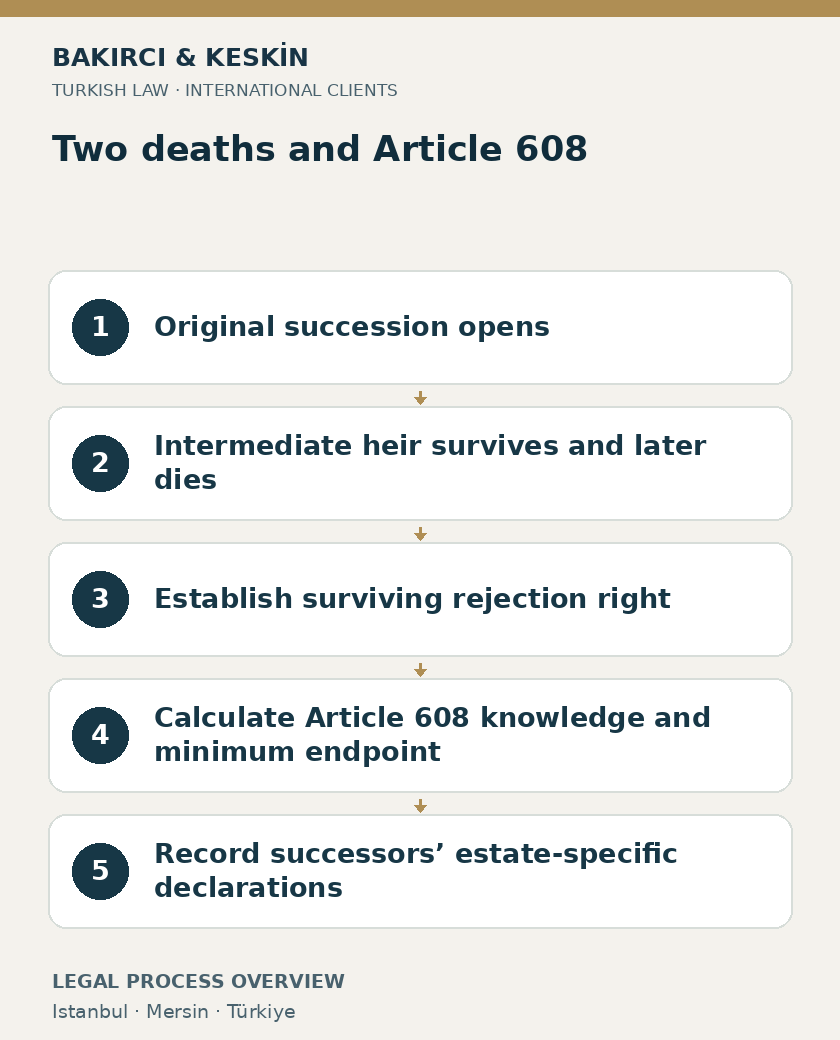
Short answer: Turkish Civil Code Article 608 provides that an heir who dies without rejecting an inheritance transmits the right of rejection to their own heirs. The successors must distinguish the original estate from the deceased heir’s separate estate and establish whether a rejection right still existed. Article 608 also contains its own timing rule: the successors’ period starts when they learn that the inheritance passed to their deceased predecessor, and cannot expire before the period allowed for rejecting that predecessor’s estate. Two deaths therefore require two succession records and a carefully documented sequence of knowledge and action.
Have a general question about this article? Ask anonymously
Quick summary
| Legal issue | An Heir Dies Before Rejecting a Turkish Inheritance: The Successors’ Rights |
|---|---|
| Short answer | Turkish Civil Code Article 608 provides that an heir who dies without rejecting an inheritance transmits the right of rejection to their own heirs. The successors must distinguish the original estate from the deceased heir's separate estate and establish whether a rejection right still existed. Article 608 also contains its own timing rule: the successors' period starts when they learn that the inheritance passed to their deceased predecessor, and cannot expire before the period allowed for rejecting that predecessor's estate. Two deaths therefore require two succession records and a carefully documented sequence of knowledge and action. |
| Key legislation | Law No. 4721 — Articles 575, 580, 599, 606, 607, 608, 609, 610, 611; Law No. 5718 — Articles 20, 43; Law No. 6100 — Articles 223, 224 |
The order of deaths determines which legal question arises
A succession chain starts with the original deceased, the person who inherited from that deceased and the heirs of that person. Identify the date of each death and whether the intermediate heir survived the original deceased. Under Civil Code Article 580, a person must be alive and capable of inheriting when the original succession opens. If that heir subsequently dies, their inheritance right passes to their own heirs.
This is different from a person who died before the original deceased. The latter position raises the rules determining who inherits at the opening of the original succession; it is not simply an Article 608 transmission of a surviving heir’s unused rejection right. The distinction must appear in the family tree and in the legal submissions. It cannot be resolved merely by noting that both people are now deceased.
Use official death records and resolve inconsistent dates before calculating deadlines or shares. Where a foreign record and a Turkish record disagree, obtain the underlying documents and identify what each entry proves. The legal sequence should be established first. The date on which a family member obtained a certificate is relevant evidence of knowledge in some circumstances, but it does not replace the actual date of death.
An estate is not held in suspense merely because no acceptance form was signed
Article 599 states that heirs acquire the inheritance as a whole by operation of law on death, subject to statutory exceptions. Turkish law therefore should not be described as a system in which nothing passes until every heir signs a general acceptance form. The right to reject and the protective statutory procedures operate against that background of acquisition.
This matters when an intermediate heir dies shortly after becoming an heir. The absence of a bank withdrawal, inheritance certificate or registered title transfer does not by itself prove that no inheritance right passed. Article 580 expressly deals with an heir who survives the opening of succession and later dies. The rights arising from the first estate can consequently form part of the second succession, alongside the intermediate heir’s other assets and liabilities.
The same point explains why the relevant inquiry is whether a rejection right remained available. An inheritance certificate is evidence of status; its absence does not automatically preserve rejection indefinitely. A useful initial review compares the legal acquisition date, the relevant knowledge dates, any court process and the intermediate heir’s conduct. The existing guide to rejecting an inheritance from abroad addresses the ordinary procedure before this additional transmission issue arises.
When an heir dies, Article 608 transfers an existing rejection right
Article 608 provides that the rejection right of an heir who dies without rejecting passes to that heir’s successors. The rule prevents the possibility of rejection from disappearing solely because the person entitled to exercise it has died. It must nevertheless be read with the provisions governing when the right expires or is lost through conduct.
Establish the intermediate heir’s actual position at death. Was the ordinary period still running? Had a court-supervised inventory changed the procedural position? Had a declaration been made? Had conduct already prevented rejection under Article 610? These are separate questions requiring documents and a chronology. It is inaccurate to promise that every second death restarts a fully available rejection option regardless of what happened during the first succession.
Identify the successors entitled to exercise the transmitted right and the basis of their own heirship. A relative authorised informally to organise funeral arrangements does not thereby acquire authority to make declarations for all successors. Where minors or protected persons are involved, the applicable representation and permission requirements must be reviewed independently. Article 608 identifies transmission; it does not remove the safeguards governing who can act for another person.
Apply the two-part timing rule without merging the estates
For the successors, Article 608 starts the relevant period when they learn that the inheritance passed to their deceased predecessor. That is a specific knowledge question. The date they learned of the original death, the date they learned of the intermediate death and the date they learned of the intermediate person’s inherited position can differ. Record each date and the evidence supporting it rather than selecting whichever date appears most convenient.
The article also imposes a protective endpoint rule: the transmitted rejection period cannot expire before the period allowed for the successors to reject the inheritance of their own deceased predecessor. Article 606 supplies the ordinary three-month period and distinguishes the starting rules for legal and testamentary heirs. The Article 608 analysis therefore requires the second estate’s deadline to be examined as well as the knowledge of the first inheritance.
Do not reduce the rule to an automatic statement that the period always runs from the second death. Nor should time be measured solely from issue of a second inheritance certificate. The actual legal status, notification and knowledge evidence matter. If protective inventory measures are relevant, Article 607’s separate rule must also be checked. A written deadline analysis should state the provision used, the triggering event, the evidence and any unresolved issue requiring the court’s determination.
Check acts that could have extinguished the rejection right
Article 610 treats an heir who does not reject within the statutory period as having acquired the inheritance unconditionally. Before the period ends, it also prevents rejection where the heir interferes in estate transactions beyond ordinary administration or what is necessary to carry on the deceased’s affairs, or conceals or appropriates estate assets. The provision expressly preserves the right where proceedings are brought to prevent a limitation or forfeiture period from expiring.
The review must therefore examine actual conduct, not simply whether a document headed “acceptance” exists. Obtain records of asset sales, payments, withdrawals, transfers, business decisions and litigation undertaken during the first succession. Identify who acted and under what authority. A step taken by someone else should not be attributed to the intermediate heir without evidence, while a transaction executed through an authorised representative still requires substantive assessment.
Necessary preservation and an ownership transaction should not be assumed to have the same effect. The legal significance depends on the nature and purpose of the act under Article 610. Keep that assessment fact-specific and supported by the record. Once the intermediate heir has died, obtaining their bank and transaction evidence through lawful channels becomes especially important because a later description by another relative may be incomplete.
Distinguish the first inheritance from the intermediate heir’s estate
The first estate contains the original deceased’s rights and obligations. The second estate contains the intermediate heir’s own rights and obligations, including the position acquired from the first estate. These are legally connected but not identical funds. Rejecting one inheritance must not be described in paperwork as though it were automatically a declaration about every succession in the family.
Prepare separate schedules of assets, liabilities, known creditors and existing proceedings. A debt owed personally by the intermediate heir is not transformed into an original-estate debt merely because it is discovered at the same time. Equally, a claim arising from the original deceased’s undertaking does not disappear from the analysis because the immediate heir has also died. Each demand must be traced to its debtor and legal basis.
The consequences of a successor’s decision about the second estate for their ability to act concerning the first must be assessed against the actual succession structure, including any independent heirship in the original estate. Do not assume that one heir’s decision supplies a convenient shortcut for the others. The declaration should identify exactly which estate and which transmitted right are at issue, and the ensuing documents must reflect that distinction.
Prepare a complete two-estate document chain
The core file should contain both death records, evidence connecting the deceased persons and the successors, any existing inheritance certificates, wills, official notifications and records of earlier rejection or inventory proceedings. Include proof relevant to when the successors learned of the first inheritance passing to the intermediate heir. Preserve full correspondence rather than isolated screenshots that omit dates or context.
Where certificates were issued in different countries, examine their functions. An overseas grant appointing an administrator is not necessarily a determination of beneficial shares. A Turkish inheritance certificate concerning only the second deceased does not by itself establish every fact about the first succession. Match each document to the precise step in the chain it proves. The inheritance-certificate guide explains that evidential role.
Foreign-language documents require a translation when relied on in Turkish proceedings under Code of Civil Procedure Article 223. Article 224 addresses authentication while preserving international agreements. Plan authentication and translation early enough to avoid making their completion the reason a time-sensitive declaration is left unexamined. The lawyer should identify which supporting documents are immediately available and how outstanding records affect the application.
Article 609 requires an unconditional declaration to the appropriate court
Article 609 permits rejection by an oral or written declaration to the Civil Court of Peace and requires it to be unconditional. The court records the declaration, and a timely rejection is entered in the special register of the court where the inheritance opened. A family agreement, an email to a bank or a statement to an overseas estate administrator is not the statutory Turkish declaration merely because it uses the word “reject.”
Where the application exercises a transmitted right, its factual basis should identify the original succession, the intermediate heir’s later death and the successors’ entitlement. Attach or identify the evidence establishing the sequence and the timing. Avoid ambiguous wording that rejects “all debts” while seeking to retain selected assets. The legal act is rejection of the relevant inheritance under the applicable conditions, not a unilateral selection of favourable estate items.
Representation documents should authorise the actual act intended. The court must be able to distinguish the persons making declarations and the capacity in which each acts. Obtain the recorded result and check names, estate identities and dates. Filing a document is not the same as verifying that the court has recorded the intended rejection correctly. Any discrepancy needs prompt attention through the appropriate procedure.
Cross-border succession adds applicable-law and jurisdiction questions
Article 20 of Law No. 5718 addresses succession law, applying the deceased’s national law generally and Turkish law to Turkish immovables, with separate rules concerning opening, acquisition and partition. In a two-death chain, the nationality and circumstances of both deceased persons can matter. Do not assume that the analysis for the first succession automatically governs the second.
Article 43 supplies the Turkish international-jurisdiction rule for inheritance cases. The relevant estate and relief must be identified before choosing the court. The fact that successors live overseas does not turn a foreign authority into the Turkish court required for an Article 609 declaration. At the same time, overseas proceedings and deadlines may require coordination so that statements made in one jurisdiction do not contradict the actual legal position being advanced elsewhere.
Prepare a shared chronology that distinguishes Turkish filings, foreign filings and dates of notification. Translate key legal terms consistently, particularly heir, beneficiary, personal representative and rejection. A single English word can conceal different legal functions in different systems. Direct coordination between the persons handling the two jurisdictions should focus on the actual documents and applicable rules rather than assumptions based on a translated label.
Verify who benefits and what happens to the assets afterwards
Article 608 contains another rule that should not be confused with transmission on an heir’s death. Where a rejection causes the inheritance to pass to people who were not previously heirs, their rejection period begins when they learn of the earlier heirs’ rejection. This concerns a new person’s entry into the succession because of a rejection. It is different from the first paragraph’s transfer of an unused rejection right through a deceased heir’s own estate.
The resulting file should therefore show why each person is now involved. Record whether the person succeeds to the intermediate heir, inherits independently from the original deceased or becomes entitled because someone else rejected. Link that capacity to the relevant court record and knowledge evidence. One person can have more than one legally relevant relationship, which makes precise drafting essential. A general family announcement that “the inheritance has been rejected” does not identify who rejected, which estate was affected or which later person’s period is being calculated. Obtain the actual declaration and resulting determination before preparing further applications.
A valid rejection changes the succession position and therefore requires the resulting heirship to be checked. Article 611 regulates the consequences of rejection by an individual heir, while other provisions address rejection by the nearest legal heirs as a group and related situations. The destination of the rejected interest should be calculated under the relevant facts and law, not stated as a universal transfer to one favoured relative.
Update the estate file with the court record and provide the appropriate document to institutions handling the affected assets or claims. Keep the two estates’ accounts separate. If a creditor continues to demand payment, the legal basis of the demand and the procedure used must be examined; possession of a rejection document is not a reason to ignore formal service.
Bakırcı & Keskin Law Office coordinates successive-death inheritance matters for overseas families through Istanbul and Mersin, with Mersin-based services throughout Turkey. The essential work is to prove the sequence, establish the surviving rejection right, calculate the correct statutory periods and record a declaration concerning the correct estate. That approach prevents one succession from being mistaken for the other.
Frequently asked questions
Does the right to reject disappear when the heir dies?
Article 608 transmits an existing rejection right to that heir’s own heirs. Whether the right remained available must still be established.
What if the intermediate person died before the original deceased?
That raises the rules determining heirship at the original opening of succession, not simply transmission of a surviving heir’s unused rejection right.
Must an heir have signed acceptance before inheriting?
No. Article 599 establishes acquisition by operation of law at death, subject to the statutory exceptions and rejection rules.
Does the new period always start on the second death?
No. Article 608 uses the successors’ knowledge that the inheritance passed to their deceased predecessor and includes an additional rule concerning the second estate’s rejection period.
Can the transmitted period expire before the second estate’s rejection period?
Article 608 expressly prevents that result. Both periods must be analysed with their actual triggering facts.
What if the intermediate heir had already sold estate assets?
The act must be examined under Article 610. Conduct beyond the permitted administration categories can prevent rejection; its effect is not determined merely by its label.
Is one inheritance certificate enough for both deaths?
Each link in the succession chain must be proved. A certificate addressing one estate does not automatically establish all facts and entitlements in the other.
Can rejection be limited to the debts?
Article 609 requires an unconditional rejection of the relevant inheritance. It is not a unilateral choice to keep selected assets while rejecting their associated estate position.
Can a relative abroad reject on behalf of everyone?
Only a person with legally sufficient authority can act for another. Informal family responsibility does not establish the required representation.
What should be checked after the declaration?
Verify the court’s recorded estate, persons, capacity and dates, then determine the resulting heirship and respond to any separate creditor procedure appropriately.
Official legal sources
- Law No. 4721 — Articles 575, 580, 599, 606, 607, 608, 609, 610, 611
- Law No. 5718 — Articles 20, 43
- Law No. 6100 — Articles 223, 224
The official Turkish legislation controls. Apply the governing provisions to the facts and documents of the individual estate.
Contact information
Do not include confidential documents or identity numbers in an initial message. An enquiry does not establish representation or suspend any legal deadline.
Istanbul and Mersin contact details
Bakırcı & Keskin Law Office is Mersin-based. Turkish matters are handled under the applicable jurisdiction and agreed mandate. The competent court and the scope of representation are assessed for each matter.
Istanbul — Polaris Plaza
Maslak Ahi Evran Caddesi, Polaris Plaza No:21, Floor 9, 34475 Sarıyer/İstanbul, Türkiye.Mersin — Profit İş Merkezi
İhsaniye Mahallesi, 4903. Sokak, Profit İş Merkezi No:23, Floor 3, Office 14, 33070 Akdeniz/Mersin, Türkiye.+90 552 224 43 66 · Contact details in English. An enquiry does not establish representation or suspend a legal deadline.
Istanbul Office – Polaris Plaza, Maslak / Sarıyer
Bakırcı & Keskin Hukuk Bürosu
Maslak Ahi Evran Caddesi, Polaris Plaza No:21, Kat:9, 34475 Sarıyer/İstanbul
Our physical offices in Istanbul and Mersin coordinate matters throughout Turkey, subject to jurisdiction and the local steps required for each case. Please specify your preferred office when arranging an in-person appointment.
Open the Istanbul office on Google Maps · Contact and appointments
Contact regarding a legal matter
In your first message, you may briefly state the subject, your country or city, and any relevant notification or recent procedural date. Please do not send identity numbers, medical data, or personal documents. Messaging alone does not constitute legal advice or create a lawyer–client relationship.
Discover more from Bakırcı & Keskin Hukuk Bürosu
Subscribe to get the latest posts sent to your email.