Extending the Turkish Inheritance Rejection Deadline While Abroad
Short answer: Civil Code Article 615 authorises the Civil Court of Peace, where important reasons exist, to extend the inheritance-rejection period or grant a new period to legal and appointed heirs. Living abroad does not itself create an automatic extension. The application must establish the correct original deadline, explain the obstacle relied on and support it with evidence. Before treating the deadline as missed, check Articles 606–608, any inventory procedure and the distinction between an ordinary rejection and the deemed-rejection rule in Article 605. A new-period request is not itself a rejection declaration.
Have a general question about this article? Ask anonymously
Quick summary
| Legal issue | Extending the Turkish Inheritance Rejection Deadline While Abroad |
|---|---|
| Short answer | Civil Code Article 615 authorises the Civil Court of Peace, where important reasons exist, to extend the inheritance-rejection period or grant a new period to legal and appointed heirs. Living abroad does not itself create an automatic extension. The application must establish the correct original deadline, explain the obstacle relied on and support it with evidence. Before treating the deadline as missed, check Articles 606–608, any inventory procedure and the distinction between an ordinary rejection and the deemed-rejection rule in Article 605. A new-period request is not itself a rejection declaration. |
| Key legislation | Law No. 4721 — Articles 589, 605, 606, 607, 608, 609, 610, 615, 619; Law No. 6100 — Articles 382; Law No. 5718 — Articles 20 |
First determine whether the rejection deadline was truly missed
Civil Code Article 606 sets an ordinary three-month rejection period. For legal heirs, it runs from learning of the deceased’s death unless they prove that they learned of their heirship later. For heirs appointed by a will, it runs from official notification of the testamentary disposition. A deadline assessment must therefore identify the person’s category and the actual triggering event.
Do not assume that issue of an inheritance certificate starts every rejection period. Nor should the date a relative first discussed the estate automatically be used without examining what was communicated and when. Preserve the death notification, relevant correspondence, official service documents and the record showing the basis of heirship. The facts establishing later knowledge must be proved where that later knowledge is relied on.
Article 607 supplies a separate rule where the estate is inventoried as a protective measure: the period begins with the court’s notification that the inventory has ended. Article 608 separately regulates transmitted rejection rights following an heir’s death. Check these provisions before asking the court to rescue a period that may have a different statutory starting point. A precise chronology can identify the correct route more effectively than a general statement that the family was overseas.
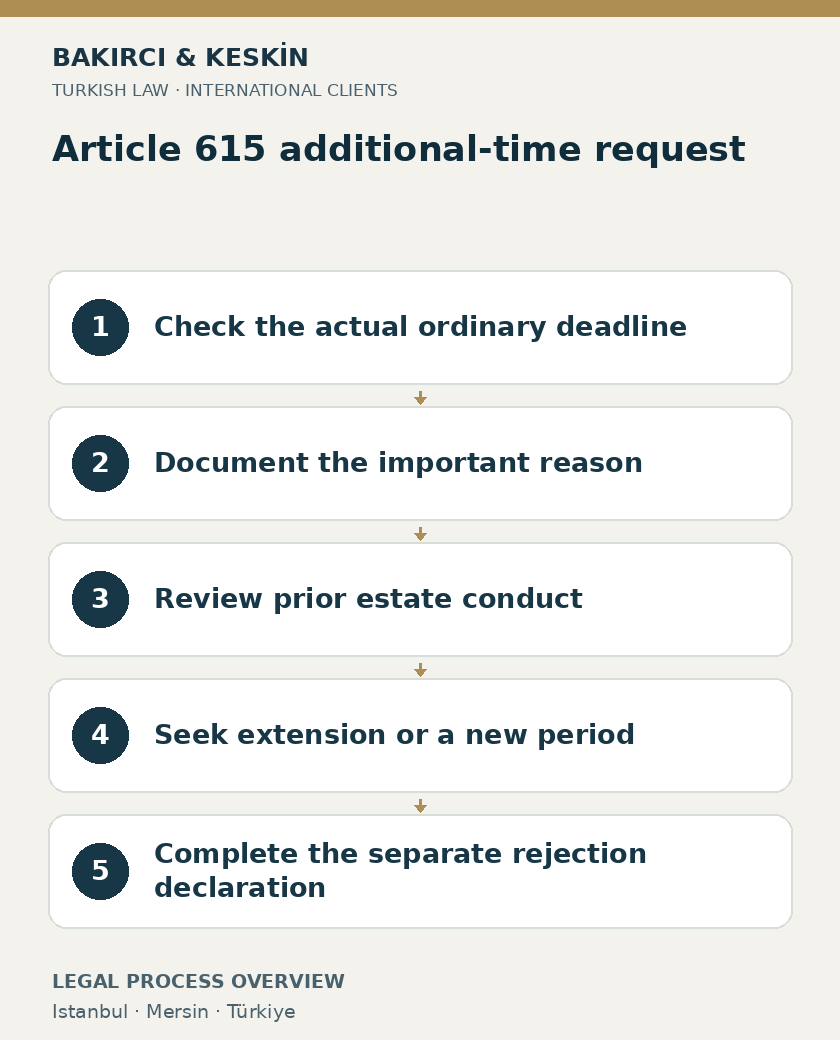
Article 615 provides for an extension or a new period
Article 615 states that, in the presence of important reasons, the Civil Court of Peace can extend the period granted to legal and appointed heirs or allow a new period. The wording covers two forms of relief. The request should identify which is sought and explain its relationship to the current deadline position, instead of treating “extension” as an undefined permission to act at any future time.
The statute makes important reasons the condition for the court’s power. It does not prescribe an automatic extension for every heir living outside Turkey, and it does not state a fixed extra number of days available in all cases. Avoid applications built around an assumed universal entitlement. The court must be given the actual circumstances and the reason they justify the particular additional time requested.
This is a targeted inheritance provision. It should not be confused with a generic request to restore every procedural deadline in every connected case. A payment-order objection, a will-annulment action and an Article 615 application raise different rules. The relief requested should remain tied to the rejection period, while any other deadline is examined separately under its own legal basis.
Explain the obstacle and its connection to the delay
A persuasive factual account states what prevented timely action, when that obstacle began, how long it lasted and what the heir did once it ended. Supply the evidence needed to evaluate those statements. The court should not have to infer an obstacle from a passport stamp, an incomplete message or a broad description of family difficulty. Connect each document to a specific part of the chronology.
Distinguish an inability to obtain information from uncertainty about whether the inheritance would be financially attractive. Unknown debts are relevant to selecting an appropriate protective procedure, but they do not remove the need to establish the statutory grounds for additional time. The application should explain why the evidence relied on constitutes an important reason in the particular circumstances, rather than asserting that uncertainty always produces an extension.
State any adverse facts accurately. A record showing that the heir discussed the estate earlier than the application suggests must be addressed. An attempted filing that did not reach the relevant authority should be described as an attempt, with its transmission and response evidence. The objective is a verifiable account of the events; selecting only favourable fragments can undermine both the factual explanation and the requested relief.
Foreign residence requires evidence of the actual impediment
Residence abroad can introduce document, representation, language and communication issues. Those issues are not all legally equivalent. Establish which one prevented or materially affected the timely step in this file. Identify the relevant authority, document request, appointment, transmission or notification, and retain records showing when action was taken. A foreign address alone does not explain why the Turkish statutory procedure could not be organised.
Separate the time needed to obtain a perfect financial picture from the time needed to make a legal decision or seek a statutory measure. An heir need not wait for an informal family investigation to finish before obtaining advice on rejection, official inventory or additional time. If documents were outstanding, explain which documents were essential to the step being taken and which were supplementary.
The file should also record whether Turkish representation had been arranged, what authority was given and when the representative received the instructions and relevant information. This does not make every representation difficulty an important reason; it allows the court to assess the real chronology. Do not claim that travel to Turkey was the only possible route without examining the legally available representation arrangements for the particular act.
Examine the heir’s conduct before relying on extra time
Article 610 provides that an heir who does not reject within the statutory period acquires the inheritance unconditionally. It also addresses conduct before expiry: interference beyond ordinary administration or what is necessary to carry on the deceased’s affairs, and concealment or appropriation of estate assets, can prevent rejection. A request concerning time must therefore be considered alongside the actual estate transactions.
Review withdrawals, asset sales, transfers, business instructions and declarations already made. Identify who acted, the legal capacity in which they acted and the purpose of the transaction. Necessary preservation is not simply the same as treating estate assets as one’s own. Conversely, the absence of a signed acceptance form does not establish that the heir did nothing legally relevant.
Article 615 should not be presented as an automatic cure for every conduct-based loss of the right. The requested relief concerns the rejection period; the consequences of earlier acts require their own analysis under Article 610. The statute expressly says that proceedings brought to prevent a limitation or forfeiture period from expiring do not remove the rejection right. Use that specific rule accurately, without extending it to every transaction loosely described as protecting the estate.
Do not confuse additional time with deemed rejection or official inventory
Article 605 contains a separate deemed-rejection rule where the deceased’s insolvency was clearly apparent or officially established at death. That issue concerns the statutory condition at the opening of succession. It is not established simply by discovering one unpaid bill later, and it is not the same application as asking for a new period under Article 615. Analyse the evidence and remedy for each route independently.
Official inventory under Article 619 has its own one-month request rule and a structured process for recording liabilities and making the later election. It should not be assumed that a request under Article 615 automatically extends every other statutory period. The official-inventory guide explains that separate mechanism. The court request must identify the legal protection actually being sought.
Official liquidation also has distinct conditions and consequences. A family should not use “inventory,” “liquidation” and “rejection” as interchangeable descriptions in correspondence or instructions. These procedures affect liability and administration differently. The legal assessment should explain why the selected route addresses the estate’s verified position and what remains to be done if the requested additional time is granted.
Present a request the court can determine
The application should identify the deceased, the applicant’s heirship, the relevant estate, the ordinary period calculation, the important reason relied on and the precise additional time sought. Include a chronological schedule of the supporting documents. Where a material date is disputed, say so and identify the evidence to be obtained. Do not conceal uncertainty behind a deadline stated without its factual basis.
The Civil Court of Peace is the authority named in Article 615. Code of Civil Procedure Article 382 lists extension of the rejection period among non-contentious inheritance matters. The appropriate venue and any international-jurisdiction question must still be determined from the actual estate and applicable provisions; an overseas residential address should not be used to guess the Turkish court.
Where a representative files the request, the authority should fit both the application and any later rejection declaration intended. They are separate procedural acts. A request for time should not be drafted as a conditional statement that purports to reject the estate only if its debts exceed its assets. Article 609 requires rejection to be unconditional. The court must be able to distinguish the request for relief from the declaration that would exercise the right.
A pending request does not resolve every estate or creditor issue
Submitting an Article 615 application should not be treated as a universal suspension of all other proceedings. Identify every formal notice and separate deadline currently running. A creditor’s enforcement step, a property transaction and the rejection-period request need coordinated handling, but they do not become one procedure merely because they concern the same deceased.
Preserve estate assets and records through the lawful measures appropriate to the facts. Article 589 empowers the Civil Court of Peace to take necessary protective measures for estate property and its transmission to the entitled persons. If a concrete asset requires protection, identify it and explain the relevant circumstances. The request for more time is not itself an instruction authorising relatives to distribute, sell or conceal that asset.
Maintain an account of expenses and actions undertaken while the request is pending. Preserve invoices and payment records showing the purpose of expenditure. A later dispute over whether an act was necessary administration is harder to assess when the only record is a vague family message. Accurate records support both the deadline application and any independent question concerning the heir’s conduct.
Read the operative order and complete the next act on time
If the court grants relief, obtain the full order and establish the start and end of the period actually allowed. Do not substitute the period requested for the period granted. Check whether the order contains conditions, identifies a triggering notification or requires further procedural action. The relevant dates should be communicated clearly to the heir and the person responsible for filing the next document.
Where rejection is the intended decision, comply with Article 609 through the appropriate court declaration and verify its recording. The grant of extra time does not itself reject the inheritance. An email telling the lawyer that the family wants no debts does not replace the statutory act. Keep the filed declaration, proof of filing and the resulting court record together.
If the request is refused, examine the decision and the legally available response in that procedure promptly. Do not assume that refusal conclusively determines every separate issue, including an independently supported Article 605 question. Equally, do not assume that merely contesting refusal automatically preserves all rights. The effect of the decision and the available procedural steps require a specific review of the file.
Coordinate the Turkish application with the overseas evidence
Prepare a separate deadline record for each applicant. A group of relatives can share an estate without sharing every legally relevant notification or knowledge date. Identify whether each person is a legal heir, an appointed heir or a successor exercising a transmitted rejection right. Attach the relevant evidence to that person’s entry. This makes it possible to explain why additional time is requested for a particular heir without treating the whole family as a single applicant with a single factual history.
Where Article 607 is relevant, obtain the actual protective-inventory record and the court’s notification that the recording exercise ended. A spreadsheet prepared by relatives, a private valuation and a request for bank balances do not establish that the statutory court procedure occurred. Record the distinction expressly. It determines whether the application concerns an ordinary period under Article 606, the specific inventory-related starting point or a request for relief under Article 615.
Keep the deadline calculation separate from the proposed evidence-gathering timetable. List the material already available, the records requested and the steps that still depend on a foreign institution. The requested period should be explained by the work needed to make and exercise the inheritance decision. An open-ended request to wait until every dispute about the estate is resolved does not identify a concrete period or a defined task for the court to assess.
In an international estate, Law No. 5718 Article 20 governs the relevant succession conflicts questions, including its specific treatment of Turkish immovables and rules on opening, acquisition and partition. The legal basis for applying the Turkish rejection framework should be addressed where the facts require it. A foreign probate process should not be assumed to settle the Turkish deadline automatically.
Translate and authenticate foreign documents according to their intended use and the applicable rules. Keep official notifications in full, including envelopes or electronic delivery records where these establish service or knowledge. Explain any difference between the date shown on a foreign document and the date it was communicated to the heir. Consistent date handling is particularly important where different jurisdictions use different formats.
Bakırcı & Keskin Law Office assists heirs abroad through its Istanbul and Mersin offices, providing Mersin-based services throughout Turkey. The focused task is to establish the real deadline position, put the important reason and its evidence before the court, and carry out any subsequent declaration correctly. The ordinary rejection guide should be read alongside this special Article 615 procedure.
Frequently asked questions
Does living abroad automatically extend the rejection period?
No. Article 615 requires important reasons. The actual obstacle and its connection to the delay must be supported by evidence.
Can the court grant a new period after the ordinary period has expired?
Article 615 expressly authorises both extension and a new period where its condition is satisfied. The application must explain the correct deadline position and grounds.
Is there a fixed extra period available to everyone?
Article 615 does not prescribe a universal additional number of days. The court determines the relief on the established circumstances.
Does the period always start when the inheritance certificate is issued?
No. Article 606 uses knowledge and official-notification rules depending on the type of heir, and Articles 607–608 contain additional rules.
Does applying for more time also reject the estate?
No. The request and the Article 609 unconditional rejection declaration are distinct acts.
Will extra time cure every earlier transaction with estate assets?
That cannot be assumed. Article 610’s conduct-based restrictions require a separate assessment.
Is discovering a debt enough to establish deemed rejection?
No. Article 605 addresses the deceased’s insolvency being clearly apparent or officially established at death, a distinct statutory question.
Does Article 615 automatically extend the official-inventory deadline?
No such automatic result should be assumed. The Article 619 inventory procedure and the particular relief sought must be analysed separately.
Can a creditor notice be ignored while the request is pending?
No. Each served proceeding has its own response requirements and must be reviewed independently.
What must be checked when the court grants extra time?
Check the exact period allowed and its triggering event, then complete and verify the required rejection declaration within that period.
Official legal sources
- Law No. 4721 — Articles 589, 605, 606, 607, 608, 609, 610, 615, 619
- Law No. 6100 — Articles 382
- Law No. 5718 — Articles 20
The official Turkish legislation controls. Apply the governing provisions to the facts and documents of the individual estate.
Contact information
Do not include confidential documents or identity numbers in an initial message. An enquiry does not establish representation or suspend any legal deadline.
Istanbul and Mersin contact details
Bakırcı & Keskin Law Office is Mersin-based. Turkish matters are handled under the applicable jurisdiction and agreed mandate. The competent court and the scope of representation are assessed for each matter.
Istanbul — Polaris Plaza
Maslak Ahi Evran Caddesi, Polaris Plaza No:21, Floor 9, 34475 Sarıyer/İstanbul, Türkiye.Mersin — Profit İş Merkezi
İhsaniye Mahallesi, 4903. Sokak, Profit İş Merkezi No:23, Floor 3, Office 14, 33070 Akdeniz/Mersin, Türkiye.+90 552 224 43 66 · Contact details in English. An enquiry does not establish representation or suspend a legal deadline.
Istanbul Office – Polaris Plaza, Maslak / Sarıyer
Bakırcı & Keskin Hukuk Bürosu
Maslak Ahi Evran Caddesi, Polaris Plaza No:21, Kat:9, 34475 Sarıyer/İstanbul
Our physical offices in Istanbul and Mersin coordinate matters throughout Turkey, subject to jurisdiction and the local steps required for each case. Please specify your preferred office when arranging an in-person appointment.
Open the Istanbul office on Google Maps · Contact and appointments
Contact regarding a legal matter
In your first message, you may briefly state the subject, your country or city, and any relevant notification or recent procedural date. Please do not send identity numbers, medical data, or personal documents. Messaging alone does not constitute legal advice or create a lawyer–client relationship.
Discover more from Bakırcı & Keskin Hukuk Bürosu
Subscribe to get the latest posts sent to your email.