Return of Court Security in Turkey: Foreign Claimants and Article 89
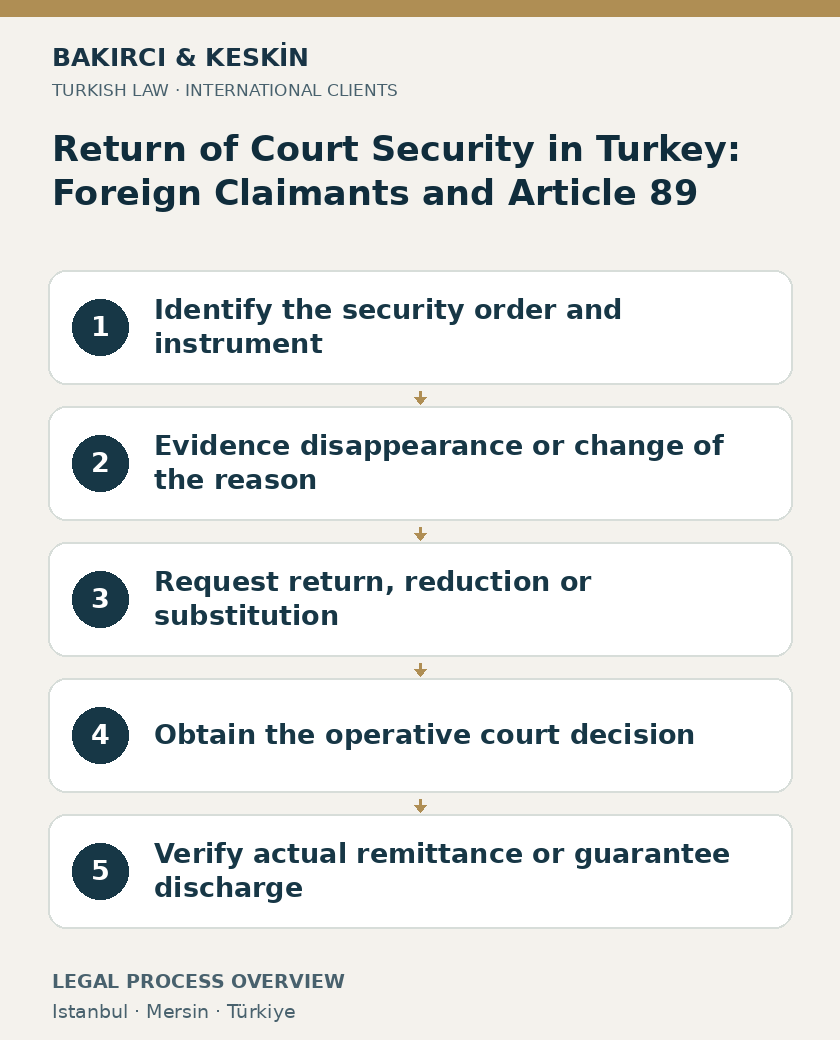
Short answer: A foreign claimant seeking return of security deposited in a Turkish court case should identify the order requiring it and show why the reason for that security has ended. Civil Procedure Code Article 89 requires an application by the interested person and a court decision on return when that reason has disappeared. A favourable judgment does not itself prove that every security in the file must immediately be released. Article 87 also permits alteration, reduction or removal when circumstances change. Distinguish this security from unused expense advances and security for an interim injunction, because their return provisions are different.
Have a general question about this article? Ask anonymously
Quick summary
| Legal issue | Return of Court Security in Turkey: Foreign Claimants and Article 89 |
|---|---|
| Short answer | A foreign claimant seeking return of security deposited in a Turkish court case should identify the order requiring it and show why the reason for that security has ended. Civil Procedure Code Article 89 requires an application by the interested person and a court decision on return when that reason has disappeared. A favourable judgment does not itself prove that every security in the file must immediately be released. Article 87 also permits alteration, reduction or removal when circumstances change. Distinguish this security from unused expense advances and security for an interim injunction, because their return provisions are different. |
| Key legislation | Law No. 5718 — Articles 1, 48; Law No. 6100 — Articles 87, 89, 333, 392 |
Identify the order and the interest the security protects
The first document to review is the order requiring security. Record its date, legal basis, amount, form, protected interest and any later variation. A payment receipt labelled security does not, by itself, establish why the court required it. Different securities can coexist in one lawsuit, and a request to return all funds risks overlooking an order that remains effective for a different purpose.
Law No. 5718 Article 48 concerns foreign natural or legal persons bringing proceedings, intervening or initiating enforcement, with security directed to costs and the opposing party’s loss or damage. The provision also requires exemption on reciprocity grounds. This article focuses on obtaining release of security held in a court case; an amount held under an enforcement-office or another distinct procedural order requires examination of that file’s own route.
Use the original order to define what must be demonstrated now. The application should answer why the circumstances supporting that particular security have ended or changed. It should not merely repeat the merits of the substantive claim. The fact that the foreign claimant was entitled to sue, performed the contract or ultimately recovered money concerns the dispute; the return question concerns the legal purpose still served by the security.
Reconstruct the deposit or bank-guarantee record
For a cash deposit, obtain the official receipt, payment date, amount, currency where applicable and the account or file reference under which the funds were recorded. Identify the payer and the person for whose procedural obligation payment was made. A parent company, client and lawyer may each appear in the payment chain for different reasons. Those records should explain the transaction without assuming that whoever transmitted money is automatically entitled to receive it back.
For a bank guarantee, preserve the instrument, any extensions or amendments, the court’s acceptance and the records identifying the beneficiary and secured obligation. The release may require steps different from a cash remittance, depending on the instrument and the court’s directions. A successful application should identify the guarantee precisely so the resulting order can be implemented without uncertainty about which obligation or document is being discharged.
Reconcile the records with any previous partial release, substitution or transfer between court files. An appeal or reassignment can produce additional file references without changing the origin of the security. Retain a chronological schedule showing each order and transaction. That schedule prevents a request for the original amount from overlooking a portion already returned or a replacement instrument now providing the actual security.
Show why the reason for security has disappeared
Civil Procedure Code Article 89 states that, when the reason requiring security has disappeared, the court decides on its return upon the interested person’s request. The operative elements are therefore the cessation of the reason, the application and the court’s decision. The provision does not describe a universal automatic refund on the day a first-instance judgment is issued.
The supporting explanation should connect current facts to the original reason. Identify the procedural outcome and any remaining matter relevant to the protected costs or loss. Supply the judgment, finality information where relevant, cost orders and records of subsequent proceedings or dispositions. If the applicant relies on another event rather than completion of the lawsuit, explain why that event removes the particular basis on which the security was required.
A statement that the case is finished should be supported by the actual record. A settlement agreement, withdrawal request and court decision recording the resulting procedural outcome are different documents. Where the parties reached a compromise, identify how costs, remaining claims and security were addressed. Their agreement can be relevant evidence, but the court-held security still requires the necessary order and implementation rather than an assumption that a private signature released it.
Be precise about what has and has not ceased. If only one component of the protected exposure remains, address its legal significance and amount rather than concealing it. That assessment can support a properly framed alternative request under Article 87. A reasoned application gives the court a basis to decide whether complete return, a reduction or another change is justified by the present circumstances.
Assess the judgment, appeals and unresolved issues
Obtain the complete operative judgment and information about service, appeals and finality. Winning the principal claim may affect the security analysis, but it should not be equated automatically with extinction of all protected exposure. The particular order, procedural position and remaining issues determine the argument. Equally, Article 89 should not be rewritten as a categorical rule that return is impossible in every case until the same procedural milestone occurs.
Review any counterclaim, separate cost dispute or relevant outstanding application. Explain whether it falls within the purpose of the security actually held. The existence of unrelated proceedings does not itself establish an unlimited right to retain every deposit. The return decision should be sought by reference to the specific secured purpose, with the opposing party’s position addressed where it is relevant to that purpose.
If the court has already ruled on a return request, obtain that ruling and examine its reasons before making another application or using a review route. A later material change should be identified with dates and evidence. Repeating an identical request without addressing the stated reason for refusal does not demonstrate that the basis for retention has disappeared.
Use Article 87 where the need has changed rather than completely ended
Article 87 governs the amount and form of security in a case, with the statutory qualification for an agreed form. Its second paragraph allows the judge to reduce, increase, change or remove security when the circumstances requiring it change. This gives a distinct basis for considering a smaller amount or different arrangement where complete return is not yet supported by the file.
A reduction request should provide a concrete account of the changed circumstances and explain how the remaining amount corresponds to the continuing purpose. Do not select a percentage merely because it is convenient for the claimant’s cash flow. The statute does not write a universal return percentage into the rule. The legal and factual change should drive the requested adjustment.
A substitution request also needs an implementable proposal, including the proposed instrument and its terms. Do not withdraw or allow an existing guarantee to lapse on the assumption that the court will accept a replacement later. Obtain the appropriate decision and verify the transition. The record should show when the replacement was accepted and when the former instrument or cash security was released.
Present a later reciprocity or treaty argument with current evidence
A claimant may discover after depositing security that a reciprocity or treaty exemption requires consideration. Article 48(2) expressly addresses reciprocity, and Article 1 preserves the applicable international agreements. The argument should identify the actual party, nationality or legal-person status, relevant instrument and covered proceeding. It should explain how that basis affects the existing security order in the current case.
Distinguish newly obtained evidence of an existing exemption from an actual later change in the legal or factual position. That distinction helps the court understand whether the applicant seeks reconsideration of the original basis or adjustment after changed circumstances. A foreign company’s change of name, transfer of shares or substitution of a different claimant should not be treated as the same event without examining the legal records and procedural consequences.
The initial security analysis is covered in our Article 48 guide for foreign plaintiffs and creditors and foreign-claimant security guide. For return, connect the exemption evidence to a specific request concerning the funds already held. Citing an exemption in correspondence outside the court file does not itself reverse the deposit order.
Prepare an application that permits a clear return order
The application should identify the court and file, the interested applicant, the original security order, the receipt or guarantee and the amount or instrument sought to be released. Set out the legal basis under Article 89 and any properly supported alternative under Article 87. Then explain the cessation or change of the reason with a concise chronology and documents that the court can verify.
Specify whether the request concerns complete return, partial return, substitution or cancellation of a particular guarantee. These outcomes require different operative wording. If the funds or instrument were moved to another file or office, supply the transfer reference. A technically correct legal submission can still be difficult to implement if it asks for the release of an unidentified deposit or gives a file number that no longer holds it.
Establish the applicant’s relationship to the security and the representative’s authority. Where a foreign legal entity is involved, use its correct current name and explain any change supported by official documents. Payment details should correspond to the legally entitled recipient and the authority’s requirements. A convenient account nominated by an unrelated person should not be substituted without resolving the underlying entitlement and representation questions.
Keep the legal request and administrative payment details consistent. The lawyer should be able to reconcile the amount requested with the official record and explain any difference. If the precise remaining balance requires confirmation from the court’s accounting records, identify that issue openly. Do not claim an additional return, interest amount or currency adjustment without a verified basis in the relevant order, account and applicable rules.
Implement the court’s order for cash or a guarantee
After a return decision, obtain the operative order and identify which office or institution must act. Confirm any implementation requirements, recipient verification and payment information through the responsible official channel. A decision allowing return and the actual release are separate stages. Record the dates and follow the implementation until the cash is received or the guarantee has been discharged in the required manner.
For an international remittance, verify the beneficiary’s name and account details carefully and retain evidence of the amount actually credited. Any bank deductions or exchange effects should be reconciled with the remittance records rather than assumed to be a deduction ordered by the court. A discrepancy between the ordered release and receipt needs to be traced to the responsible stage of the transaction.
For a guarantee, obtain confirmation of release consistent with the instrument and court order. Returning a paper document, notifying the bank and cancelling a continuing bank obligation are not necessarily identical practical events. The claimant should verify the actual position with the records available and resolve any continuing requirement. The file is not complete merely because the legal team received a favourable copy of the court’s decision.
Keep unused expense advances and injunction security on their own routes
Article 333 addresses the unused portion of an expense advance after the judgment becomes final, with the court deciding return of its own motion. That differs from Article 89’s interested-person application concerning security whose reason has ended. A court account can contain both categories. Separate them by the original payment purpose and governing order instead of treating every amount paid during litigation as the same deposit.
Security for an interim injunction has another specific rule. Article 392(2) provides for return where no compensation action is brought within one month after finality of the main judgment or lifting of the injunction. That provision should be applied to the security it regulates. Its one-month rule should not be copied mechanically into an Article 48 security-return application simply because both sums are called security in English.
Other procedural securities can likewise have their own legal basis and release conditions. Identify each instrument separately and obtain the relevant file and order before seeking its return. Court fees, expense advances, security for costs and a bond supporting a protective measure have different purposes. Accurate classification is the foundation of a useful return application and a complete financial reconciliation at the end of litigation.
Close the record only after the release is verified
A completed security file should contain the original order, payment or guarantee evidence, later variations, return application, return decision and proof of actual implementation. Reconcile any partial releases and replacement instruments. Where the matter involved several courts or offices, retain the correspondence identifying which authority held and released each amount. This provides a clear audit trail for an overseas client or corporate finance team.
Update the litigation budget to distinguish returned security from costs actually spent and amounts recovered on the substantive claim. Security returned to the claimant is not itself damages paid by the defendant. Treating it as litigation recovery can distort the commercial account of the case. The final report should explain each flow of funds according to its actual source and purpose.
If a balance remains held, record the reason, the order supporting continued retention and the next event relevant to review. A partially successful return request should not disappear from the case record once the main litigation team closes its work. The outstanding security remains a defined financial and procedural item until it is lawfully released or otherwise dealt with under the applicable decision.
Frequently asked questions
1. Is court security automatically returned when I win?
No universal automatic rule follows from a favourable judgment. Article 89 requires the reason for security to have disappeared and an application by the interested person.
2. Which document should I obtain first?
Obtain the order requiring security and the deposit or guarantee record. They identify its purpose, amount, form and file.
3. Can the amount be reduced while the case continues?
Article 87 permits reduction or other adjustment when the circumstances requiring security change. The request must explain and evidence that change.
4. Can a guarantee replace a cash deposit automatically?
No. Seek the appropriate decision and verify acceptance and release. Do not assume that a proposed replacement has already discharged the existing security.
5. Can reciprocity support return after security was paid?
It may require consideration under Article 48(2), but the applicable basis and its effect on the existing order must be established in the court file.
6. Is unused litigation expense money the same as security?
No. Article 333 separately governs unused expense advances after finality. Classify each payment before requesting return.
7. Does every security have a one-month waiting rule?
No. Article 392(2) contains a specific rule for interim-injunction security. It should not be applied indiscriminately to Article 48 security.
8. Does a private settlement itself release court-held funds?
The agreement can be relevant to the return request, but the necessary court order and implementation still need to be obtained.
9. Is a release order the same as receipt of the money?
No. Verify the actual remittance or discharge of the guarantee and reconcile it with the order.
10. Does this court procedure automatically govern an enforcement-office deposit?
No. Identify the authority, statutory basis and specific enforcement-file procedure. This article addresses security held under a court case’s security order.
Official legal sources
Legal sources reviewed on 28 October 2026. The applicable law and procedural requirements must be assessed for the individual case.
Contact information
Do not include confidential documents or identity numbers in an initial message. An enquiry does not establish representation or suspend any legal deadline.
Istanbul and Mersin contact details
Bakırcı & Keskin Law Office is Mersin-based. Turkish matters are handled under the applicable jurisdiction and agreed mandate. The competent court and the scope of representation are assessed for each matter.
Istanbul — Polaris Plaza
Maslak Ahi Evran Caddesi, Polaris Plaza No:21, Floor 9, 34475 Sarıyer/İstanbul, Türkiye.Mersin — Profit İş Merkezi
İhsaniye Mahallesi, 4903. Sokak, Profit İş Merkezi No:23, Floor 3, Office 14, 33070 Akdeniz/Mersin, Türkiye.+90 552 224 43 66 · Contact details in English. An enquiry does not establish representation or suspend a legal deadline.
Istanbul Office – Polaris Plaza, Maslak / Sarıyer
Bakırcı & Keskin Hukuk Bürosu
Maslak Ahi Evran Caddesi, Polaris Plaza No:21, Kat:9, 34475 Sarıyer/İstanbul
Our physical offices in Istanbul and Mersin coordinate matters throughout Turkey, subject to jurisdiction and the local steps required for each case. Please specify your preferred office when arranging an in-person appointment.
Open the Istanbul office on Google Maps · Contact and appointments
Contact regarding a legal matter
In your first message, you may briefly state the subject, your country or city, and any relevant notification or recent procedural date. Please do not send identity numbers, medical data, or personal documents. Messaging alone does not constitute legal advice or create a lawyer–client relationship.
Discover more from Bakırcı & Keskin Hukuk Bürosu
Subscribe to get the latest posts sent to your email.