Restricting a Spouse’s Disposals in Turkey: Article 199 Asset Protection
Short answer: Turkish Civil Code Article 199 allows a judge, on a spouse’s application, to make dealings with specified assets dependent on that spouse’s consent where necessary to protect the family’s economic position or secure a financial obligation arising from marriage. The court must identify the assets and the protection required; the provision does not automatically freeze everything the other spouse owns. It also provides for a land-register annotation when the judge removes a spouse’s power to dispose of immovable property. Foreign spouses must additionally address applicable law and jurisdiction, and distinguish this marriage-protection measure from a family-home annotation or an injunction securing a separate property claim.
Have a general question about this article? Ask anonymously
Quick summary
| Legal issue | Restricting a Spouse’s Disposals in Turkey: Article 199 Asset Protection |
|---|---|
| Short answer | Turkish Civil Code Article 199 allows a judge, on a spouse's application, to make dealings with specified assets dependent on that spouse's consent where necessary to protect the family's economic position or secure a financial obligation arising from marriage. The court must identify the assets and the protection required; the provision does not automatically freeze everything the other spouse owns. It also provides for a land-register annotation when the judge removes a spouse's power to dispose of immovable property. Foreign spouses must additionally address applicable law and jurisdiction, and distinguish this marriage-protection measure from a family-home annotation or an injunction securing a separate property claim. |
| Key legislation | Law No. 4721 — Articles 169, 194, 199, 200, 201, 229; Law No. 5718 — Articles 13(3), 14(4), 15, 40; Law No. 6100 — Articles 389, 390, 393, 396, 397 |
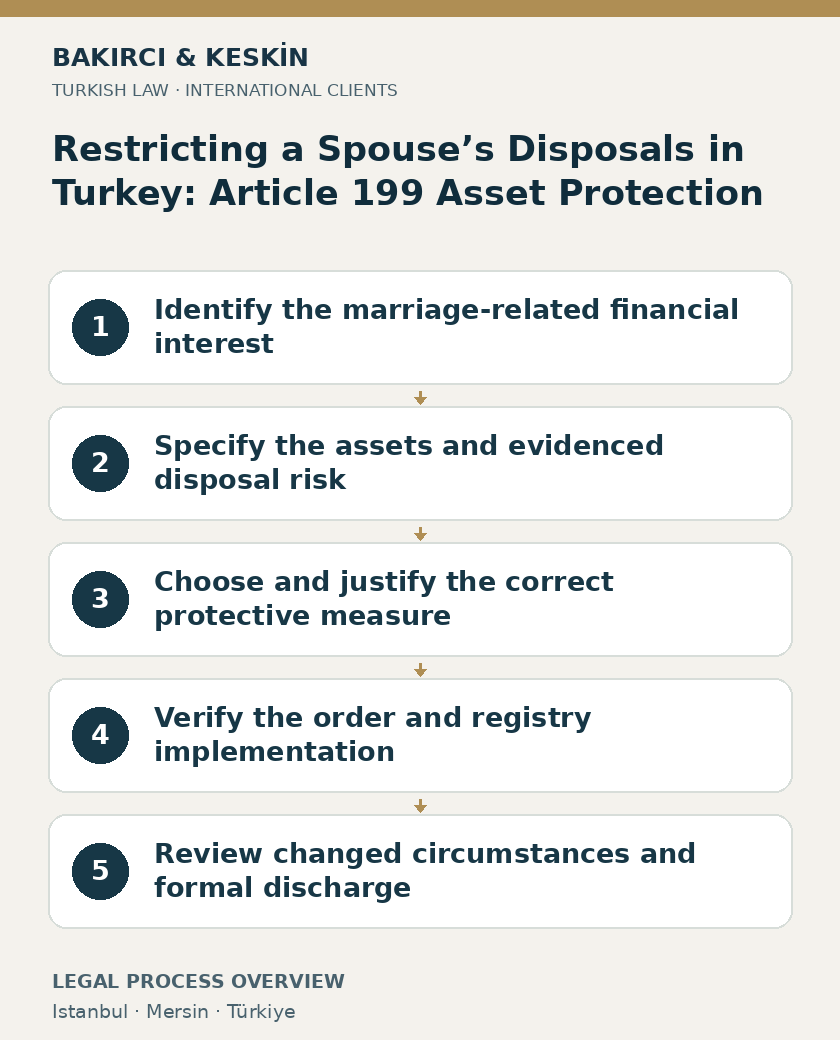
Article 199 protects the family’s economic position and marital financial duties
Civil Code Article 199 identifies two linked grounds: protecting the family’s economic existence and ensuring performance of a financial obligation arising from the marriage. The requested restriction must be necessary to the extent required by those purposes. The application should therefore explain the financial interest needing protection and how the proposed dealings would affect it. A general statement that the relationship has deteriorated does not establish the statutory connection.
The measure concerns specified assets and a requirement for the applicant spouse’s consent to dispositions involving them. This provides a focused form of protection while the relevant legal conditions exist. It is not a final allocation of ownership, an award of damages or a calculation of the spouses’ ultimate participation claims. A successful application must be understood according to the operative terms of the court order rather than described as immediate division of the marital estate.
Article 199 also directs the judge to take the necessary measures. The application should identify what implementation is required for the requested restriction to function. A statement addressed only to the other spouse may not provide the same practical protection as an order communicated to the relevant registry or institution. The court’s decision and implementation instructions determine what action the receiving authority is required to take.
Confirm the continuing marriage and classify the legal basis
Article 199 appears within the Civil Code’s provisions protecting the marital union. Establish the marriage, its current legal status and any proceedings that affect that status. Supply the marriage record and relevant divorce or recognition decisions. A person already divorced should not assume that a provision directed to protection of the marriage supplies the same remedy for a post-divorce monetary claim. The continuing claim requires its own substantive and procedural basis.
For a marriage with foreign connections, applicable law needs explicit analysis. Law No. 5718 Article 13(3) addresses the general effects of marriage, while Article 15 addresses matrimonial property and includes a rule for immovables at liquidation. Article 14(4) applies Turkish law to interim-measure requests. These provisions must be matched to the legal character of the relief; the location of one asset does not automatically answer every question about the spouses’ relationship.
Include any matrimonial agreement and identify the spouses’ nationalities and relevant habitual residences. Those facts help the court distinguish protection of the marital union from liquidation under a particular property regime. The application should state the legal route relied on and the facts supporting it. Presenting every foreign matrimonial dispute as an ordinary Turkish acquired-property claim can conceal issues that materially affect the relief available.
Identify the precise assets and the dispositions causing concern
For immovable property, obtain the current land-register information, parcel identifiers, registered owner and existing encumbrances. For other assets, provide reliable identifiers and records showing ownership and the proposed or disputed dealing. Article 199 refers to the assets the judge determines. A request describing all property, all accounts or all business interests without identifying their connection to the family’s economic position gives the court less material on which to frame a precise order.
Separate assets owned personally by the spouse from property belonging to a company or a third party. A spouse’s shareholding and the company’s individual assets are legally different objects. The application should not assert direct ownership of a company bank balance merely because the spouse manages the company. Establish the relevant proprietary interest and assess which restriction can lawfully attach to it without treating separate persons’ assets as interchangeable.
Identify the transaction risk in concrete terms: an announced sale, a proposed encumbrance, a documented transfer instruction or other evidenced conduct. Distinguish completed transfers from future dispositions. An order restricting a spouse’s future dealings does not automatically reverse a transfer already registered to another owner. A challenge to an existing transaction requires analysis of its legal basis, the parties who must participate and any separate protective relief.
Current records matter throughout the application. A title extract obtained before a later transfer can describe an ownership position that no longer exists when the court acts. Record the retrieval date and obtain updated information where the situation requires it. The proposed operative wording should match the asset and current legal holder, so the court and implementing authority can identify exactly what the restriction concerns.
Connect the asset risk to a documented financial need
Prepare evidence of the family’s financial structure: regular support obligations, housing costs, relevant income, essential expenditure and the role of the identified asset. The purpose is to demonstrate why the proposed restriction is necessary for a statutory objective. Where the asset provides rental income used for family maintenance, the income records and expenditure obligations explain that connection more clearly than a general allegation that the asset is valuable.
For a marital financial obligation, identify its source and amount where established, the dates performance became due and the evidence of non-performance. Attach the relevant agreement, court order or other supporting material. Separate an existing obligation from a projected entitlement that has not yet been determined. The court can then assess the requested protection against the actual legal and factual basis presented rather than an unexplained total of future demands.
Evidence should also address proportionality. Explain why the specified restriction meets the demonstrated need and whether a narrower measure would suffice. A focused application can identify the value involved, other available resources and the effect of the restriction on ordinary family or business activity. These facts assist the court in applying Article 199’s requirement that protection extend only as far as the statutory purpose requires.
Frame the consent requirement so that the order is workable
The central mechanism is a court-imposed requirement for the applicant spouse’s consent to dispositions involving the identified assets. The requested order should specify the relevant asset and dealings with sufficient clarity for implementation. A vague prohibition on financial misconduct does not identify which transaction requires consent. The operative text should allow the parties and any registry or institution addressed to understand the restriction without inventing its scope themselves.
Consent under a particular protective order should not be confused with general control over the other spouse’s affairs. Read the decision before authorising or opposing a transaction. A sale, encumbrance, collection of income and routine expenditure may raise different questions depending on its terms. If the wording does not address a necessary transaction clearly, seek a judicial clarification or appropriate variation rather than relying on a private assumption that the order covers everything.
The restriction also does not decide the ultimate financial merits between the spouses. It preserves the interest described by the statute and order. Keep the records needed for any later accounting, maintenance or property proceedings, including consent requests and the transactions approved. The evidence supporting initial protection and the evidence determining a final monetary entitlement can overlap, but they perform different legal functions.
Obtain and verify the land-register annotation where ordered
The final paragraph of Article 199 requires the judge to order an annotation in the land register of their own motion when removing a spouse’s power to dispose of immovable property. The application should provide accurate title identifiers so that the order can be communicated to the correct land-registry office. A favourable decision with an incorrect parcel reference or an incomplete implementation instruction requires correction through the proper channel.
After the order is transmitted, obtain confirmation of the actual registry entry and compare its wording and property identifiers with the judgment. The date of the court order and the date on which the registry records the annotation are separate factual events. Both should be retained. A statement that the property is protected should be supported by the current record and the precise effect of the operative order.
Existing mortgages, annotations, third-party interests and earlier registered transactions must remain part of the analysis. Article 199 does not state that an annotation erases all prior rights or establishes the applicant spouse as co-owner. A proposed sale or enforcement transaction involving existing rights requires examination of those rights and the order. The spouse’s protective measure should be described accurately to prospective counterparties and the court.
Distinguish Article 199 from the special family-home provisions
Civil Code Article 194 deals specifically with the family home. It restricts termination of the relevant lease, transfer of the home and limitation of rights over it without the other spouse’s express consent. It also gives the non-owning spouse a route to request the relevant family-home annotation from the land-registry office. Its statutory object and mechanism differ from a court’s asset-specific protection under Article 199.
An asset that contributes to family finances is not necessarily the family home. A rental apartment, commercial unit or investment asset must be classified according to the actual facts and legal basis. Conversely, where a property is the family home, its particular protection should be considered directly. Our family-home protection guide addresses that separate provision and the need to establish the property’s qualifying use.
When more than one legal basis is relevant, describe each basis and the requested effect. Avoid treating the label on a registry application as sufficient legal analysis. The court and registry need to know whether the requested entry records the family-home position, a judicial restriction under Article 199 or an injunction made in other litigation. Correct classification helps determine who applies, which authority acts and what later change or removal requires.
Separate protection during divorce from an injunction securing property litigation
Once divorce or separation proceedings are filed, Article 169 requires the judge to take necessary interim measures, particularly concerning housing, maintenance, management of spouses’ property and care and protection of children. That provision should be examined alongside the case’s circumstances. Our interim divorce measures guide explains its broader role. Filing a divorce petition does not, by itself, establish that every asset has been restrained.
A separate property dispute can raise the general injunction provisions of Civil Procedure Code Articles 389–397. Article 389 concerns the subject matter of the dispute and the specified risk to obtaining the right or of serious harm through delay. Article 390 requires a clear statement of the injunction ground and type, together with approximate proof of the applicant’s entitlement on the merits. An unsecured monetary demand does not automatically justify restraint over any asset selected by the claimant.
Where a general procedural injunction is sought, its security, implementation and continuation rules need separate attention. Article 393 requires implementation to be requested within one week of pronouncement or service of the order on the applicant. For an injunction granted before the main action, Article 397 requires the action and the specified implementation-file steps within two weeks from the implementation request. These are the general injunction rules; they should not be imposed indiscriminately on every differently classified marriage-protection measure.
Nor does the acquired-property accounting rule in Civil Code Article 229 operate as an automatic present restraint. That article addresses specified additions in liquidation, including certain gratuitous transfers and transfers intended to reduce the other spouse’s participation claim. A potential later accounting consequence and an effective restriction on today’s disposal are different forms of legal protection. Identify whether the file needs one, the other or properly founded applications addressing both.
Address the competent court and the foreign connection explicitly
For measures protecting the marital union, Article 201 identifies the court at either spouse’s domicile. It also addresses competing applications where the spouses have different domiciles and specifies the court for later modification, supplementation or removal. These provisions should be applied to the actual domicile facts. The location of a Turkish investment property should not automatically be substituted for every statutory venue requirement.
Law No. 5718 Article 40 generally links international jurisdiction to domestic territorial rules. Where both spouses live abroad or foreign proceedings are pending, counsel must examine the jurisdictional basis for the particular measure, its relationship to the pending case and the applicable procedural route. A Turkish registry’s ability to implement a properly issued order is a different question from which court has authority to issue that order.
Supply reliable evidence of domicile, nationality, marriage status, existing litigation and the relevant assets. Foreign documents should be prepared for Turkish judicial use with the required translation and authentication analysis. The matrimonial-property applicable-law guide provides the broader Article 15 framework, while this application must remain focused on the specific protective interest and legal basis asserted.
Review the continuing need and obtain formal variation or discharge
Article 200 provides for necessary changes to the decision when circumstances change and removal of the measure when its reason has ended, on a spouse’s application. A restriction is therefore not something the parties should assume remains appropriate regardless of later payment, asset changes or other material developments. The evidence supporting a variation should explain what changed, when it changed and why the existing order now requires adjustment.
Article 201 also governs the court responsible for these later applications, including the situation in which both spouses’ domiciles have changed. For a general procedural injunction, the separate rules in Articles 396–397 require consideration instead. Identify the original legal basis before applying for release. A private agreement between spouses should be reflected through the necessary judicial and registry process where a recorded restriction continues to exist.
When the court changes or removes an order, verify implementation at every affected registry or institution. Retain the original order, later decision, communications and updated records. A complete file shows the protection granted, the transactions affected and the date its terms changed. That record supports both compliance during the measure and a clear understanding of the asset’s position when later negotiations or property proceedings continue.
Frequently asked questions
1. Does Article 199 freeze every asset owned by a spouse?
No. It concerns assets determined by the judge and protection necessary for the statutory family-economic or marital-financial purpose.
2. Do I become co-owner when an Article 199 restriction is imposed?
No. A restriction on dispositions is different from a transfer or final allocation of ownership.
3. Can the court require my consent to a property disposal?
Article 199 authorises a consent requirement for dealings with specified assets where its conditions are met. The actual restriction is defined by the court’s order.
4. Is the land-register annotation automatic whenever I apply?
No. The statutory annotation follows the judicial restriction described in Article 199. Filing an application does not itself create the registry entry.
5. Is Article 199 the same as a family-home annotation?
No. Article 194 protects the qualifying family home through its own rules; Article 199 provides judicial protection for specified assets for its stated economic purposes.
6. Can I use the marriage-protection provision after divorce without further analysis?
No. Establish the current marital status and classify the surviving claim and protective remedy. A post-divorce property claim requires its proper legal basis.
7. Does filing for divorce automatically stop a sale?
No. Examine the measures actually made under Article 169 or another applicable provision and verify any necessary implementation.
8. Does a future Article 229 accounting claim block a present transfer?
Article 229 addresses additions in property-regime liquidation. It does not itself create an automatic present registry restraint.
9. Can a restriction be narrowed after circumstances change?
Article 200 permits necessary modification or removal on a spouse’s application when its conditions are met. The proper court and implementation steps still need to be identified.
10. Do all foreign spouses automatically qualify under Turkish substantive law?
No blanket conclusion follows from foreign nationality or ownership in Turkey. Applicable law, jurisdiction and the character of the protective request must be examined under the relevant provisions of Law No. 5718.
Official legal sources
- Law No. 4721 — Articles 169, 194, 199, 200, 201, 229
- Law No. 5718 — Articles 13(3), 14(4), 15, 40
- Law No. 6100 — Articles 389, 390, 393, 396, 397
Legal sources reviewed on 28 October 2026. The applicable law and procedural requirements must be assessed for the individual case.
Contact information
Do not include confidential documents or identity numbers in an initial message. An enquiry does not establish representation or suspend any legal deadline.
Istanbul and Mersin contact details
Bakırcı & Keskin Law Office is Mersin-based. Turkish matters are handled under the applicable jurisdiction and agreed mandate. The competent court and the scope of representation are assessed for each matter.
Istanbul — Polaris Plaza
Maslak Ahi Evran Caddesi, Polaris Plaza No:21, Floor 9, 34475 Sarıyer/İstanbul, Türkiye.Mersin — Profit İş Merkezi
İhsaniye Mahallesi, 4903. Sokak, Profit İş Merkezi No:23, Floor 3, Office 14, 33070 Akdeniz/Mersin, Türkiye.+90 552 224 43 66 · Contact details in English. An enquiry does not establish representation or suspend a legal deadline.
Istanbul Office – Polaris Plaza, Maslak / Sarıyer
Bakırcı & Keskin Hukuk Bürosu
Maslak Ahi Evran Caddesi, Polaris Plaza No:21, Kat:9, 34475 Sarıyer/İstanbul
Our physical offices in Istanbul and Mersin coordinate matters throughout Turkey, subject to jurisdiction and the local steps required for each case. Please specify your preferred office when arranging an in-person appointment.
Open the Istanbul office on Google Maps · Contact and appointments
Contact regarding a legal matter
In your first message, you may briefly state the subject, your country or city, and any relevant notification or recent procedural date. Please do not send identity numbers, medical data, or personal documents. Messaging alone does not constitute legal advice or create a lawyer–client relationship.
Discover more from Bakırcı & Keskin Hukuk Bürosu
Subscribe to get the latest posts sent to your email.