A Neighbour Wants a Pipe or Cable Across Your Turkish Land: Compulsory Conduit Rights
Short answer: Civil Code Article 744 requires a landowner to tolerate specified pipes, channels and cables over or under the land only within its statutory framework, including impossibility or excessive cost of another route and advance payment of the owner’s full loss. Article 745 protects the burdened owner’s interests, and Article 746 regulates later relocation when circumstances change. Expropriation projects follow their own applicable rules.
Have a general question about this article? Ask anonymously
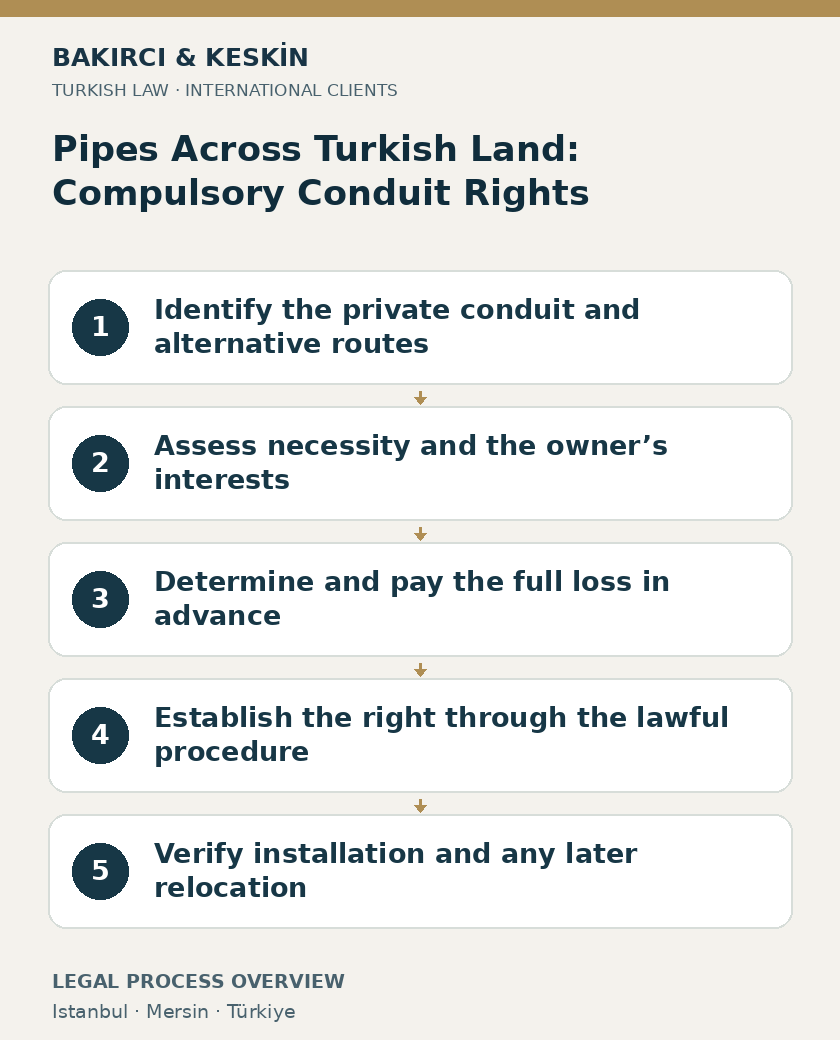
Quick summary
| Legal issue | A Neighbour Wants a Pipe or Cable Across Your Turkish Land: Compulsory Conduit Rights |
|---|---|
| Short answer | Civil Code Article 744 requires a landowner to tolerate specified pipes, channels and cables over or under the land only within its statutory framework, including impossibility or excessive cost of another route and advance payment of the owner’s full loss. Article 745 protects the burdened owner’s interests, and Article 746 regulates later relocation when circumstances change. Expropriation projects follow their own applicable rules. |
| Key legislation | Law No. 4721 — Articles 727, 731, 744, 745, 746; Law No. 6325 — Articles 18/B; Law No. 6100 — Articles 12 |
Identify the proposed conduit and the legal right claimed
A request to carry water, drainage, gas, electricity or a similar service across private Turkish land requires more than a drawing showing a convenient route. Identify the person seeking the right, the land to benefit, the land to be burdened, the proposed installation and the legal basis relied on. A private neighbour’s compulsory-conduit claim and an infrastructure project governed by expropriation rules are different matters.
Civil Code Article 744 addresses specified conduits passing over or under another property where routing elsewhere is impossible or excessively costly, subject to advance payment of the owner’s entire loss. The provision establishes conditions for a legal burden. It does not authorise construction merely because a contractor announces that crossing the neighbouring parcel would be easier.
The property and registry guide for clients abroad explains the broader need to identify title, authority and intended use. In a conduit dispute, the particular route and its legal basis must be established before the owner agrees to works or the claimant treats access as secured.
Article 744 requires examination of other possible routes
The statutory test is that passing elsewhere is impossible or excessively expensive. A claimant should therefore identify the available alternatives and the evidence supporting their rejection. A plan displaying only the preferred route does not establish why another route fails the test. Technical feasibility, the required connection and the costs of the relevant alternatives need a coherent explanation.
The burdened owner should obtain and review the actual plan, not simply oppose the project in general terms. Identify the disputed assumptions: a claimed physical obstacle, the location of an available connection, the required installation method or an unexplained cost difference. A meaningful response addresses the evidence underlying necessity rather than asserting that the owner’s preference alone determines the legal result.
The court must assess the statutory conditions on the established facts. Neither a universal distance threshold nor a fixed percentage cost test appears in Article 744’s wording. Do not invent one from a contractor’s customary practice. A technical report should state its measurements, assumptions and comparison method so the legal decision can be made on a reviewable basis.
Define the route, installation and affected area precisely
The plan should connect the proposed works to the registered parcel and its physical features. Identify whether the conduit runs above or below ground, its route and the area actually affected. The description must be sufficient to determine what use of the neighbour’s land is required. A general permission to pass utilities can conceal a materially broader installation than the owner considered.
Obtain the relevant cadastral and title information through the lawful access route. Compare the technical plan with the official property identifiers and any existing rights. A wall, fence or informal path is not necessarily the legal boundary. If the route depends on a disputed boundary, that issue must be disclosed and addressed rather than silently resolved in the claimant’s drawing.
Separate construction access from the enduring conduit right and identify the maintenance requirements intended. The legal instrument or judgment should describe the burden actually established. A right concerning a pipe should not be presented as unrestricted use of the property for storage, traffic or additional works unless a legally sufficient basis exists for those further uses.
The owner’s entire loss must be paid in advance under Article 744
Article 744 makes advance payment of the burdened owner’s full loss a condition of the duty to tolerate the conduit. The compensation inquiry should therefore be completed against the proposed route and actual burden. A token payment selected without valuation is not the statutory measure, and a promise to discuss damage after installation should not be described as equivalent to the stated advance-payment condition.
Identify the effects requiring assessment and the evidence supporting them. The relevant inquiry can concern the burden imposed on the property and the consequences of the works, but each claimed component must be legally connected and substantiated. The owner’s full asking price for the entire parcel is not automatically the loss caused by a particular conduit. Equally, the calculation should not ignore a proved impact merely because the trench occupies a narrow strip.
Keep the agreed or adjudicated amount, payment conditions and proof of payment with the plan. A receipt must identify the obligation satisfied and the property concerned. If the route materially changes before implementation, examine whether the prior assessment and consent still address the actual burden. The payment record and installed route must correspond.
Article 745 protects the burdened owner’s interests
Article 745 entitles the burdened owner to request fair consideration of their interests. This supplements the necessity and compensation framework. Identify existing lawful uses, access, buildings and other relevant property interests that the proposed route affects. The purpose is to assess the actual impact rather than treat the shortest engineering line as automatically the legally appropriate route.
The owner should support the position with current records and technical information. A planned development or asserted use needs to be described according to its established legal and factual status. The decision should not rest on a speculative project presented as an existing permission. The claimant should likewise disclose assumptions about the land’s use instead of treating it as vacant merely because the owner lives abroad.
The parties can compare adjusted routes and installation methods against the statutory criteria. Record the version finally accepted or determined. A negotiated adjustment is useful only if the legal document and technical plan identify the same burden. Leaving alternative drawings in circulation without stating which governs creates a later dispute about what the owner was required to tolerate.
Exceptional above-ground circumstances can support a purchase request
Article 745 contains a further rule for conduits passing over the land. Where extraordinary circumstances exist, the owner can request purchase of an appropriate part of the land through which the conduit will pass for an amount fully compensating the loss. This is a specific statutory possibility with stated conditions. It is not an automatic right to require purchase of the whole property whenever any pipe is proposed.
The request must identify the above-ground installation, extraordinary circumstances, appropriate land portion and valuation basis. The factual explanation should show why the particular burden engages the provision. A bare statement that the owner would prefer a sale does not establish the statutory condition. The claimant must have a clear account of the actual request and supporting evidence.
Where a purchase is agreed or ordered, treat the land-transfer steps and the conduit arrangement distinctly. Identify the area, ownership result, price, required formalities and treatment of the remaining property. Compensation for a burden and purchase of part of the land produce different legal outcomes. The documents should not leave the parties uncertain which outcome they accepted.
Article 744 excludes the neighbour-law route where expropriation rules govern
The second paragraph of Article 744 states that the Code’s neighbouring-property conduit provisions do not apply where passage is subject to expropriation rules. Establish the project’s legal basis before assuming that the private-law mechanism governs. The fact that the installation carries electricity or water does not, without the actual authority and project documents, identify the applicable procedure.
Obtain any public decision, authorisation or notice relied on by the project promoter. Determine whether the request concerns negotiated private rights, a compulsory neighbour-law right or a public acquisition procedure. These routes can involve different authorities, documents and remedies. A contractor’s statement that the works are for public benefit is not a substitute for the legal instrument establishing that position.
The owner should not miss a separately applicable public-law or acquisition deadline while discussing a private agreement. Keep the notices and legal routes distinct. The present analysis concerns Articles 744–746; it does not convert an expropriation dispute into a private neighbour case or imply that the compensation and procedure of the two systems are identical.
Ownership of the conduit and the right over the land are different
Article 727 generally treats conduits for water, gas, electricity and similar services as accessories of the undertaking and property of its owner, even when outside the undertaking’s land, unless another rule provides otherwise. The physical location of a pipe on someone’s parcel therefore does not alone establish that the parcel owner owns the installation. Identify the undertaking and any relevant contrary legal arrangement.
Outside the cases required by neighbour law, Article 727 provides for an easement to burden land with such a conduit as a real right. It distinguishes an externally invisible conduit, for which the easement arises through registration, from an externally visible one, for which it arises through construction based on a contract drawn up by a notary. These ordinary rules must not be confused with Article 744’s compulsory-neighbour framework.
Article 731 states that statutory property restrictions take effect without registration. Article 744 separately permits registration of the conduit right at the right holder’s request and expense. Absence of a current entry should therefore not be treated as resolving every statutory-neighbour claim. At the same time, a claimant’s assertion does not prove that the statutory conditions have been established or authorise unreviewed construction.
Changed circumstances can justify moving an existing conduit
Civil Code Article 746 allows the burdened owner to request relocation of the conduit in their interest when circumstances change. The request should identify the original arrangement, the subsequent change and the proposed alternative. This is a different inquiry from whether the initial route was lawfully established. Preserve the original plan and instrument so the later change can be evaluated against them.
The article places relocation expenses on the conduit-right holder as the general rule. It also permits the landowner to be required to contribute an appropriate part where special circumstances justify that result. Neither party should replace this framework with an absolute statement that the owner requesting the move always pays everything or never contributes anything.
Relocation must be arranged through the proper agreement or legal process. A request under Article 746 is not permission for the owner to cut or move an operating line personally. The plan should address the new route, costs, required implementation steps and the continuing right. Verify the resulting installation and registry position where relevant after the move is completed.
Neighbour-law mediation and the property-court rules require attention
Law No. 6325 Article 18/B makes application to mediation a precondition for lawsuits arising from neighbour rights within its scope. A compulsory-conduit dispute should therefore be classified and prepared with the applicable pre-action process in mind. A meeting between contractors or an exchange of proposed plans is not automatically completion of statutory mediation.
The same article requires an enforceability endorsement for the agreements it covers and provides a specific registration route for agreements transferring immovable property or establishing a limited real right after endorsement, subject to the registry’s statutory examination. Do not apply the ordinary instrument rule without considering this specific legislated route where a qualifying mediation agreement is used. The settlement must comply with property-law limitations and identify the right precisely.
Code of Civil Procedure Article 12 assigns exclusive territorial jurisdiction to the location of the immovable for the real-right and easement claims it specifies. The actual claim and competent court must be identified accordingly. The owner’s residence abroad does not change where the land or the proposed burden is legally situated.
For an agreement concerning immovable property, Article 18/B(3) places the enforceability-endorsement examination before the Civil Court of Peace where the property is located. The court examines suitability for mediation and enforcement and compliance with the property-law restrictions and procedures; it can obtain institutional information and documents and hold a hearing where necessary. That endorsement function should be distinguished from the court hearing the substantive disputed claim. The parties should retain the endorsed agreement, approved plan and registry outcome as connected but separate records.
An overseas owner should approve the actual burden and verify the works
Before authorising a representative, identify whether the task is record collection, negotiation, mediation, litigation or creation of a property right. The power and written instructions should match the acts required. A person engaged to obtain a technical opinion should not be assumed authorised to accept a permanent easement or a land sale. Preserve the approved plan and any limits on authority.
The official-record guide is useful for checking the resulting entry where registration occurs. Compare the installed route with the agreed or adjudicated plan and preserve completion evidence. A payment and a registry entry do not establish that the contractor followed the approved physical route; technical verification and legal verification answer different questions.
The final record should identify the right holder, affected land, conduit, compensation paid, continuing conditions and any registry action. Articles 744–746 provide a structured balance between genuine necessity and protection of the burdened owner. Applying those conditions to the actual route and evidence allows a lawful service connection without treating convenience alone as a right over another person’s property.
Frequently asked questions
Can a neighbour cross my land merely because it is cheaper?
Article 744 requires impossibility or excessive cost of routing elsewhere, together with the other statutory conditions.
Does the rule cover both underground and above-ground conduits?
Article 744 expressly addresses passage under or over the property for the specified services.
When must compensation be paid?
The article makes advance payment of the burdened owner’s full loss a condition of the duty to tolerate the conduit.
Can I demand consideration of my existing property use?
Article 745 entitles the burdened owner to fair consideration of their interests, supported by the actual circumstances.
Can I require the claimant to buy all my land?
No automatic right follows. Article 745 concerns an appropriate part in the stated extraordinary above-ground circumstances.
Does Article 744 govern every public infrastructure project?
No. It excludes the neighbour-law conduit rules where expropriation rules govern the passage.
Do I automatically own a pipe because it is on my parcel?
Article 727 generally allocates conduit ownership to the undertaking’s owner unless another rule provides otherwise.
Can an established conduit later be relocated?
Article 746 permits a request when circumstances change, with its specified cost-allocation framework.
Who generally pays relocation costs?
The conduit-right holder under Article 746, with an appropriate owner contribution possible where special circumstances justify it.
Is mediation relevant before a neighbour-right lawsuit?
Article 18/B of Law 6325 imposes the stated pre-action requirement and regulates the qualifying settlement and endorsement route.
Official legal sources
- Law No. 4721 — Articles 727, 731, 744, 745, 746
- Law No. 6325 — Articles 18/B
- Law No. 6100 — Articles 12
Legal review: 28 October 2026. The official Turkish legislation controls. The statutory conditions must be applied to the actual property, official documents and project history.
Contact information
Do not include confidential documents or identity numbers in an initial message. An enquiry does not establish representation or suspend any legal deadline.
Istanbul and Mersin contact details
Bakırcı & Keskin Law Office is Mersin-based. Turkish matters are handled under the applicable jurisdiction and agreed mandate. The competent court and the scope of representation are assessed for each matter.
Istanbul — Polaris Plaza
Maslak Ahi Evran Caddesi, Polaris Plaza No:21, Floor 9, 34475 Sarıyer/İstanbul, Türkiye.Mersin — Profit İş Merkezi
İhsaniye Mahallesi, 4903. Sokak, Profit İş Merkezi No:23, Floor 3, Office 14, 33070 Akdeniz/Mersin, Türkiye.+90 552 224 43 66 · Contact details in English. An enquiry does not establish representation or suspend a legal deadline.
Istanbul Office – Polaris Plaza, Maslak / Sarıyer
Bakırcı & Keskin Hukuk Bürosu
Maslak Ahi Evran Caddesi, Polaris Plaza No:21, Kat:9, 34475 Sarıyer/İstanbul
Our physical offices in Istanbul and Mersin coordinate matters throughout Turkey, subject to jurisdiction and the local steps required for each case. Please specify your preferred office when arranging an in-person appointment.
Open the Istanbul office on Google Maps · Contact and appointments
Contact regarding a legal matter
In your first message, you may briefly state the subject, your country or city, and any relevant notification or recent procedural date. Please do not send identity numbers, medical data, or personal documents. Messaging alone does not constitute legal advice or create a lawyer–client relationship.
Discover more from Bakırcı & Keskin Hukuk Bürosu
Subscribe to get the latest posts sent to your email.