Your Turkish Building Permit Expired: Starting, Completing and Renewing Under Article 29
Short answer: Under Zoning Law Article 29, the ordinary period to begin construction is two years from the permit date, and completion must occur within five years including that start period. Failure to meet the stated periods makes a new permit necessary, while the article preserves acquired rights in commenced construction. Verify the actual permit, approved project and construction history; a private delivery extension or pending renewal application is not the same as current authorisation.
Have a general question about this article? Ask anonymously
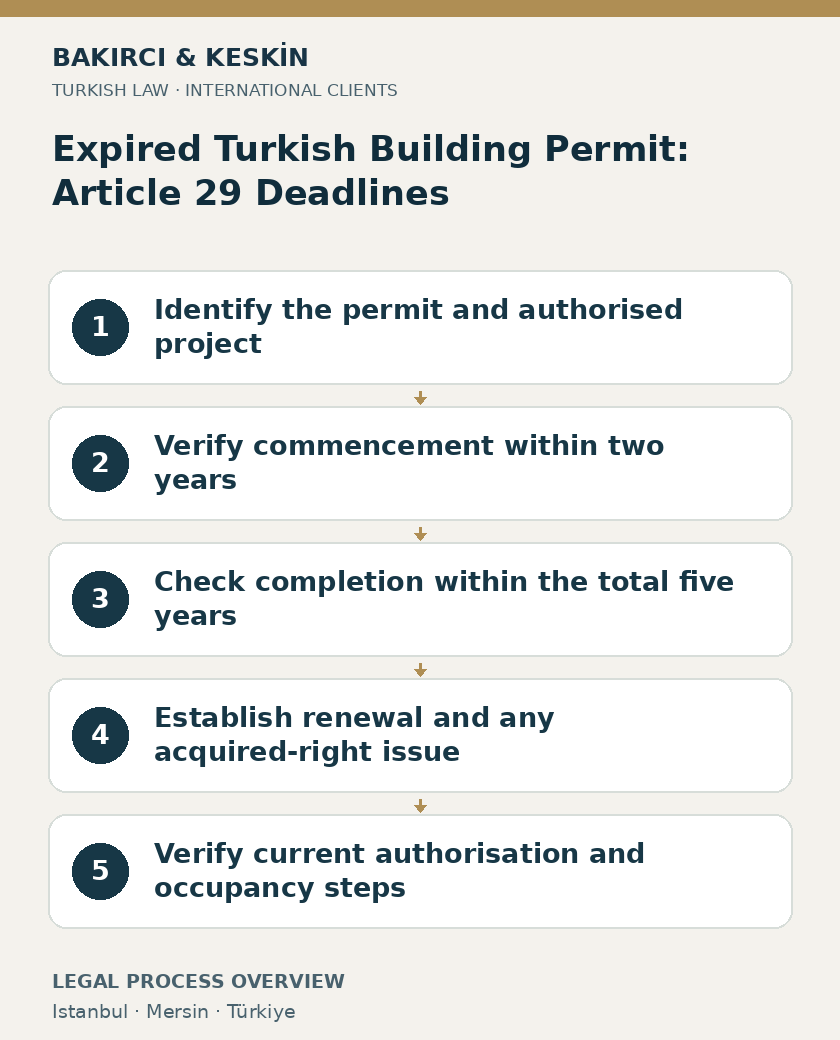
Quick summary
| Legal issue | Your Turkish Building Permit Expired: Starting, Completing and Renewing Under Article 29 |
|---|---|
| Short answer | Under Zoning Law Article 29, the ordinary period to begin construction is two years from the permit date, and completion must occur within five years including that start period. Failure to meet the stated periods makes a new permit necessary, while the article preserves acquired rights in commenced construction. Verify the actual permit, approved project and construction history; a private delivery extension or pending renewal application is not the same as current authorisation. |
| Key legislation | Law No. 3194 — Articles 21, 22, 29, 30, 32 |
Read the building permit itself before calculating expiry
A Turkish construction file can contain a building permit, approved projects, amendments, renewal documents, inspection records and an occupancy permission. Identify which document is being examined and the works it authorises. A developer’s construction schedule or a purchase-contract delivery date is not the statutory building-permit date. The owner needs the complete administrative file before deciding whether work remains authorised.
Zoning Law No. 3194 Article 29 sets the ordinary commencement and completion periods: construction must start within two years of the permit date and must be completed within five years including the commencement period. The document’s issue date, authorised scope and subsequent legally effective changes therefore need to be established from official records.
The occupancy-permit guide concerns a different stage. An owner should not treat an occupancy application, title certificate or construction-servitude entry as proof that the relevant construction permit still authorises ongoing works. Each document performs its own legal function.
The ordinary start period is two years from the permit date
Article 29 states that the period for commencing construction is two years from the permit date. The file must establish whether construction actually began within that period. A contract with a builder, payment of an advance or purchase of materials should not be assumed to establish the legally relevant commencement merely because those steps show an intention to build.
Obtain the official and technical records concerning the works and their dates. Identify what was constructed, the approved project to which it relates and the evidence of its condition at the relevant time. The legal assessment should not rest only on a dated photograph whose location or relationship to the permitted structure is uncertain. Connect the evidence to the actual site and permit.
Where the commencement position is disputed, identify the particular administrative finding or missing record. A contractor’s statement that the project had started needs to be tested against the relevant evidence. Equally, an owner should not accept an unexplained conclusion that no start occurred without obtaining the material on which the authority relies. The statutory period must be applied to established facts.
The five-year completion period includes the start period
The wording of Article 29 includes the commencement period within the five years. It should not be presented as two years to start followed by an additional five years to finish. A project that begins near the end of the commencement window does not thereby obtain an automatic new five-year period measured from the first work on site.
Prepare a chronology showing the original permit, established commencement, approved amendments, any renewal and the state of completion. Distinguish the original statutory period from the consequences of a subsequent legally valid permit. An informal statement that a project was restarted does not itself establish a fresh administrative authorisation or a new statutory calendar.
The ordinary rule must also be distinguished from any specifically applicable legal regime or express administrative act affecting the particular permit. A private delay agreement between buyer and developer does not amend Article 29. If an extension or different legal treatment is asserted, identify its actual legal basis and scope instead of assuming that financial difficulty, foreign residence or a delayed sale automatically extends the permit.
Failure to meet the stated periods makes a new permit necessary
Article 29 states that the permit is ineffective if construction does not begin within the commencement period or, after beginning, is not completed within the total five-year period, regardless of the reason stated in that ordinary rule. It then requires a new permit. The owner should not rely on the continued physical existence of an old permit copy as evidence of authority to continue.
Obtain a written account of the permit status and the requirements for the next lawful step from the responsible administration. Identify whether the issue is a renewal request, a changed project, an expired authorisation or an existing enforcement decision. The same physical building can raise more than one of those questions, and a single application may not resolve them all.
Continuing work should be assessed against the actual current authorisation. A pending request and a granted permit are different states. Article 22 provides procedures for examining permit applications, but the mere existence of an application receipt should not be described as approval of every proposed work. The implementation team needs the document that lawfully authorises the construction it intends to perform.
The reservation for commenced construction must be applied to the actual project
Article 29 expressly preserves acquired rights in construction that has begun. That reservation is material, but its application requires the relevant permit, approved project, lawful commencement and construction history. It should not be converted into an unsupported statement that beginning any work permanently protects every possible future development on the parcel.
Identify the right said to have been acquired and the facts supporting it. The original project, construction level, later amendments and any change in the planning framework can be relevant to the legal assessment. The owner should obtain technical and legal review of the actual records rather than rely on a broad assurance that an old permit can never be affected by a later issue.
Conversely, the need for a new permit does not justify ignoring Article 29’s express reservation. A refusal or revised requirement should be examined for its treatment of the established acquired-right position. The submission should identify the relevant protection precisely and connect it to the authorised works and documentary history, without overstating either the owner’s entitlement or the administration’s freedom to disregard it.
Article 22 sets a documentary and response framework for permit applications
Article 22 provides for an application by the building owner or legal representative and identifies the supporting title, architectural, structural, electrical and installation materials and related plans within its framework. The current application must correspond to the actual project and the legally required procedure. An outdated plan should not be submitted as though it describes a changed structure.
Where the permit and annexes are complete and correct, Article 22 requires issue within thirty days from the application. Where deficiencies or errors exist, it requires written notification of all of them within fifteen days; after they are remedied, it provides a fifteen-day period from the renewed application. Preserve the original submission, deficiency notice and complete response as different events.
These response rules should not be used to assume a permit was granted by silence under Article 22. The occupancy-permission rule in Article 30 has different wording and a different purpose. The owner should obtain the actual construction authorisation and examine any failure to act through the appropriate legal route, rather than treating unrelated statutory periods as interchangeable.
A change to the project can require its own permit assessment
Article 21 generally requires a new permit for changes to a permitted structure within its framework and lists specified repairs that do not require a permit. The classification depends on the actual work. A proposal described commercially as a small renovation can involve a change to the authorised structure, while an item of ordinary repair may fall within the statutory exception.
Identify the proposed works and obtain the necessary technical description. Compare them with the approved projects and the legally applicable exemption conditions. Do not use Article 29’s renewal discussion to bypass the separate question whether a modified project needs approval. A valid permit for one design does not automatically establish permission to construct a different design.
The construction instructions should identify the approved version. Where the authority accepts revised plans, preserve the resulting permit and annexes and remove ambiguity about superseded drawings. A contractor working from a privately revised plan can create a compliance problem even when the owner possesses a valid permit for the earlier project.
Article 29’s fee rule does not make every project expense disappear
Article 29 states that an additional fee is not collected for permit renewal and plan amendment within its rule. It then addresses increases in construction area or changes to the gross area or nature of independent units: the previously paid fee is deducted from the newly calculated fee. If the calculation decreases, the article provides no refund of the difference.
The fee calculation should identify the change triggering it, the earlier amount paid and the new statutory calculation. Preserve official receipts and the authority’s assessment. A general invoice labelled renewal should not obscure whether it concerns an official fee, professional design work or another separate expense. The statutory rule must be applied to the charge it actually regulates.
Architectural, engineering, survey and representation services require their own agreed scope and cost account. Article 29’s permit-fee provision should not be presented as making all such services free. The owner should receive a transparent distinction between official charges and private professional services so the financial consequences of renewing or changing the project can be reviewed.
Keep the permit and approved annexes available at the construction site
Article 29 requires the permit and its annexes to be kept at the building site. This is an operational part of compliance, not merely an archival preference. The site team should know which permit and approved projects govern the current work. An owner abroad should arrange access to the authoritative documents without allowing the contractor’s private drawing set to replace them.
Keep the owner’s own copy of the administrative file and track changes received from the authority. A project manager’s assurance that all paperwork is in order should be supported by the actual documents. The file should show what was authorised, when the authorisation applied and how subsequent modifications were approved.
Inspection and progress records should use the same parcel, permit and project references. Consistent identification allows a later reviewer to compare the authorised scheme with the physical works. It also helps distinguish a dispute over expiry from a dispute over deviation from the permit, which can require different corrective steps.
An expired or non-compliant project can also raise Article 32 issues
Article 32 provides the framework for recording and stopping unauthorised or non-compliant construction within its scope. It includes sealing and cessation of works and regulates the steps following the stop-work record. An owner should obtain any existing enforcement documents before assuming that a renewal application alone resolves the situation.
Keep the permit-status inquiry separate from compliance with an actual stop-work measure. The authority’s removal of a seal and permission to continue require the relevant legal determination. The owner or contractor should not treat submission of additional documents as authority to disregard an outstanding official restriction. Review the particular record and the action required to address it.
Where a dispute reaches court, the administrative decision, its notification and the applicable remedy period require prompt analysis. A private construction dispute with the developer does not automatically challenge the public-law act. The file should show which decision is being contested and what protective relief, if any, the court has actually granted.
Completion of construction and permission to use remain distinct
Article 30 requires occupancy permission for a completed structure, or completed parts capable of separate use, within its framework. It requires examination of conformity with the permit and annexes and technical suitability for use. Article 29’s construction-completion period should therefore be read with the separate legal step needed for occupation.
Article 30 has its own thirty-day decision rule and stated consequence for failure to conclude the owner’s application. It also preserves liability for breaches of law, permit and annexes and for taxes and charges. The provision should not be invoked as a blanket cure for construction carried out without the necessary authorisation. The particular application and statutory conditions must be established.
For buyers, the developer-dispute framework is relevant to contractual delivery issues, but the public permit record must be checked independently. A contractually promised handover date does not prove lawful construction completion or occupancy permission. Keep contractual performance and administrative compliance as separately evidenced outcomes.
The overseas owner’s final record should show current authority and remaining tasks
Assemble the original permit, approved annexes, commencement evidence, renewals, amendments, inspection documents and any enforcement decision. Record what remains unfinished and the authorisation required for that work. The chronology should allow another professional to determine the current position without relying on oral explanations from a former contractor.
After a new permit or renewal is issued, verify the document against the property and intended works. Check the authorised design, conditions and dates and circulate the correct version to those implementing it. A favourable response in principle is different from the final permit and annexes. The owner should know which legal event has actually occurred.
The Article 29 analysis is precise: two years to commence and five years in total under the ordinary rule, a new permit where the stated periods are not met, and an express reservation of acquired rights for commenced construction. Applying that framework to the actual permit history avoids both an assumed extension and an unsupported claim that every earlier lawful right has vanished.
Frequently asked questions
How long is the ordinary period to start construction?
Article 29 states two years from the permit date.
Is the completion period five years after work starts?
No. The five-year period expressly includes the commencement period.
What happens if the stated periods are not met?
Article 29 treats the permit as ineffective and requires a new permit within its framework.
Does a private developer extension change the statutory permit period?
No automatic statutory extension follows from a private delivery agreement.
Are acquired rights in commenced construction ignored?
No. Article 29 expressly preserves them, but their actual scope must be established from the lawful project and construction history.
Does applying for renewal itself authorise continued work?
Do not equate an application with the permit or any separate permission required to continue.
Are ordinary repairs always a new permit matter?
Article 21 lists specified exceptions, but the actual works must be classified correctly.
Is every renewal-related expense free?
No. Article 29 regulates the stated permit-fee treatment, including recalculation conditions; private professional expenses are separate.
Must the permit be kept on site?
Article 29 requires the permit and annexes to be available at the construction site.
Does finishing construction remove the occupancy-permission issue?
No. Article 30 governs the separate permission-to-use stage and its conditions.
Official legal sources
Legal review: 28 October 2026. The official Turkish legislation controls. The statutory conditions must be applied to the actual property, official documents and project history.
Contact information
Do not include confidential documents or identity numbers in an initial message. An enquiry does not establish representation or suspend any legal deadline.
Istanbul and Mersin contact details
Bakırcı & Keskin Law Office is Mersin-based. Turkish matters are handled under the applicable jurisdiction and agreed mandate. The competent court and the scope of representation are assessed for each matter.
Istanbul — Polaris Plaza
Maslak Ahi Evran Caddesi, Polaris Plaza No:21, Floor 9, 34475 Sarıyer/İstanbul, Türkiye.Mersin — Profit İş Merkezi
İhsaniye Mahallesi, 4903. Sokak, Profit İş Merkezi No:23, Floor 3, Office 14, 33070 Akdeniz/Mersin, Türkiye.+90 552 224 43 66 · Contact details in English. An enquiry does not establish representation or suspend a legal deadline.
Istanbul Office – Polaris Plaza, Maslak / Sarıyer
Bakırcı & Keskin Hukuk Bürosu
Maslak Ahi Evran Caddesi, Polaris Plaza No:21, Kat:9, 34475 Sarıyer/İstanbul
Our physical offices in Istanbul and Mersin coordinate matters throughout Turkey, subject to jurisdiction and the local steps required for each case. Please specify your preferred office when arranging an in-person appointment.
Open the Istanbul office on Google Maps · Contact and appointments
Contact regarding a legal matter
In your first message, you may briefly state the subject, your country or city, and any relevant notification or recent procedural date. Please do not send identity numbers, medical data, or personal documents. Messaging alone does not constitute legal advice or create a lawyer–client relationship.
Discover more from Bakırcı & Keskin Hukuk Bürosu
Subscribe to get the latest posts sent to your email.