A Turkish Commercial Agent Collects a Customer’s Payment: Special Authority and Discharge
Short answer: A Turkish commercial agent does not acquire unrestricted collection authority merely by introducing customers. Under Turkish Commercial Code Article 106, an agent needs the principal’s special written permission or authority to receive the price of goods the agent did not personally deliver. Authority to conclude contracts, authority to accept payment and authority to reduce or replace the debt must be checked separately. Whether the customer’s payment discharges its debt also depends on the applicable representation rules and the actual payment evidence.
Have a general question about this article? Ask anonymously
Quick summary
| Legal issue | A Turkish Commercial Agent Collects a Customer's Payment: Special Authority and Discharge |
|---|---|
| Short answer | A Turkish commercial agent does not acquire unrestricted collection authority merely by introducing customers. Under Turkish Commercial Code Article 106, an agent needs the principal's special written permission or authority to receive the price of goods the agent did not personally deliver. Authority to conclude contracts, authority to accept payment and authority to reduce or replace the debt must be checked separately. Whether the customer's payment discharges its debt also depends on the applicable representation rules and the actual payment evidence. |
| Key legislation | Turkish Commercial Code No. 6102; Turkish Code of Obligations No. 6098; Law No. 5718 on Private International and Procedural Law |
Identify the commercial agency relationship
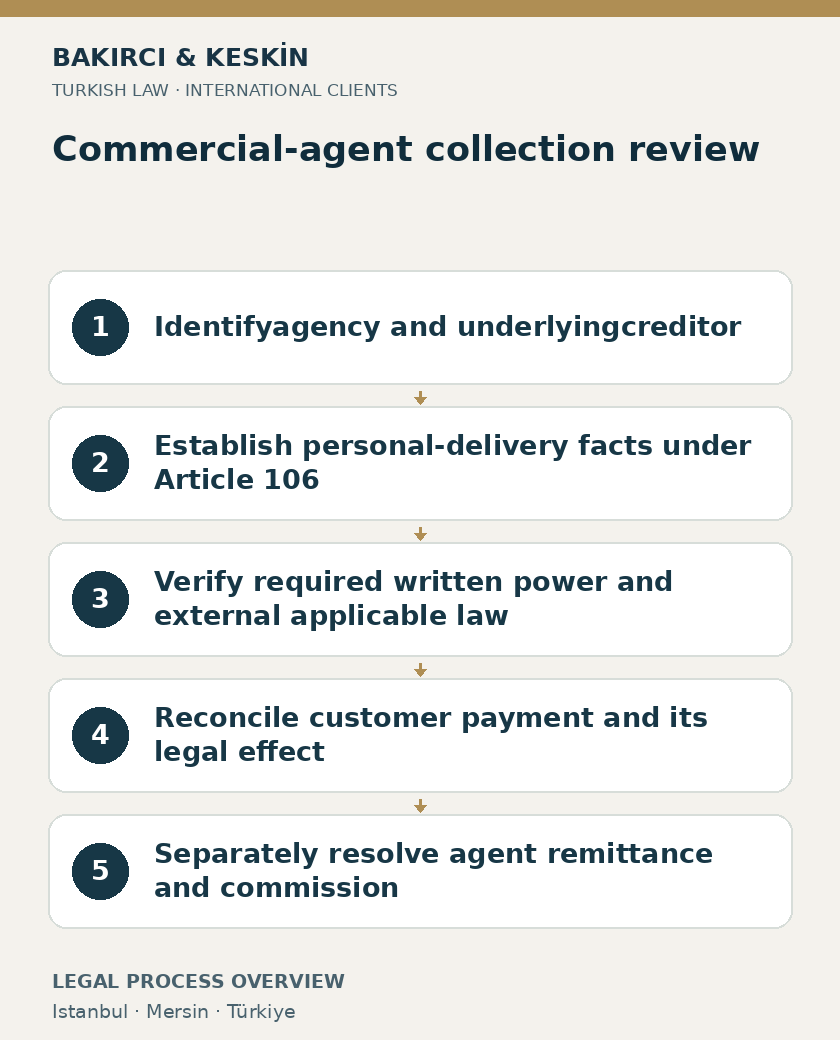
The word agent is used for several different legal relationships. Article 102 of the Turkish Commercial Code describes an independent intermediary or contracting agent who professionally and continuously works on transactions concerning a commercial enterprise within a particular place or region. An employee, corporate representative, distributor purchasing for its own account and person appointed for one transaction cannot be treated as the same category merely because correspondence calls each of them an agent.
Articles 102 and 103 of the Code provide the relevant starting framework and preserve special-sector rules. Article 103 also extends the chapter to specified dealings for foreign merchants without a Turkish centre or branch. The actual agreement and activity therefore need to be identified before Article 106 is applied. A separate sectoral regime must be examined where the business falls within it; a general collection analysis does not displace that regime.
The documents should show the principal, agent, customer, goods and underlying sale. Establish whose name appears as seller and creditor. The customer should not assume that an agent’s local address makes it the seller. Conversely, an intermediary contracting in its own name requires examination of that capacity. The legal identity of the creditor determines the authority question and prevents a payment dispute being directed against the wrong business.
Article 106 and the delivery distinction
Article 106 expressly restricts an agent’s authority to accept the price of goods it did not personally deliver without the principal’s special written permission or authority. This wording makes the delivery history material. It is inaccurate to state either that every commercial agent can collect every invoice or that every collection invariably requires the same additional document. The statutory condition must be applied to the particular goods and the agent’s actual role.
The review should connect the payment to the relevant delivery, not simply to the agent’s wider appointment. Delivery notes, warehouse instructions, transport records and customer acknowledgements can establish what the agent actually did. The fact that it negotiated an order or arranged transport does not by itself answer whether it personally delivered the goods for Article 106. A precise factual record is necessary before relying on the distinction in that provision.
The article also restricts receipt of goods whose price the agent did not personally pay, and the replacement or reduction of claims arising from the specified transactions. Those are connected statutory limits, but they concern different acts. A dispute over a customer’s payment should identify the precise act said to bind the principal rather than treat the whole commercial relationship as one undifferentiated authorisation.
Examine the written collection authority
Where special written authority is required, obtain the actual document from the principal and examine its scope. It should identify the authorised agent and permit the collection in question. Relevant restrictions can concern the customer, invoices, currency, amount, period or collection destination. A general statement that the agent promotes the principal’s goods does not establish a specific collection power. The operative wording and the principal’s valid grant of authority matter.
The authority must also be connected to the person using it. An authorisation granted to an agency company does not automatically answer whether a particular employee or substitute can receive payment in the manner proposed. Identify the corporate signatory and any further authorisation on which the payment instruction relies. A business card, title or message from an unfamiliar account should not replace the relevant authority record.
Keep the version in force at the time of payment, together with the communication through which the customer received it. An authority document produced only after a dispute must be assessed against its actual creation, scope and any later approval. The enquiry should distinguish proof of prior power from ratification of an act already done. Altering the document’s date or reconstructing approval as if it existed earlier does not supply reliable evidence.
Contract-making power is a separate enquiry
Article 107 requires special written authority for the agent to conclude a contract in the principal’s name. It also requires the agent to register and publish documents conferring that contract-making power. The existence of such a document is relevant, but the collection question still requires examination of Article 106 and the instrument’s wording. A contract signature power and permission to receive money need not have identical boundaries.
Article 105 supplies other powers, including making and receiving rights-preserving declarations concerning transactions in which the agent mediated or contracted. Receipt of a notice, protest or complaint under that provision should not be confused with receipt of the purchase price. Each power has a statutory function. The fact that a customer properly sends a contractual notice to the agent does not establish that a transfer to the agent will satisfy the invoice.
Article 108 addresses contracts concluded without authority or beyond its limits, allowing the principal to approve when it learns of the contract and making the agent responsible if approval is not given. The precise act must nevertheless be identified. A question about the validity of the sale, an unauthorised price reduction and the destination of an otherwise due payment can require separate conclusions within the same file.
Separate customer discharge from remittance
The customer’s position and the agent’s position toward the principal are related but distinct. Under Code of Obligations Article 40, an authorised legal act performed in another’s name and for its account directly affects the represented person. Collection through an authorised representative must therefore be examined as performance toward the principal, subject to the actual authority, payment and applicable law. The account receiving money is not the entire legal test.
Once payment has been validly accepted for the principal, the agent’s subsequent failure to remit is a separate issue. Article 112 expressly requires an agent that owes remittance or delivery of the principal’s money to pay interest from the date that obligation arose if it fails to perform, and compensation where required. The provision addresses the agent’s duty. A missing onward transfer does not, by itself, prove that the customer’s original payment was unauthorised.
Equally, proof that money left the customer’s bank account does not establish discharge if authority or the true recipient is unresolved. The reviewer must examine the legal recipient, actual credit and debt allocation. A principal seeking payment again should first address the earlier payment’s effect. The customer should retain its authority evidence and payment record instead of relying only on the agent’s statement that everything has been settled.
Discounts, settlements and replacement debts
Article 106 expressly limits an agent’s ability to renew or reduce the relevant receivable without the required special written authority. Acceptance of a sum and agreement to extinguish a larger balance are different acts. The records should establish whether the principal authorised simple collection, a discount, a settlement or replacement of the original claim. A receipt for money received should not silently be treated as an authorised release of every remaining amount.
The same care is needed when documents contain expressions such as final settlement or balance closed. Those words must be connected to the signer’s actual power and the parties’ transaction. A ledger entry made by the agent is not proof that the principal agreed to a reduction. The customer’s communications, principal’s instructions and exact settlement document should be preserved together, so the effect is assessed from the whole authorised arrangement.
A dispute over the agent’s own commission does not itself give the agent power to discount the customer’s purchase debt. The commission account is a relationship between agent and principal. Any asserted deduction, set-off or retention right must be examined on its own legal basis. Combining those issues into a single unexplained net figure can conceal both an unauthorised price change and an unpaid remittance.
Changed or withdrawn authority
Authority can change during a continuing agency. Under Code of Obligations Article 41, the scope of authority created by a legal act is determined by that act; where authority has been communicated to third parties, the communication matters to its external scope. The file should therefore preserve what the principal told the customer, not only the internal instructions sent to the agent. The two records may answer different questions.
Article 42 allows restriction or revocation and protects the separate contractual rights arising from the underlying relationship. Where the principal expressly or implicitly notified third parties of the authority, it cannot invoke an uncommunicated revocation against good-faith third parties in the circumstances stated by the article. An internal cancellation email does not necessarily complete the external analysis. Record the recipients, content and delivery of any changed payment instructions.
Articles 44 and 45 separately address the return of authority documents and acts made without knowledge that authority ended, subject to the third party’s knowledge. These are specific statutory conditions, not a general promise that old documents remain effective. The chronology must identify when authority changed, what the agent knew and what the customer knew at the actual payment or transaction.
Keep the termination of the agency contract, withdrawal of a particular collection power and notification to customers as separate dated events. They may appear in different documents and reach different recipients. A final statement that the relationship has ended should not replace the evidence showing which authority was withdrawn and when the relevant customer learned of that change. Preserve returned authority documents and the corresponding handover record.
The foreign principal and applicable law
A foreign principal introduces an applicable-law question before domestic representation rules are applied. Article 30 of Law No. 5718 distinguishes authority arising from the internal relationship from the conditions for binding the principal toward a third party. Its connecting rules address the representative’s business establishment, the specified alternatives involving the place of actual exercise and the particular case of an employee without an independent establishment.
The site’s international representative-authority guide explains those connecting rules. An English-law agency clause does not itself answer every external authority question in a Turkish payment dispute. The analysis must identify the relevant relationship, connecting facts and applicable mandatory provisions. This article explains the Turkish commercial-agency rules where they govern the collection issue; it does not assume that foreign nationality alone selects or excludes them.
Collection commission and withheld sums
Article 113(4) allows the agent to seek collection commission for money collected in accordance with the principal’s instructions. The wording connects remuneration to instructed collection. A claim to collection commission is not an independent source of authority to receive any customer payment. The agency agreement, instruction and amount collected should therefore be reviewed together before the commission is calculated or deducted from funds due to the principal.
The wider account must separate gross receipts, any established commission, expenses, remittances and the balance outstanding. The site’s agent accounting and handover guide addresses the general mandate account. Commercial-agency provisions remain central here. Any right to retain property or proceeds under Article 119 requires its own conditions; a commission invoice alone does not resolve the legality of withholding a particular sum.
Trace the receipt and onward payment
The payment record should identify the customer, invoice, amount, currency, date, receiving account and capacity in which the agent received it. Obtain the bank evidence and the receipt or confirmation actually issued. Reconcile the principal’s sales ledger with the agent’s collection record. Differences should be recorded by transaction rather than hidden in an overall balance that includes unrelated customers or periods.
Instructions changing a bank account should be verified through an established channel and retained with their origin and timing. A forged message, a genuine agent exceeding authority and an authorised collection followed by non-remittance are legally different events. Preserving complete correspondence helps identify which event occurred. Screenshots alone may omit the surrounding instruction, attachments or sequence needed to understand the authority and payment history.
Resolve the dispute without confusing the claims
A clear demand identifies whether the dispute concerns the customer’s outstanding purchase debt, the agent’s unauthorised act or money the agent must remit. It then states the amount and supporting evidence for that particular claim. The same receipt should not be ignored in the customer account while also being asserted as money held by the agent without explaining the legal basis for both positions.
For the foreign principal, the immediate task is to assemble the agency contract, authority instruments, delivery history and payment reconciliation. For the customer, it is to preserve the authority relied upon and proof of performance. The resulting analysis should establish who remains liable, for which amount and under which relationship before selecting the recovery procedure.
Frequently asked questions
1. Can every Turkish commercial agent collect customer payments?
No. Article 106 restricts collection of the price of goods the agent did not personally deliver unless the principal grants the required special written permission or authority.
2. Why does personal delivery matter?
It is part of Article 106’s express condition. The actual delivery records must be examined; merely negotiating the order does not answer whether the agent personally delivered the goods.
3. Is permission to sign sales contracts enough?
Contract-making authority under Article 107 and collection under Article 106 are separate enquiries. The actual written power must be checked for the act in question.
4. Does receiving a complaint give the agent power to receive the price?
No such conclusion follows automatically. Article 105 concerns rights-preserving declarations and other specified powers; the collection question requires its own authority analysis.
5. Must the customer pay again if the agent fails to remit?
Not merely because remittance failed. First determine whether the customer’s payment was validly accepted for the principal. Article 112 separately regulates the agent’s duty to deliver the principal’s money.
6. Can the agent agree a discount while collecting?
Article 106 restricts reduction or renewal of the relevant claim without the required special written authority. Collection permission should not be assumed to authorise every settlement.
7. Does internal revocation always defeat the customer’s reliance?
No. Article 42 contains protection for good-faith third parties where previously communicated authority is revoked without the required notification. Its actual conditions and the customer’s knowledge must be examined.
8. Can the agent claim a separate collection commission?
Article 113(4) permits collection commission for money collected according to the principal’s instructions. The fee claim does not itself establish collection authority.
9. Does a foreign governing-law clause settle every authority question?
No. Law No. 5718 Article 30 separately addresses the internal relationship and external representative authority. Its connecting rules require analysis of the actual circumstances.
10. Which records should be provided first?
Provide the agency agreement, written powers and changes, sale and delivery records, payment instructions, bank confirmation, receipts and the principal-agent reconciliation.
Official legal sources
- Turkish Commercial Code No. 6102 — Articles 102, 103, 105, 106, 107, 108, 112, 113(4), 119
- Turkish Code of Obligations No. 6098 — Articles 40, 41, 42, 44, 45, 46
- Law No. 5718 on Private International and Procedural Law — Articles 30
Legal sources reviewed on 28 October 2026. The official Turkish legislation controls; individual facts and later amendments must be checked before action.
Contact information
Do not include confidential documents or identity numbers in an initial message. An enquiry does not establish representation or suspend any legal deadline.
Istanbul and Mersin contact details
Bakırcı & Keskin Law Office is Mersin-based. Turkish matters are handled under the applicable jurisdiction and agreed mandate. The competent court and the scope of representation are assessed for each matter.
Istanbul — Polaris Plaza
Maslak Ahi Evran Caddesi, Polaris Plaza No:21, Floor 9, 34475 Sarıyer/İstanbul, Türkiye.Mersin — Profit İş Merkezi
İhsaniye Mahallesi, 4903. Sokak, Profit İş Merkezi No:23, Floor 3, Office 14, 33070 Akdeniz/Mersin, Türkiye.+90 552 224 43 66 · Contact details in English. An enquiry does not establish representation or suspend a legal deadline.
Istanbul Office – Polaris Plaza, Maslak / Sarıyer
Bakırcı & Keskin Hukuk Bürosu
Maslak Ahi Evran Caddesi, Polaris Plaza No:21, Kat:9, 34475 Sarıyer/İstanbul
Our physical offices in Istanbul and Mersin coordinate matters throughout Turkey, subject to jurisdiction and the local steps required for each case. Please specify your preferred office when arranging an in-person appointment.
Open the Istanbul office on Google Maps · Contact and appointments
Contact regarding a legal matter
In your first message, you may briefly state the subject, your country or city, and any relevant notification or recent procedural date. Please do not send identity numbers, medical data, or personal documents. Messaging alone does not constitute legal advice or create a lawyer–client relationship.
Discover more from Bakırcı & Keskin Hukuk Bürosu
Subscribe to get the latest posts sent to your email.